
Crystallization · API Process Development
Glass Crystallization Reactors for API Process Development
Selecting a crystallization glass reactor system for API production starts with understanding the development process—not simply choosing a vessel size. Solvent behavior, temperature history, agitation and solids handling all affect how a crystallization experiment should be designed. A suitable equipment configuration provides a platform for evaluating these variables, while API quality and process performance remain matters for material-specific testing and documented validation.
Define the crystallization task before choosing equipment
API crystallization development may involve dissolving a material, changing its solubility through cooling or solvent composition, and managing the resulting slurry. These operations are related to synthesis, but a crystallization reactor should not be treated as interchangeable with every synthesis reactor. Reaction hazards, pressure requirements, dosing arrangements and downstream isolation steps need separate assessment.
The Crystallization Reactor range includes specified material capacities, jacket capacities and receiving-flask sizes. Its listed configuration also includes variable-frequency speed control, digital temperature and rotational-speed display, a self-lubricating mechanical seal and a PTFE filter sand core. These are equipment features; they do not establish a particular crystal form, particle-size distribution, finished-product purity or yield.
Does a crystallization reactor determine API purity or crystal form?
I treat the reactor as a platform for process development, not as a guarantee of product quality. Solvent selection, impurity behavior, supersaturation, seeding and the operating sequence must be evaluated using the actual material. Analytical results and repeatable trials are needed before drawing conclusions about crystal form or purity.
Solvent compatibility and cleaning requirements
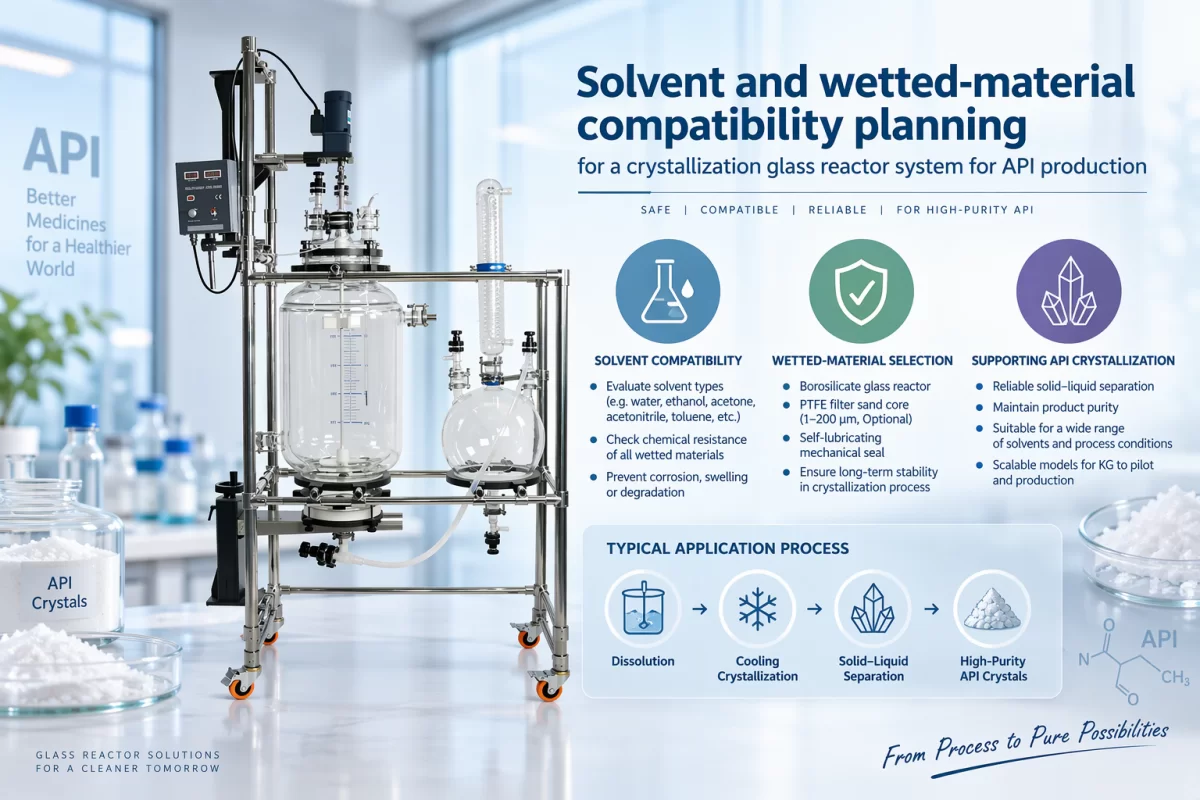
Begin with the solvent system, solute concentration and expected solids loading. Compatibility assessment should cover every wetted component, including the vessel, seals, filter element and connections. Compatibility cannot be established from the word “glass” alone: the complete contact-material arrangement and the intended exposure conditions matter.
The listed body-to-cover connection uses vacuum grease on the mating surface. For pharmaceutical development, the grease selection, potential contact with the process and cleaning procedure deserve attention. A project may require evidence that residues can be removed to an acceptable level and that cleaning agents are compatible with the assembly.
Solvent volatility and flammability also influence the required installation, ventilation and electrical configuration. A stated motor or control feature should not be interpreted as certification of the complete system for a hazardous area. Define the solvent hazards and site requirements before specifying the equipment package.
Documented capacities for crystallization development
The following capacities describe the listed reactor configurations. The material-capacity designation is not a validated working charge for every solvent or slurry. Select a practical operating fill after considering mixing, headspace, additions and changes in slurry volume during crystallization.
| Model | Material capacity (L) | Jacket capacity (L) | Receiving flask (L) |
|---|---|---|---|
| GF-10L/5L | 10 | ≈2 | 5 |
| GF-20L/10L | 20 | ≈5 | 10 |
| GF-30L/10L | 30 | ≈8 | 10 |
| GF-50L/20L | 50 | ≈15 | 20 |
| GF-100L/20L | 100 | ≈20 | 20 |
Receiving-flask capacity should be assessed against the expected collected-liquid volume and the planned collection sequence. It should not be assumed to match the entire reactor charge. Likewise, increasing material capacity does not establish that a laboratory cooling profile or mixing condition will transfer unchanged to a larger configuration.
Cooling and agitation in a glass reactor system for API development
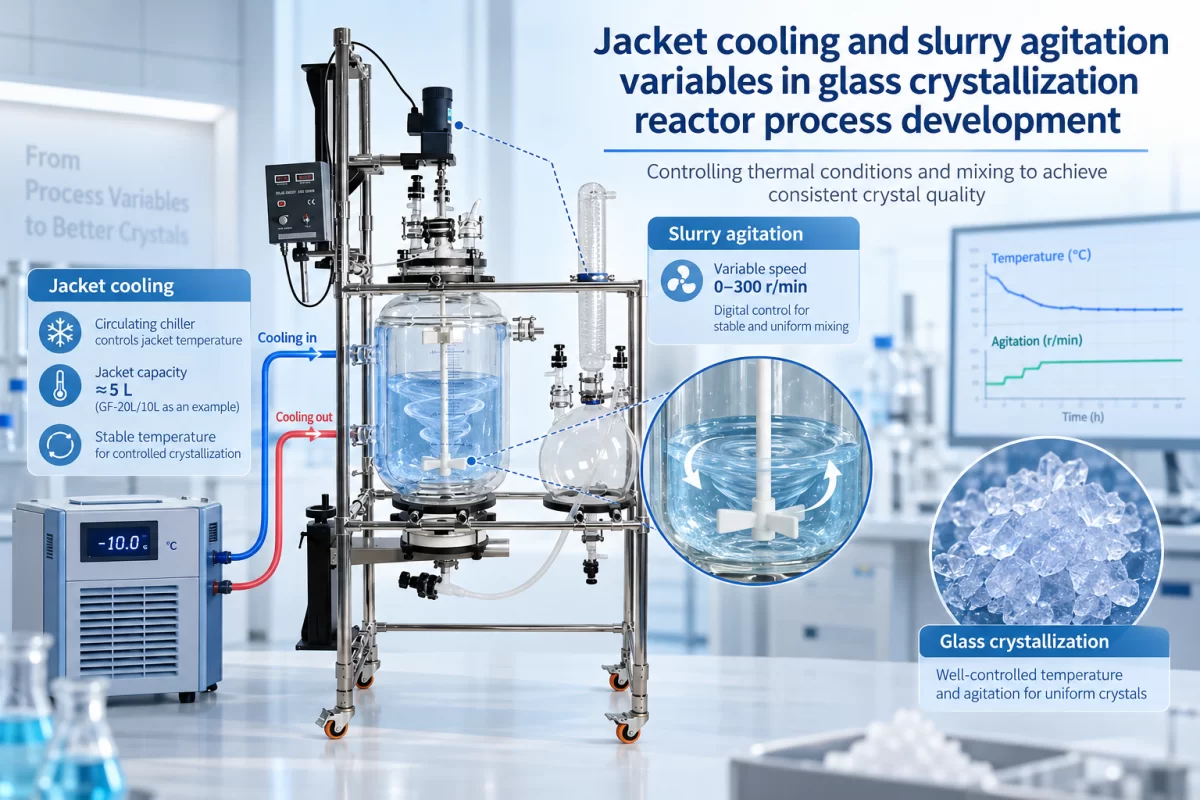
The jacket provides an interface for thermal-fluid circulation, but jacket volume alone does not define cooling performance. The external circulator, fluid choice, flow conditions, temperature difference and process heat load must be matched to the experiment. A development plan should record both the programmed thermal profile and the measured process temperature.
Digital temperature display is listed, but display availability is different from verified measurement accuracy or a qualified control system. Probe location, calibration requirements and temperature-recording arrangements should be included in the project specification.
The listed rotational-speed range is 0–300 r/min, with variable-frequency control and digital speed display. Selecting an operating speed requires slurry trials: the same rotational speed does not necessarily produce the same suspension behavior at different scales. Consider impeller configuration, fill level, viscosity and solids loading rather than using speed as the sole scale-up criterion.
Can jacket capacity establish a repeatable cooling rate?
I would not use jacket capacity as a cooling-rate specification. It is useful configuration information, but achievable temperature profiles depend on the thermal system and the batch. I recommend evaluating the cooling response under representative conditions and retaining the temperature records as part of process development.
Slurry handling, filtration and collection
As crystals form, an initially mobile solution may become a more demanding slurry. Development trials should examine whether solids remain suspended, accumulate near the outlet or form deposits that complicate transfer and cleaning. Outlet geometry, transfer connections and the intended collection sequence belong in the configuration review.
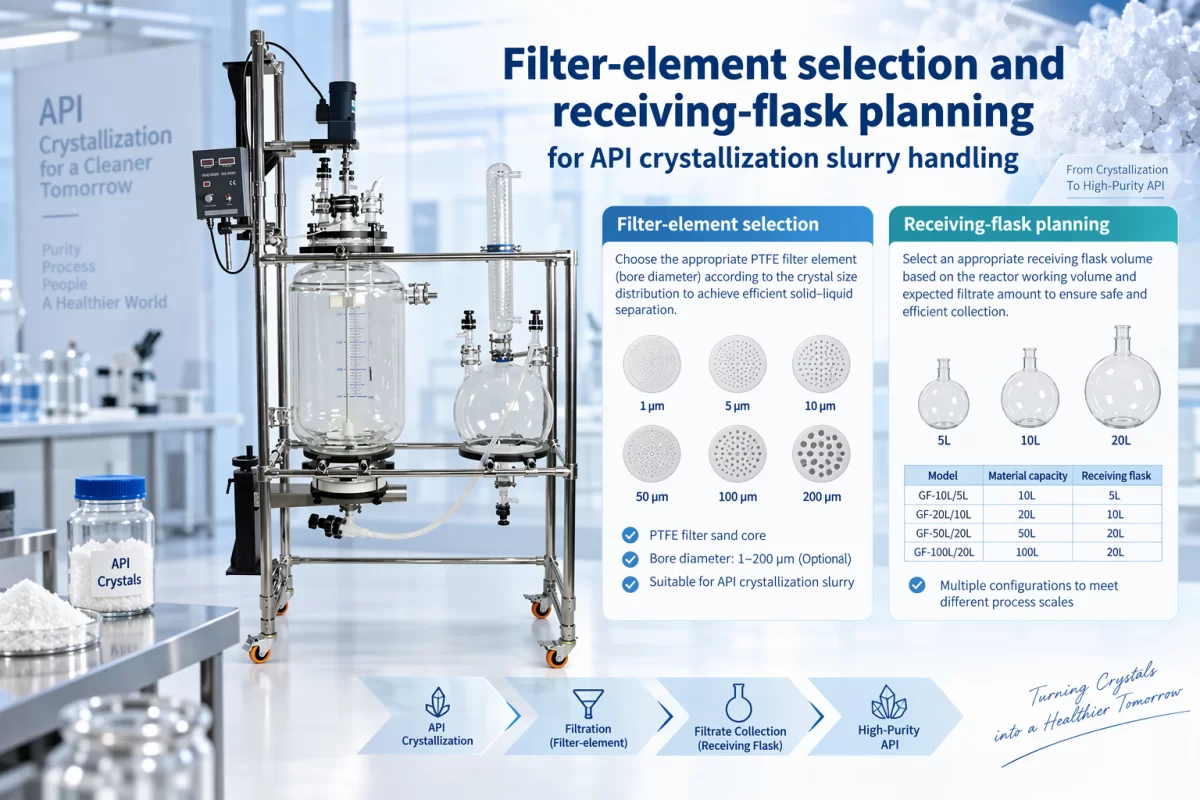
The equipment specification lists a PTFE filter sand core with an optional listed pore-diameter range of 1–200 μm. This range describes a selectable filter-element characteristic, not the particle size the reactor will produce. Filter selection must consider the actual solids, liquid properties, retention needs and potential blinding.
A filter element and receiving flask do not, by themselves, establish filtration throughput, cake-washing performance or final moisture content. Drying capability is not established by these features. If the project requires a dry isolated API, specify and assess the downstream drying operation separately.
Is the finest available filter element always the best choice?
I would select the filter using representative slurry tests rather than pore size alone. A finer element may change resistance and fouling behavior, while a coarser element may not provide the required retention. The decision should balance solids retention, liquid collection and a workable cleaning procedure.
Separate equipment scope, process assessment and project documentation
A useful purchasing review separates three categories of information:
- Equipment configuration: model, capacities, agitation arrangement, seals, filter selection, temperature measurement, collection assembly and utility connections.
- Process suitability: solvent compatibility, working charge, cooling response, suspension behavior, transfer performance and cleaning feasibility.
- Project verification documents: required material records, calibration evidence, acceptance tests, operating procedures and qualification documentation appropriate to the intended use.
The listed supply is 220 V / 50 Hz, with customization available according to customer requirements. Electrical selection should be coordinated with the installation site and the agreed equipment scope. Pharmaceutical use remains conditional on the specific material, cleaning requirements and applicable qualification documents; a general application description is not whole-system GMP certification or a commercial-production compliance guarantee.
Company reference price
US$2,000This is our company reference price, not a model-specific quotation or a confirmed turnkey-system price. The actual quotation depends on the selected configuration and inquiry results.
Choose around the API crystallization process
A crystallization glass reactor system for API production should be evaluated around solvent compatibility, a justified working batch, a testable cooling profile and practical slurry handling. The documented capacities and equipment features provide a starting point for selection; product quality, isolation performance and production suitability require their own process evidence.
For a configuration review and quotation, submit the material and solvent system, intended working batch, temperature profile, expected solids loading, filtration and collection needs, cleaning requirements, site utilities and required project documentation. These operating conditions allow the proposed reactor configuration and supply scope to be assessed against the actual development task.