
Buying a Jacketed Glass Reactor System for Chemical Synthesis
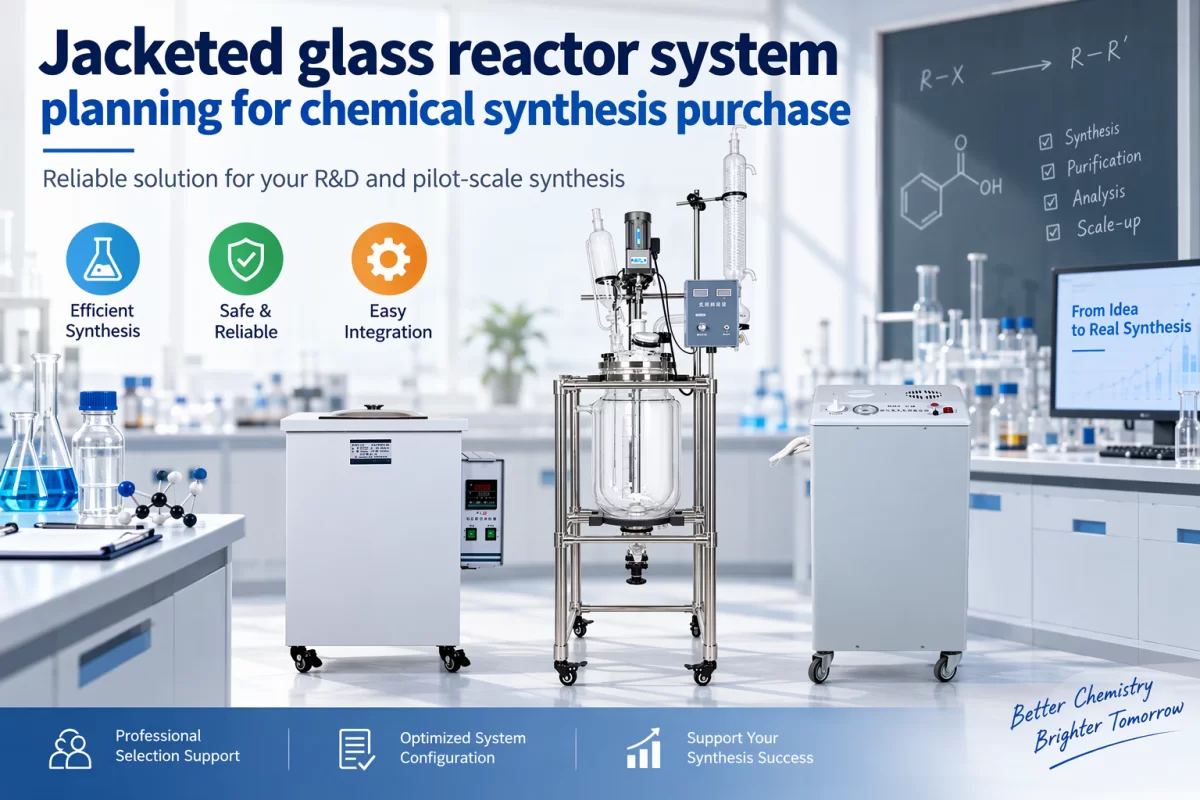
An industrial jacketed glass reactor system for chemical synthesis purchase should begin with the process and the complete equipment boundary—not simply a vessel size. Heating and cooling, stirring, condensation, vacuum handling and discharge must work together around the intended batch.
Start with the synthesis process, not the catalog capacity
A jacketed glass reactor provides a reaction vessel with a surrounding jacket through which a suitable heat-transfer fluid can circulate. That arrangement is useful when a synthesis needs controlled heating or cooling, but the vessel alone does not define the performance of the complete installation. The circulating unit, connecting hoses, agitation arrangement and process instrumentation all influence the resulting system.
Begin the purchasing specification with the chemistry: solvents, reagents, expected solids, viscosity changes, reaction heat and vapor generation. Describe the operating sequence from initial charging through addition, reaction, reflux or solvent removal, and final discharge. This makes it easier to distinguish equipment needed for the process from accessories that are merely convenient.
Does a glass jacket establish high-pressure capability?
I would not treat a jacket as evidence of pressure capability. An ordinary jacketed glass reactor must not be described as a high-pressure reactor on that basis. The reaction vessel and jacket have separate operating limits, and suitability depends on the documented assembly, seals, connections and intended service. Vacuum suitability likewise does not establish a positive-pressure rating.
Compare 10L and 20L options against the working batch
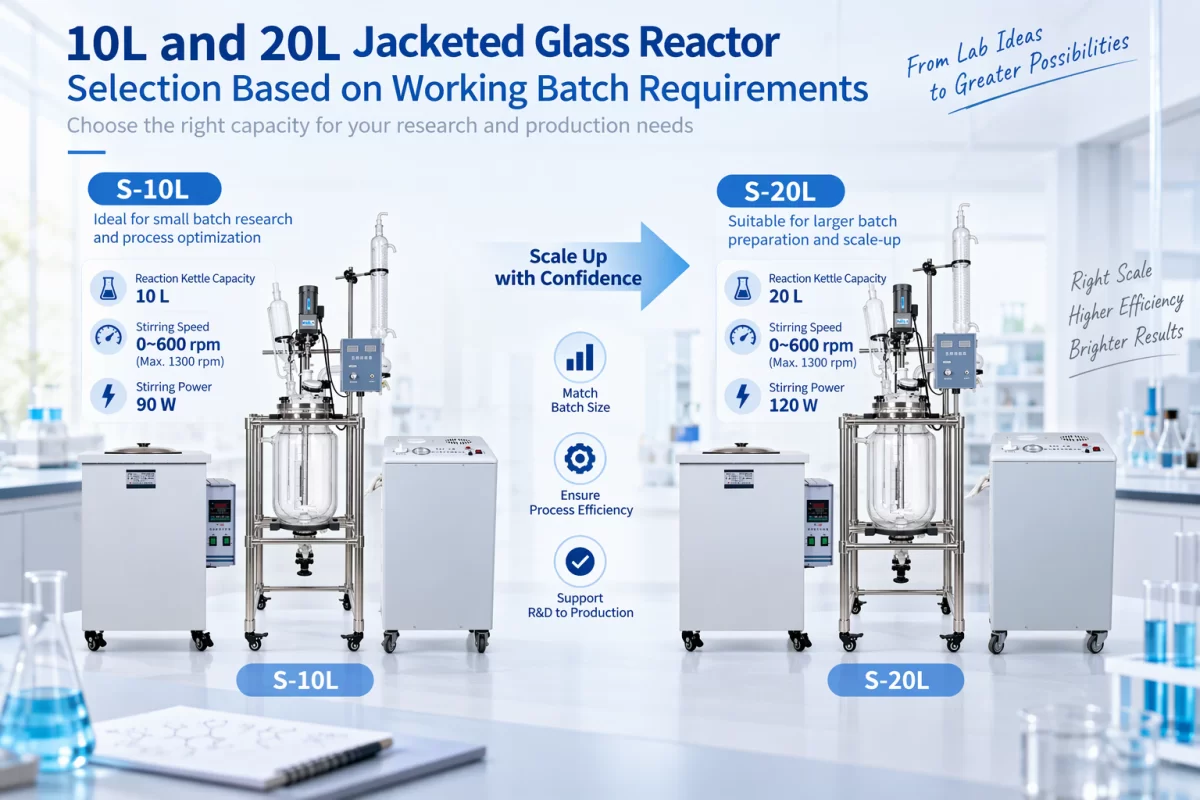
The 10L Jacketed Glass Reactor is a candidate when evaluating a nominal 10 L vessel for chemical synthesis. Selection should connect that capacity to the actual liquid inventory, mixing needs and required vapor space. A nominal 10 L designation does not mean that every process can safely or effectively run a 10 L working batch.
The 20L Jacketed Glass Reactor provides a nominal 20 L option for comparison. A larger vessel may accommodate a different batch requirement, but capacity alone does not establish better mixing, faster cooling or adequate condenser performance. Compare the corresponding vessel, jacket, agitator, condenser, ports, drain and temperature-control package as a complete configuration.
| Product | Nominal capacity (L) | Basis for batch selection |
|---|---|---|
| 10L Jacketed Glass Reactor | 10 | Liquid inventory through the full process, agitation coverage and process-specific headspace. |
| 20L Jacketed Glass Reactor | 20 | The same process assessment, with separate consideration of increased thermal and vapor-handling demand. |
Keep four capacity questions separate:
- Current batch: Identify the initial charge and the largest liquid inventory during the existing recipe.
- Addition changes: Account for reagent feeds, dilution, washes and any changes in phase volume.
- Process margin: Allow for the specific behavior of foaming, boiling, suspended solids and mixing—not a universal filling percentage.
- Future expansion: Define planned batch growth separately so that future capacity does not obscure present operating needs.
Can nominal vessel volume be used as the working batch?
I size the working batch from the process inventory and operating behavior, rather than applying one fill ratio to all materials. For example, assuming an initial liquid charge of 6 L and a later liquid addition of 2 L, with no removal or volume change, the calculated inventory becomes 8 L. That arithmetic does not establish suitability for a 10 L vessel; it is not an equipment guarantee and leaves headspace, mixing and thermal requirements to be assessed.
Define the industrial jacketed reactor system boundary
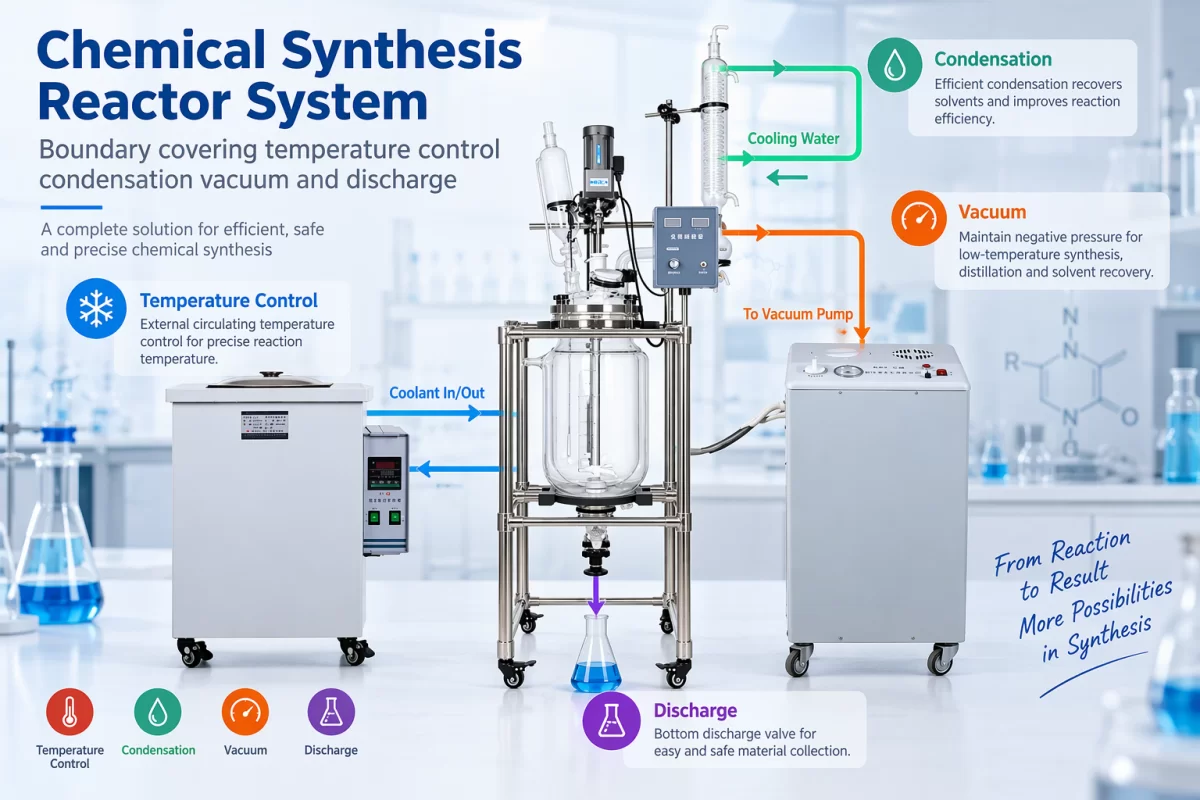
A meaningful quotation should identify where each subsystem starts and ends. Two proposals can name the same reactor capacity while covering different equipment. The following system-boundary table provides a purchasing framework; it describes scope to specify rather than claiming that every item is included with either vessel.
| Subsystem | Vessel-side boundary | Supporting equipment and interfaces | Purchasing basis |
|---|---|---|---|
| Temperature control | Jacket connections and process-temperature measurement. | Heating/cooling circulator, fluid, hoses, fittings and control integration. | Specify process temperatures, heat-release profile, cooling duty and site utilities. |
| Condensation | Vapor outlet, condenser mounting and reflux or collection route. | Condenser, coolant circuit, receiver and connecting glassware. | Match the solvent, vapor load and intended reflux or distillation operation. |
| Vacuum | Process connections and sealing arrangement. | Pump, trap, isolation, pressure measurement and exhaust handling. | Define the operating pressure, solvent exposure and vapor-management duty. |
| Discharge | Bottom outlet, valve and wetted seals. | Transfer connection, receiving vessel and required containment. | Consider viscosity, solids, drainability, cleaning and receiver access. |
| Stirring and ports | Drive, shaft, impeller, seal and vessel openings. | Feed lines, sampling connections, sensors and controls. | Assess mixing across the intended batch range and allocate ports to each process function. |
Temperature-control selection should distinguish the circulator setpoint from the desired process temperature. Heat transfer also depends on circulation, fluid properties, reaction conditions and agitation. Similarly, a condenser should be evaluated against vapor generation rather than selected by appearance alone.
For vacuum service, consider the entire vapor path, including trapping and pump exhaust. For discharge, think beyond the valve opening: settling solids, product viscosity, receiving-vessel position and cleaning access can determine whether the arrangement is practical.
Before purchase, establish the permitted temperature and pressure conditions for the selected vessel and jacket, wetted-material compatibility, and site utility requirements. Flammable-solvent service also requires an installation-specific assessment of electrical equipment, ventilation and applicable hazardous-area requirements.
Use reference pricing to start a configuration discussion
Our company reference price for the jacketed glass reactor offering is: US$1,699 This is a reference price, not a quotation for a complete 10L or 20L chemical synthesis system. The actual quotation is subject to the selected configuration and inquiry results.
Compare quotations on equivalent scope: reactor assembly, temperature-control equipment, condenser arrangement, vacuum equipment, discharge accessories, instrumentation and installation responsibilities. A vessel-only price and a packaged-system price answer different purchasing questions.
What makes two reactor quotations meaningfully comparable?
I compare the equipment list, operating requirements and exclusions first. Only then do I compare price. Each proposal should show which components are supplied, how they connect, what utilities they need and what acceptance checks apply to the assembled system.
Make the chemical synthesis purchase a system decision
A well-defined jacketed glass reactor purchase aligns nominal capacity with the actual working batch and aligns every supporting subsystem with the chemistry. Choose between 10L and 20L options by separating current inventory, addition changes, process margin and future expansion. Do not infer high-pressure capability from a jacket or assume that a larger vessel automatically improves process performance.
To develop a corresponding proposal, submit the materials and solvents, initial and maximum batch volumes, addition sequence, target temperatures and pressures, mixing needs, condensation duty, vacuum requirements and preferred discharge arrangement. Include available site utilities and future capacity plans so the appropriate configuration and quotation can be established.