
Chemical Glass Reactor System for Pharmaceutical Pilot Production
A practical explanation of reactor sizing, heat transfer, mixing, safety, qualification, and realistic budget planning—written for teams moving a pharmaceutical process beyond the laboratory.
What does a pilot glass reactor system actually do?
A chemical glass reactor is a transparent reaction vessel used to mix materials while controlling temperature and, when the equipment is correctly rated, vacuum. In pharmaceutical pilot production, it helps bridge the gap between a small laboratory flask and a larger production vessel. Typical work includes API route development, crystallization, solvent exchange, extraction, concentration, reflux, and small-batch formulation studies.
The jacket around the vessel circulates heating or cooling fluid from a temperature-control unit. A motor turns a PTFE-coated stirring shaft and impeller, while a condenser can return solvent vapor to the batch or direct it to a receiver. A vacuum pump may lower boiling temperature and support solvent removal. These components form a system; selecting only the vessel without matching utilities often creates poor temperature control or unstable vacuum.
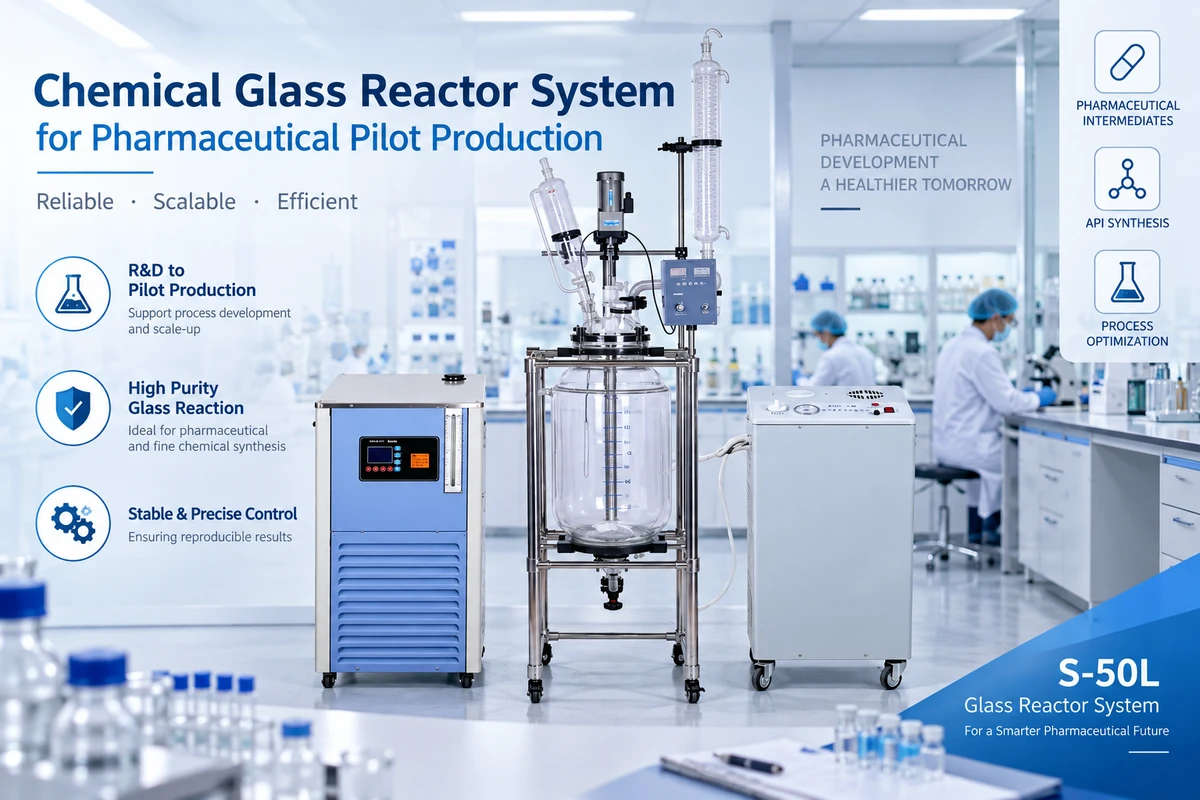
In my view, no. Visibility is useful process information: it helps reveal incomplete suspension, wall buildup, foaming, a changing liquid level, or the onset of crystallization. Observation does not replace instruments, but it makes development and troubleshooting faster.
How to choose the right working volume
Nominal vessel capacity is not the same as recommended batch volume. Headspace is needed for agitation, additions, vapor formation, and foaming. The correct fill level depends on chemistry, impeller design, viscosity, reflux rate, and the supplier’s operating limits. As a planning example—not a universal rating—a team targeting a 12–15 L liquid charge may begin evaluating a 20 L vessel rather than assuming a 10 L vessel can be filled to its brim.
For early route development, 1–5 L systems conserve expensive intermediates. A 20L glass reactor can suit intermediate pilot batches and process demonstrations. A 50L glass reactor gives more room for scale-up studies, crystallization, and solvent-handling trials. A 100 L unit is closer to pilot-plant duty, but it also requires more floor space, stronger utilities, more cleaning effort, and a clear material-transfer plan.
I would not select it that way. The decision should include the highest temporary volume after all additions, required headspace, foam behavior, condenser load, minimum impeller coverage, sampling needs, and safe drain strategy.
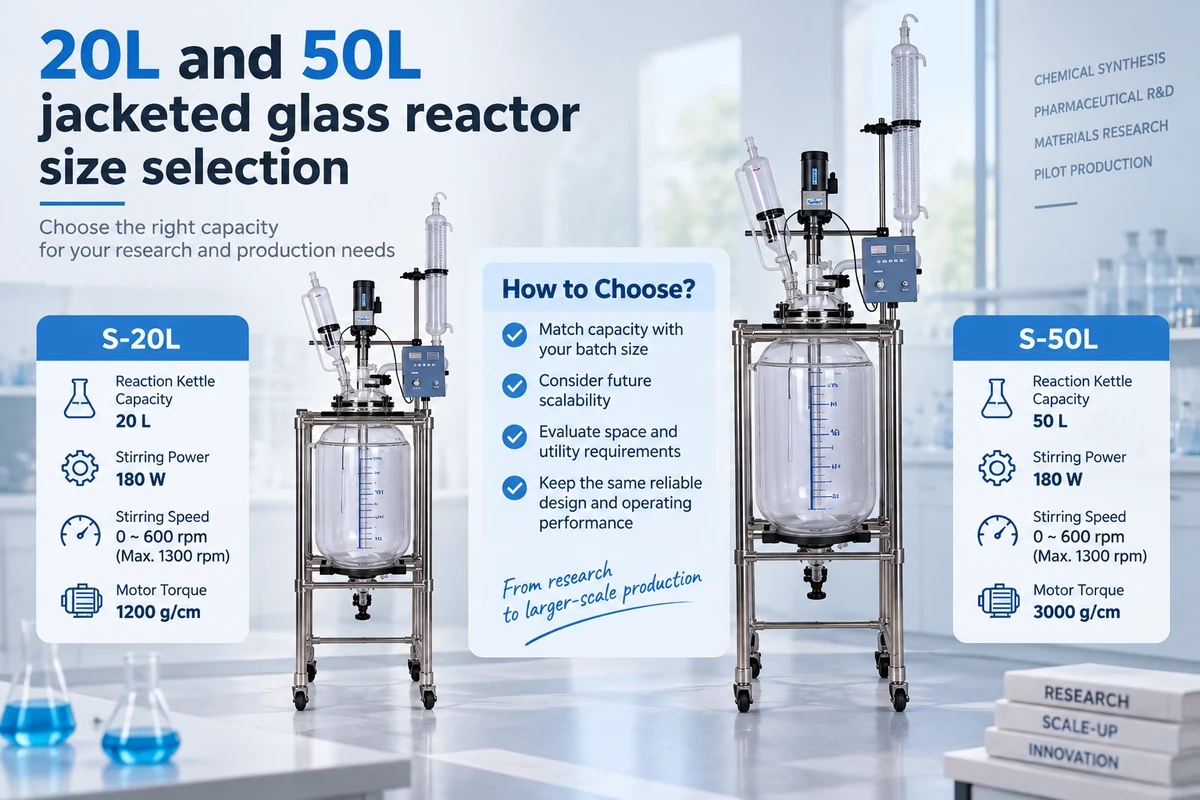
Useful specifications for a 1–100 L reactor family
The supplied S-series data show a broad path from laboratory work to pilot production. All listed standard systems use 220 V, 50/60 Hz power, and stirring speed is stated as 0–600 rpm with a listed maximum of 1,300 rpm. Actual permitted speed must still be confirmed for the chosen vessel, impeller, viscosity, and mechanical condition; a catalogue maximum is not an instruction to run every batch at that speed.
| Model group | Capacity | Stirring power | Shaft diameter | Listed torque | Frame / supply |
|---|---|---|---|---|---|
| S-1L to S-5L | 1, 2, 3, 5 L | 60 W | 12 mm | 2,000–4,800 g·cm* | Floor type; 220 V, 50/60 Hz |
| S-10L to S-100L | 10, 20, 30, 50, 100 L | 120–250 W* | 12–15 mm* | 1,000–3,000 g·cm* | 304 stainless frame; 220 V, 50/60 Hz |
*Values vary by model. Final model-to-value mapping and the suitability for a specific viscosity must be confirmed in the supplier’s approved technical quotation.
Explosion-proof configurations are listed as available, with optional stirring power values of 180, 250, or 370 W. A 110 V/60 Hz supply can also be customized. “Explosion-proof” must apply to the complete installation and hazardous-area strategy—not merely the motor label—so the chiller, vacuum pump, controls, wiring, grounding, ventilation, and local classification should be reviewed by qualified personnel.
Where GMP thinking enters pilot production
A glass vessel does not become “GMP compliant” simply because it is clean and transparent. Compliance depends on the equipment design, materials, cleaning method, records, calibration, procedures, process controls, and intended regulatory use. Product-contact parts commonly include borosilicate glass and PTFE, but compatibility must be checked against solvents, pH, temperature, and cleaning agents.
The U.S. FDA’s 21 CFR 211.63 states that equipment must be of appropriate design and adequate size and suitably located for its intended use, cleaning, and maintenance. FDA’s 2011 Process Validation guidance describes a lifecycle with three stages: Process Design, Process Qualification, and Continued Process Verification. That three-stage model is a useful reminder that a successful pilot batch is evidence, not the end of process understanding.
For active pharmaceutical ingredients, ICH Q7 also addresses equipment design, maintenance, cleaning, and calibration. In practical terms, pilot teams should define critical process parameters such as product temperature, addition rate, mixing speed, vacuum level, and hold time, then record them with calibrated instruments where the development plan requires it.
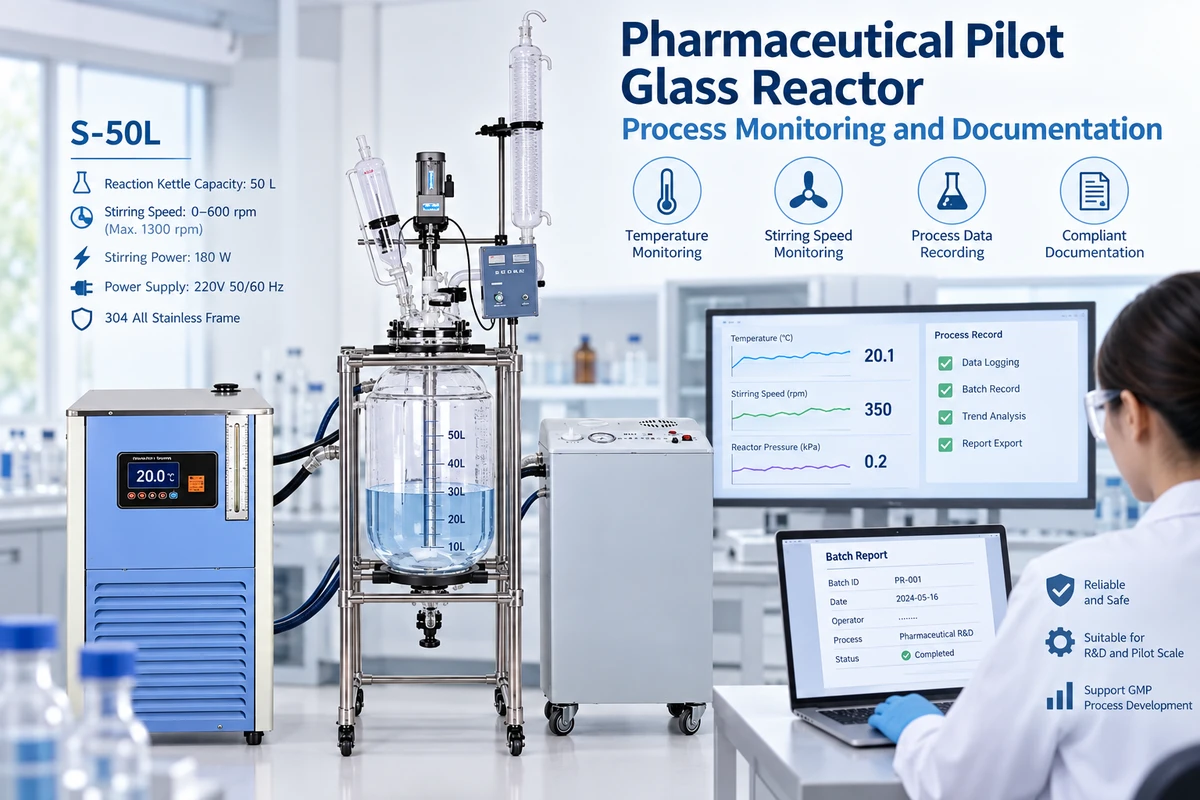
In my experience, not automatically. Impeller geometry, position, liquid level, viscosity, solids loading, and vortex formation can matter as much as motor wattage. Mixing should be evaluated as a complete system, preferably using process-relevant material or a justified simulant.
Indicative glass reactor system prices
Buyers often want one number, but scope changes the number. The supplied marketplace price list includes bare or basic reactors as well as differently configured systems. Following the requested middle-but-lower selection approach where several listings were available, the table below uses representative reference prices rather than the highest listing. These are not binding quotations and may exclude a chiller, vacuum pump, freight, duties, installation, qualification documents, or explosion-proof upgrades.
| Capacity | Representative price | Typical pilot use | Budget note |
|---|---|---|---|
| 1 L | US$560 | Route screening and small valuable batches | Basic listing reference |
| 5 L | US$850 | Lab scale-up and formulation work | Common mid-lower listing |
| 10 L | US$1,499 | Small pilot reactions and reflux | Configuration-dependent |
| 20 L | US$1,700 | Intermediate process demonstration | Several supplied listings cluster here |
| 50 L | US$2,200 | Crystallization and larger pilot batches | Explosion-proof scope may cost more |
| 100 L | US$2,800 | Pilot-plant scale and scale-up studies | Mid-lower reference among multiple listings |
For a broader comparison of configurations and current options, review the glass reactor system price and equipment page. A useful quotation should separate the reactor, frame, agitation assembly, seals, condenser, receivers, valves, temperature unit, vacuum system, controls, spare parts, packaging, and shipping.
Questions a supplier should answer before an order
What are the nominal volume, recommended working-volume range, and minimum mixing level?
What are the documented temperature, vacuum, pressure, and thermal-shock limits?
Which glass grade, gasket, seal, hose, valve, and impeller materials contact the product?
Can the agitator handle the expected viscosity and solids loading across the batch?
What heating and cooling duty is required, and are jacket connections matched to the circulator?
What condenser area and coolant conditions are recommended for the solvent and boil-up rate?
Are grounding, hazardous-area components, and certificates suitable for the installation location?
Which manuals, material certificates, calibration records, drawings, spare parts, and test documents are included?
Final recommendation
Begin with a written process brief rather than a model number. Include all charge volumes, solvents, operating temperatures, expected vacuum, viscosity changes, solids content, addition rates, cleaning method, required measurements, and room utilities. The best chemical glass reactor system is not necessarily the largest or fastest one; it is the system that controls the target process repeatably, allows safe observation and sampling, and produces records useful for the next scale-up decision.