
Pharmaceutical equipment selection
GMP Design Questions to Ask Before Selecting a Stainless Steel Reactor
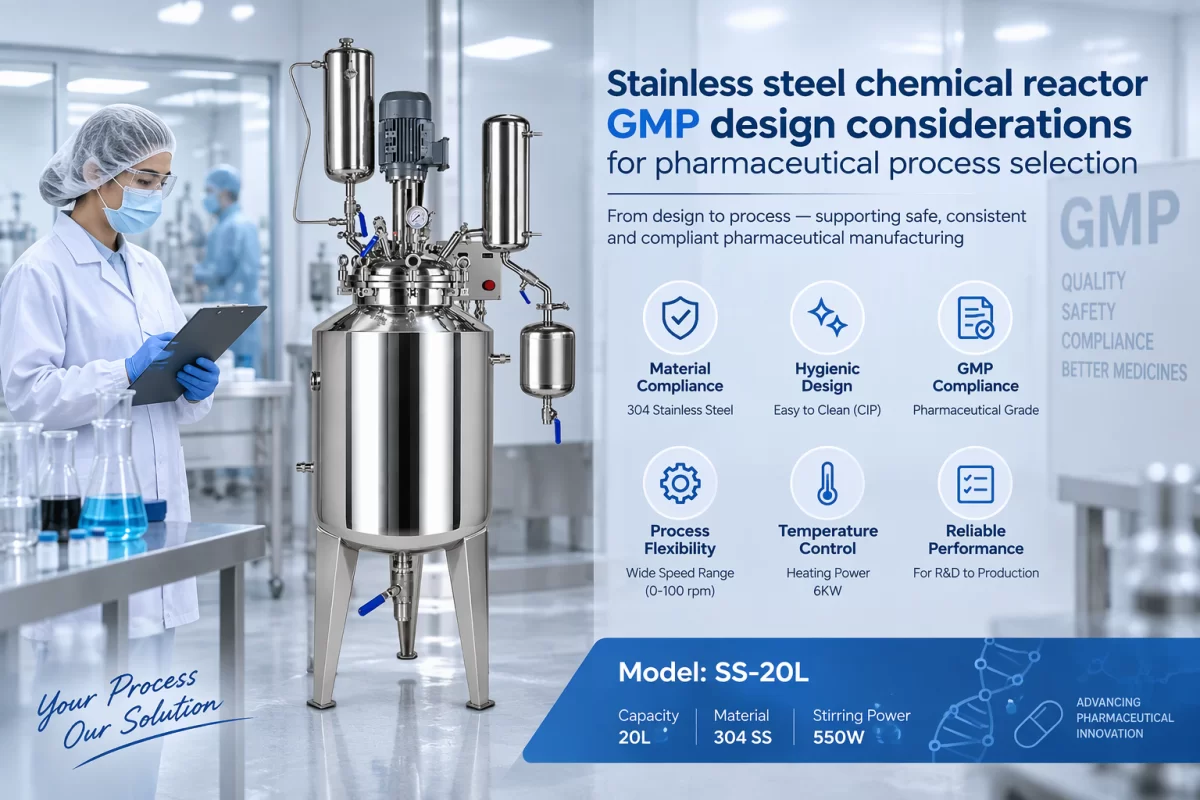
Evaluating stainless steel chemical reactor GMP design considerations for pharmaceutical use starts with questions about the process—not with a general equipment label. Materials, surface condition, cleaning access, and qualification evidence must match the intended product and operating conditions.
1. Define the pharmaceutical process before comparing equipment
A useful selection brief identifies the substances handled, solvent composition, solids loading, viscosity, target working batch, and expected reaction conditions. It should also explain whether the reactor is intended for development, pilot work, or a defined manufacturing step. Nominal vessel capacity alone does not establish a suitable working volume or sufficient mixing headspace.
When evaluating a Stainless Steel Reactor Vessel, start with the vessel boundary: product-contact surfaces, connections, discharge arrangement, and access for inspection. Assess the proposed configuration against the process requirements rather than assuming that the product category establishes pharmaceutical suitability.
- Batch and handling: What working volume, filling sequence, solids addition method, and discharge behavior are required?
- Operating conditions: What temperatures, pressure or vacuum conditions, and hold times must the selected assembly support?
- Contamination control: What carryover, residue, and cross-contamination risks must the equipment design address?
- Utilities and installation: What electrical supply, thermal circulation system, ventilation, and maintenance access are available?
2. Ask which materials actually contact the product
A stainless steel vessel body does not describe every wetted component. The agitator, valves, probes, connection fittings, seal faces, and gaskets may have different materials. Request a component-level product-contact material schedule and assess compatibility with both process substances and cleaning agents.
The SS-5L equipment description identifies a 316 stainless steel reactor body, but specifies a 304 stainless steel stirring rod. This distinction matters: a body material designation should not be extended to the entire product-contact assembly. Material selection requires an assessment of the actual chemistry, exposure duration, and cleaning conditions.
Does a 316 stainless steel reactor body establish pharmaceutical suitability?
Alice: No. I would treat the body material as one input to the assessment. The remaining wetted materials, surface characteristics, cleaning method, and project qualification evidence must also support the intended use. A material designation is not whole-machine GMP certification.
For surfaces, ask how the required finish will be specified, measured, and documented. Consider weld locations, internal transitions, crevices, and areas that are difficult to inspect. Where a project calls for a defined surface roughness, passivation, or another treatment, include the acceptance criteria and evidence requirements in the purchase specification rather than assuming those features are included.
3. Review a defined configuration—not combined series limits
A Stainless Steel Chemical Reactor should be assessed as an assembled process system. Mixing, heat transfer, sealing, instrumentation, and connections interact, so comparisons should use the same configuration basis. Do not combine a large model’s capacity with another configuration’s operating limits or drive specification.
The following SS-5L details provide a concrete starting point for discussing equipment design. They describe equipment features, not qualification results or a guarantee of pharmaceutical production compliance.
| Design item | SS-5L detail | Process assessment |
|---|---|---|
| Reactor volume | 5 L | Determine suitable working batch and headspace separately. |
| Reactor body | 316 stainless steel | Assess compatibility with the process and cleaning chemistry. |
| Agitator | 304 stainless steel rod; three blades | Review wetted-material compatibility and mixing requirements. |
| Stirring speed | 0–600 rpm; frequency-converter control | Assess mixing across the intended viscosity and fill range. |
| Heating method | Circulation heating | Define thermal duty and the required circulation utility. |
| Temperature display | PT100 sensor with digital display | Define sensor placement and calibration requirements. |
| Seal and connections | Mechanical seal; threaded union connections | Review leakage control, disassembly, and cleanability. |
| Discharge | Ball quick-discharge valve | Assess retained liquid and access to internal valve surfaces. |
A speed range does not establish mixing performance for every viscosity, and a temperature display does not demonstrate temperature uniformity throughout the batch. Define the required performance tests around the intended material, working volume, and operating sequence.
4. Examine cleaning access and residue removal
Cleaning design deserves review before purchase. Ask whether cleaning will involve manual access, component removal, circulation, or a specified clean-in-place arrangement. The presence of a jacket, mechanical seal, or discharge valve does not itself establish a validated cleaning capability.
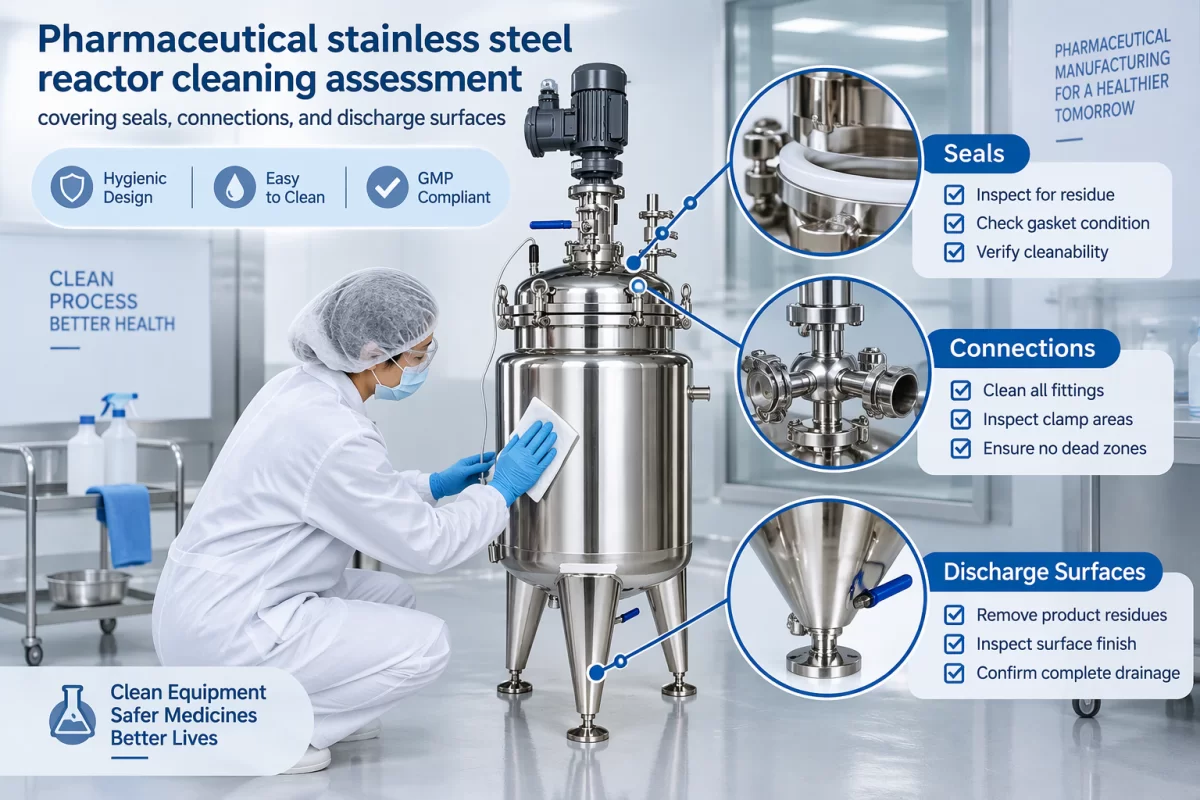
- Connections and seal areas: Can residues be reached, removed, and sampled using the proposed procedure?
- Discharge path: Does the arrangement drain adequately for the process, and can retained material in the valve be addressed?
- Cleaning chemistry: Are all exposed materials compatible with the selected agents, concentration, temperature, and contact time?
- Verification: What sampling locations, analytical methods, and residue acceptance limits will the project use?
Can threaded unions and a ball discharge valve be assumed to support validated cleaning?
Alice: I would not make that assumption. Their suitability depends on the detailed geometry, access, assembly procedure, and cleaning process. I would evaluate residue-retention locations and demonstrate cleaning effectiveness under representative conditions before accepting the arrangement for a pharmaceutical application.
5. Separate equipment documents from project qualification
Keep three evidence layers distinct. Equipment documentation describes what is supplied. Process suitability assessment explains whether that configuration meets the intended chemical, thermal, mixing, and cleaning needs. Project validation and qualification records demonstrate acceptance against approved requirements.
Ask which documents can be included in the agreed scope: component material records, drawings, instrument information, calibration records, operating instructions, maintenance instructions, and applicable test reports. Document availability and coverage should be agreed for the purchased configuration; they should not be inferred from a general application description.
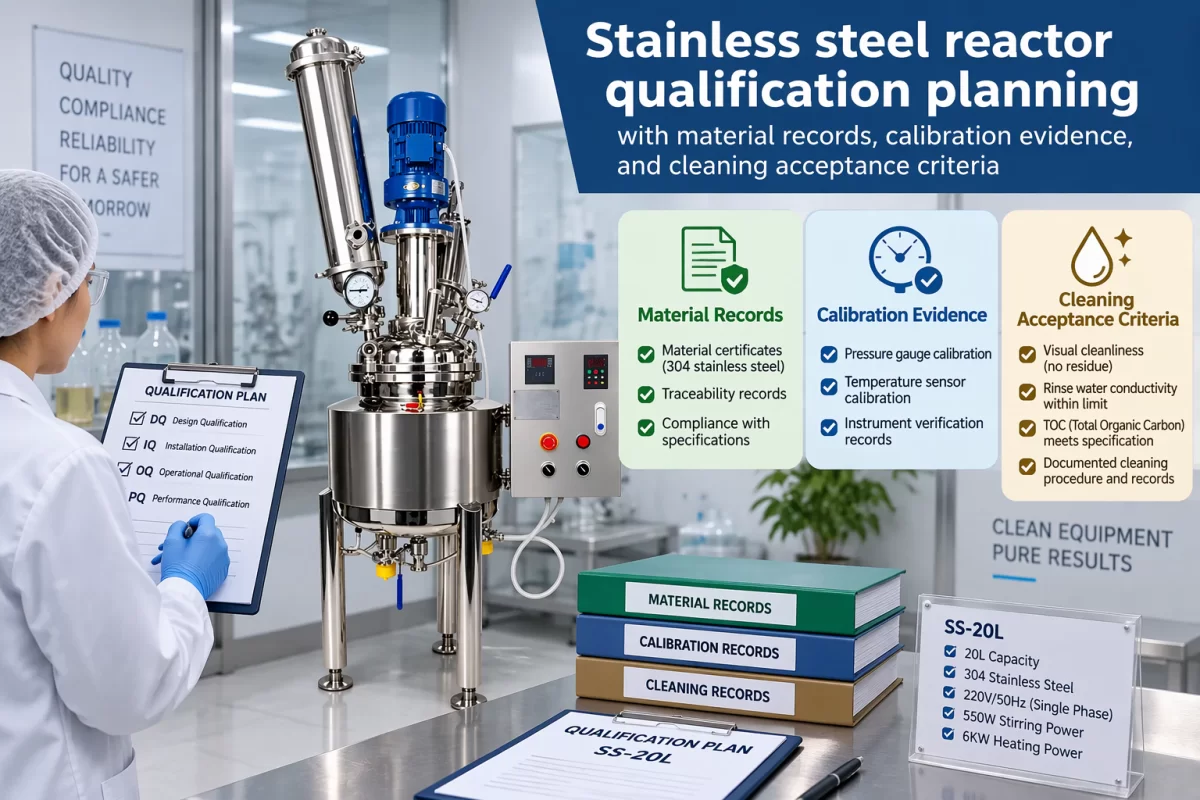
Where the project requires design, installation, operational, or performance qualification, define the responsibilities and acceptance criteria in advance. Factory and site acceptance activities may support that work, but they do not automatically replace the site’s qualification or cleaning validation.
Which evidence should guide a reliability comparison between reactor proposals?
Alice: I would compare documented materials, seal maintenance requirements, instrument calibration provisions, service access, and agreed acceptance-test results on an equivalent configuration basis. “Best” or “reliable” should express a purchasing objective, not an unsupported ranking or an absolute performance promise.
6. Compare procurement scope as well as reference price
Our company’s reference price is US$2,042, based on the midpoint selection of the supplied company price listings. This is a portfolio-level budgeting reference, not a quotation for the SS-5L configuration or a pharmaceutical-qualified system. The actual quotation depends on the selected configuration and inquiry results.
A meaningful comparison should identify the vessel and agitator configuration, thermal equipment, seals, connections, instrumentation, cleaning provisions, and document deliverables included in each offer. Qualification support and acceptance testing should also have a clearly defined scope. A lower initial equipment price does not establish a lower total project cost.
Turn GMP design questions into a clear purchase specification
For pharmaceutical use, stainless steel reactor selection should connect the intended process with component materials, surface requirements, cleaning access, operating capability, and qualification evidence. Equipment specifications establish a starting point; process assessment and project verification establish whether the selected arrangement is suitable for its intended role.
Plan the next step: Submit the material and solvent details, target working batch, viscosity or solids loading, temperature and pressure conditions, cleaning method, available utilities, and required configuration and documentation scope. These inputs support a focused technical review and a configuration-specific quotation.