
Industrial jacketed glass reactor for pharmaceutical synthesis purchase.
Buying a jacketed glass reactor for pharmaceutical synthesis is not only about vessel volume. It is about temperature control, mixing stability, solvent compatibility, vacuum performance, safety configuration, and the real cost of a workable system. This guide explains the essentials in plain English so a purchase decision can be made with fewer surprises.
Why jacketed glass reactors matter in pharmaceutical synthesis
An industrial jacketed glass reactor is a transparent reaction vessel with an outer jacket for heating or cooling liquid. In pharmaceutical synthesis, this design is valued because the reaction can be seen directly: color change, precipitation, foaming, phase separation, and crystallization are visible without opening the vessel. For early API development, kilo-lab work, pilot batches, and process optimization, this visibility is extremely useful.
The jacket allows a circulating heater, chiller, or combined temperature control unit to move heat-transfer fluid around the vessel. This makes it easier to hold a reaction at a stable temperature, run controlled cooling, or perform solvent reflux. When paired with a condenser, vacuum pump, feeding funnel, and PTFE sealing system, the reactor becomes a flexible platform for common pharmaceutical operations.
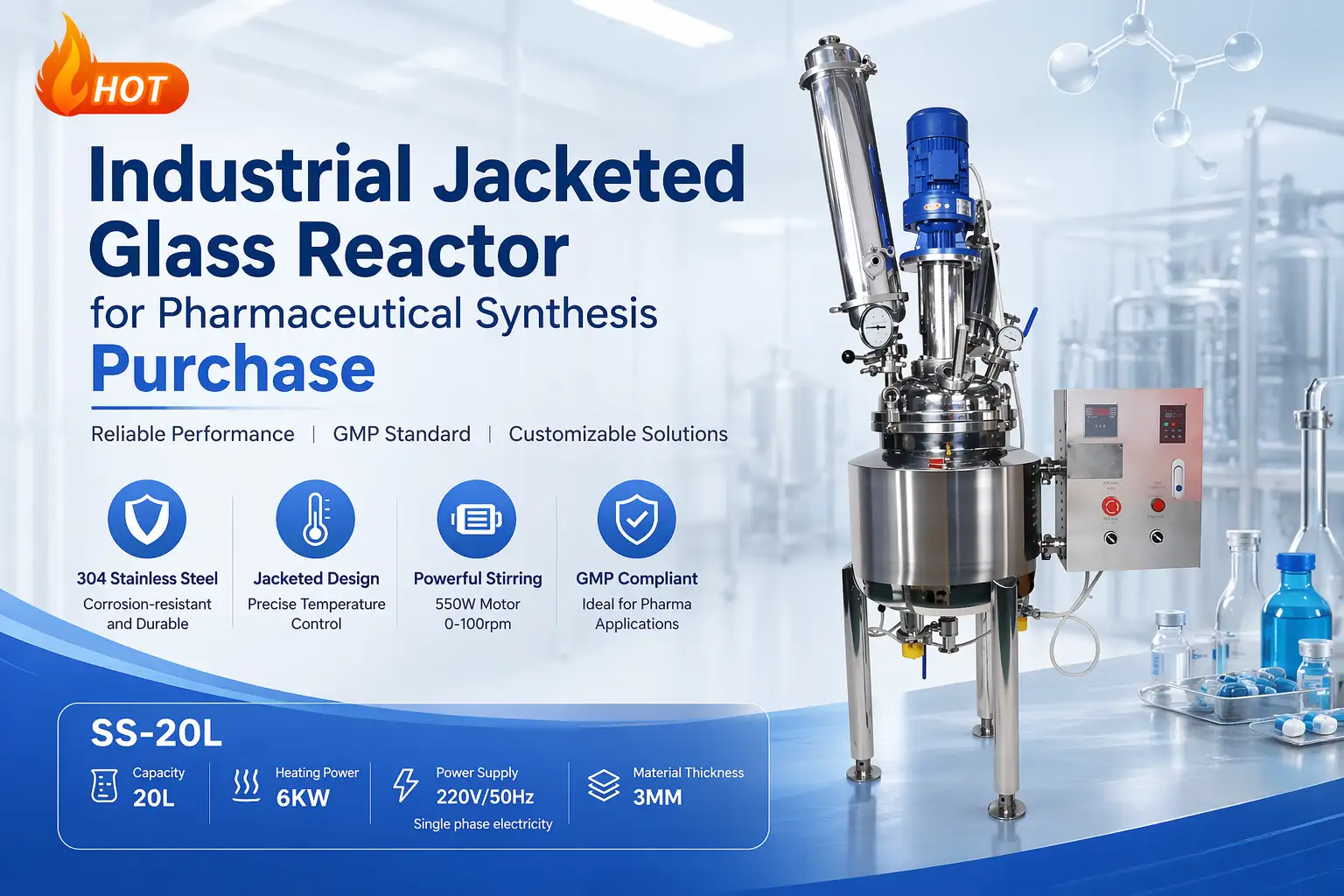
Jacketed glass reactor system for pharmaceutical synthesis and process development.
Authoritative reference: ISO 3585 defines borosilicate glass 3.3 as a glass with a mean linear thermal expansion coefficient of about 3.3 × 10⁻⁶ K-1 between 20°C and 300°C. This low expansion is one reason borosilicate glass is widely used for laboratory and pilot reaction vessels where temperature changes are frequent.
Core specifications to check before buying
The supplied product data covers S-series double-jacketed glass reactors from 1L to 100L. For small reactors from 1L to 5L, the standard stirring power is 60W, the speed range is 0–600 rpm with a maximum of 1300 rpm, the stirring shaft diameter is 12 mm, and the power supply is 220V 50/60Hz. These compact models are often suitable for method screening, small-batch synthesis, or teaching laboratories.
For larger 10L to 100L models, the stirring power increases from 120W to 250W, the shaft diameter is 12 mm for smaller capacities and 15 mm for larger capacities, and the frame is 304 stainless steel. Explosion-proof configuration is available, and power supply can be customized to 220V/50Hz or 110V/60Hz. For more general product browsing, the glass reactor system price page is a useful internal reference.
In many cases, yes. A 10L jacketed glass reactor is a practical bridge between bench chemistry and pilot processing. It gives enough working volume to observe heat transfer, mixing behavior, crystallization, and work-up conditions, while still being easier to clean and less costly than 50L or 100L equipment. For a dedicated 10L option, see the 10L glass reactor product page.
Model and price reference for purchasing
Price is usually the first question, but it should be read together with configuration. A basic vessel price may not include a chiller, vacuum pump, condenser, receiving flask, explosion-proof motor, or customized power supply. Based on the provided price list, the following values are reasonable mid-to-lower reference prices when several similar products are available.
| Capacity | Typical use | Key supplied parameter | Reference price | Buying note |
|---|---|---|---|---|
| 1L | Screening, small reactions | 60W stirring, 12 mm shaft | $560 | Best for limited material and early trials |
| 5L | Lab synthesis and small batches | 60W stirring, 0–600 rpm | $850 | Good balance of cost and usable volume |
| 10L | Process development | 120W stirring, stainless frame | $1,499 | Common entry size for scale-up work |
| 20L | Scale-up and distillation | 120W stirring, 12 mm shaft | $1,699 | Useful when 10L batches are too small |
| 50L | Pilot synthesis, crystallization | 250W stirring, 15 mm shaft | $2,100 | Check floor space and cooling capacity |
| 100L | Pilot plant and larger trials | 250W stirring, 15 mm shaft | $2,800 | Consider explosion-proof and lifting design |
For 100L projects, the vessel is no longer just a lab item; it becomes part of a pilot process. Review ceiling height, drainage, frame strength, operator access, and heat-transfer fluid volume. A related internal option is the 100L glass reactor.
Safety and compliance considerations
Pharmaceutical synthesis often involves flammable solvents such as ethanol, methanol, acetone, ethyl acetate, toluene, or heptane. If these solvents are heated, distilled, or used under vacuum, explosion-proof electrical components should be discussed before purchase. The supplied reactor data clearly notes explosion-proof availability, which is important for solvent-heavy operations.
Another authoritative point comes from the U.S. FDA Process Validation Guidance for Industry (2011), which describes process validation as a lifecycle activity including process design, process qualification, and continued process verification. In practical terms, equipment should support repeatable operation, stable parameters, and records that help a team understand whether a synthesis step is under control.
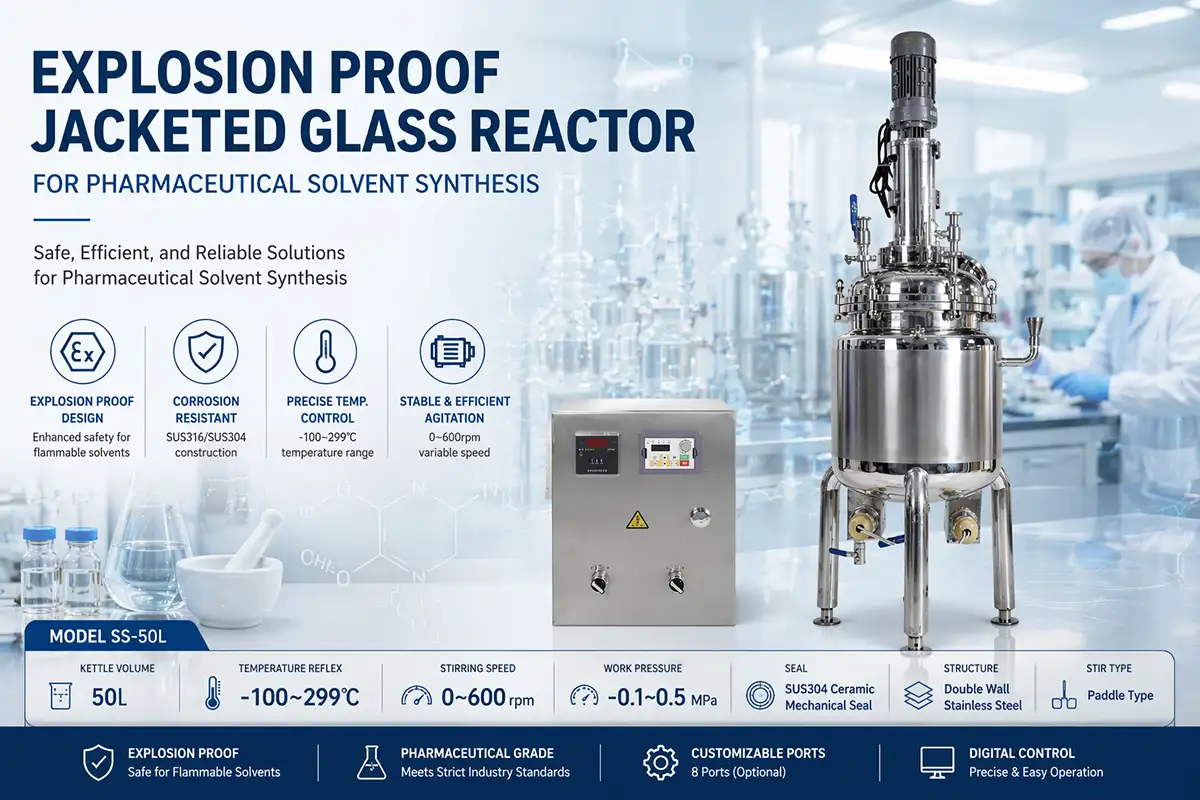
Explosion-proof jacketed reactor configuration for solvent-based pharmaceutical synthesis.
It is worth considering whenever flammable vapor may be present near the motor, controller, switches, or heating equipment. The extra cost is small compared with the risk of ignition, downtime, and failed safety review. For aqueous, low-temperature, nonflammable chemistry, a standard configuration may be enough, but solvent distillation and reflux should be treated more carefully.
How to match reactor size to the process
A reactor should not be filled to the top. In real pharmaceutical synthesis, headspace is needed for stirring vortex, foaming, gas release, additions, reflux, and safe pressure relief. A practical working volume is often lower than the total vessel capacity. For example, a 20L reactor may not mean 20L of actual reaction mixture in every process.
Small sizes such as 1L, 2L, 3L, and 5L are convenient when raw material is expensive or the route is still uncertain. The 10L and 20L sizes are better for developing a stable procedure, confirming addition rate, optimizing temperature ramps, and collecting enough product for analysis. The 50L and 100L models are better when the route is mature and batch reproducibility matters more than quick setup.
Simple sizing rule
If the goal is chemical route exploration, choose a smaller model. If the goal is process demonstration, choose 10L or 20L. If the goal is pilot production, choose 50L or 100L and confirm utility requirements before signing the purchase order.
Not always. Larger volume can reduce the number of batches, but it may also increase heating time, cooling time, cleaning work, solvent inventory, and risk during troubleshooting. Efficiency improves only when the process is already understood and the utility system can control the larger thermal load.
What should be included in a purchase inquiry?
A clear inquiry saves time and prevents under-specification. Instead of asking only for “a reactor price,” include reaction volume, solvent type, operating temperature range, vacuum requirement, stirring viscosity, power supply, explosion-proof requirement, and whether the system needs a chiller, heater, vacuum pump, or condenser. If the reaction mixture becomes thick during crystallization, mention that as well because stirrer design and motor torque become more important.
Capacity and working volume: specify total vessel size and expected batch volume.
Temperature control: define heating and cooling range, ramp speed, and holding accuracy if known.
Solvent and safety: list flammable solvents and request explosion-proof options when needed.
Vacuum and distillation: ask for compatible seals, condenser area, and receiving flask configuration.
Power supply: confirm 220V/50Hz or customized 110V/60Hz before shipment.
Documentation: request manuals, packing list, material information, and available test records.
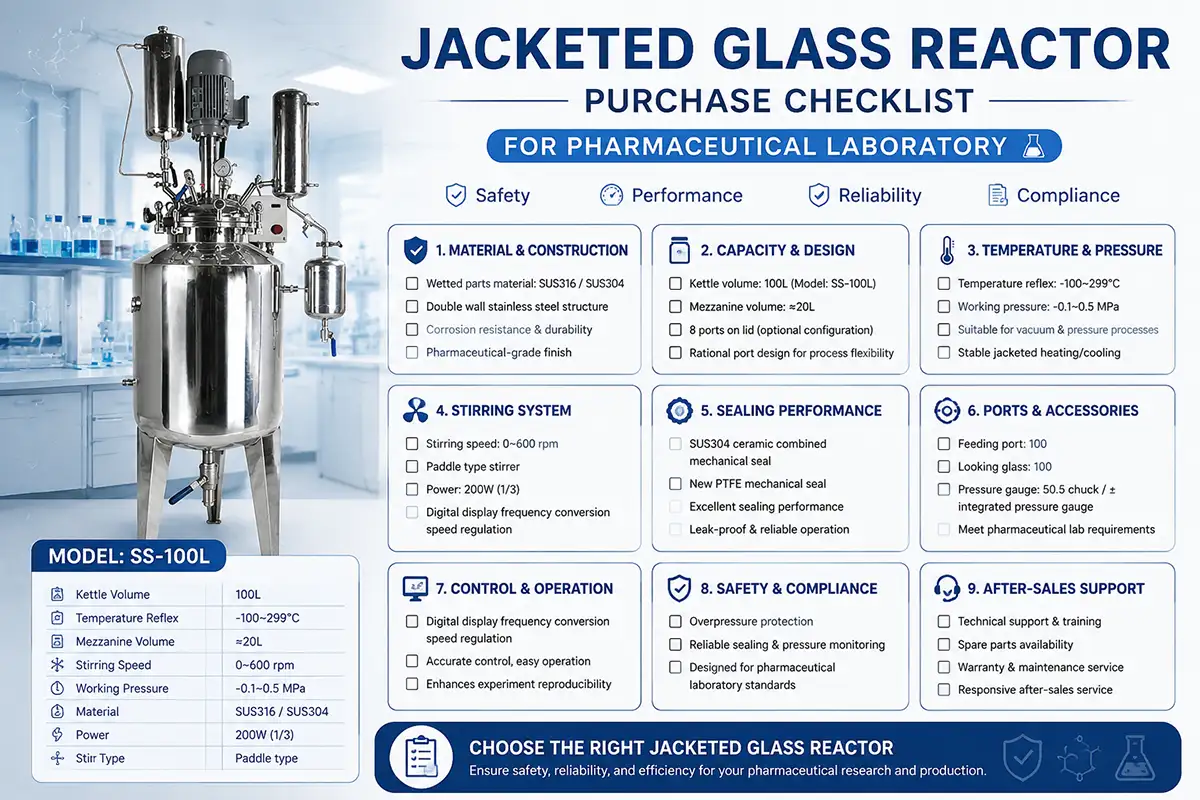
Purchase checklist for selecting a pharmaceutical jacketed glass reactor.
Final purchase recommendation
For pharmaceutical synthesis purchase, the best industrial jacketed glass reactor is the one that matches the stage of development. A 1L or 5L reactor is economical for screening and education. A 10L or 20L reactor is usually the most practical choice for process development because it provides meaningful scale without excessive facility demand. A 50L or 100L reactor is appropriate for pilot-scale synthesis, crystallization, and larger validation-style batches.
Before comparing suppliers, compare the complete system: glass quality, jacket design, stirring motor, sealing material, frame, condenser, valves, vacuum connection, temperature control unit, and safety options. A cheaper vessel can become expensive if it lacks the accessories required for the actual pharmaceutical process. A well-matched jacketed glass reactor, by contrast, helps make synthesis safer, more visible, and easier to reproduce.
Need a practical reactor configuration?
Prepare the target capacity, solvent list, temperature range, and power supply requirement, then request a configuration matched to the pharmaceutical synthesis process.
View Glass Reactor Systems Compare 10L Options