
Industrial Jacketed Glass Reactors for Chemical Synthesis Purchase
A clear, decision-focused guide to selecting the right capacity, thermal system, stirrer, safety configuration and realistic budget for laboratory, pilot and small-production chemistry.
What an industrial jacketed glass reactor actually does
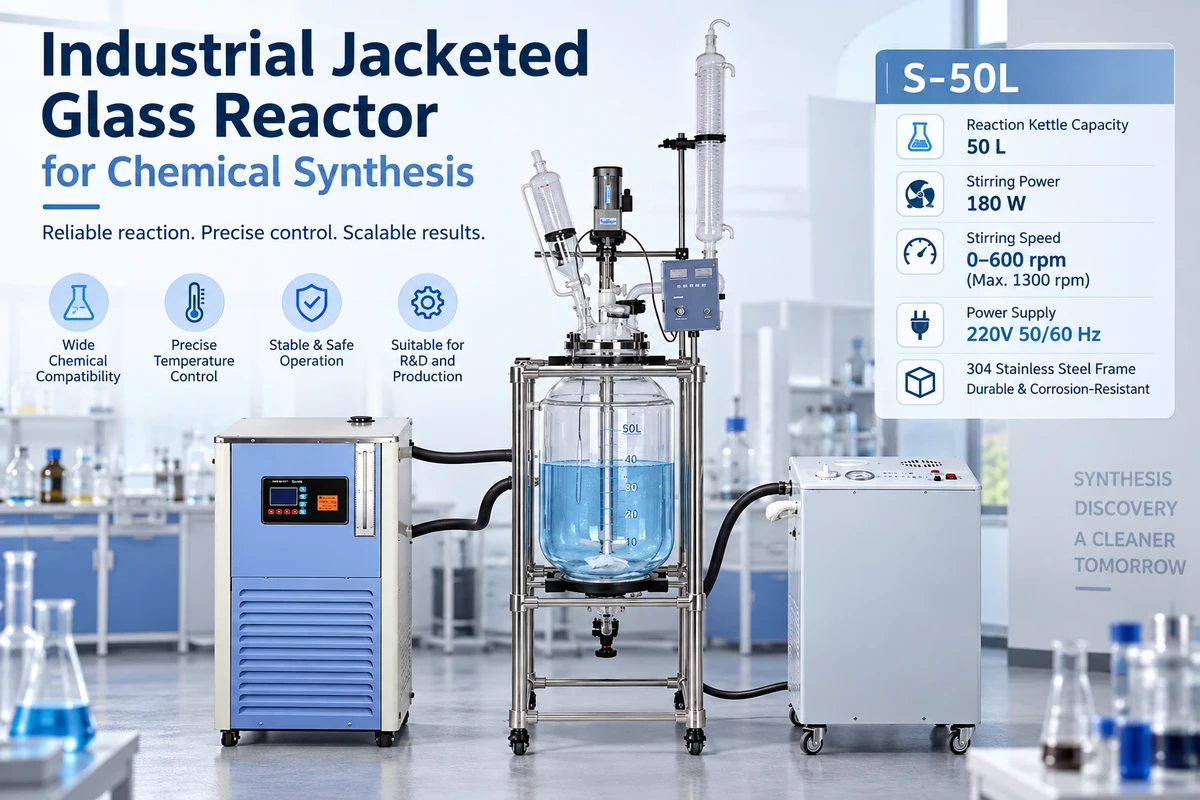
An industrial jacketed glass reactor is a transparent reaction vessel surrounded by an outer jacket. A temperature-control fluid flows through that jacket, transferring heat into or out of the chemical mixture. An overhead motor turns a shaft and impeller to keep reactants uniform. Typical accessories include a condenser, feed funnel, temperature probe, vacuum port and bottom discharge valve.
This arrangement is useful for synthesis, extraction, crystallization, reflux, vacuum concentration and formulation because the operator can see color change, foaming, phase separation, crystal growth and mixing behavior. Visibility is more than a convenience: it can make process development faster because physical changes are observed without opening the vessel.
The most important purchase lesson is that the reactor is a system, not only a glass vessel. A functional installation may also require a heating/cooling circulator, vacuum pump, condenser coolant source, hoses, clamps, sensors and suitable ventilation. Comparing vessel-only prices with complete-system prices creates misleading budgets.
Choose capacity from working volume—not the model number
A 20 L vessel does not automatically mean a 20 L process charge. Headspace is needed for agitation, vapor expansion, foaming and additions. The safe working volume depends on the chemistry, impeller, vessel geometry and supplier guidance. Before ordering, define the normal batch volume, minimum batch volume, expected foam level and maximum addition volume.
No. Oversizing can weaken mixing at small fill levels, consume more thermal fluid, occupy more floor space and increase glass replacement cost. The best size provides adequate headspace while keeping the normal batch within the supplier’s recommended working range.
For method development and expensive materials, 1–5 L models reduce consumption. A 10L glass reactor is often a practical bridge between bench testing and scale-up. A 20L glass reactor supports larger pilot batches, while 50–100 L systems better fit repeated pilot production or small manufacturing campaigns.
1–5 L: route scouting, formulation, teaching and high-value compounds.
10–20 L: pilot synthesis, extraction, distillation and process verification.
30–50 L: scale-up studies and small-batch production.
100 L: pilot-plant campaigns where floor space, lifting and utility capacity are already planned.
Heating, cooling and mixing determine process performance
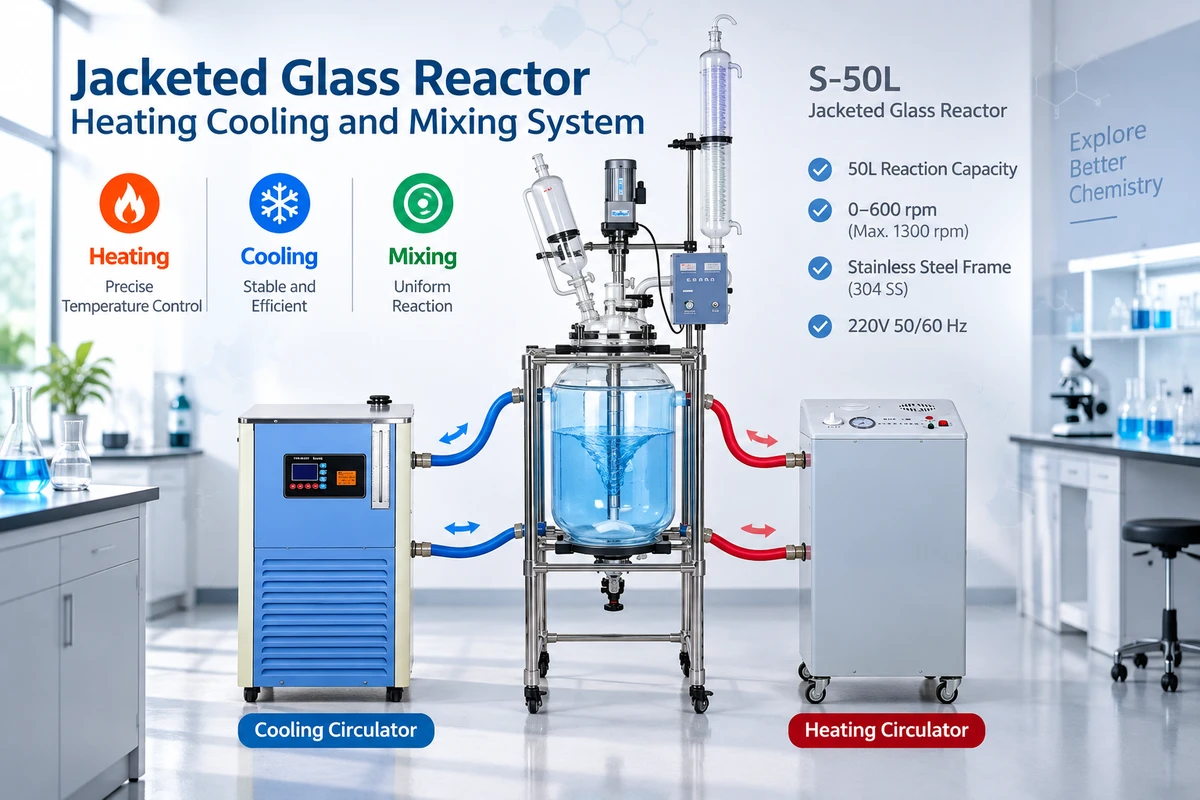
The jacket does not generate heating or cooling. It is a passage for thermal fluid supplied by an external circulator. The circulator must deliver the required temperature range, cooling capacity, heater power, pump flow and pressure while remaining compatible with the jacket and hose materials. Heat-up and cool-down targets should be stated as “batch from temperature A to temperature B within a specified time,” not simply as a maximum jacket temperature.
No. A heater/chiller or thermostatic circulator is required. Reactor size alone cannot select it; solvent mass, heat capacity, reaction heat, target ramp time, ambient conditions and heat losses must also be considered.
Mixing deserves equal attention. The supplied data specify 0–600 rpm operation, with a stated maximum of 1300 rpm, but usable speed depends on liquid viscosity, fill level, impeller type and shaft stability. A fast motor is not automatically a strong motor. Ask for torque across the operating speed range and explain whether the batch is water-like, viscous, slurry-forming or crystallizing.
Core specifications from 1 L to 100 L
The following comparison organizes the supplied S-series data. Values should be reconfirmed on the final quotation because motor configuration, shaft diameter and explosion-protection options can change with capacity and customization.
| Models | Capacity | Stirring power | Speed | Shaft | Power supply | Frame / note |
|---|---|---|---|---|---|---|
| S-1L to S-5L | 1, 2, 3, 5 L | 60 W standard | 0–600 rpm* | 12 mm | 220 V, 50/60 Hz | Floor type |
| S-10L | 10 L | 120 W | 0–600 rpm* | 12 mm | 220 V, 50/60 Hz | 304 stainless frame |
| S-20L / S-30L | 20 / 30 L | 120 W | 0–600 rpm* | 12 mm | 220 V, 50/60 Hz | 304 stainless frame |
| S-50L / S-100L | 50 / 100 L | 250 W | 0–600 rpm* | 15 mm | 220 V, 50/60 Hz | 304 stainless frame |
*Supplied documents state “Max. 1300 rpm.” Explosion-proof options list 180, 250 or 370 W motor power. A 110 V/60 Hz configuration can be customized for smaller units; confirm availability for the selected model. Supplied torque figures also vary by capacity, so the final technical sheet should govern.
Indicative purchase prices and the real installed budget
Published prices are useful for initial screening, but they do not replace a quotation. From the supplied product list, one representative mid-to-lower reference price was selected for capacities with several entries rather than presenting the highest or lowest extreme. Currency is USD.
| Capacity | Representative reference price | Likely purchasing context | Budget caution |
|---|---|---|---|
| 1 L | $560 | Bench research | Water bath or accessories may differ |
| 5 L | $850 | Laboratory synthesis | Check lifting and vacuum package |
| 10 L | $1,499 | Pilot heating/cooling | Circulator may be separate |
| 20 L | $1,699 | Reaction and distillation | Explosion-proof options add cost |
| 50 L | $2,100 | Pilot or small production | Freight and utilities matter |
| 100 L | $2,800 | Pilot-plant campaigns | Rigging and installation required |
These are product-list references, not binding offers. Vessel material, seal arrangement, condenser size, automation, hazardous-area motor, chiller, vacuum pump, shipping, taxes and commissioning can materially change the total. For current configurations, compare the published glass reactor system price information and request an itemized scope.
Material and safety checks that cannot be skipped
Borosilicate glass is widely selected because of its chemical resistance, visibility and relatively low thermal expansion. ISO 3585 specifies borosilicate glass 3.3 and reports a mean linear thermal expansion coefficient of (3.3 ± 0.1) × 10−6 K−1 between 20 °C and 300 °C. That authoritative figure helps explain its thermal-shock resistance, but it does not make glass unbreakable. Scratches, impact, clamping stress, sudden temperature differences and inappropriate pressure can still cause failure.
No. The complete installation must be assessed. Motor, controller, wiring, sensors, switches, grounding, ventilation and nearby equipment all need to suit the hazardous location. IEC 60079 provides the international standards framework for equipment and installations in explosive atmospheres; local law and a qualified safety professional determine the applicable solution.
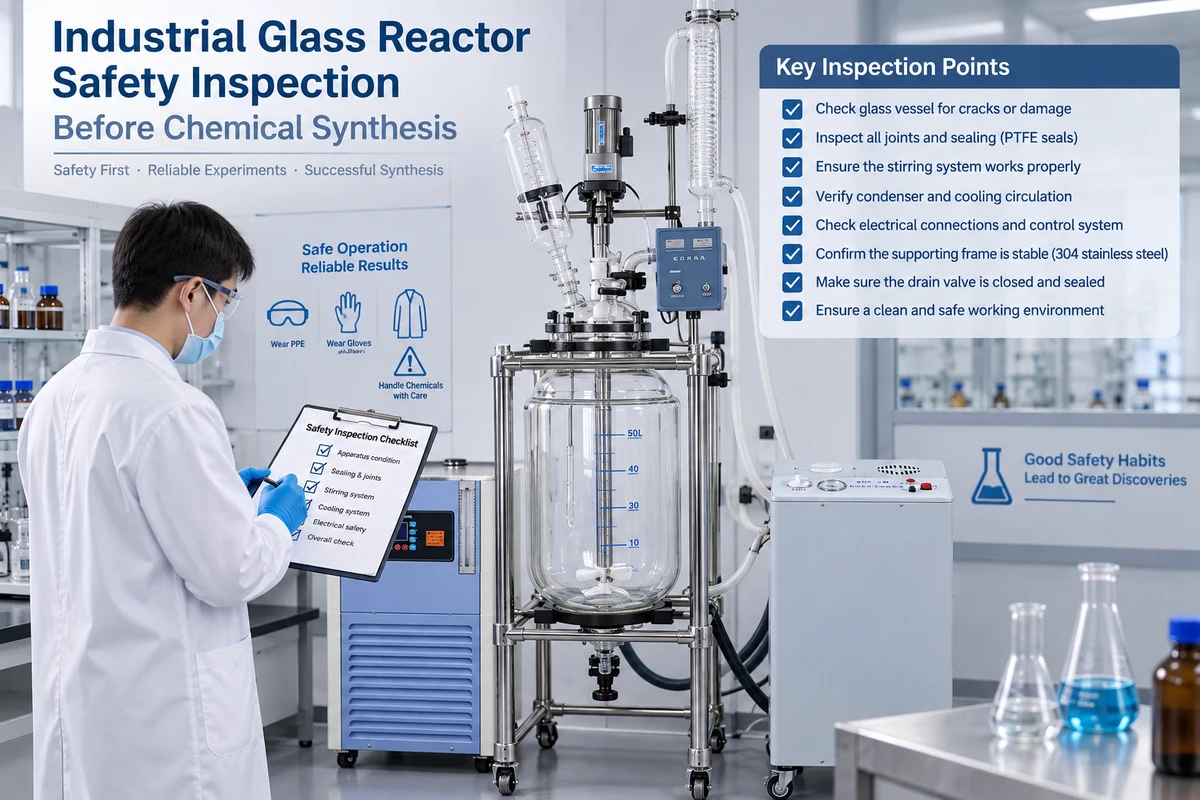
Also request a chemical-compatibility review for the glass, PTFE seals, hoses, gaskets and valves. Clearly state maximum allowable pressure and vacuum. A conventional jacketed glass reactor should never be treated as a high-pressure vessel unless the manufacturer explicitly certifies that design and operating limit.
A purchase sequence that prevents expensive mismatches
Define the process. List chemicals, concentrations, batch volume, viscosity, solids, foaming, reaction heat and cleaning method.
Set operating limits. Specify batch and jacket temperatures, vacuum/pressure, desired ramp time, agitation speed and required torque.
Match utilities. Confirm site voltage and frequency, available cooling, exhaust ventilation, floor loading, doorway clearance and drain access.
Itemize the scope. Separate vessel, frame, stirrer, seals, condenser, probes, circulator, vacuum pump, hoses, spares, freight and commissioning.
Review safety documentation. Request drawings, manuals, material declarations, electrical certificates where applicable, inspection procedures and allowable operating limits.
Plan maintenance. Keep critical seals, discharge-valve parts and suitable glass components available; clarify warranty coverage and replacement lead time.
Questions to send with the request for quotation
What is the recommended minimum and maximum working volume?
What torque is available at the actual operating speed?
What are the maximum jacket pressure and allowable vessel vacuum/pressure?
Which chiller capacity meets the stated heat-up and cool-down target?
Which wetted materials contact the product, and are they compatible?
Exactly which accessories, spare parts, certifications and services are included?
Buy from a process requirement—not from capacity alone
The right industrial jacketed glass reactor balances usable volume, heat-transfer duty, mixing torque, chemical compatibility, safe installation and total system cost. A detailed process brief allows the supplier to recommend a defensible configuration and prevents underpowered circulation, weak agitation or missing accessories.
Compare Glass Reactor Systems