
Which Jacketed Glass Reactor Is Best for Lab Scale?
For most general synthesis, extraction, crystallization, and process-development work, a 5 L floor-type jacketed glass reactor offers the best balance of useful batch size, temperature control, visibility, manageable cleaning, and price.
Best Overall: A 5 L Jacketed Glass Reactor
A 5 L model is the most practical all-round choice when the laboratory handles more than tiny screening reactions but is not yet operating at pilot scale. It gives enough room for useful product recovery while remaining easier to move, clean, and control than a 20 L or 50 L system. The supplied S-series data specify a 5 L vessel with a 60 W stirrer, 0–600 rpm normal speed range (up to 1,300 rpm maximum), a 12 mm stirring shaft, 220 V 50/60 Hz power, and motor torque up to 4,800 g·cm for the S-5L configuration.
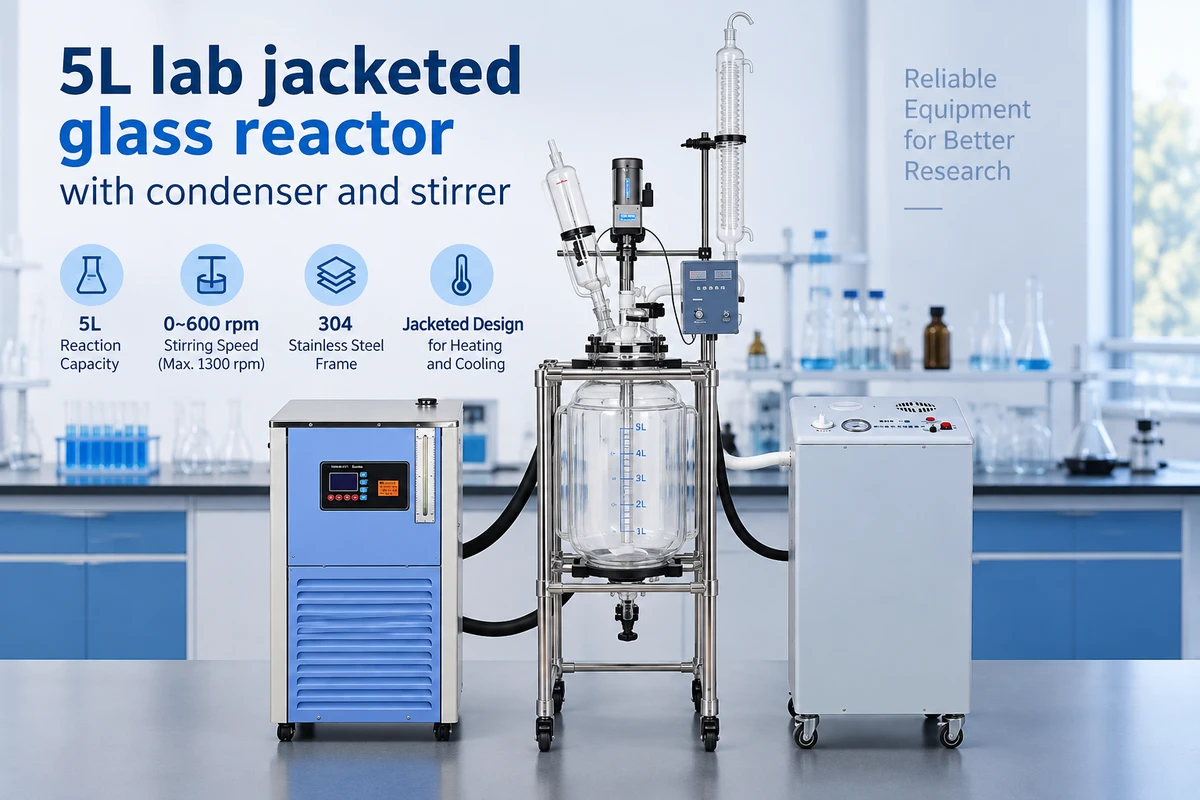
Match Reactor Size to the Real Working Batch
The nameplate volume is not the same as the recommended working volume. Headspace is needed for stirring, foaming, boiling, additions, and reflux. The exact minimum and maximum fill levels depend on vessel shape, impeller position, viscosity, and process behavior, so the operating range should be confirmed with the manufacturer before purchase.
| Model | Nominal capacity | Best use | Stirring power | Shaft | Author's assessment |
|---|---|---|---|---|---|
| S-1L | 1 L | Costly compounds, screening | 60 W | 12 mm | Best for minimum material use |
| S-2L | 2 L | Small synthesis batches | 60 W | 12 mm | Compact and practical |
| S-3L | 3 L | Routine R&D | 60 W | 12 mm | Good middle ground |
| S-5L BEST | 5 L | General lab processing | 60 W | 12 mm | Best overall balance |
| S-10L | 10 L | Scale-up and larger recovery | 120 W | 12 mm | First step toward pilot work |
| S-20L | 20 L | Pilot batches | 120 W | 12 mm | Requires more space and utilities |
What Specifications Actually Matter?
1. Glass quality and chemical resistance
High-borosilicate glass is preferred because it combines chemical resistance with low thermal expansion. ISO 3585 identifies borosilicate glass 3.3 by a mean linear thermal-expansion coefficient of (3.3 ± 0.1) × 10−6 K−1 from 20 °C to 300 °C. That low expansion improves thermal-shock resistance, but it does not make glass unbreakable. Sudden jacket-temperature changes, scratches, mechanical stress, and incorrect clamping must still be avoided.
2. Temperature-control package
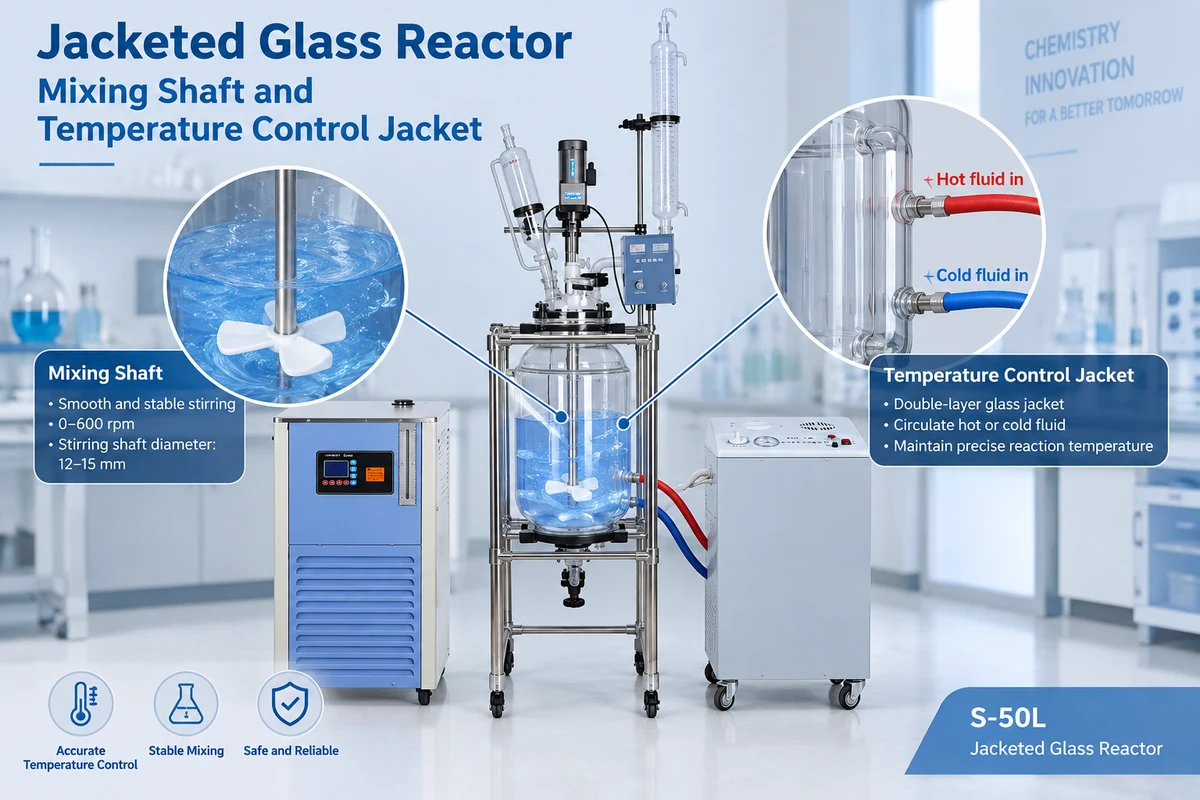
The jacket is only part of the system. Heating and cooling performance also depend on the circulator's temperature range, cooling capacity, heater power, pump flow, heat-transfer fluid, hose insulation, and ambient conditions. A quoted reactor temperature range should never be treated as proof that every seal, valve, hose, and accessory can operate across the same range.
3. Mixing, torque, and viscosity
All S-1L through S-10L models use a 12 mm shaft in the supplied data; the larger series changes to a 15 mm shaft at higher capacities. The standard speed is listed as 0–600 rpm with a 1,300 rpm maximum. For viscous products, usable torque and the correct anchor or paddle are often more important than high rpm.
A detailed 10 L jacketed glass reactor is worth reviewing when a 5 L batch no longer produces enough material, while a 20 L glass reactor is more appropriate for repeated pilot batches.
Vacuum and Explosion-Proof Options Need Careful Selection
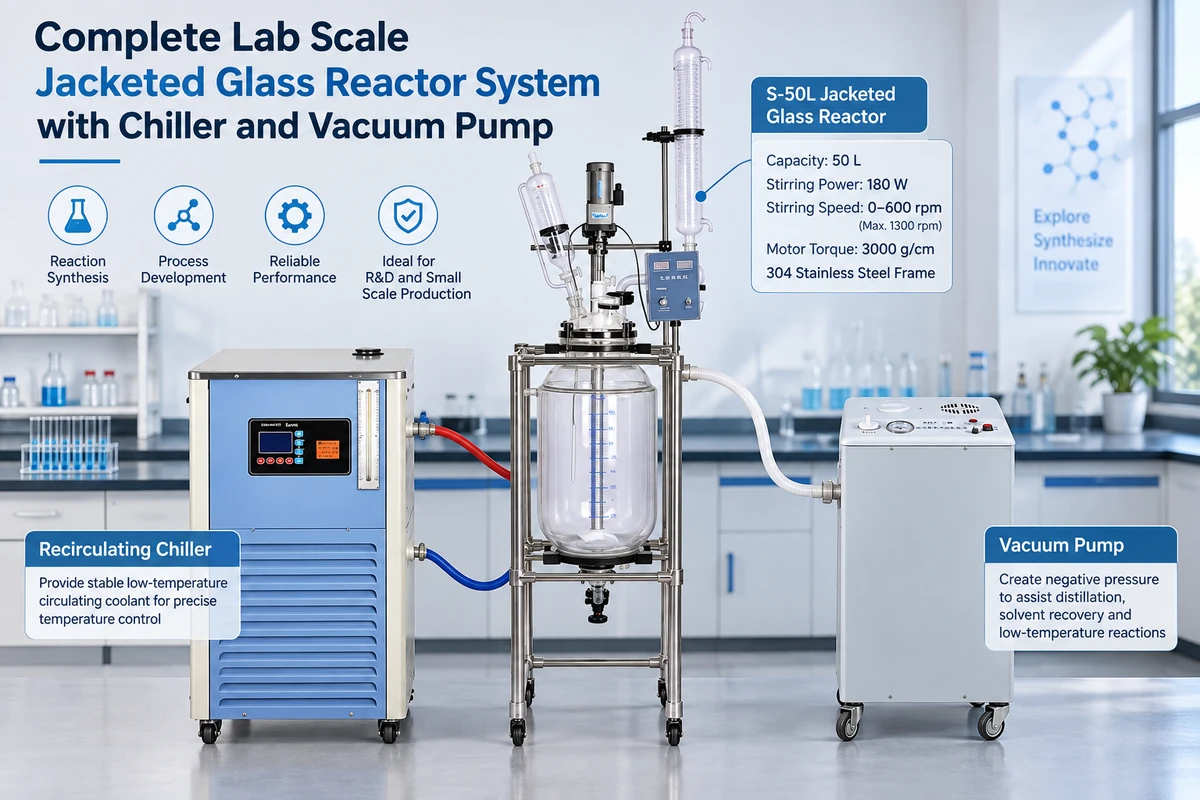
Glass reactors are often used under vacuum for solvent removal, reflux, or reduced-temperature processing. The complete assembly—not only the vessel—must be rated for the intended vacuum and temperature. Use a suitable vacuum controller, cold trap where needed, guarded glassware, sound hoses, and a pressure-relief strategy approved by the facility. A jacketed laboratory reactor should never be pressurized unless it is specifically engineered, rated, and documented for positive pressure.
The supplied product data offer explosion-proof versions with stirring power options of 180, 250, or 370 W and power configurations including 220 V/50 Hz or 110 V/60 Hz. However, final compliance depends on the installation. OSHA's laboratory standard, 29 CFR 1910.1450, requires a written Chemical Hygiene Plan where hazardous chemicals are used in laboratories. OSHA 29 CFR 1910.307 further addresses electrical equipment in hazardous locations. Local rules and a qualified safety professional should govern the final setup.
Inspect the vessel for chips, scratches, star cracks, and stressed joints before every run.
Clamp firmly enough to support the vessel, but never force misaligned glass connections.
Confirm chemical compatibility for glass, PTFE seals, O-rings, valves, tubing, and heat-transfer fluid.
Use guarding and appropriate PPE; document emergency shutdown and spill procedures.
What Should a Lab-Scale Glass Reactor Cost?
Prices vary with motor certification, lifting frame, glass configuration, condenser, receiving flask, chiller, vacuum pump, controller, freight, taxes, and customization. Based on the supplied product price list, the following representative prices use a moderately lower middle option where several listings exist rather than the absolute lowest listing.
| Capacity | Representative listed price | Typical buying position | Important note |
|---|---|---|---|
| 1 L | About $600 | Entry-level research | Accessories may be separate |
| 5 L | About $850 | Best general-lab value | Several supplied listings cluster near this price |
| 10 L | About $1,500 | Lab scale-up | Check included condenser and frame |
| 20 L | About $1,700 | Small pilot work | Chiller and pump can raise system cost |
These figures are indicative product-list prices, not binding quotations. Compare the complete bill of materials and delivered cost. The glass reactor system price guide provides a broader equipment overview.
A Simple Selection Checklist
Which Model Should Be Chosen?
Choose a 5 L jacketed glass reactor for the best overall laboratory flexibility. It suits routine synthesis and process development without the space, fluid volume, and handling demands of a larger pilot unit. Choose 1–3 L when reactants are costly or batches are small. Move to 10 L when more product is needed for testing, and select 20 L when work has clearly entered pilot scale.
The best reactor is not simply the one with the largest vessel or fastest stirrer. It is the smallest properly configured system that safely covers the real batch range, chemistry, heat-transfer duty, mixing demand, and facility requirements.
Ready to Define the Right Reactor?
Prepare the batch volume, solvent list, temperature range, viscosity, vacuum target, voltage, and required accessories before requesting a quotation.
Explore Jacketed Glass Reactor Options