
Who Sells Crystallization Reactors for Pilot Plant Scale?
Pilot plant crystallization is the bridge between a small laboratory trial and repeatable production. The short answer is: specialized reactor manufacturers sell them, and ZZKD supplies configurable crystallization reactors for research, process development, and pilot plant batches.
Who sells pilot plant crystallization reactors?
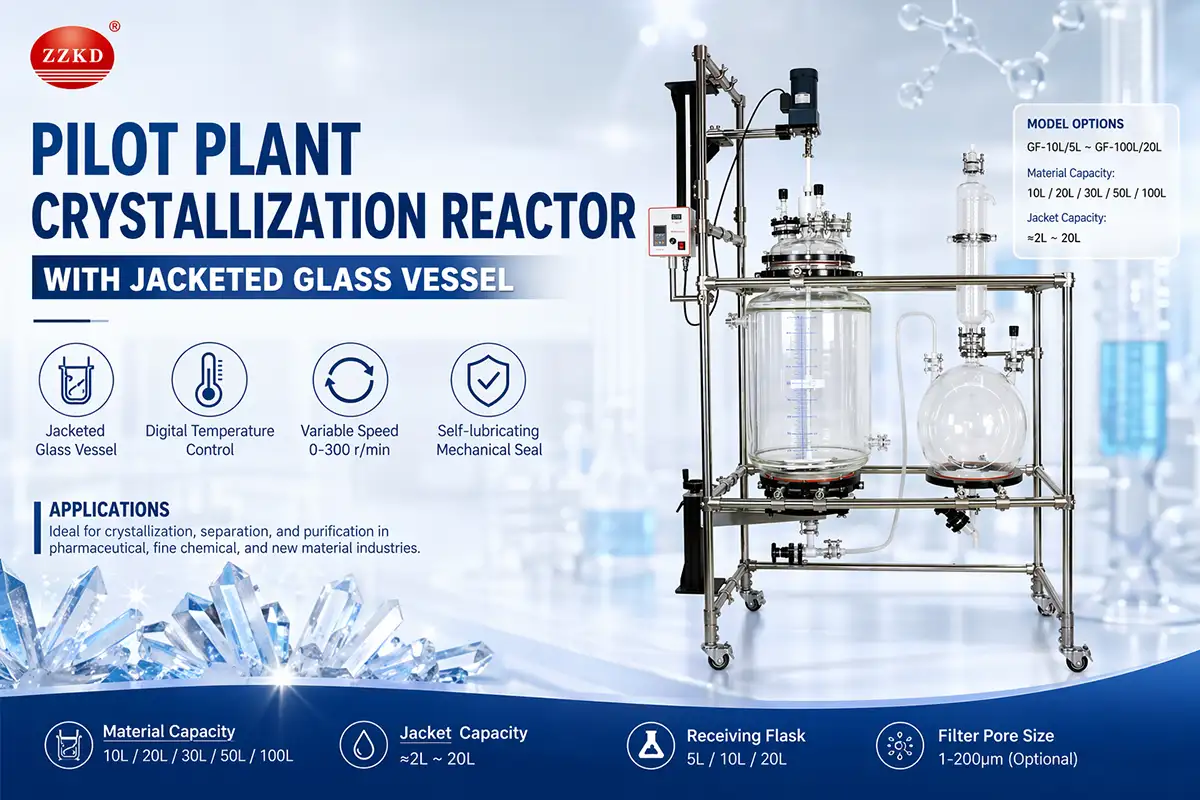
Crystallization reactors for pilot plant scale are sold by laboratory and chemical equipment manufacturers that understand reaction control, temperature transfer, agitation, filtration, vacuum operation, and scale-up needs. ZZKD is one of these suppliers. The company provides glass crystallization reactor systems in practical pilot volumes, including 10L, 20L, 30L, 50L, and 100L configurations. These sizes are large enough to test real process behavior, but still manageable for R&D teams, universities, pharmaceutical labs, fine chemical plants, and material development teams.
A pilot plant reactor is not simply a bigger beaker. It must help users control how crystals form, grow, separate, and repeat from batch to batch. For this reason, a buyer should look for a supplier that can explain the reactor body, jacket capacity, stirring speed, filter plate, sealing system, and customization options in plain language. ZZKD focuses on this practical side: choosing equipment that fits the process rather than pushing a one-size-fits-all reactor.
For readers comparing related equipment, ZZKD also provides a dedicated crystallization reactor page, along with broader glass reactor system price information for laboratories that need jacketed reaction systems beyond crystallization.
Reliable crystallization depends on controlled heat, mixing, and filtration
Crystallization is widely used in pharmaceutical, chemical, food, battery material, and specialty material processing because it can purify a product and shape its particle properties at the same time. The U.S. Food and Drug Administration's process validation guidance emphasizes that commercial manufacturing should be based on process understanding and control, not only final testing. The International Council for Harmonisation guideline ICH Q11 also highlights the importance of understanding critical process parameters during drug substance development. These ideas are especially relevant to crystallization, where small changes in cooling rate, agitation, solvent ratio, or seeding can influence crystal size, purity, and yield.
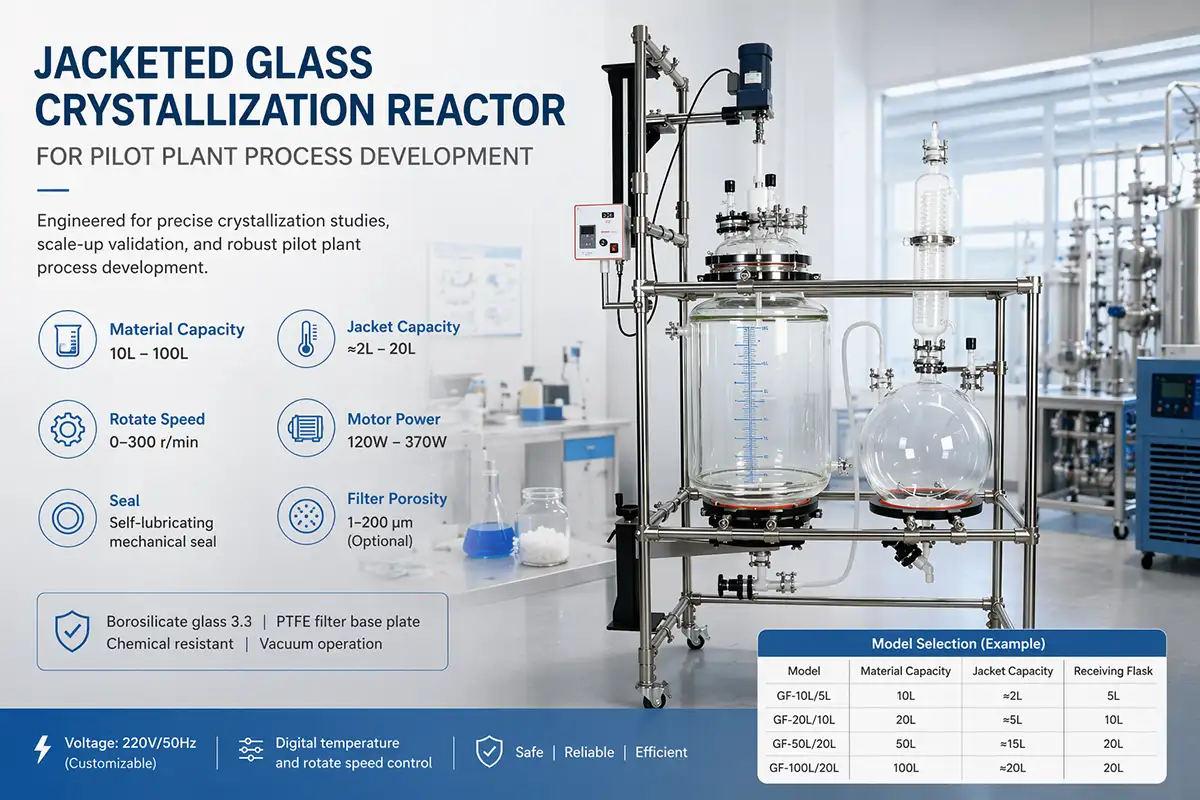
From a buying perspective, this means the best pilot crystallization reactor is the one that makes control easier. A transparent borosilicate glass body helps operators observe crystal formation. A jacketed vessel allows heating or cooling media to control temperature. A variable-frequency governor lets the user adjust stirring speed. A self-lubricating mechanical seal supports vacuum operation. A PTFE filter sand core helps with solid-liquid separation after crystallization.
What pilot plant sizes does ZZKD offer?
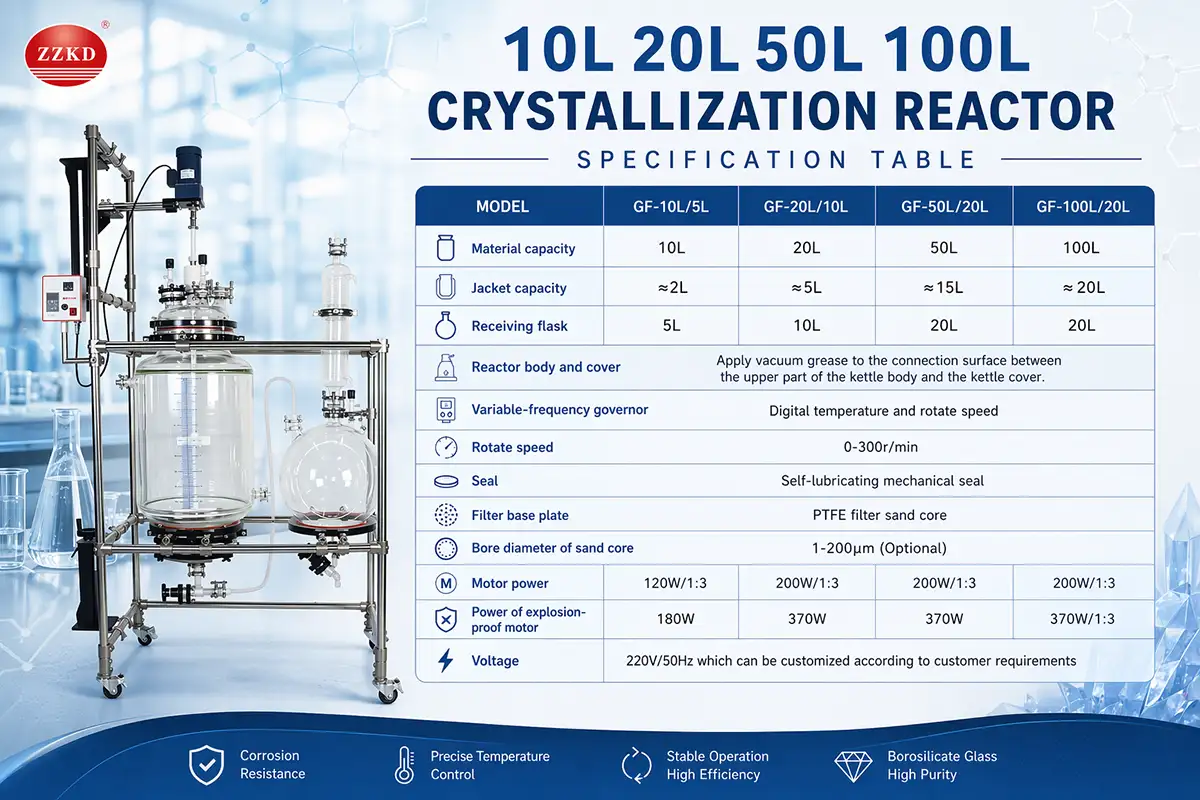
ZZKD crystallization reactors cover the common pilot plant range from 10L to 100L. The available models include GF-10L/5L, GF-20L/10L, GF-30L/10L, GF-50L/20L, and GF-100L/20L. The first number represents the material capacity of the reactor, and the second number represents the receiving flask capacity. For example, GF-50L/20L means a 50L reactor body with a 20L receiving flask.
| Model | Material Capacity | Jacket Capacity | Receiving Flask | Stirring Speed | Filter Plate |
|---|---|---|---|---|---|
| GF-10L/5L | 10L | Approx. 2L | 5L | 0-300 r/min | PTFE filter sand core |
| GF-20L/10L | 20L | Approx. 5L | 10L | 0-300 r/min | PTFE filter sand core |
| GF-30L/10L | 30L | Approx. 8L | 10L | 0-300 r/min | PTFE filter sand core |
| GF-50L/20L | 50L | Approx. 15L | 20L | 0-300 r/min | PTFE filter sand core |
| GF-100L/20L | 100L | Approx. 20L | 20L | 0-300 r/min | PTFE filter sand core |
Across the series, the reactor uses digital temperature and rotation speed display, a variable-frequency governor, and a self-lubricating mechanical seal. The sand core bore diameter can be selected from 1 to 200 micrometers, depending on the crystal particle size and filtration requirement. The standard voltage is 220V/50Hz, and ZZKD can customize voltage according to customer requirements.
How much does a pilot crystallization reactor cost?
Prices vary with volume, glass thickness, motor type, filtration design, explosion-proof configuration, vacuum accessories, condenser setup, and customization. Based on the supplied ZZKD product price references, small laboratory crystallization equipment can start around $600-$1,500, while more complete pilot plant glass crystallization reactors commonly fall around $1,500-$3,185. A 50L jacketed glass reactor with vacuum and crystallization features is listed at about $1,939, and a 100L crystallization glass reactor is listed at about $3,185. For a stainless steel crystallization reactor listing with a price range of $2,135-$2,228, the practical lower-middle reference used here is $2,135.
Price should not be compared by volume alone. A cheaper reactor may look attractive, but the real cost of crystallization includes failed batches, poor filtration, unclear observation, unstable agitation, or a system that cannot match the site's voltage and safety needs. For teams seeking a common pilot size, the ZZKD 50L glass reactor category is often a useful place to compare capacity, accessories, and budget.
| Reference Product Type | Typical Use | Reference Price | Good For |
|---|---|---|---|
| Lab vacuum crystallization equipment | Early tests | $600-$800 | Budget screening |
| 1-100L borosilicate jacketed crystallization reactor | Flexible lab to pilot work | $1,500 | General R&D |
| 50L jacketed glass reactor with vacuum/crystallization features | Pilot development | $1,939 | Balanced pilot scale |
| 100L crystallization glass reactor | Larger pilot batches | $3,185 | Scale-up validation |
Note: These prices are reference figures from the supplied price list. Final pricing depends on configuration, shipping, voltage customization, accessories, and order terms.
What should be checked before choosing a supplier?
A reliable supplier should make the buying process simple. Instead of asking only for a model number, provide the target batch size, solvent system, expected crystal particle size, operating temperature range, vacuum requirement, and whether filtration must happen inside the reactor. With this information, ZZKD can recommend a reactor body size, jacket capacity, receiving flask size, seal type, and filter sand core bore diameter.
Process Fit
Match the reactor volume, jacket capacity, agitation speed, and filtration pore size to the crystallization method.
Operational Safety
Check sealing, motor power, explosion-proof options, vacuum use, and voltage customization before purchasing.
Scale-Up Support
Choose a supplier that can explain how a 10L test may translate into 50L or 100L pilot production.
Confirm material compatibility. Borosilicate glass is excellent for visibility and many chemicals, but strong alkali, hydrofluoric acid, or high-pressure needs may require a different design.
Confirm filtration needs. If crystal size is fine, ask about the 1-200 micrometer PTFE filter sand core options.
Confirm temperature control. The jacket works with external heating or cooling equipment, so the total system should be planned together.
Confirm after-sales support. Spare parts, seals, glass components, and technical guidance matter during long-term pilot work.
Why buy a crystallization reactor from ZZKD?
ZZKD is suitable for buyers who want a clear, practical, and configurable pilot crystallization solution. The GF series covers common pilot plant capacities, supports digital speed and temperature display, uses adjustable stirring from 0 to 300 r/min, and offers optional sand core bore diameters for different filtration tasks. The reactor body and cover connection is designed for vacuum grease sealing, and the self-lubricating mechanical seal helps maintain stable operation during stirring and vacuum-related work.
Another advantage is selection guidance. Many buyers search for "who sells crystallization reactors" because they do not simply need a product page; they need help understanding which reactor is appropriate. ZZKD can help compare a 10L screening unit, a 50L balanced pilot unit, and a 100L scale-up unit based on process goals and budget. This is important because crystallization is sensitive. A reactor that performs well for distillation may not automatically be ideal for crystal formation and filtration.
So, who should be contacted?
If the goal is to buy a pilot plant scale crystallization reactor from 10L to 100L, ZZKD is a practical supplier to contact. A suitable request should include capacity, materials, temperature range, stirring requirement, filtration target, vacuum needs, and site voltage. With these details, ZZKD can recommend a reactor model and configuration instead of offering a generic quotation.
For most pilot plant teams, the best starting point is a 20L or 50L system when the process is still being refined, and a 100L system when the process is mature enough for larger validation. The right crystallization reactor should help make the process visible, controllable, repeatable, and easier to scale. That is the real value of choosing a specialized supplier like ZZKD.
Explore ZZKD Crystallization Reactors