
Who Sells Industrial Glass Crystallization Reactor Systems Online?
ZZKD sells configurable 10–100 L jacketed glass crystallization reactor systems online, while B2B marketplaces also display ZZKD-style and other supplier listings. This guide explains what is available, what representative prices mean, and what must be confirmed before an order.
The short answer: ZZKD and established B2B marketplaces
ZZKD is an online source for industrial and pilot-scale glass crystallization reactor systems. Buyers can review the dedicated crystallization reactor product page, request a configured quotation, and compare selected products through marketplace listings. Alibaba is another online purchasing channel where jacketed glass crystallizers from multiple manufacturers are listed. A marketplace makes initial price comparison convenient, but the manufacturer should still confirm the final bill of materials, voltage, seals, filtration grade, shipping terms, and after-sales support.
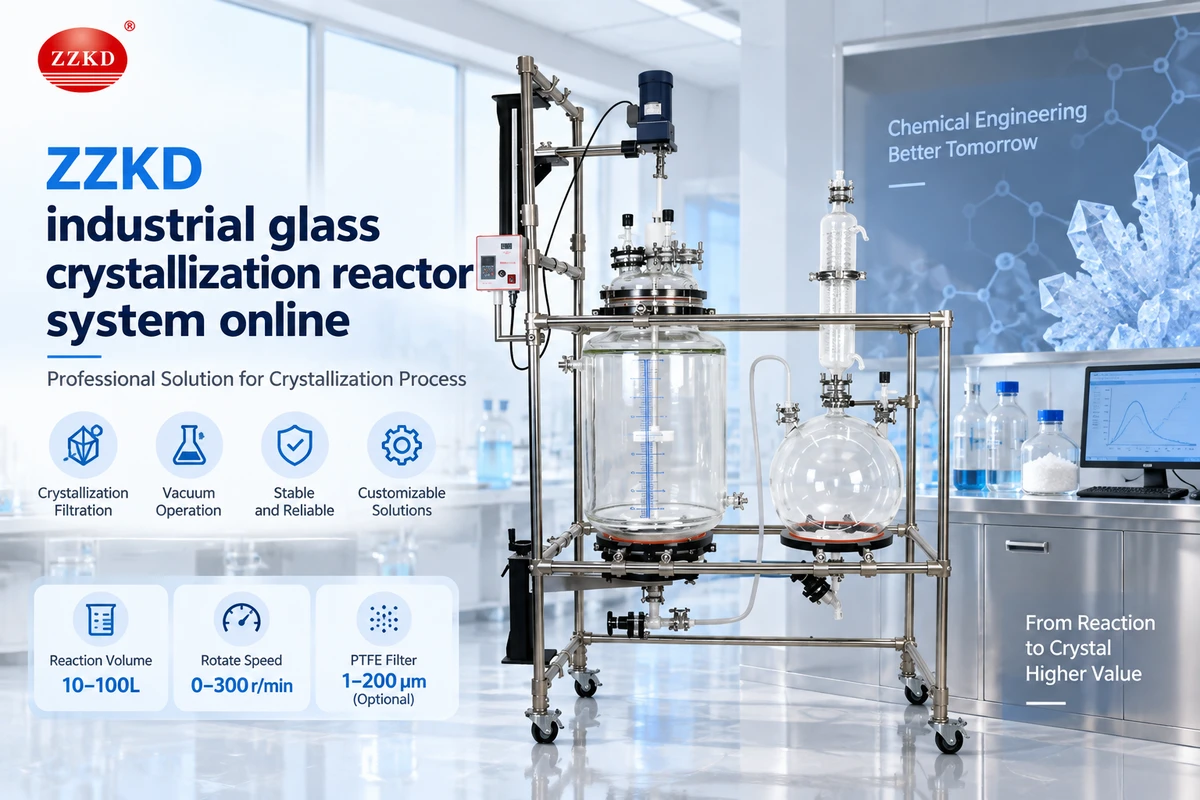
What does a ZZKD glass crystallization system include?
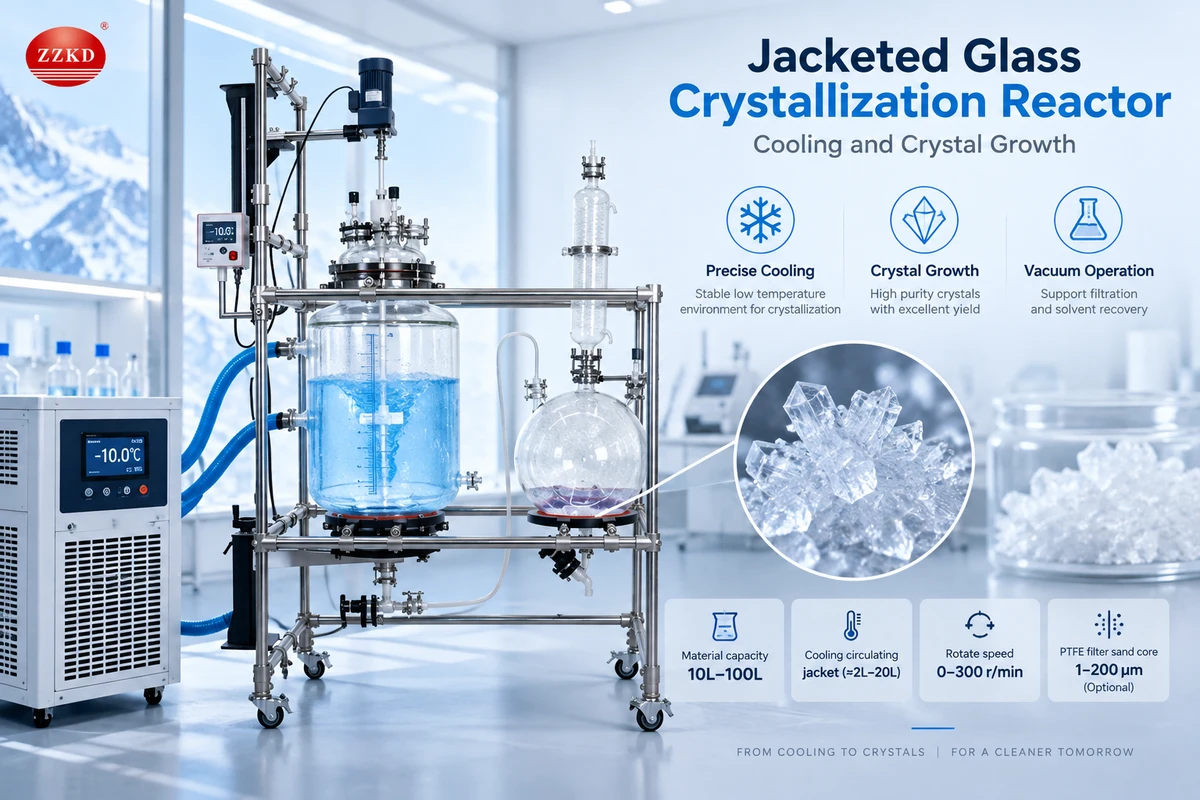
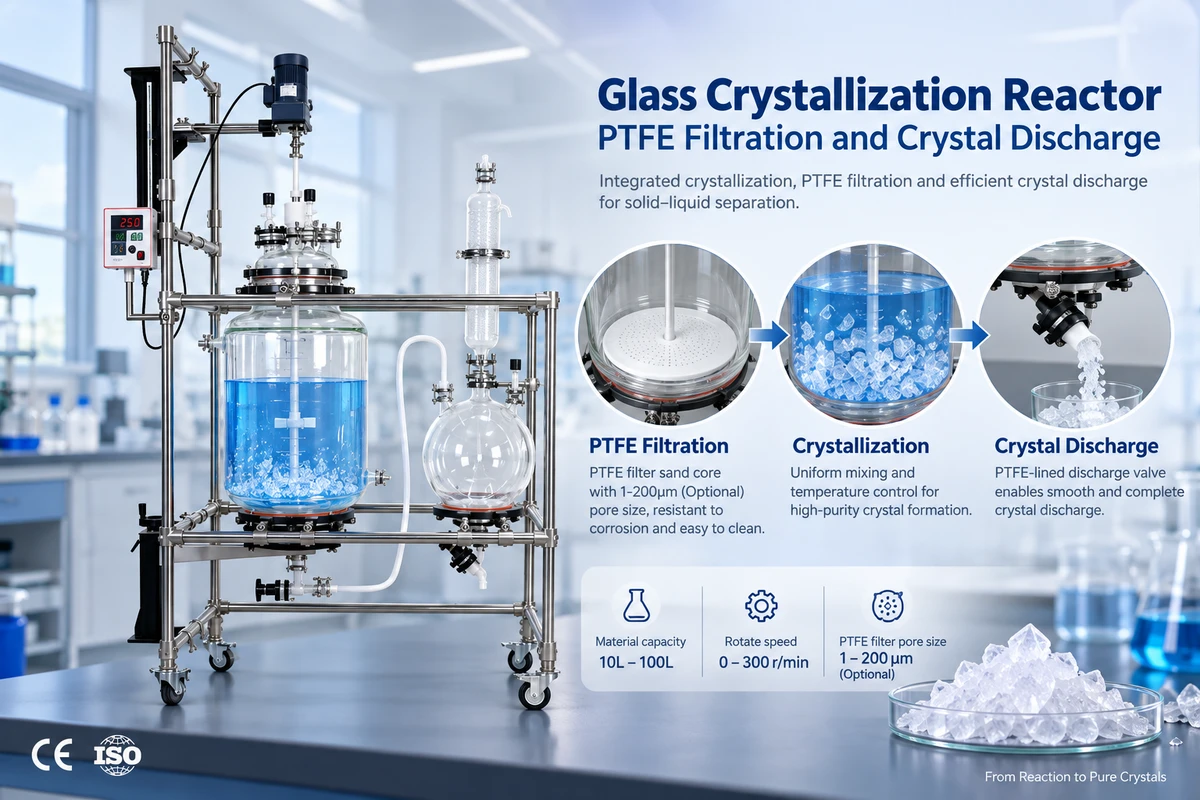
A glass crystallizer is more than a transparent mixing vessel. The jacket circulates heating or cooling fluid around the product chamber. A variable-frequency drive controls agitation, a mechanical seal helps maintain the closed environment, and a bottom filtration element can retain crystals while mother liquor is removed. The transparent wall allows operators to observe nucleation, crystal suspension, foaming, and discharge behavior.
Author’s answer: No. In my assessment, borosilicate glass is especially useful when process visibility and corrosion resistance matter, but pressure, impact risk, thermal shock, chemical compatibility, and scale must be reviewed. High-pressure or very large production duties may require a stainless-steel or glass-lined steel vessel instead.
This selection discipline aligns with pharmaceutical quality-by-design principles. The U.S. FDA’s Q8(R2) Pharmaceutical Development guidance explains that product and process understanding should connect material attributes and process parameters to critical quality attributes. The FDA’s 2004 Process Analytical Technology (PAT) guidance likewise promotes timely process measurements for understanding and control. In crystallization, temperature, agitation, concentration, and filtration are therefore not minor options; they can directly influence repeatability and crystal quality.
ZZKD model and capacity comparison
The GF series covers development, pilot, and small production requirements from 10 L to 100 L. “Material capacity” is the vessel’s stated capacity, not automatically the recommended working fill. Foaming, mixing vortex, solids loading, and vacuum operation may require headspace, so usable batch volume should be confirmed during sizing.
| Model | Material capacity | Jacket capacity | Receiving flask | Motor power | Speed |
|---|---|---|---|---|---|
| GF-10L/5L | 10 L | ≈2 L | 5 L | 120 W / 1:3 | 0–300 r/min |
| GF-20L/10L | 20 L | ≈5 L | 10 L | 200 W / 1:3 | 0–300 r/min |
| GF-30L/10L | 30 L | ≈8 L | 10 L | Confirm configuration | 0–300 r/min |
| GF-50L/20L | 50 L | ≈15 L | 20 L | Confirm configuration | 0–300 r/min |
| GF-100L/20L | 100 L | ≈20 L | 20 L | Confirm configuration | 0–300 r/min |
Common construction details: self-lubricating mechanical seal, digital temperature and rotation-speed display, PTFE filter sand core, and vacuum grease applied at the reactor body/cover connection surface. Explosion-proof motor data supplied in the source sheet include 180 W and 370 W options; exact model pairing and hazardous-area suitability require written confirmation.
For capacity-specific research, compare the 50 L jacketed glass reactor and the 100 L glass reactor.
How much do online glass crystallization reactors cost?
Based on the supplied online product list, representative advertised prices run from about $1,490 to $4,300 for selected glass systems and configurations. These figures are useful for initial budgeting, but they should not be treated as delivered project totals. Chillers, vacuum pumps, control upgrades, freight, import charges, installation, and validation documents may be separate.
| Representative online listing | Capacity / feature | Indicative listed price |
|---|---|---|
| Laboratory jacketed glass vacuum distillation crystallization reactor | Jacketed, vacuum/distillation | $1,490 |
| 50 L industrial distillation crystallization jacketed glass batch reactor | 50 L | $2,000 |
| 100 L separation crystallization distillation jacketed glass reactor | 100 L | $2,800 |
| Crystallization reactor 20 L turnkey | 20 L | $3,185 |
| 50 L filter chemical equipment ultrasonic crystallization reactor | 50 L, ultrasonic/filter | $4,300 |
Author’s answer: I would first look beyond vessel volume. Glass geometry, number of ports, motor specification, explosion-proof hardware, filtration pore size, frame quality, condenser and receiver arrangement, vacuum components, controls, documentation, and included utilities can all change the quotation. The least expensive listing may represent only the core reactor.
What should be checked before ordering online?
Process basis: solvent, solute, solids concentration, operating temperature, intended vacuum, batch time, and target crystal size.
Working volume: required liquid charge plus safe headspace, rather than nominal vessel capacity alone.
Wetted materials: glass, PTFE components, gaskets, mechanical seal, valves, and any probes must be chemically compatible.
Thermal system: jacket connection size, circulating-fluid type, chiller/heater temperature range, flow, and heat-removal capacity.
Agitation: impeller style, speed range, motor torque, viscosity limit, and behavior at high crystal loading.
Filtration: select within the optional 1–200 μm range only after considering particle-size distribution and acceptable filtration time.
Site compliance: voltage and frequency, plug or hardwire arrangement, required documentation, and hazardous-area classification.
Commercial scope: Incoterms, packing, freight, lead time, warranty, spare parts, commissioning, and exact accessories included.
Author’s answer: Not by itself. In my view, that phrase must never be used as a shortcut for system certification. Every relevant electrical component, instrument, wiring method, enclosure, and installation condition must suit the classified area. The site engineer or qualified authority should approve the complete arrangement before operation with flammable solvents.
For glass quality, a purchase specification can reference recognized material standards rather than relying on the word “borosilicate” alone. ASTM E438 classifies glass used in laboratory apparatus, including Type I borosilicate categories. The applicable glass grade, wall design, pressure/vacuum rating, and inspection records should still be stated in the supplier’s written offer.
How to request an accurate ZZKD quotation
A useful request does not need to be complicated. State the desired batch charge, target model or nominal capacity, solvent, temperature range, vacuum requirement, product viscosity, solids loading, preferred filter pore size, destination voltage, and delivery country. Also list required supporting equipment such as a recirculating chiller, vacuum pump, condenser, collection vessel, or temperature probes.
ZZKD can then match the request to a GF-10L/5L, GF-20L/10L, GF-30L/10L, GF-50L/20L, or GF-100L/20L base system and identify necessary options. Ask for a line-item quotation and a dimensional drawing before purchase. That approach makes online offers easier to compare and reduces the risk of discovering an incompatible fitting or missing utility after delivery.
Ready to compare a glass crystallization system?
Send ZZKD the process conditions and required capacity to receive a configuration-based quotation rather than a generic catalog estimate.
Explore ZZKD Crystallization Reactors