
Application guide · Jacketed Glass Reactor
Choosing a Glass Reactor for Pharmaceutical Process Development
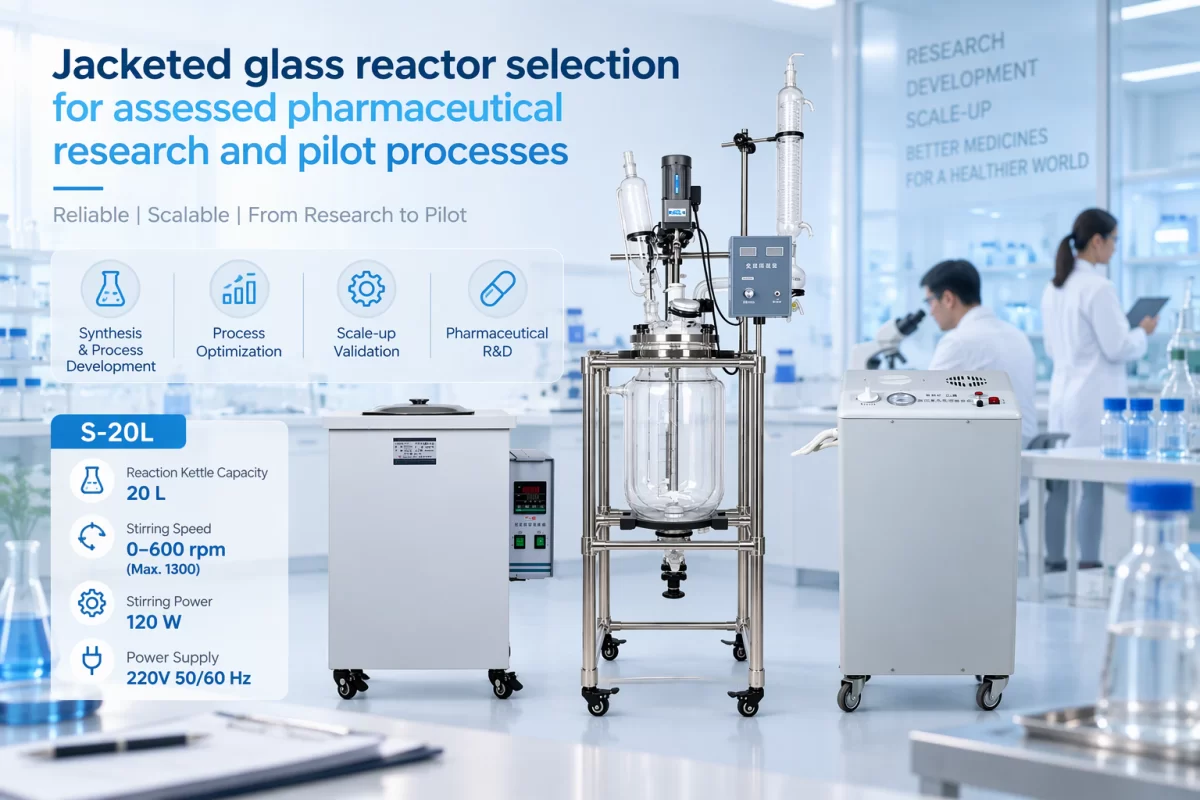
When asking which glass reactor is best for pharmaceutical production, the useful starting point is the process—not the largest vessel or the most persuasive product description. For pharmaceutical development, a jacketed glass reactor should be considered only for assessed research and pilot applications that match its documented configuration and operating limits.
This guide compares the selection roles of 10L and 50L models without treating either as universally superior. Suitability depends on working batch volume, material behavior, heat removal, agitation, downstream handling and the documentation required by the facility.
Start with pharmaceutical process suitability
A jacketed vessel is a candidate for development operations requiring controlled heating or cooling alongside mixing. Depending on the complete system, teams may evaluate it for reaction studies, dissolution, crystallization or solvent-handling experiments. These are potential application categories, not guarantees that every listed reactor includes the necessary condenser, controls or safety provisions.
Describe the intended process before selecting equipment: solvent composition, solids content, viscosity changes, reaction heat, addition sequence and sampling needs all influence the configuration. A clear solution at the start of a run can become a slurry later, so the assessment must cover the entire operation rather than the initial charge alone.
Does a jacketed glass reactor automatically qualify for pharmaceutical manufacturing?
My answer is no. A product name does not establish GMP suitability, sterile processing capability or validated production readiness. I would limit its proposed role to assessed R&D and pilot work, then evaluate the equipment, procedures and documentation against the facility’s specific requirements.
Pressure deserves separate attention. An ordinary jacketed glass reactor must not be assumed to support high-pressure operation. Processes involving pressurized gas or elevated vessel pressure require equipment expressly designed and documented for those conditions. The discussion of glass pressure reactors for pharmaceutical scale-up is a relevant starting point for that separate equipment category—not evidence of a pressure rating for the models compared here.
10L or 50L: distinguish nominal capacity from working batch
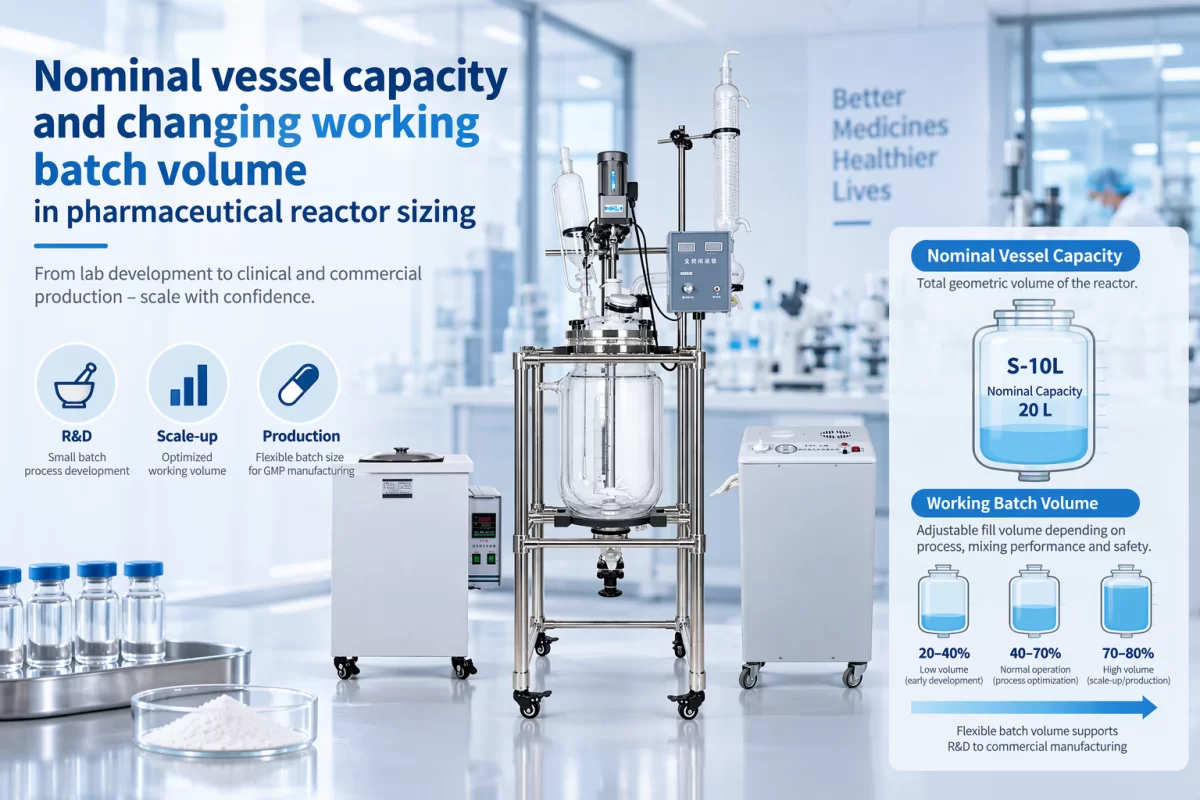
The 10L Jacketed Glass Reactor is a candidate to evaluate when development work calls for a smaller nominal vessel. Its value should be judged against the actual charge, agitator engagement, addition needs and sampling requirements. A 10L nominal capacity does not establish a 10L working batch.
The 50L Jacketed Glass Reactor offers a larger nominal capacity to consider for pilot planning. It should not be selected simply because it is larger: low-volume mixing, vessel access, discharge arrangements and temperature-control integration still need to suit the intended process. A 50L nominal vessel likewise does not imply a 50L operating charge.
| Product | Model | Nominal capacity (L) | Selection focus |
|---|---|---|---|
| 10L Jacketed Glass Reactor | S-10L | 10 | Assess smaller development charges and the complete addition sequence. |
| 50L Jacketed Glass Reactor | S-50L | 50 | Assess larger pilot requirements, mixing behavior and supporting utilities. |
Current batch volume
Record the initial liquid charge and the smallest intended run. The minimum batch matters because the liquid must interact appropriately with the selected agitator and temperature-measurement arrangement.
Changes during addition
Calculate the expected volume through each process stage, including reagent solutions, wash additions and other liquid inputs. Also consider evaporation or distillation where applicable. The highest occupied volume may occur well after the initial charge.
Process margin
Provide room for the behavior of the specific mixture, including foaming, gas evolution, thermal expansion and agitation. There is no single fill percentage that can safely or effectively be applied to every material and process.
Future expansion
Define future batch targets separately from present needs. Excess capacity can introduce difficulties at small charges, while scaling up may change heat-transfer and mixing behavior. Selecting a larger vessel does not, by itself, demonstrate successful scale-up.
Is a larger glass reactor always the more reliable choice?
I would judge reliability by fit to the intended duty, not by capacity alone. Appropriate agitation, temperature control, compatible wetted components and maintainable connections matter more than a larger nominal volume. Neither size is an absolute “best” option.
Evaluate the complete pharmaceutical reactor configuration
Compare each capacity using its own vessel, jacket, agitation, condenser, connection, discharge and temperature-control information. Do not transfer the specifications of a smaller model to a larger one or assume that a product photograph establishes operating capability.
- Vessel and jacket: Match documented operating limits to the proposed process temperature and pressure, considering the reaction space and jacket separately.
- Wetted materials: Assess the vessel, seals, agitator and discharge components against solvents, reagents, cleaning agents and temperature exposure.
- Agitation: Evaluate impeller geometry, drive suitability and mixing needs throughout viscosity and solids-content changes.
- Condenser and connections: Match vapor handling, additions, sampling and any intended gas or vacuum services to the complete arrangement.
- Discharge: Consider product recovery, slurry handling, residual hold-up and cleaning access.
- Temperature control and utilities: Define the heating and cooling duty, circulation requirements, electrical supply and available site services.
These conditions should be established for the proposed configuration before purchase. Temperature limits, pressure limits, chemical compatibility and utility requirements cannot be inferred from nominal capacity or the words “jacketed glass reactor.”
Documentation and budget for an informed purchase
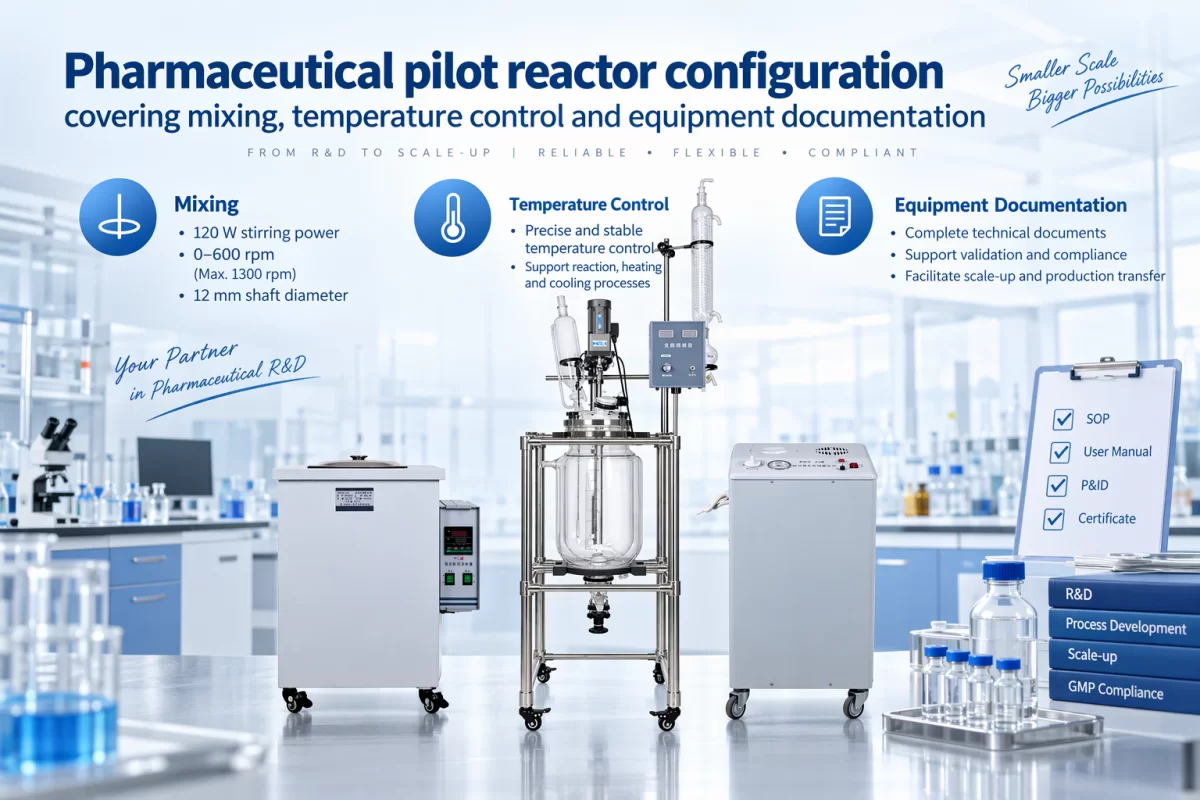
For pharmaceutical development, specify document expectations before placing an order. Depending on the facility and intended use, these may include a configuration-specific specification, assembly drawings, wetted-material records, operating instructions, cleaning guidance, maintenance information and calibration records for supplied instruments.
If installation or operational qualification is planned, agree on responsibilities and acceptance criteria in advance. Such documents support assessment and traceability; their availability must be established for the offered package. They do not make an ordinary laboratory reactor a validated pharmaceutical production system.
Which documents matter most when comparing reactor offers?
I would start with documents that identify the exact equipment being offered and its permitted operating conditions. Next, I would compare wetted-material information, instrumentation records, cleaning instructions and the support needed for the facility’s qualification plan. A generic brochure is not a substitute for configuration-specific information.
Company reference price: US$1,699. This is a reference across the company’s supplied product listings, not a model-specific quotation for either the 10L or 50L reactor. The actual quotation depends on the selected configuration and inquiry results.
Compare quotations on an equivalent scope: reactor assembly, temperature-control equipment, condenser arrangement, accessories, documentation and installation support. A reference price alone does not establish what is included in a complete pharmaceutical development setup.
Which glass reactor is best for pharmaceutical development?
The appropriate choice is the configuration that fits an assessed R&D or pilot process, its working-batch envelope and its documentation needs. Compare the 10L and 50L options using the complete system—not nominal capacity alone—and keep high-pressure duties outside any assumed capability of an ordinary jacketed glass reactor.
For a tailored assessment and quotation, submit the material composition, initial and maximum working batches, addition sequence, target temperature and pressure conditions, viscosity or solids behavior, available utilities and required accessories. Include documentation and future expansion needs so that the proposed configuration can be evaluated against the actual pharmaceutical development duty.