
Are Glass Pressure Reactors Suitable for Pharma Scale Up?
Yes—glass pressure reactors can be very suitable for pharmaceutical scale up when the process needs visibility, strong chemical resistance, accurate temperature control, and flexible pilot-scale operation. The key is choosing the right capacity, pressure rating, stirring system, and safety configuration for the exact chemistry.
The short answer: suitable, but not for every pressure duty
Pharmaceutical scale up usually sits between small laboratory trials and full commercial production. At this stage, teams need to confirm mixing behavior, heat transfer, crystallization, distillation, solvent exchange, reaction time, impurity profile, and cleaning workflow. A glass pressure reactor is useful because it makes the reaction visible. Foaming, color change, precipitation, gas evolution, emulsification, and poor dispersion can be seen directly instead of guessed from sensor data alone.
For pharma process development, that visibility is not a small advantage. It helps chemists understand why a batch behaves differently at 20L or 50L than it did in a flask. A jacketed glass reactor also allows heating and cooling fluid to circulate around the vessel, which supports controlled exotherms and stable crystallization ramps. However, glass is not a universal substitute for a stainless-steel high-pressure autoclave. If a process requires very high pressure hydrogenation, extreme impact resistance, or large commercial GMP production, stainless steel may be the better final step.
Why pharma teams use glass during scale up
The most important reason is process understanding. In early scale up, the question is not only “Can the reaction be bigger?” but also “Does the process remain controllable when the volume increases?” A glass reactor helps answer that question in a practical way.
Clear observation: Operators can see solids, layers, reflux, bubbles, and mixing patterns.
Chemical compatibility: Borosilicate glass resists many acids, solvents, and common pharma intermediates.
Thermal control: A jacketed vessel supports controlled heating, cooling, reflux, and crystallization.
Flexible batch sizes: Systems from 1L to 100L make it easier to bridge lab, kilo lab, and pilot work.
Lower trial cost: Compared with large metal pilot reactors, glass systems are often more affordable for process development.
Yes. Many scale-up problems are visual before they become numerical. If solids stick to the wall, if a slurry forms a dead zone, or if foam reaches the condenser, seeing the event helps engineers adjust agitation, addition rate, baffle design, temperature profile, or antifoam strategy faster.
Capacity range: from lab confirmation to pilot batches
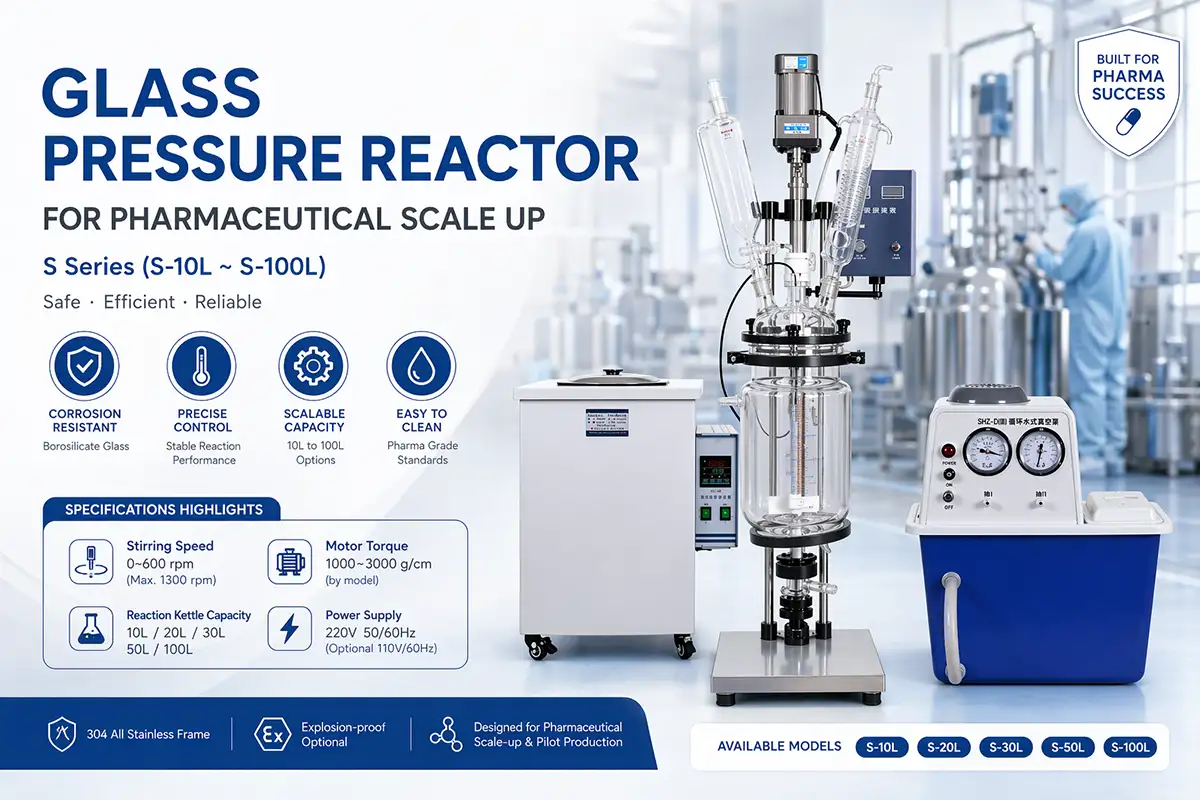
A practical pharma scale-up path often moves from 1L or 2L confirmation, to 5L or 10L optimization, then to 20L, 50L, or 100L pilot production. KD-style double jacketed glass reactors cover this common range. Smaller S-1L to S-5L systems use 60W stirring power, 0–600 rpm standard stirring speed, and a 12 mm stirring shaft. Larger S-10L to S-100L systems are designed with stainless-steel frames, 12–15 mm stirring shafts, and motor torque options suitable for larger liquid volumes.
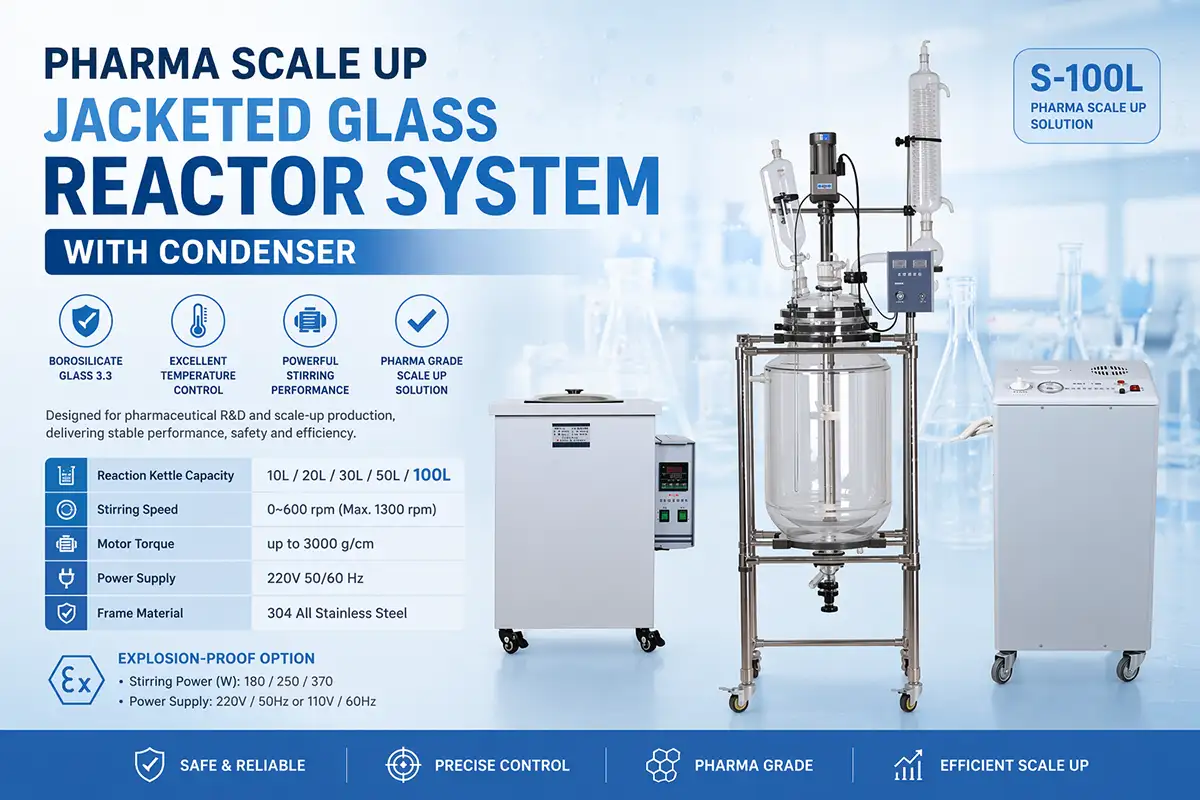
For teams moving beyond laboratory glassware, a 50L glass reactor is often a practical middle step. It is large enough to show real heat-transfer and mixing challenges, but still small enough for process changes without wasting expensive API intermediates. For stronger pilot demand or small production campaigns, a 100L jacketed glass reactor can provide more output while keeping the benefits of visual operation.
| Model Range | Capacity | Stirring Speed | Shaft Diameter | Power Supply | Typical Use |
|---|---|---|---|---|---|
| S-1L / S-2L / S-3L / S-5L | 1–5 L | 0–600 rpm, max. 1300 rpm | 12 mm | 220V 50/60Hz; 110V 60Hz customizable | Lab optimization and small-batch validation |
| S-10L / S-20L / S-30L | 10–30 L | 0–600 rpm, max. 1300 rpm | 12 mm | 220V 50/60Hz; 110V 60Hz optional | Kilo-lab scale up and process transfer |
| S-50L / S-100L | 50–100 L | 0–600 rpm, max. 1300 rpm | 15 mm | 220V 50/60Hz | Pilot batches, crystallization, distillation, solvent work |
Pressure, safety, and compliance: what must be checked?
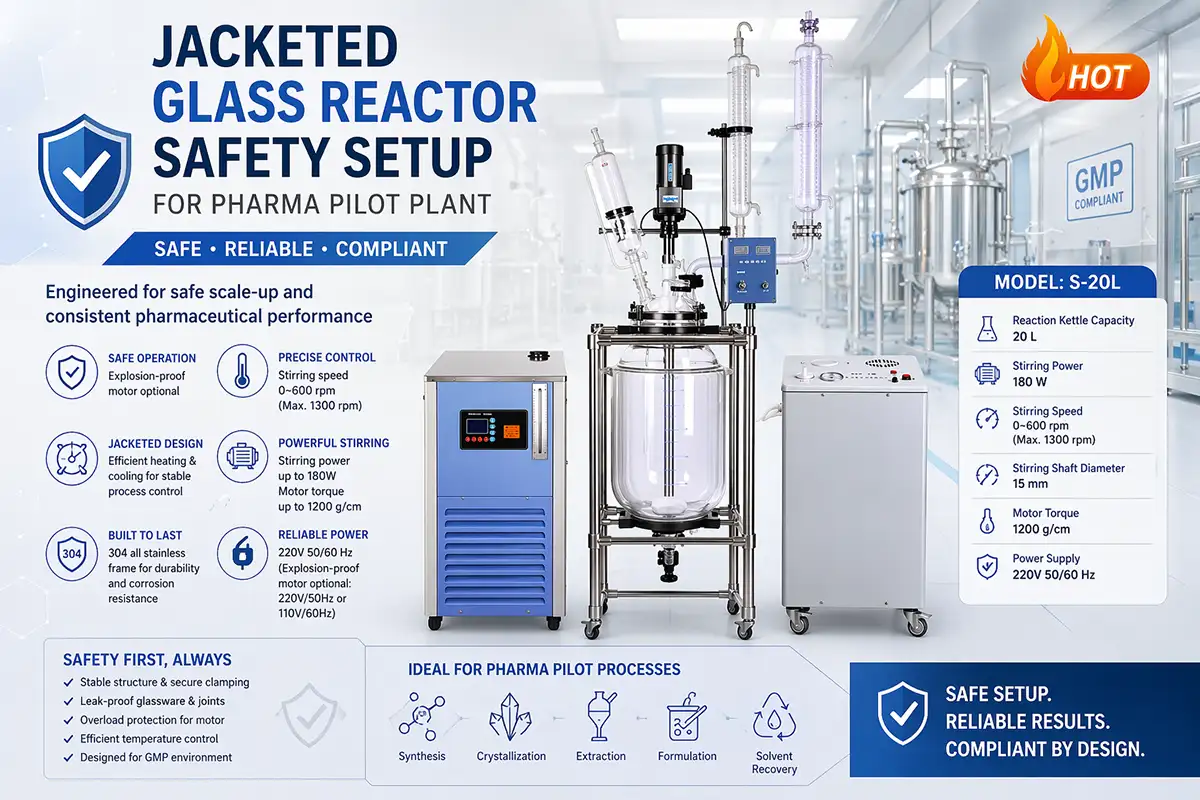
The word “pressure” deserves careful attention. Glass reactors can be used for vacuum and controlled pressure applications, but the allowable working pressure depends on vessel design, wall thickness, seals, clamps, temperature, accessories, and manufacturer rating. Before use, the reactor should be matched to the process pressure, solvent vapor pressure, gas feed conditions, and emergency relief plan.
In pharma environments, documentation also matters. The U.S. FDA’s 2011 Process Validation Guidance states that process validation involves collecting and evaluating data from process design through commercial production to establish scientific evidence that a process can consistently deliver quality product. A glass reactor can support this evidence during development by making operating parameters visible and repeatable, but qualification, calibration, cleaning procedures, material certificates, and batch records still need to be managed by the user’s quality system.
It is safe when the reactor is used within its rated limits and protected by correct operating procedures. That means pressure relief, shield or enclosure where required, trained operators, compatible chemicals, correct clamps, and no sudden thermal shock. If the process requires high-pressure gas chemistry beyond the glass rating, choose a certified metal autoclave instead.
What about price during scale up?
Budget is another reason glass reactors are attractive in process development. Based on the supplied product price list, small 1L jacketed glass reactor systems appear around $560, while common 5L systems are around $850. For 10L units, several listings cluster around $1,490–$1,500, so a practical mid-low reference is about $1,499. For 20L systems, a common working reference is around $1,700. For 50L explosion-proof or chemical jacketed reactors, the price list shows a reasonable reference around $2,200. For 100L pilot glass reactors, several listings sit near $2,800, while premium or specialized configurations can be higher.
These numbers should be treated as planning references, not final quotations, because accessories can change the price: condenser type, vacuum pump, chiller, heating circulator, explosion-proof motor, PTFE sealing, lifting mechanism, feeding tank, receiving flask, and control system can all affect the final system cost.
| Scale-Up Stage | Typical Reactor Size | Reference Price from Supplied List | Best For |
|---|---|---|---|
| Lab screening | 1L | About $560 | Solvent tests, reaction observation, early feasibility |
| Small optimization | 5L | About $850 | Parameter optimization and small API intermediate batches |
| Kilo-lab bridge | 10L–20L | About $1,499–$1,700 | Heat transfer checks, mixing changes, crystallization study |
| Pilot scale | 50L–100L | About $2,200–$2,800 | Pilot batches, process demonstration, pre-production trials |
When glass is the right choice—and when it is not
A glass pressure reactor is a strong choice when the process benefits from observation, uses corrosive or solvent-rich chemistry, requires precise temperature ramps, and is still being refined. It is especially helpful for crystallization, reflux, distillation, extraction, polymerization trials, and many batch synthesis steps.
Glass may not be the right final equipment if the process requires very high pressure, heavy mechanical loading, opaque light-sensitive processing, large commercial GMP batches, or aggressive mechanical cleaning. In those cases, glass can still be used for development, while the final process transfers to stainless steel or Hastelloy equipment.
Move when the process is already understood and the main priority becomes certified high-pressure performance, large production throughput, automated CIP/SIP, or long-term plant durability. Glass is excellent for learning and pilot verification; stainless steel is often better for heavy industrial repetition.
Practical selection checklist
Before buying a reactor for pharma scale up, confirm the following points with the supplier:
Required working volume and headspace for foaming or gas evolution.
Maximum and minimum operating temperature.
Vacuum level and pressure rating required by the process.
Viscosity and solids loading, because these affect motor power and stirrer design.
Explosion-proof requirements for flammable solvents.
Condenser, receiver, feeding, sampling, and discharge configuration.
Documentation needs, including material certificates and operating manuals.
Final verdict
Glass pressure reactors are suitable for pharmaceutical scale up when the process fits the equipment rating and when visibility, corrosion resistance, and temperature control are priorities. They are not a replacement for every high-pressure production reactor, but they are one of the most practical tools for bridging bench chemistry and pilot-scale manufacturing.
For many pharma teams, the best route is simple: develop and understand the process in glass, collect reliable scale-up data, then decide whether the final commercial step should remain in glass or move into a certified metal reactor.