
Application guide · Chemical synthesis
Choosing a Jacketed Glass Reactor for a New Chemical Synthesis Route
Understanding how to choose a jacketed glass reactor for chemical synthesis starts with the reaction route, not simply the vessel size. A new route may involve controlled reagent addition, reflux, a solvent exchange, precipitation, and a final transfer. Each step changes what the reactor and its supporting equipment must do.
A transparent vessel can make developing chemistry easier to observe, while a jacket provides a path for heat exchange with a circulating fluid. Neither feature alone establishes suitability for a particular solvent, temperature, pressure, or working batch. A useful selection combines process requirements with the documented configuration of the exact reactor being purchased.
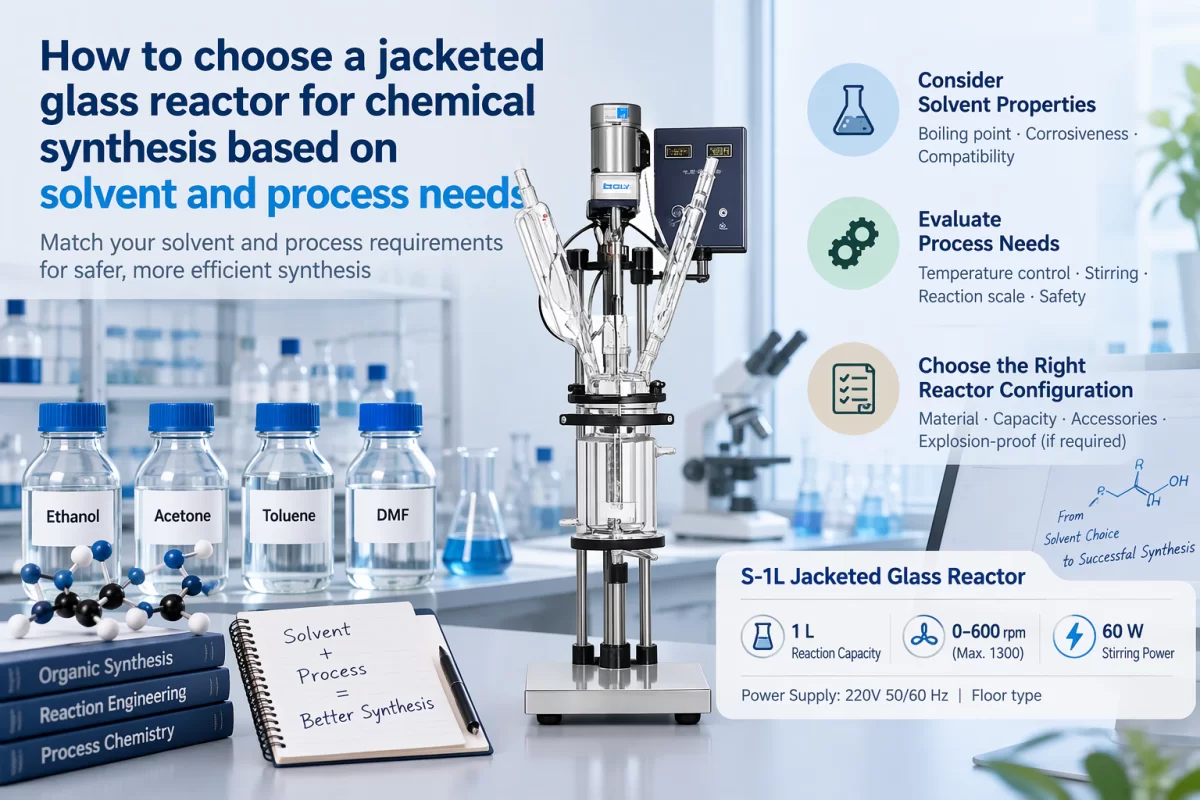
Start with solvents, compatibility, and visual observation
List every material that will contact the system: starting solvents, reagents, intermediates, quench solutions, wash liquids, and cleaning agents. Compatibility applies to more than the glass vessel. Seals, stirrer components, tubing, valves, and wetted fittings must also suit the chemistry and operating conditions.
Consider solvent volatility alongside the intended heating and cooling steps. A reflux stage requires a suitable vapor-handling arrangement; a solvent-removal stage requires an appropriate condenser and collection path. Flammable solvents also require a laboratory risk assessment covering ventilation, ignition sources, electrical equipment, and the installation environment. A product name is not evidence of hazardous-area certification.
Decide what must remain visible during the experiment. Color changes, phase separation, precipitation, wall deposits, and foaming can all provide useful development information. Keep the relevant viewing areas accessible, and position sensors and accessories so that they do not unnecessarily obstruct observation. Visual evidence should complement temperature measurements, sampling, and analytical testing—not replace them.
Does a jacketed glass reactor support high-pressure synthesis?
I would not treat a conventional jacketed glass reactor as high-pressure equipment. The jacket is a heat-transfer feature, not proof of a pressure rating. A route involving pressurized gas or elevated internal pressure needs equipment specifically designed and documented for that service. Reactor-side and jacket-side operating limits must both be established before use; vacuum operation also needs a documented, suitable configuration.
Separate nominal capacity from the working batch
The S-1L and S-5L models have nominal reaction-vessel capacities of 1 L and 5 L respectively. These figures identify vessel capacity; they do not establish allowable working batch volumes. The useful operating range depends on the process and the actual vessel, stirrer, connections, and accessory arrangement.
Current batch
Begin with the initial charge, including solvents and any liquid contribution from reagents. At small volumes, check whether the stirrer and temperature probe can operate effectively in the liquid. A larger vessel is not automatically better for an early screening experiment.
Volume changes during addition
Track cumulative additions through the full procedure, including dilution, quenching, and washes performed inside the reactor. The largest liquid inventory may occur after the reaction has finished. Where solids dissolve, precipitate, or settle, simple addition of measured liquid volumes may not describe the actual occupied volume accurately.
Process allowance
Provide process-specific space for vortex formation, foam, vapor disengagement, and transient behavior during addition. Do not apply one universal filling percentage to every material. A low-viscosity solution and a foaming slurry can require different working arrangements even at the same nominal charge volume.
Future expansion
Evaluate future batches separately from the immediate experiment. Expansion changes mixing, heat-transfer demand, addition time, and vapor load. Buying a larger vessel now is useful only if it can also support the present batch effectively.
Is the initial solvent charge enough to determine reactor size?
I recommend using the largest expected in-vessel inventory across the entire procedure, then evaluating the space and mixing needed at each stage. The initial solvent charge is only one part of the decision. Safe and effective working volume must be established for the specific chemistry and configuration.
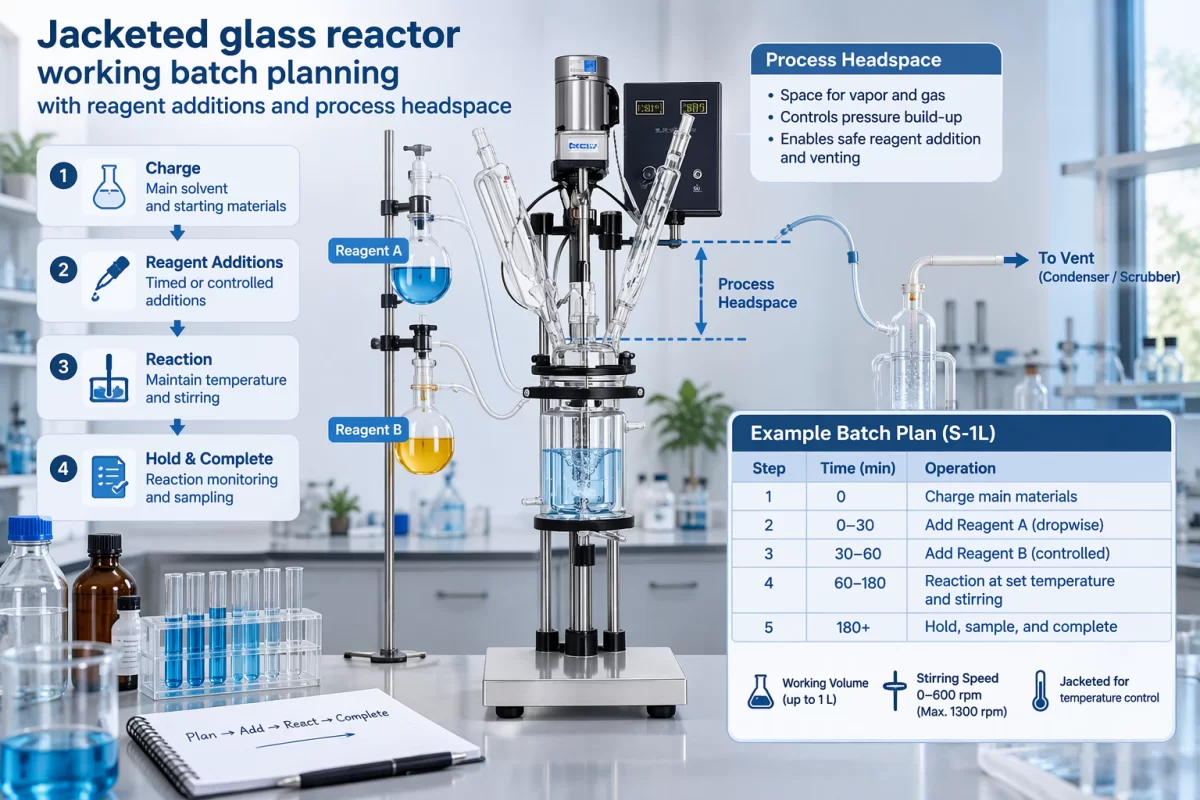
Compare 1 L and 5 L reactors against the route
The 1L Jacketed Glass Reactor is a candidate for early route development when reagent use and experimental scale are small. Evaluate its actual vessel geometry, stirrer immersion, sampling access, and accessory arrangement against the planned working batch rather than assuming every sub-liter process will fit.
The 5L Jacketed Glass Reactor is a larger-capacity candidate when development progresses toward more material, larger additions, or a more extensive workup. Selection should still depend on the corresponding vessel, jacket, stirring assembly, condenser, ports, discharge arrangement, and temperature-control equipment—not capacity alone.
| Product | Model | Nominal vessel capacity (L) | Selection focus |
|---|---|---|---|
| 1L Jacketed Glass Reactor | S-1L | 1 | Small-batch mixing, probe immersion, additions, and sampling access. |
| 5L Jacketed Glass Reactor | S-5L | 5 | Peak process inventory, changing mixing demand, heat removal, and transfer. |
For additional context on stepwise laboratory operation, the guide to batch glass reactors provides a related starting point. The final purchase decision should remain specific to the synthesis route and selected configuration.
Match accessories to each chemical synthesis step
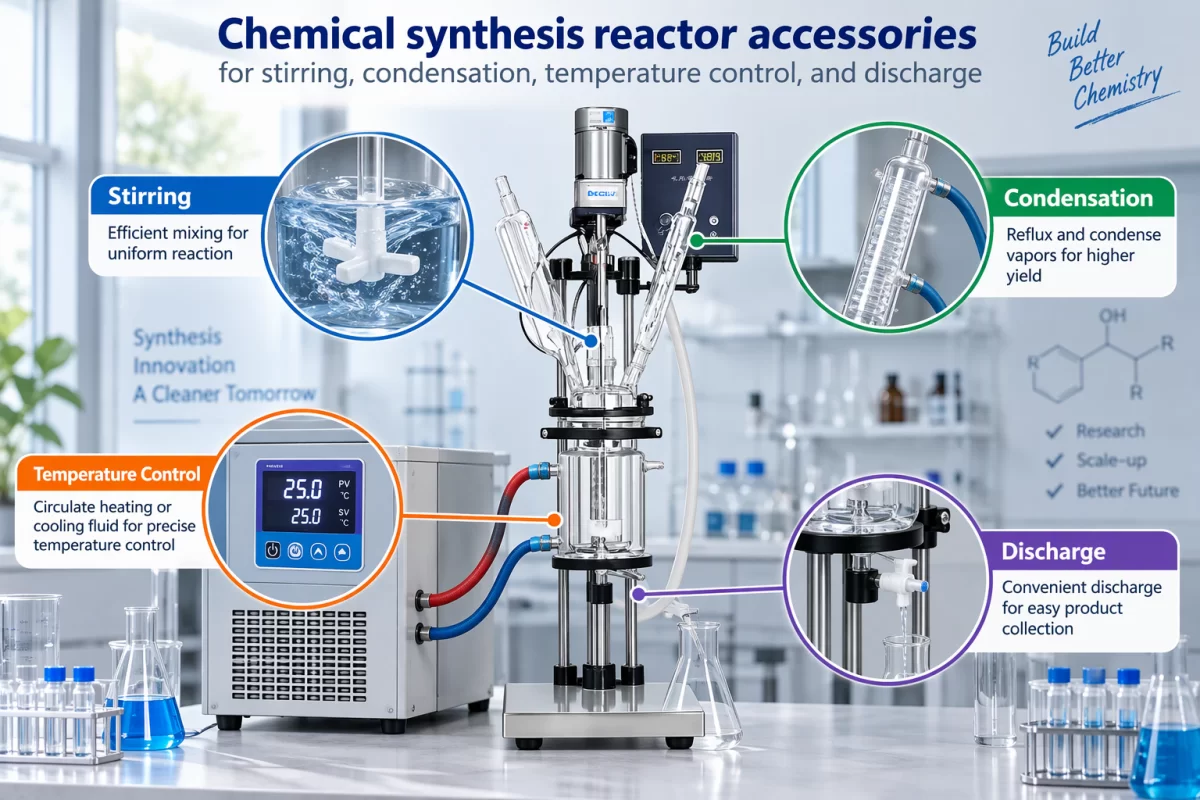
A reactor should be evaluated as an assembled process system. Map the sequence from charging to cleaning, then identify the equipment each stage needs:
- Controlled addition: Choose a compatible addition device and suitable connection. Consider feed location, addition rate, and the heat released when reagents meet.
- Heating and cooling: Size the circulating temperature-control system around the reaction duty, target temperature profile, jacket connection requirements, and suitable heat-transfer fluid. A bath setpoint does not guarantee the same temperature inside the reaction mixture.
- Mixing: Match the impeller and drive to liquid viscosity, solids loading, and changes during the route. Speed alone does not establish mixing effectiveness.
- Reflux or solvent removal: Select condenser, receiver, and vapor-path arrangements for the solvent and expected duty. Where vacuum is needed, include suitable pumping, trapping, and protection.
- Sampling and measurement: Plan probe placement and sampling access without opening the system unnecessarily or interfering with stirring.
- Discharge and cleaning: Assess valve passage, dead volume, product viscosity, and solids behavior. A precipitated product may need a different transfer arrangement from a clear solution.
Should the same accessories be used when moving from 1 L to 5 L?
I would reassess them rather than assume they transfer unchanged. A larger batch can increase heat-removal demand, condenser load, mixing difficulty, and transfer time. Connections may also differ. Compare the proposed assemblies and laboratory utilities before carrying an accessory package into the larger setup.
Installation planning should cover available electrical service, cooling utilities, ventilation, equipment clearance, and access for maintenance. Obtain documented material compatibility and operating limits for the exact assembly before approving the route for operation.
Budget for the configured system
Our company’s reference price across the supplied jacketed-reactor listings is US$1,699. This is a portfolio-level reference, not a model-specific quotation for either the 1 L or 5 L reactor. The actual quotation depends on configuration and the inquiry result.
Compare purchasing scope as well as price. Identify whether the proposed package includes temperature-control equipment, a condenser, addition hardware, a vacuum system, a receiver, connecting hoses, and installation support. An apparently simple vessel purchase can require additional equipment to carry out the complete synthesis route.
Choose around the synthesis route, then confirm the configuration
The practical answer to how to choose a jacketed glass reactor for chemical synthesis is to connect solvent compatibility, observation needs, changing working volume, and each process step to the actual equipment assembly. A 1 L or 5 L nominal vessel is a starting point—not a promise of usable batch size or pressure capability.
For a relevant proposal, submit the solvent and reagent list, initial and peak working batch, addition sequence, target temperature profile, intended pressure or vacuum conditions, viscosity or solids information, and required accessories. Include available laboratory utilities and future expansion goals so the corresponding configuration and quotation can be evaluated for the new route.