
Pharmaceutical process development · Jacketed Glass Reactor
Glass Reactors for Pharmaceutical Scale-Up: Process Fit and Limits
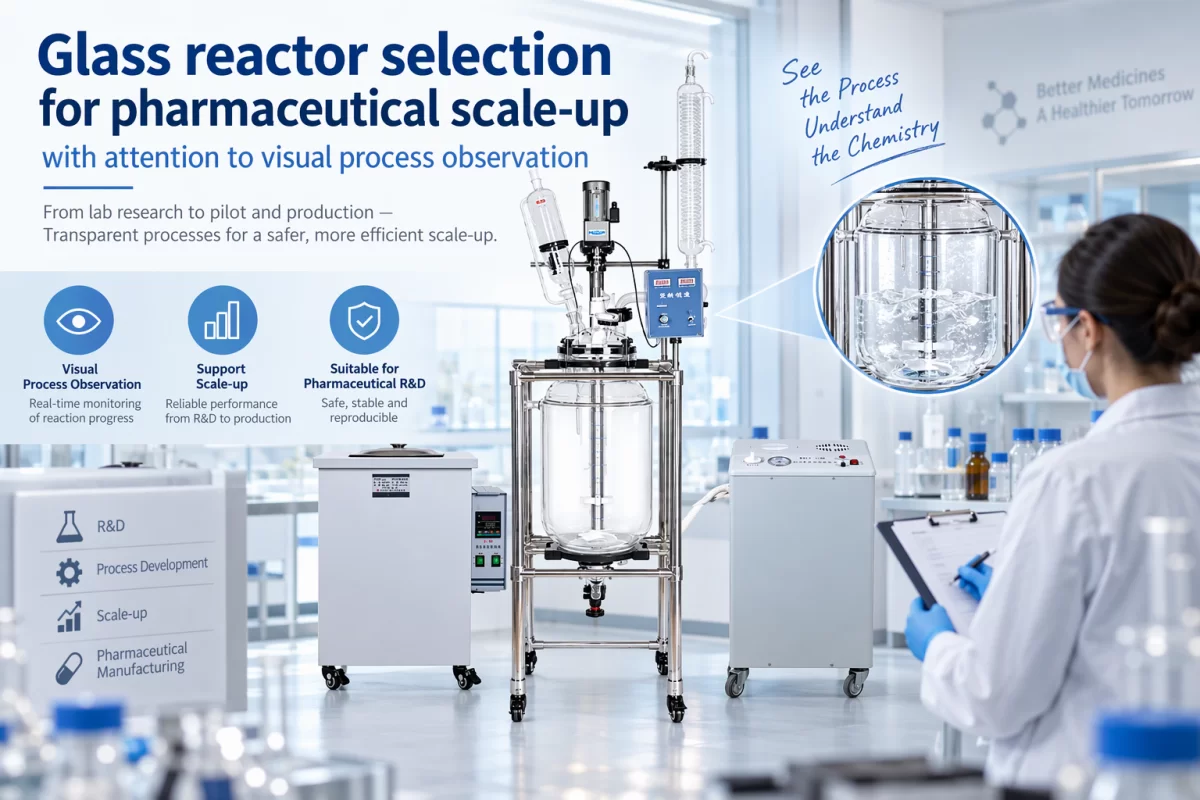
Understanding how to choose a glass reactor for pharmaceutical scale-up starts with the process, not the largest vessel available. Visibility can help explain a reaction, crystallization, or phase separation, but working volume, heat removal, agitation, and pressure boundaries determine whether the equipment fits the intended operation.
Start with process fit: what visibility adds—and what it cannot prove
A transparent vessel can make process development more informative. Operators may observe dissolution, suspended solids, phase boundaries, foaming, or changes in the apparent mixing pattern. These observations can support decisions about addition timing and sampling, especially when a laboratory procedure is being translated into a larger batch.
Visibility is nevertheless a diagnostic aid, not proof of uniform temperature or composition. An apparently moving liquid can still contain poorly mixed regions, while opaque slurries may hide the impeller and vessel interior. Temperature measurements, representative sampling, and process data remain necessary to assess performance.
Glass is also not universally compatible with pharmaceutical materials. Selection should consider the complete wetted path: vessel, agitator, seals, gaskets, valves, probes, and transfer connections. Cleaning chemistry, solvent exposure, solids abrasion, and contamination controls belong in the application review rather than being inferred from the reactor name.
How to choose a glass reactor for pharmaceutical scale-up: separate four volume decisions
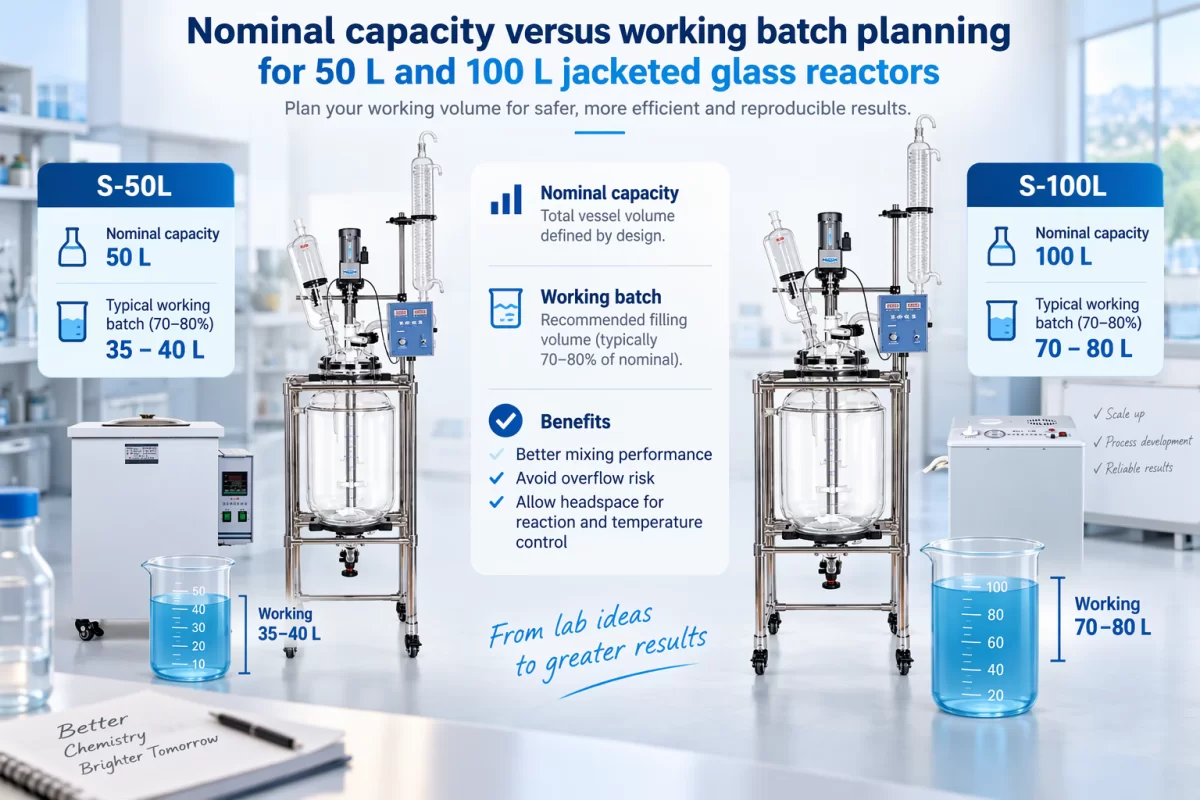
Nominal vessel capacity is not the same as usable batch volume. The acceptable working batch depends on the process stage, impeller immersion, vapor space, foaming, solids loading, and liquid movement. A single filling percentage should not be applied to every material or operation.
1. Current batch
Define the initial liquid charge, solids inventory, and minimum liquid level. A vessel that accommodates the final batch may still be unsuitable at startup if the initial charge does not adequately engage the selected impeller or temperature probe.
2. Addition-driven changes
Record the maximum inventory after reagent additions, solvent washes, or dilution. Consider displacement by solids and any change in density or phase behavior. Final product volume alone can underestimate the largest volume encountered during the procedure.
3. Process allowance
Reserve space for the actual operation: foaming, reflux, gas evolution, slurry movement, or feed fluctuations. This allowance should come from process knowledge and trials, not a universal loading rule.
4. Future expansion
Treat a future production target as a separate operating case. More nominal capacity may provide expansion options, but an oversized vessel can complicate today's low-volume mixing, sampling, and temperature control. Compare both operating cases before committing to one platform.
Compare 50 L and 100 L options as complete systems
The 50L Jacketed Glass Reactor is a nominal-capacity option to evaluate when the current process inventory can fit within an appropriately established working envelope. Its suitability should be assessed through the vessel geometry, jacket arrangement, agitation configuration, condenser, connection layout, discharge arrangement, and matched temperature-control equipment.
The 100L Jacketed Glass Reactor provides a larger nominal-capacity option for evaluating higher inventory or future expansion. It should not be assumed to offer twice the usable batch, twice the heat-removal capability, or equivalent mixing at the same stirrer speed. Those outcomes depend on the configured system and the process.
| Selection item | 50L Jacketed Glass Reactor | 100L Jacketed Glass Reactor |
|---|---|---|
| Nominal vessel capacity (L) | 50 | 100 |
| Working-batch decision | Evaluate current and peak inventory against the selected configuration. | Evaluate larger inventory and minimum-charge performance separately. |
| Thermal assessment | Match jacket and temperature-control system to process heat load. | Reassess heat load, circulation, and response for the larger operating case. |
| Agitation assessment | Match impeller geometry and drive capability to the material. | Evaluate mixing across initial, intermediate, and final batch levels. |
The capacities shown are nominal vessel volumes, not guaranteed working-batch quantities.
Heat transfer and agitation must scale with the process
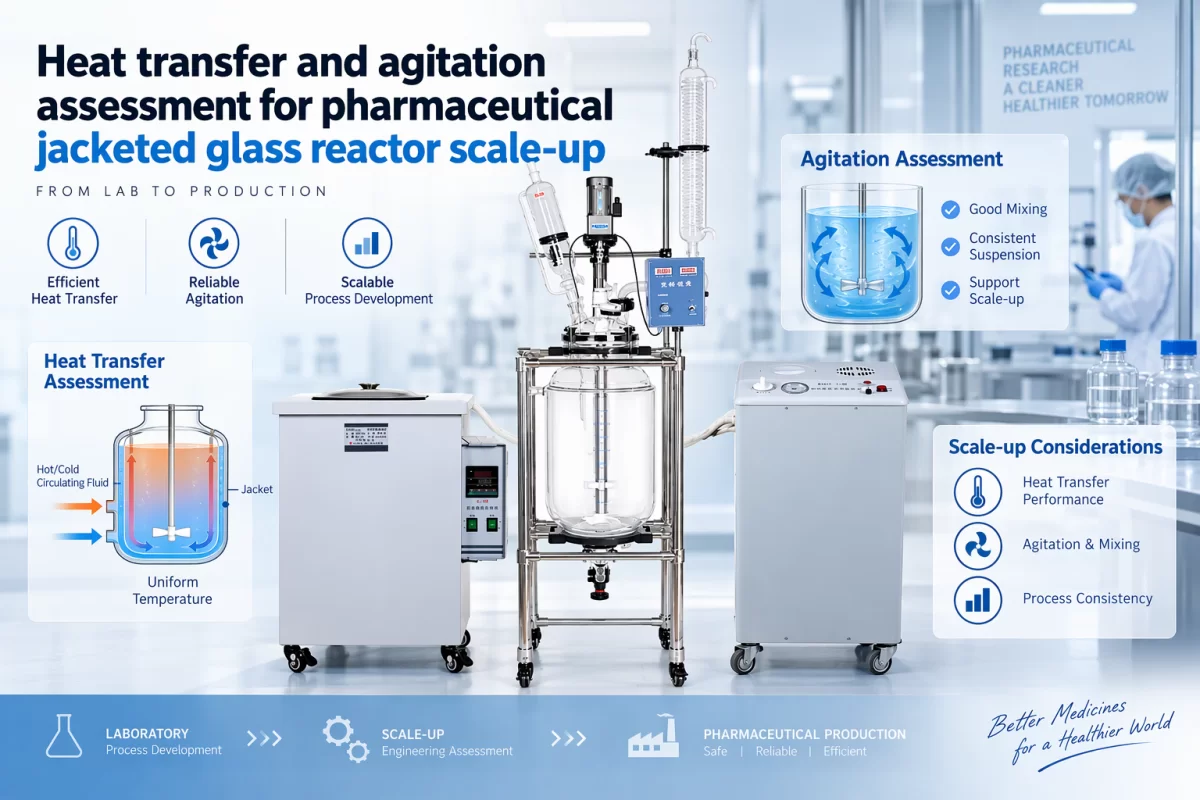
A jacket provides a route for heating and cooling, but it does not by itself establish achievable ramp rates or reaction heat-removal capacity. Thermal performance depends on jacket geometry, heat-transfer fluid, circulation, fluid temperature, vessel contents, and the available temperature-control system. Larger batches can be more demanding because heat-transfer area does not generally grow in direct proportion to volume.
For an exothermic addition, define the anticipated heat release, feed profile, operating temperature, and acceptable temperature excursion. For crystallization, consider the cooling trajectory alongside changing slurry properties. The condenser and its cooling supply must also be assessed when reflux or solvent vapor is part of the process.
Agitation deserves an equally specific review. Stirrer speed alone cannot establish mixing performance: impeller diameter, blade geometry, liquid depth, viscosity, solids content, and drive torque all matter. A mixing setting that worked in a small vessel should not be copied into a larger reactor without evaluating its process consequences.
Pressure limits are a selection boundary, not a marketing inference
An ordinary jacketed glass reactor must not be presented as high-pressure equipment merely because pressure-related products or articles appear on the same website. A product name, photograph, or search ranking does not establish an allowable operating pressure.
Positive-pressure and vacuum service require an application-specific assessment of the complete assembly. The vessel, lid, seals, fittings, connected equipment, and jacket circuit may have different limits. Temperature and pressure conditions must be considered together, including startup, shutdown, blocked outlets, and loss of cooling.
Processes involving pressurized gases or hydrogenation should be evaluated against purpose-designed equipment requirements. The discussion of glass pressure reactors for pharmaceutical scale-up is relevant to that separate selection question; it is not evidence of a pressure rating for the ordinary 50 L or 100 L jacketed models.
Procurement: evaluate the configured package, not just the vessel
Pharmaceutical procurement should include discharge behavior, cleaning access, seal compatibility, sampling arrangements, and the documentation needed for the intended use. A vessel that handles the reaction may still create difficulties during slurry transfer or cleaning if the outlet and connections do not suit the material.
Electrical supply, heating and cooling duties, coolant availability, vacuum equipment, ventilation, and installation space also affect system fit. Where flammable solvents are used, the required hazardous-area provisions should be defined for the complete installation rather than assumed from a general equipment label.
Our company's reference price is US$1,699 across the supplied jacketed glass reactor listings. This is a portfolio reference, not a specific quotation for either capacity discussed here. Actual quotations depend on configuration and the inquiry results.
Choose a process envelope before choosing a capacity
The practical answer to how to choose a glass reactor for pharmaceutical scale-up is to establish where glass adds value and where the process exceeds its documented boundaries. Visibility can aid development, but it cannot replace adequate heat removal, effective mixing, compatible wetted components, or suitable pressure limits. Compare the 50 L and 100 L options using working inventory and complete-system requirements—not nominal capacity alone.
Submit an application-focused inquiry
Send the material and solvent identities, initial and peak batch quantities, addition sequence, solids or viscosity behavior, target temperature and pressure conditions, and available utilities. Include the preferred capacity, condenser duty, agitation needs, connections, discharge requirements, and cleaning or documentation expectations. These details support a configuration-specific suitability review and quotation.