
Laboratory synthesis · Configuration guide
High Pressure Autoclaves for Laboratory Synthesis: Configuration Choices
Selecting a high pressure autoclave reactor for laboratory synthesis starts with the experiment, not the largest vessel or the highest number in a product series. Capacity, heating, stirring, wetted materials, and process connections must work together at the intended operating conditions.
Choose capacity around the actual synthesis workflow
For researchers evaluating a High Pressure Autoclave Reactor, nominal vessel capacity is a starting point rather than an approved working charge. A useful configuration request separates four different needs instead of combining them into one oversized capacity estimate.
- Current batch: describe the initial liquid charge, solids loading, reactant quantities, and required gas space for the present experiment.
- Feed changes: identify additions during the run, including their volume, timing, temperature, and delivery method. The final inventory may differ substantially from the initial charge.
- Process allowance: account for thermal expansion, foaming, gas evolution, and mixing requirements. Suitable headspace depends on the chemistry and operating conditions; one filling percentage should not be applied to every material.
- Future expansion: state the next planned batch size separately. Extra vessel volume alone does not establish comparable mixing or heat-transfer behavior at a larger scale.
The CJF capacity table identifies models including CJF-0.05 at 0.05 L, CJF-1 at 1 L, CJF-5 at 5 L, and CJF-20 at 20 L. These nominal capacities help organize a shortlist, but they do not establish an allowable charge for a particular reaction. Select the complete model configuration around the process, including the required temperature-pressure envelope and agitation arrangement.
Does a larger vessel automatically provide more useful working capacity?
I recommend comparing the intended charge with the vessel geometry and mixing arrangement before choosing a larger model. A small charge in a larger vessel can change impeller immersion and temperature measurement conditions. Expansion capacity is valuable only when the present and future batches both have a suitable configuration.
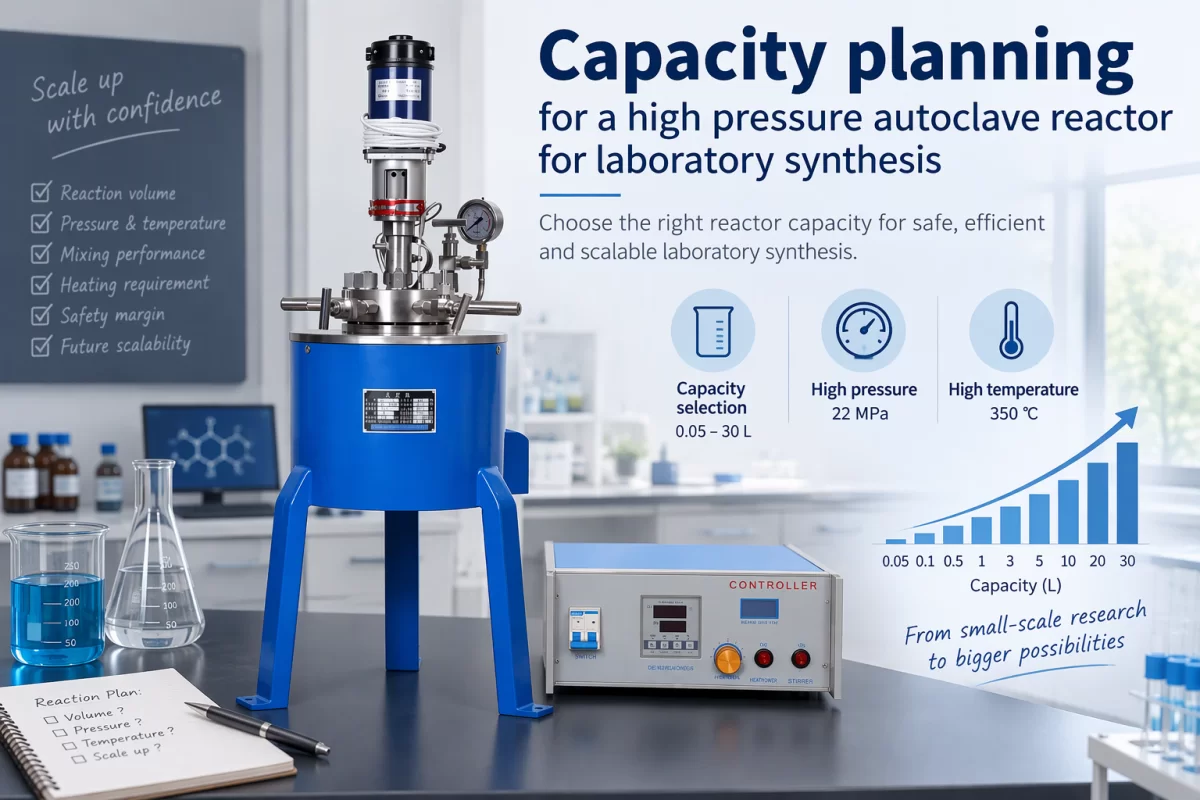
Compare pressure and temperature by individual model
When considering a High Pressure Chemical Reactor, compare the named model rather than combining the largest capacity with the highest pressure and temperature listed elsewhere in the series. The FCF model data below show why this distinction matters: the listed pressure changes as capacity increases, and the larger models also have different temperature specifications.
| Model | Capacity (L) | Pressure (MPa) | Temperature (°C) | Stirring speed (r/min) | Heating power (kW) |
|---|---|---|---|---|---|
| FCF-0.1 | 0.1 | 22 | 350 | 50–1000 | 0.6 |
| FCF-1 | 1 | 22 | 350 | 50–1000 | 1.5 |
| FCF-5 | 5 | 22 | 350 | 50–600 | 4 |
| FCF-20 | 20 | 22 | 350 | 50–600 | 10 |
| FCF-30 | 30 | 16 | 350 | 50–600 | 12 |
| FCF-50 | 50 | 10 | 300 | 50–600 | 12 |
| FCF-100 | 100 | 6 | 300 | 50–600 | 14 |
These are model-specific listed specifications, not an operating recipe or a statement that every listed endpoint is approved for simultaneous use. Obtain the allowable pressure-temperature envelope for the selected vessel, materials, seals, and connected components before establishing operating limits.
Define the normal operating temperature and pressure separately from startup, dosing, and credible upset conditions. A configuration suitable for one synthesis may not suit another with a different solvent, gas supply, reaction heat release, or corrosion exposure.
Match heating and stirring to the laboratory reaction
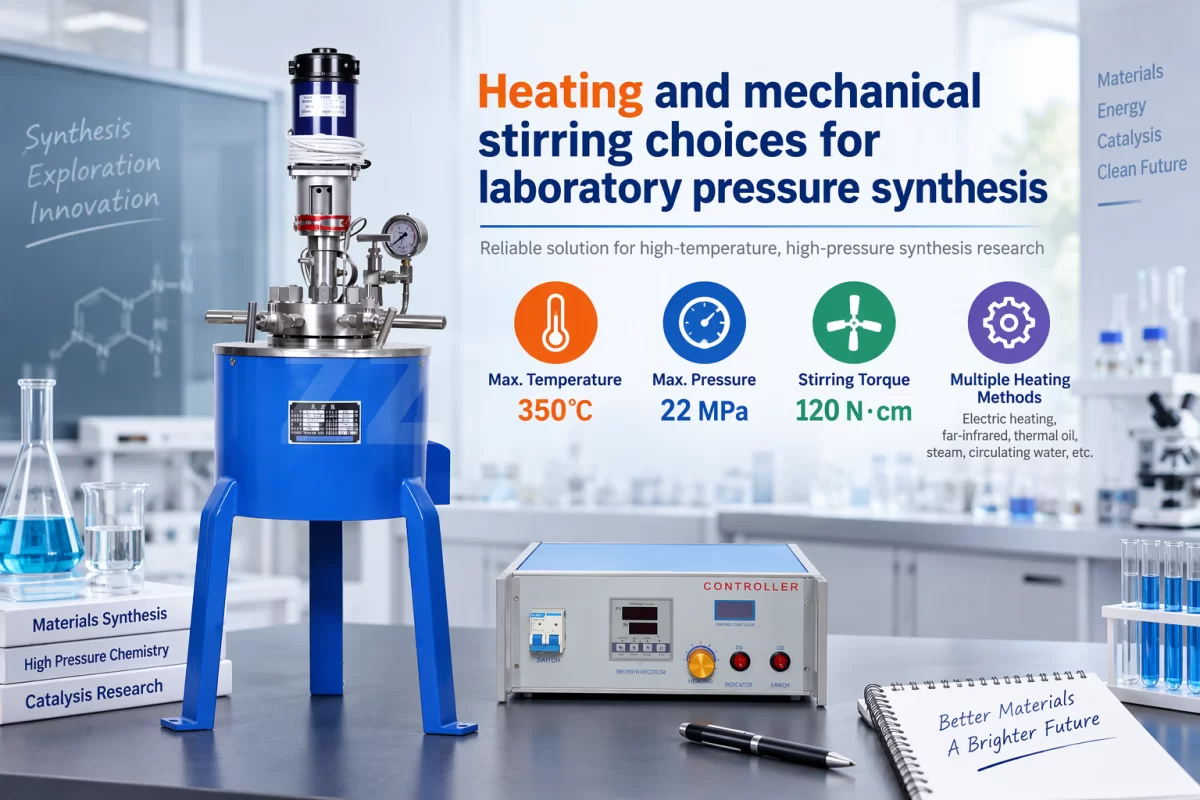
Heating power helps distinguish configurations, but it does not by itself predict heat-up time, cooling time, or temperature uniformity. For example, FCF-1 lists 1.5 kW heating power, while FCF-20 lists 10 kW. The practical temperature response also depends on the charge, vessel construction, insulation, mixing, and heat losses. Provide the desired temperature profile and cooling requirement rather than requesting heater power alone.
The TGYF-C specification lists modular electrical heating and mechanical stirring. The CJF heating description includes general electric heating and alternative approaches such as far-infrared, thermal oil, steam, and circulating water. Treat an alternative heating or heat-transfer method as a configuration choice to discuss for the selected model, not as equipment included in every delivery.
Stirring should be selected around viscosity, suspended solids, gas-liquid contact, and the expected change in material behavior during synthesis. The FCF table lists 50–1000 r/min for FCF-1 and 50–600 r/min for FCF-5. A speed range does not establish available torque under load or prove that an impeller will keep a particular solid suspended.
Is the highest stirring speed the best choice for synthesis?
I would prioritize the required mixing task over the maximum speed. Impeller geometry, working level, viscosity, and drive capability all affect performance. For a gas-liquid reaction, the configuration should also address gas entry and dispersion rather than relying on a speed number alone.
For projects involving hydrogen, the guide to high-pressure laboratory reactors for hydrogenation experiments provides related process context. Suitability for a specific hydrogenation run still requires a model-specific assessment of gas handling, wetted components, sealing, instrumentation, and operating conditions.
Specify materials, seals, measurements, and interfaces
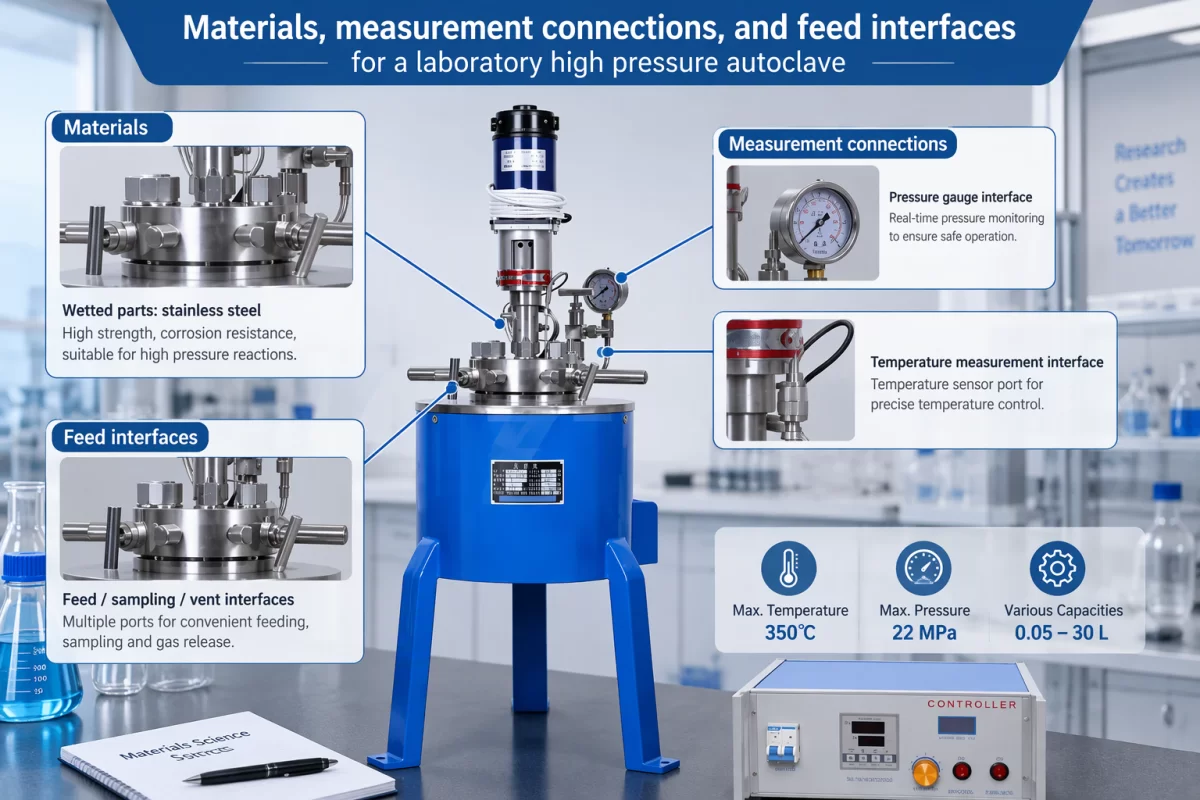
A laboratory autoclave is more than a pressure vessel and heater. The TGYF-C material specification lists stainless steel 304 and 316. Material selection must consider the complete reaction mixture, including solvents, catalysts, impurities, and cleaning agents at the intended temperature. These material listings should not be transferred automatically to an FCF or CJF configuration.
Include all wetted components in the compatibility review: vessel body, lid, stirrer, dip tubes, valves, sensor sheaths, and seals. Specify the required sealing arrangement and maintenance access without assuming that a particular coupling or seal design is standard.
- Measurement: define pressure and temperature measurement ranges, sensor locations, recording needs, and any required alarms or shutdown functions.
- Gas connections: describe the gas, supply conditions, inlet arrangement, isolation needs, and vent destination.
- Liquid feed and sampling: state whether additions or samples are required during operation and describe the intended transfer conditions.
- Discharge and access: identify slurry handling, cleaning, vessel opening, and any lifting or removal requirements.
- Pressure protection: request a protection arrangement matched to the process and applicable requirements, including a suitable discharge route.
Can spare ports alone make an autoclave ready for later upgrades?
I recommend defining the likely upgrade before specifying extra ports. Connection size, material, pressure-temperature suitability, internal tube position, and available lid space determine whether an interface is useful. A spare opening does not establish compatibility with a future feed pump, sampling device, or sensor.
Build a configuration-based purchasing comparison
Compare quotations against the same process description and equipment scope. A meaningful purchasing comparison identifies the vessel model, wetted materials, heating arrangement, stirrer and drive, seals, instruments, valves, process connections, and included accessories. Avoid treating prices for different reactor sizes or accessory packages as interchangeable.
Our company's reference price
US$2,990
This reference price is not a quotation for every model or configuration. The actual quotation depends on the selected configuration and the inquiry result.
Where documentation or certification is required by the laboratory or purchasing organization, specify it in the inquiry. Include installation utilities, commissioning expectations, operator training needs, and spare-part requirements so the proposed scope can be compared consistently.
Select a laboratory synthesis autoclave as a complete system
The right high pressure autoclave reactor for laboratory synthesis is the configuration that fits the current batch, planned additions, process allowance, and future research needs without borrowing specifications from another model. Evaluate capacity and the allowable temperature-pressure combination together, then match heating, agitation, materials, sealing, measurements, and interfaces to the actual chemistry.
Submit the reaction materials, initial and final batch quantities, target operating conditions, heating and cooling profile, mixing needs, and required connections. Include future expansion plans and documentation requirements to obtain a model-specific configuration proposal and quotation.