
High Pressure Lab Reactor for Hydrogenation Experiments
Hydrogenation can turn a small laboratory idea into a repeatable chemical process, but it requires pressure control, reliable mixing, suitable materials and practical safety design. This guide explains what matters when selecting a high pressure lab reactor without burying the answer in technical jargon.
Why hydrogenation needs a purpose-built pressure reactor
Hydrogenation is a reaction where hydrogen gas is added to a molecule, often with a metal catalyst such as palladium, platinum, nickel or ruthenium. In everyday language, it is a controlled way to “feed” hydrogen into a liquid or slurry so the target compound changes structure. In pharmaceutical research, fine chemicals, flavors, fragrances, polymer additives and material synthesis, this step is common because it can improve stability, remove unsaturation or create a desired functional group.
The challenge is that hydrogen is a gas and many useful reactions happen faster when the gas is held under pressure. A simple flask cannot safely do this. A high pressure lab reactor is designed as a sealed vessel with controlled heating, stirring, pressure monitoring and gas inlet/outlet hardware. For hydrogenation, these functions are not optional; they directly affect conversion, selectivity and operator safety.
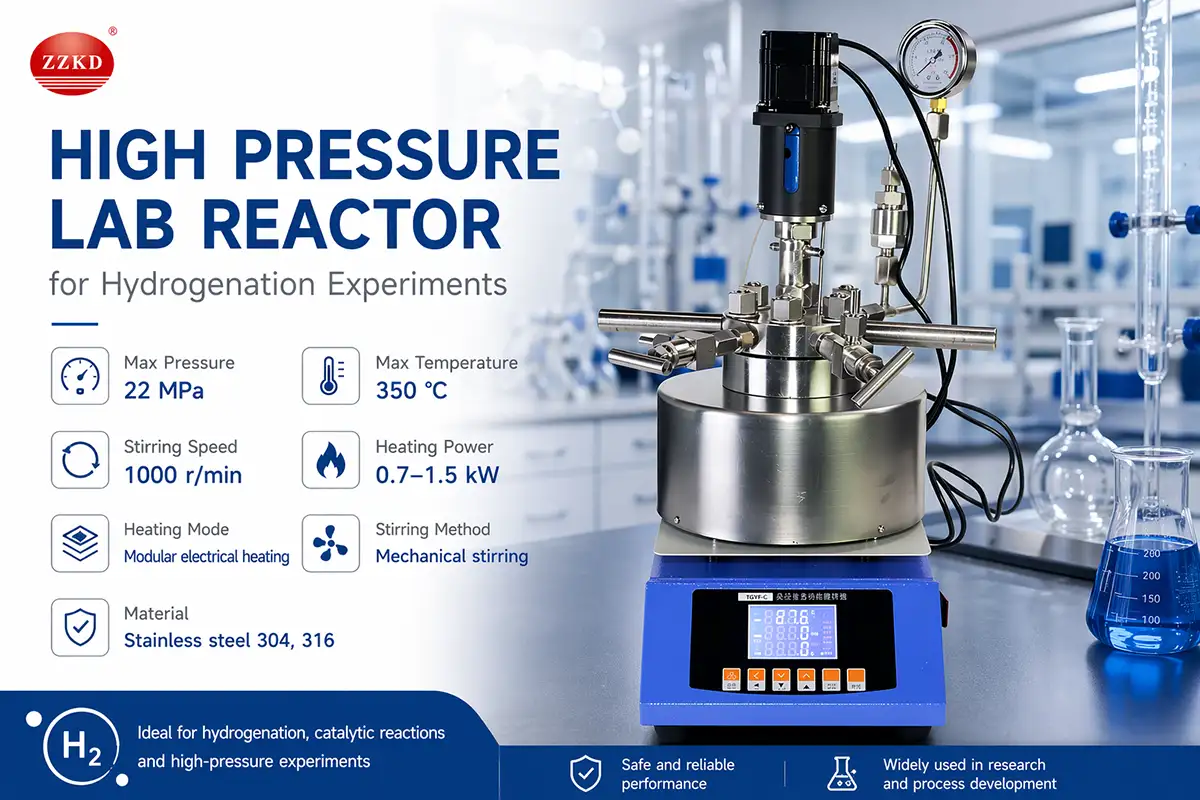
Compact high pressure lab reactor used for hydrogenation screening.
What specifications matter most?
For most laboratory hydrogenation work, the best reactor is not automatically the largest or the most expensive one. The better choice is the unit that matches the reaction scale, pressure range, temperature window, catalyst loading and cleaning routine. ZZKD’s TGYF-C series is built for small-batch laboratory experiments, with volumes from 50 ml to 1 L, 22 MPa pressure rating, 350°C temperature capability and mechanical stirring up to 1000 r/min.
Not necessarily. Many reactions may run far below the rated limit, but a higher rated vessel gives useful operating margin. The practical point is not to run every experiment at the maximum pressure; it is to select a reactor with enough certified capacity for the planned method, safety factor and future process development.
| Model | Volume | Pressure | Temperature | Stirring Speed | Heating Power | Material |
|---|---|---|---|---|---|---|
| TGYF-C | 0.05 L | 22 MPa | 350°C | 1000 r/min | 0.7 kW | SS304 / SS316 |
| TGYF-C | 0.1 L | 22 MPa | 350°C | 1000 r/min | 0.7 kW | SS304 / SS316 |
| TGYF-C | 0.25 L | 22 MPa | 350°C | 1000 r/min | 0.7 kW | SS304 / SS316 |
| TGYF-C | 0.5 L | 22 MPa | 350°C | 1000 r/min | 1.5 kW | SS304 / SS316 |
| TGYF-C | 1 L | 22 MPa | 350°C | 1000 r/min | 1.5 kW | SS304 / SS316 |
The modular electrical heating system helps the vessel reach the set temperature smoothly, while mechanical stirring improves gas-liquid-solid contact. This matters because hydrogenation often involves three phases: hydrogen gas, liquid reactant and solid catalyst.
Stirring, mass transfer and repeatability
In hydrogenation, stirring is more than “mixing the liquid.” It helps hydrogen move from the gas headspace into the liquid and then to the catalyst surface. If stirring is weak, the reaction may appear slow even when the catalyst is good. If stirring is stable and repeatable, experiment results are easier to compare between batches.
A reactor with 1000 r/min stirring capacity gives room to optimize agitation for different viscosities and catalyst suspensions. For screening work, the same stirring speed, pressure and temperature should be recorded in every run. This makes it easier to understand whether a change in conversion is caused by the catalyst, the substrate, or the reactor conditions.
Pressure control
Stable pressure helps maintain hydrogen availability during the reaction and supports consistent kinetic data.
Material choice
SS304 suits many general experiments, while SS316 is often preferred for better corrosion resistance.
Heating response
0.7 kW and 1.5 kW options match small-volume thermal needs without making the system unnecessarily bulky.
Safety facts that should guide equipment selection
Hydrogenation equipment should always be treated as pressure equipment, not as ordinary glassware. The U.S. Department of Energy’s Hydrogen Safety Panel notes that hydrogen has a very wide flammability range in air, about 4% to 75% by volume, and an extremely low minimum ignition energy, often cited near 0.02 mJ under favorable conditions. These figures explain why sealing quality, ventilation, leak testing, grounding, pressure relief and careful operating procedures are essential.
Glass is excellent when visual observation is the priority, but high-pressure hydrogenation usually favors a metal pressure vessel because stainless steel handles higher pressure and mechanical stress better. A glass pressure reactor can be useful in specific visible-process studies, but stainless steel is the more common choice for demanding hydrogenation pressure ranges.
Good practice also includes using compatible gaskets, checking valves before charging gas, purging oxygen from the vessel, avoiding overfilling, and never exceeding the rated pressure or temperature. For hydrogen work, a smaller reactor can often be safer and more economical during early method development because it reduces material inventory while still producing meaningful data.
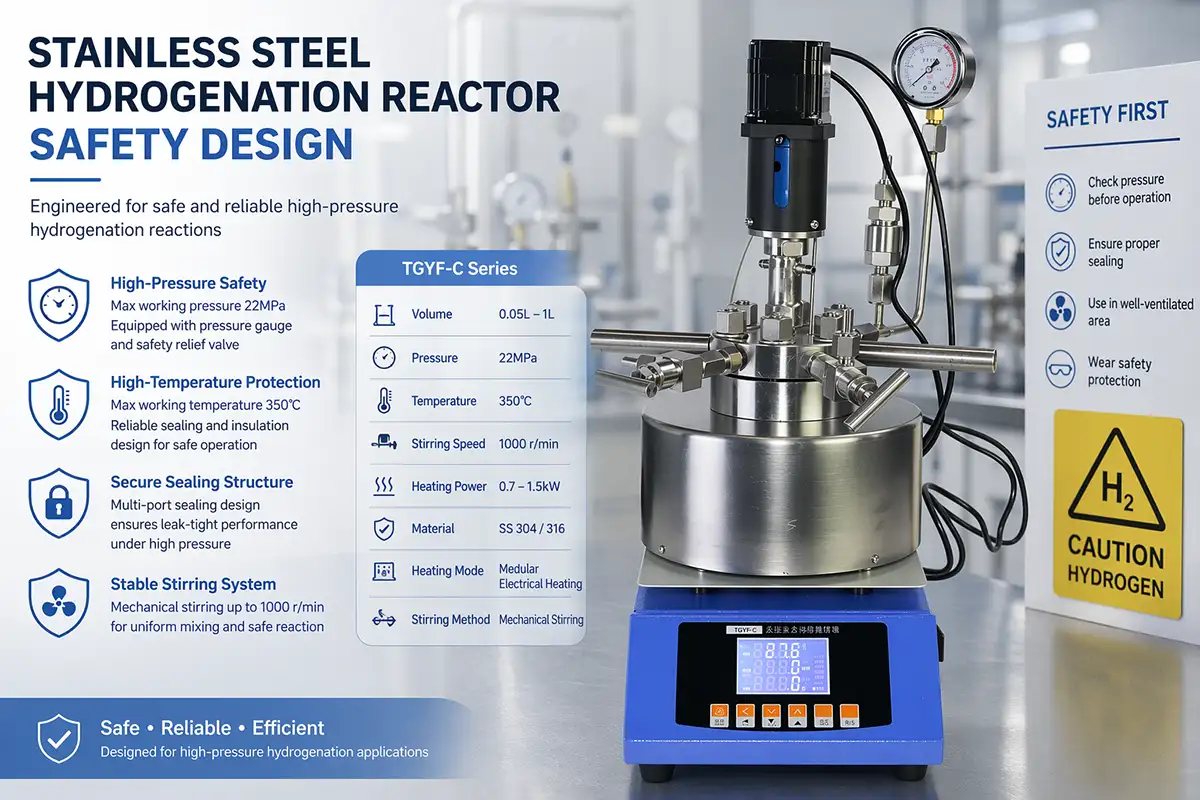
Stainless steel vessel, fittings and pressure monitoring for hydrogenation.
How much should a laboratory hydrogenation reactor cost?
Price depends on volume, pressure rating, material, stirring design, controller type, valves, safety accessories and customization. Based on the supplied ZZKD price references, small high pressure laboratory reactors may start around $1,500 for 50–1000 ml stainless steel units. A ZZKD 0.1–10 L maintenance-free lab high pressure stirred tank reactor with a listed range of $2,300–$3,200 can be estimated at about $2,750 when selecting a middle, relatively economical reference price. A dedicated 1 L lab hydrogenation high pressure reactor reference price is about $3,714, while 50 L hydrogenation systems can reach about $15,600.
For most screening work, 50 ml, 100 ml or 250 ml is enough. These sizes reduce raw material and catalyst consumption while allowing researchers to evaluate pressure, temperature, solvent and catalyst effects. A 0.5 L or 1 L reactor becomes more attractive when the method is proven and more product is required for analysis or downstream testing.
Choosing between SS304 and SS316
ZZKD TGYF-C reactors are available in stainless steel 304 and 316. SS304 is a reliable general-purpose stainless steel for many laboratory reactions. SS316 contains molybdenum, which improves resistance to pitting and corrosion in more aggressive environments. For hydrogenation involving chlorinated solvents, acidic conditions, halogen-containing substrates or long cleaning cycles, SS316 is often worth considering.
For a broader look at stainless pressure equipment, the ZZKD guide to stainless steel reactors explains why alloy selection, surface finish and sealing structure affect long-term performance. In simple terms, material choice should follow the chemistry, not only the budget.
Choose SS304 for many neutral, general-purpose hydrogenation experiments.
Choose SS316 when corrosion resistance is more important or when cleaning solvents are harsher.
Confirm compatibility of gaskets, valves and internal wetted parts, not just the main vessel body.
Document pressure, temperature, stirring speed, catalyst amount and reaction time for every run.
Why ZZKD TGYF-C fits laboratory hydrogenation development
The TGYF-C series is suitable for teams that need a compact high pressure reactor for repeatable hydrogenation experiments. The 0.05 L to 1 L volume range supports early-stage screening, the 22 MPa pressure rating gives operating headroom, and the 350°C temperature limit covers many hydrogenation and high-temperature catalytic studies. Mechanical stirring is especially useful for catalyst suspension and gas-liquid contact.
Compared with oversized pilot equipment, a small laboratory reactor is easier to install, easier to clean and more economical for precious substrates. Compared with improvised pressure setups, a purpose-built high pressure autoclave reactor offers a more professional path for safe, traceable and scalable data collection.
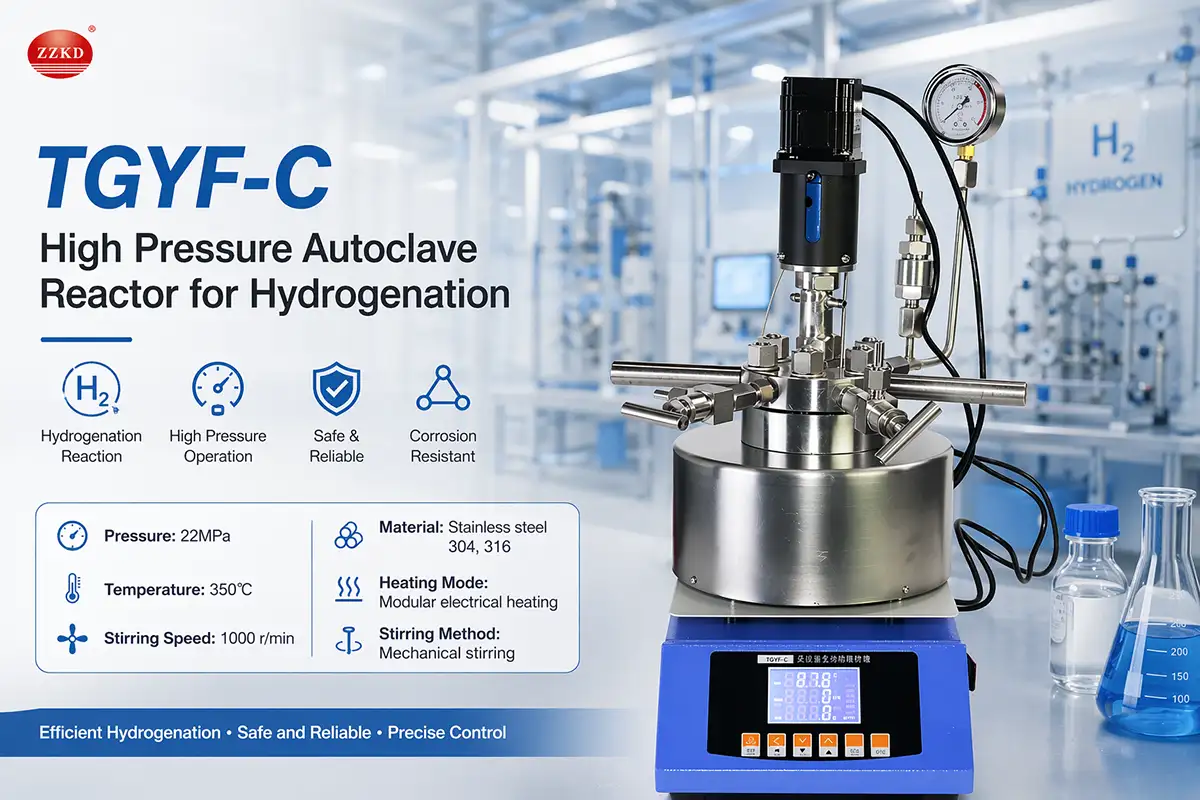
ZZKD TGYF-C style high pressure autoclave reactor for laboratory work.
HydrogenationCatalyst screeningHigh pressure chemistrySS304 / SS316
Final takeaway
A good high pressure lab reactor for hydrogenation should answer four practical questions: Can it safely hold the required pressure? Can it heat and stir the reaction consistently? Is the material compatible with the chemistry? Is the size economical for the experiment stage? ZZKD’s TGYF-C series addresses these needs with compact volumes, 22 MPa pressure capability, 350°C temperature performance and stainless steel construction for modern laboratory hydrogenation research.
Explore ZZKD High Pressure Lab Reactors