
Stainless Steel Reactor · Procurement Planning
Planning a Batch Reactor for Small-Scale Pharmaceutical Manufacturing
Selecting a stainless steel batch reactor for small-scale pharmaceutical manufacturing starts with the production sequence—not just the vessel volume. Batch scheduling, charging and discharge methods, cleaning time, and documentation requirements should all become purchasing inputs before a configuration is selected.
Build the batch plan before selecting the reactor
A small-scale manufacturing schedule should account for preparation, charging, reaction, cooling, transfer, cleaning, inspection, and release for the next batch. Reaction time alone does not describe equipment availability. A vessel that fits the chemistry may still create a scheduling bottleneck if charging is slow or product changeover requires extensive disassembly.
When evaluating a Stainless Steel Batch Reactor, define the minimum and maximum working batch sizes, the planned number of batches, and the sequence of products sharing the equipment. Include expected viscosity, solids content, foaming behavior, and any additions during processing. These inputs help frame the required mixing arrangement and working-volume assessment without assuming that nominal capacity equals usable batch volume.
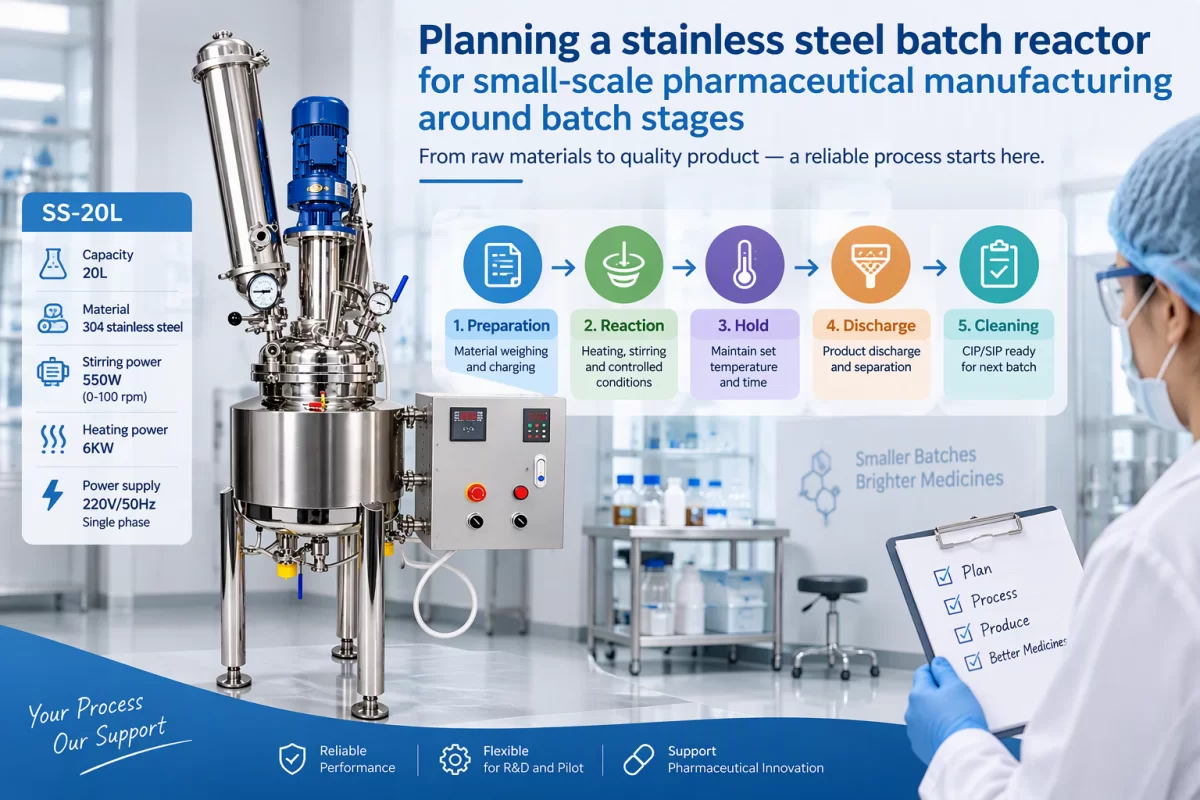
An SS-5L configuration reference for early planning
The supplied SS-5L specification provides a concrete starting point for discussing a small stainless steel reactor. The following details belong to that model; they should not be carried over automatically to a larger vessel or a differently equipped package.
| Item | Specified detail | Planning relevance |
|---|---|---|
| Nominal reactor volume | 5 L | Starting point for evaluating the proposed working batch. |
| Reactor material | 316 stainless steel | Assess against the process media and cleaning chemistry. |
| Frame and pipe material | 304 stainless steel | Identify each component’s function and exposure conditions. |
| Stirring rod | 304 stainless steel; three blades | Evaluate mixing needs and product-contact compatibility. |
| Stirring speed | 0–600 rpm; frequency-converter control with digital display | Relate the intended speed to the actual batch and material properties. |
| Heating method | Circulation heating | Define the external thermal equipment and connection scope. |
| Temperature indication | PT100 sensor with digital display | Specify measurement location, calibration, and recording needs. |
| Seal and interface connection | Mechanical seal; threaded union connections | Review compatibility, access, and cleaning requirements. |
| Discharge arrangement | Ball-type quick-discharge valve | Evaluate drainage, retained product, and receiving-container connection. |
| Electrical supply | 220 V / 60 Hz | Match the specified unit to the installation supply. |
| Mobility | Braked swivel casters | Plan positioning and safe routing of connected services. |
A speed range is not a mixing-performance guarantee, and circulation heating alone does not establish a heating or cooling rate. Procurement should connect these equipment details to a defined process duty, including batch mass, viscosity, thermal load, and required control behavior.
Plan material transfer around the vessel interfaces
A Stainless Steel Reactor Vessel should be assessed as part of the complete material path: raw-material staging, charging, processing, discharge, and downstream collection. The product page is a starting point for the vessel inquiry, not evidence that every connection or accessory needed for a pharmaceutical process is included.
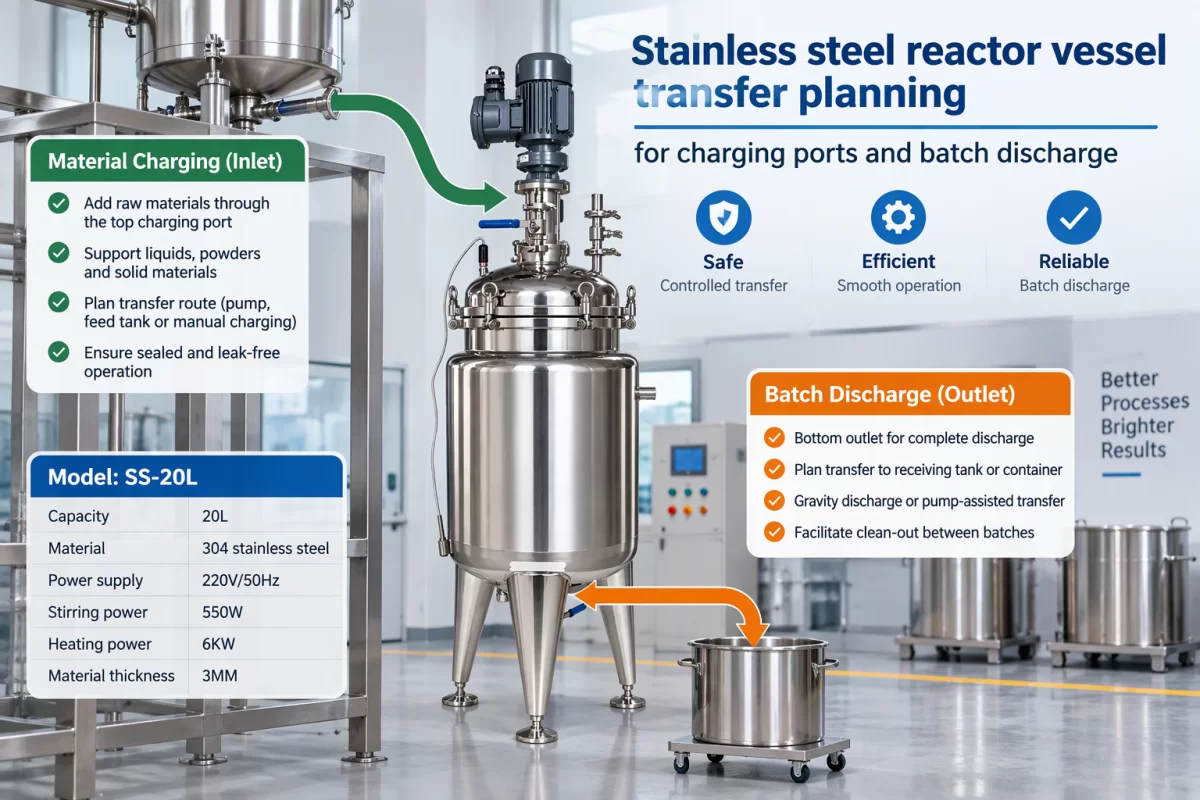
The SS-5L lid specification identifies stirring, solid-material, temperature-measurement, pressure-gauge, constant-pressure-funnel, and condensation-reflux ports, with customization described as available. Translate those functions into the intended charging and processing sequence. Specify connection dimensions, mating equipment, hose materials, containment needs, and access for cleaning in the requested configuration.
For discharge, consider the viscosity at transfer temperature, the presence of solids, and the receiving container’s position. A quick-discharge valve does not by itself establish complete drainage or suitability for every slurry. Request the proposed discharge layout and identify how the valve and downstream line will be emptied and cleaned.
Make cleaning and pharmaceutical suitability explicit
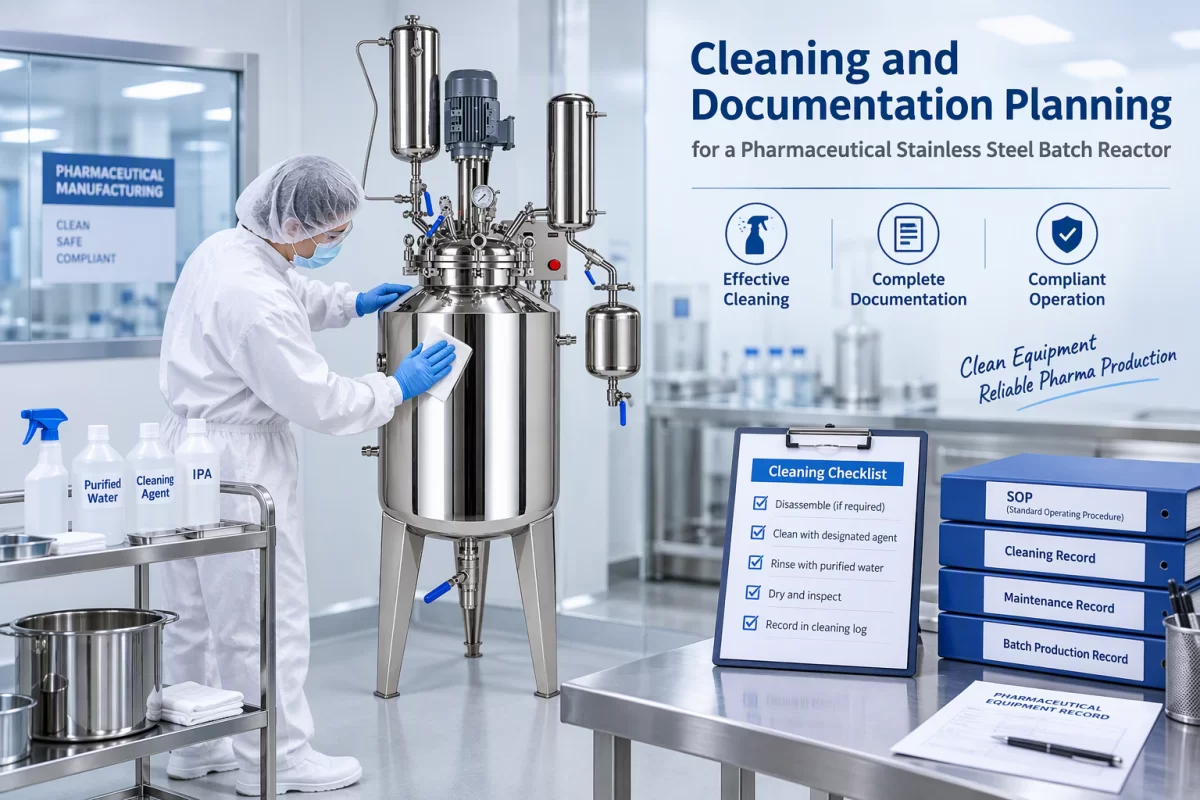
Stainless steel material selection is only one part of pharmaceutical suitability. Review the actual process ingredients, solvents, cleaning agents, concentrations, temperatures, and exposure times against every product-contact component. In the SS-5L description, the reactor is specified as 316 stainless steel while the stirring rod is 304 stainless steel; the vessel material should not be treated as a description of the entire wetted assembly.
Define whether cleaning will involve manual access, component removal, circulation, or a proposed clean-in-place arrangement. Give particular attention to seal areas, threaded unions, the discharge valve, and any attached transfer lines. Set expectations for inspection access, residue removal, drainage, and drying before requesting a cleaning configuration.
Turn process requirements into a defined purchase scope
Compare quotations only when the vessel, agitation, heat-transfer arrangement, seals, connections, controls, and accessories have the same scope. Do not combine the largest capacity or highest operating limits from different configurations into a single equipment expectation.
| Purchasing input | Define in the inquiry | Agree before ordering |
|---|---|---|
| Batch duty | Working volume range, recipe sequence, viscosity, solids, and cycle schedule. | Selected model and configuration-specific operating limits. |
| Heat transfer and utilities | Process temperatures, heating and cooling duty, electrical supply, and available services. | External equipment, connections, controls, and installation responsibilities. |
| Material transfer | Charging method, containment needs, discharge route, and receiving equipment. | Port schedule, mating connections, valves, hoses, and accessory scope. |
| Cleaning and materials | Process chemistry, cleaning method, residue criteria, and access requirements. | Wetted-material schedule, surface-finish requirements, and cleaning arrangement. |
| Delivery documents | Site requirements for qualification, calibration, and equipment records. | Availability and scope of drawings, material certificates, manuals, test records, and applicable certification. |
Keep requested features separate from the base supply. A condenser, circulation unit, specialized instrumentation, or customized port arrangement should appear explicitly in the quotation if required. Optional descriptions and images are not substitutes for an itemized supply agreement.
Company reference price
US$1,820 is our company’s reference price from the supplied stainless steel reactor price list. It is a budgeting reference, not a quotation for the SS-5L configuration or a complete pharmaceutical manufacturing system. The actual quotation is subject to the selected configuration and inquiry result.
Select for the complete small-scale manufacturing cycle
The right stainless steel batch reactor for small-scale pharmaceutical manufacturing should fit the planned batch sequence, material-transfer route, cleaning approach, and site utilities—not simply a nominal volume. The SS-5L details offer a useful configuration reference, while pharmaceutical suitability depends on the specific process conditions and the agreed equipment documentation.
Build the purchasing decision around a consistent configuration and a clearly defined supply scope. This makes it easier to compare proposals, allocate supporting equipment, and plan installation and qualification activities.