
What Size Stainless Steel Reactor Vessel Do I Need?
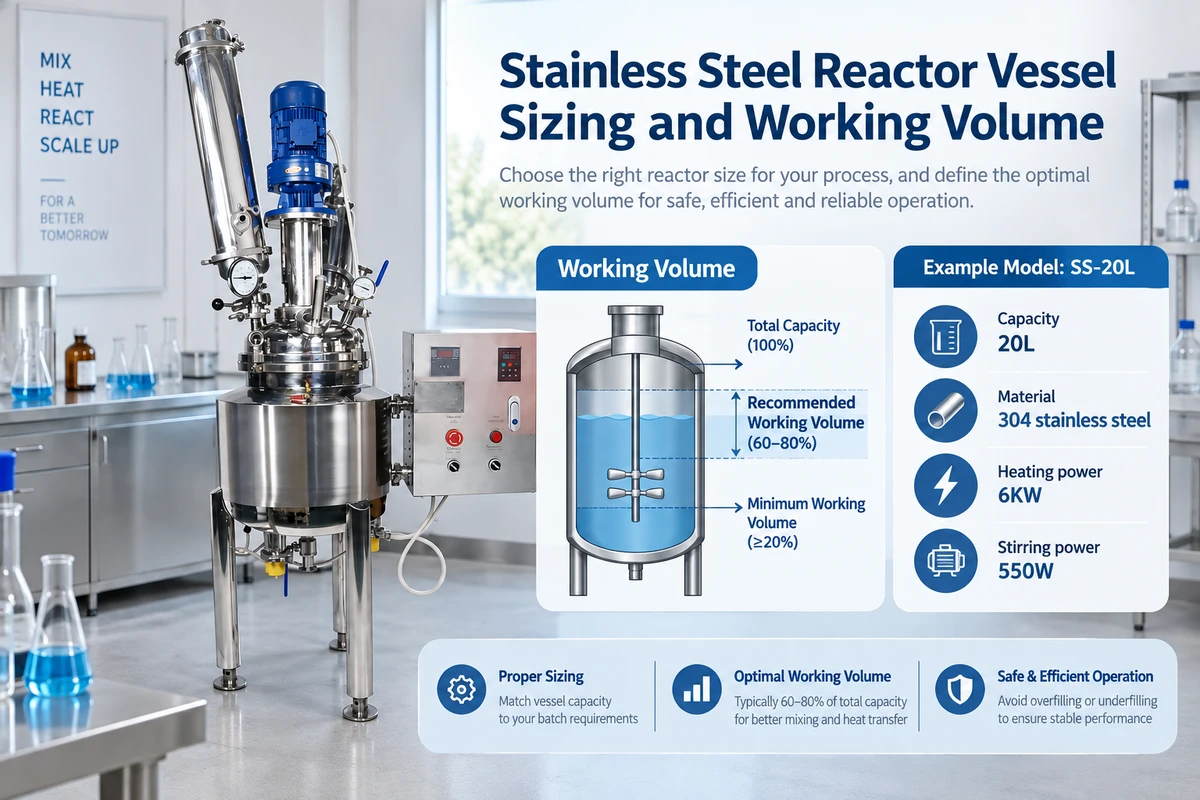
The correct vessel is not simply the one that holds the recipe. It must also leave room for mixing, foaming, vapor, additions, and safe process control.
The direct answer
For example, a process with a maximum liquid charge of 40 L at an 80% working fill needs 40 ÷ 0.80 = 50 L of total vessel capacity. If the same product foams and requires a 60% fill, it needs 40 ÷ 0.60 = 66.7 L, making an 80 L model the sensible next standard size.
1. Calculate the real maximum batch
Use the largest volume present at any moment—not only the starting solvent. Add liquids, dissolved or suspended solids, rinse material, catalysts, and all feeds introduced during the run. Also consider thermal expansion and any temporary liquid increase caused by reflux or process transfers.
Record the initial liquid charge.
Add every feed introduced before any material leaves.
Convert solid additions to their displaced or slurry volume.
Allow for expansion from the lowest filling temperature to the highest operating temperature.
Identify foam, gas evolution, boiling, and reflux behavior.
Headspace is a process requirement, not wasted capacity. A calm blending duty may operate near the higher end of a supplier-approved fill range, while fermentation, neutralization, decarboxylation, or solvent boiling often needs more free space. A trial with representative material is valuable when foam behavior is uncertain.
2. Match a practical ZZKD capacity
ZZKD stainless steel reactor configurations cover laboratory, pilot, and small-production work. The uploaded specifications include 5 L and 20 L units and a broader double-wall series from 10 L through 300 L. The table below turns common batch volumes into quick starting points; it is a screening guide, not a certified design decision.
| Maximum batch | Fill assumption | Minimum total volume | Practical starting size | Typical use |
|---|---|---|---|---|
| 3 L | 60% | 5 L | 5 L | R&D and formulation |
| 8 L | 80% | 10 L | 10 L | Laboratory scale |
| 16 L | 80% | 20 L | 20 L | Process development |
| 30 L | 60% | 50 L | 50 L | Foaming pilot batch |
| 80 L | 80% | 100 L | 100 L | Pilot or small production |
| 180 L | 60% | 300 L | 300 L | Gas-evolving production |
Available series data supplied for ZZKD models: 10, 20, 30, 50, 100, 150, 200, and 300 L; customization may be required for a particular process.
3. Capacity alone is not enough
Mixing
An oversized vessel can be a poor mixer when filled too shallowly. The liquid may not cover the impeller correctly, and vortex shape, solids suspension, gas dispersion, and heat transfer can change. This is why scale-up should preserve meaningful relationships such as geometry, impeller tip speed, or power per unit volume—whichever best fits the process.
Temperature control
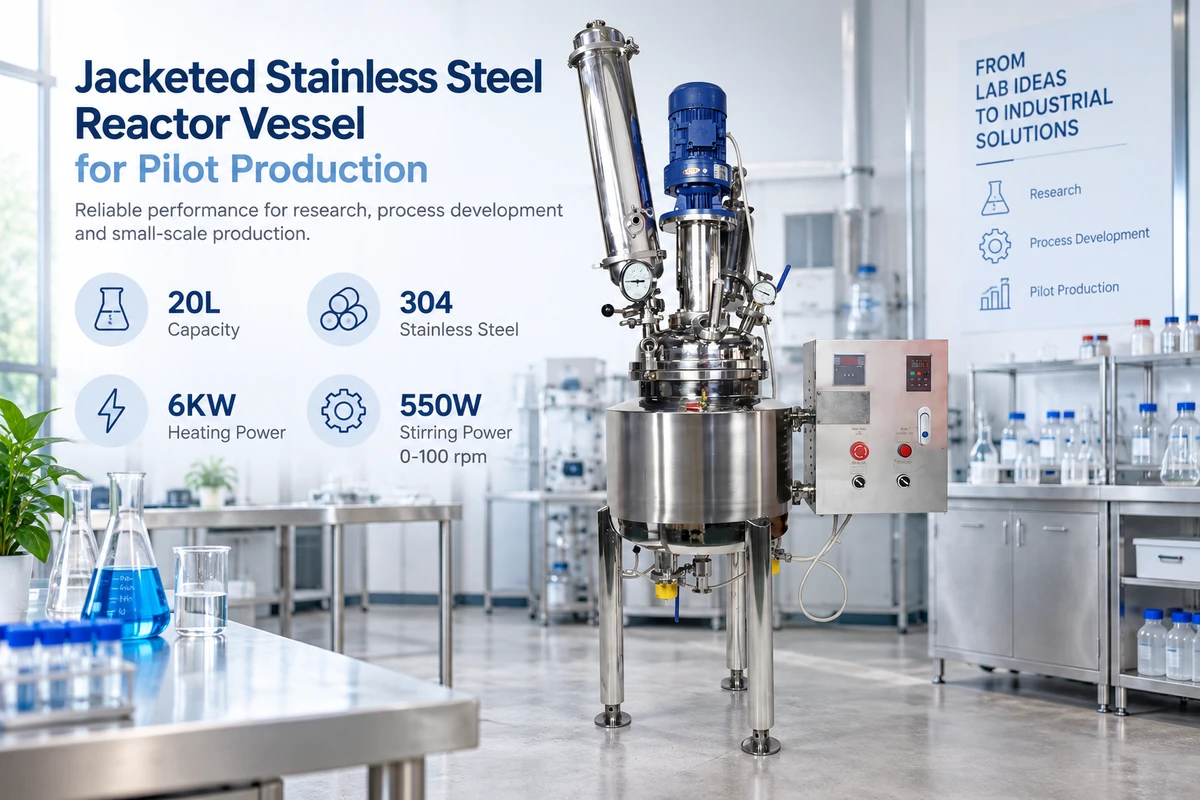
More volume means more energy must be added or removed. Check heat-up time, cooling duty, jacket volume, utility temperature, and reaction heat. The supplied ZZKD double-wall series lists a temperature range of −100 to 299°C and stirring up to 600 rpm, while the SS-5L data lists −100 to 250°C and −0.098 to 0.5 MPa. These are model specifications, not permission to operate every fluid at every temperature-pressure combination.
Pressure, vacuum, and materials
Size does not determine allowable pressure. Vessel wall thickness, closures, nozzles, seals, welds, material, temperature, corrosion allowance, and applicable code do. In the United States, ASME Boiler and Pressure Vessel Code Section VIII, Division 1 provides construction rules for pressure vessels. For pharmaceutical manufacturing, the U.S. FDA states in 21 CFR §211.65 that product-contact surfaces must not be reactive, additive, or absorptive in a way that alters drug safety, identity, strength, quality, or purity.
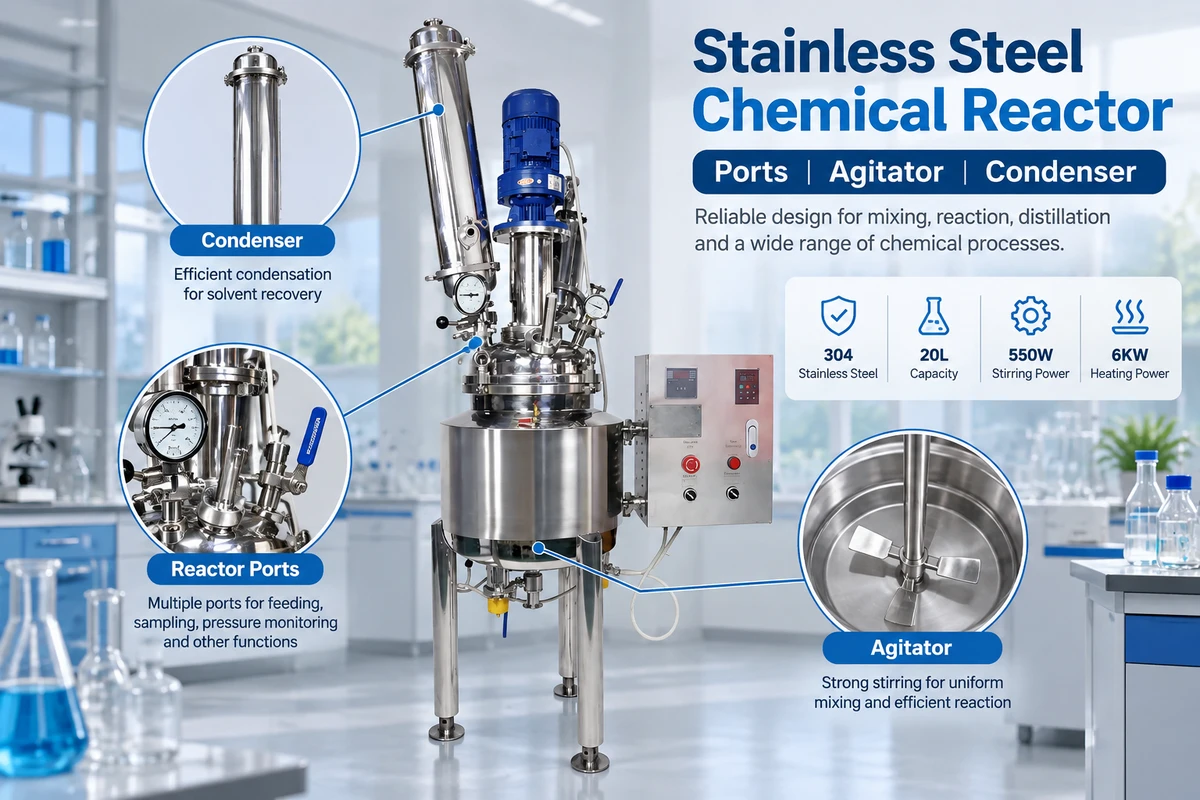
ZZKD options in the supplied series include SUS304 or SUS316 product-contact construction, a double-wall body, frequency-converter speed control, and PTFE mechanical sealing. Selection between 304 and 316 should follow actual chemical compatibility, chloride exposure, cleaning media, temperature, and purity requirements. For a broader overview, read the stainless steel chemical reactor technical guide.
4. Budget by usable capacity, not tank liters
Indicative list prices from the supplied ZZKD product sheet show why correct sizing matters. A 5 L jacketed stainless steel reactor is listed at about $1,485, a 20 L model at about $1,634, and a 50 L model at about $2,042. A 60–80 L listing spans $2,135–$2,228; the representative middle value is approximately $2,181.50. A 100 L decarboxylation model spans $3,300–$5,100, giving a midpoint reference of about $4,200.
These figures are planning references, not final quotations. Pressure rating, 316 stainless steel, motor size, condenser, controls, ports, sanitary finish, electrical standard, certification, shipping, and customization can change the total. Compare quotations with the same material, working pressure, temperature, agitation, jacket, accessories, and documentation. The relevant starting point is the ZZKD stainless steel reactor vessel range.
A reliable buying checklist
Send a supplier a process brief instead of requesting only “a 50 L reactor.” The brief should state:
Minimum, normal, and maximum liquid volume at each process stage
Chemical names, concentrations, solids content, viscosity, and corrosion concerns
Foam, gas generation, reflux, crystallization, and powder-addition behavior
Normal and design temperature plus normal and design pressure or vacuum
Desired heat-up, cool-down, and mixing times
Required wetted material, surface finish, seals, drainability, and cleaning method
Required ports, condenser, sensors, sampling, controls, and applicable certification
Final recommendation
Calculate the highest in-process volume, divide it by a justified fill fraction, move up to the next practical model, and then verify mixing, heat transfer, material compatibility, pressure design, and site rules. For many non-foaming processes, total capacity near 125% of the maximum batch is a useful first estimate; demanding foaming or gas-evolving duties may need about 167% or more.
ZZKD can evaluate 5–300 L requirements and suitable custom ports, agitation, jackets, and accessories from a complete process brief.
Explore ZZKD Reactor Vessels