
Small-batch process planning
Planning Small Chemical Batches in a Stainless Steel Reactor
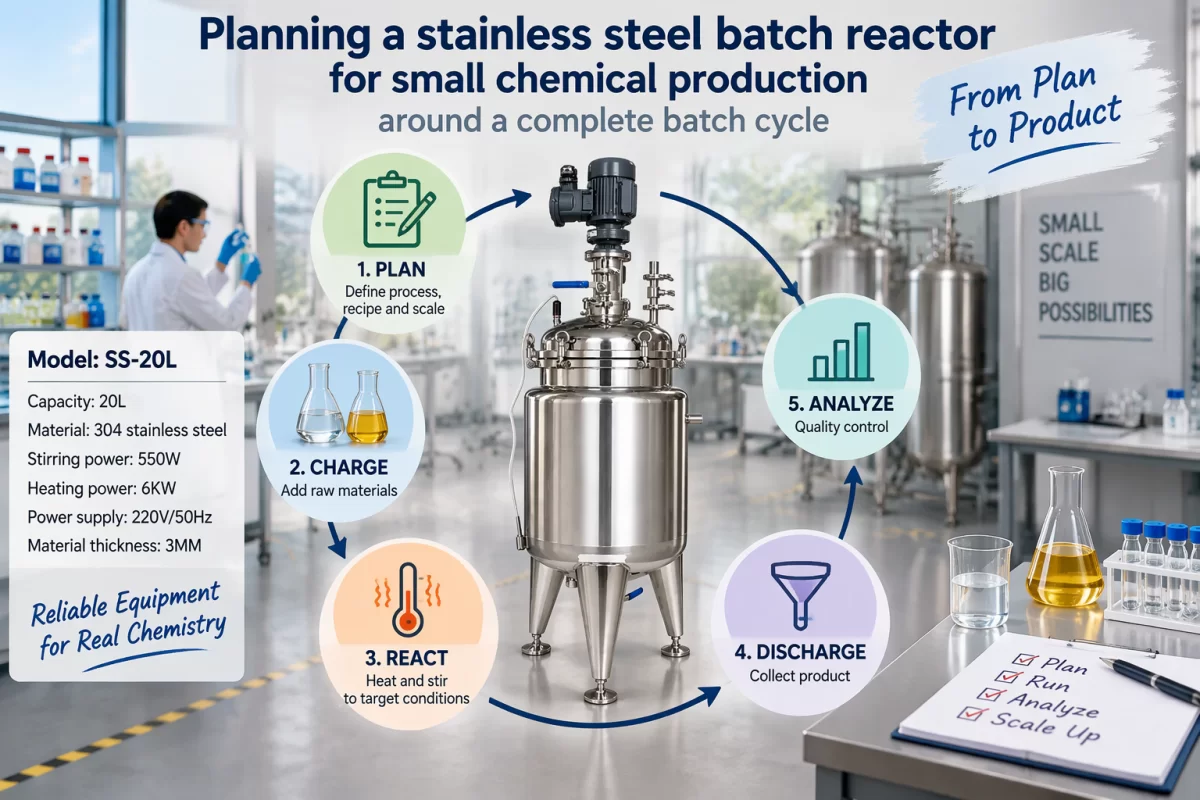
Choosing a stainless steel batch reactor for small chemical production starts with the batch schedule, not simply the vessel size. Charging, mixing, heat transfer, discharge and cleaning all affect how much usable product can move through a small production setup.
Plan the workload before choosing the vessel
A small-batch plan should state the required output, the number of formulations and the available operating hours. A short reaction may still occupy the reactor for much longer once charging, temperature conditioning, sampling, cooling, transfer and cleaning are included. Scheduling only the reaction hold time can therefore underestimate the equipment workload.
When evaluating a Stainless Steel Batch Reactor, map the entire cycle for each intended recipe. Separate operator-attended steps from waiting periods, and identify which tasks can happen outside the vessel. Preparing feed materials and receiving containers in advance may reduce interruptions, but those benefits should be checked against the actual site workflow.
- Define the batch: record the initial charge, later additions, solids content and expected final volume.
- Build the cycle: include charging, processing, cooling, discharge, cleaning and readiness checks.
- Identify changeovers: distinguish repeat batches of one formulation from switches between different materials.
- Allow operating margin: reserve time for sampling, inspections and routine maintenance.
Does a 5 L vessel mean a 5 L working batch?
I would not treat nominal vessel volume as an approved working charge. The suitable fill level depends on mixing coverage, additions, foaming, vapor space and the process behavior. Establish the working batch size through configuration review and trials with the intended material.
Use a defined small-reactor configuration as the starting point
The SS-5L equipment specification provides a concrete starting point for a compact batch discussion. Its reactor material is listed as 316 stainless steel, while the frame, pipe material and three-blade stirring rod are listed as 304 stainless steel. That distinction matters: the vessel material alone does not describe every component that may contact the process.
| Item | Listed specification | Planning relevance |
|---|---|---|
| Reactor volume | 5 L | Starting point for working-fill assessment |
| Reactor material | 316 stainless steel | Assess compatibility with the formulation |
| Frame and pipe material | 304 stainless steel | Review the process-contact boundary |
| Agitation | 0–600 rpm; frequency-converter control and digital speed display | Select an operating speed through mixing assessment |
| Stirring rod | 304 stainless steel; three blades | Evaluate mixing at the intended fill and viscosity |
| Heating method | Circulation heating | Define the external temperature-control requirements |
| Temperature indication | PT100 sensor with digital display | Include temperature measurement in the batch procedure |
| Seal and connections | Mechanical seal; threaded union interfaces | Review compatibility, access and maintenance needs |
| Discharge | Ball quick-discharge valve | Assess flow, retained material and cleaning access |
| Movement | Braked swivel casters | Plan positioning, utility routing and secured operation |
The lid specification includes stirring, solid charging, temperature measurement, pressure-gauge, constant-pressure funnel and condensation-reflux ports, with customization available according to requirements. Specify the accessories needed for the recipe separately; a listed port does not establish that a complete dosing or reflux assembly is included.
For a broader sizing discussion, the guide to choosing a stainless steel reactor vessel size is a relevant next step. Keep comparisons tied to a defined model and configuration rather than assuming that a larger vessel preserves the same mixing and transfer behavior.
Match mixing and heat transfer to the chemical process
A Stainless Steel Chemical Reactor should be evaluated against the formulation’s viscosity, solids loading, corrosion behavior and thermal demands. A speed range describes the available control range; it does not establish mixing quality, solids suspension or suitability for a viscous product.
For the SS-5L circulation-heated configuration, the project review should address the temperature-control unit, circulation fluid, connections and expected heating or cooling duty. Batch mass, heat capacity and any reaction heat influence the required cycle time. Temperature indication is useful for monitoring, but it does not by itself demonstrate temperature uniformity throughout the charge.
Can a stirring-speed specification predict batch completion time?
I use it as an equipment input, not a production guarantee. Trial work should establish whether the selected speed and blade arrangement provide adequate circulation at the planned fill level, and whether mixing remains acceptable as the material changes during the batch.
Treat discharge as part of the production cycle
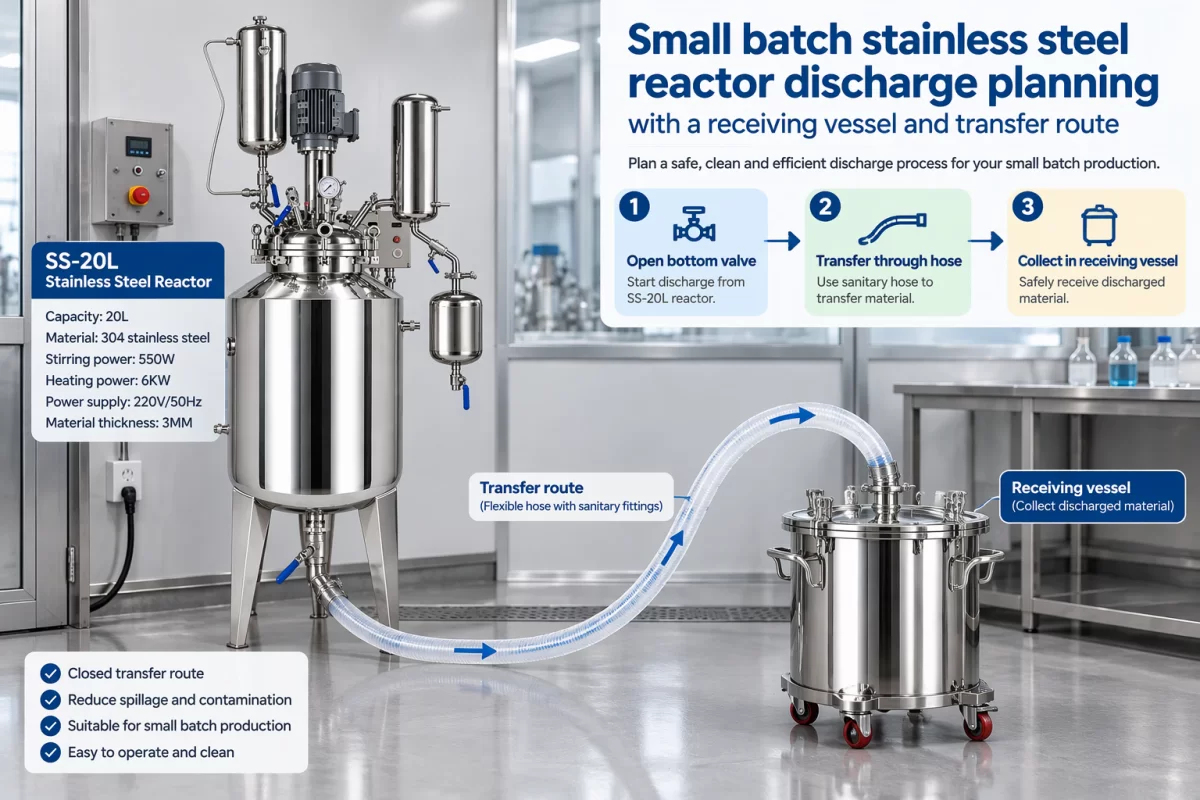
The SS-5L ball quick-discharge valve is relevant to small-batch planning because transfer can determine when the next cycle starts. However, its name does not establish a drainage rate or guarantee complete emptying. Product viscosity, particles, discharge temperature, outlet arrangement and the receiving vessel all influence the transfer step.
Define whether the product will be collected directly, routed through a hose or transferred into another process stage. Check the intended transfer route for material compatibility and practical cleaning access. Where yield is important, assess retained product in the vessel, valve and connected line rather than considering vessel discharge alone.
Build cleaning and changeover into the schedule
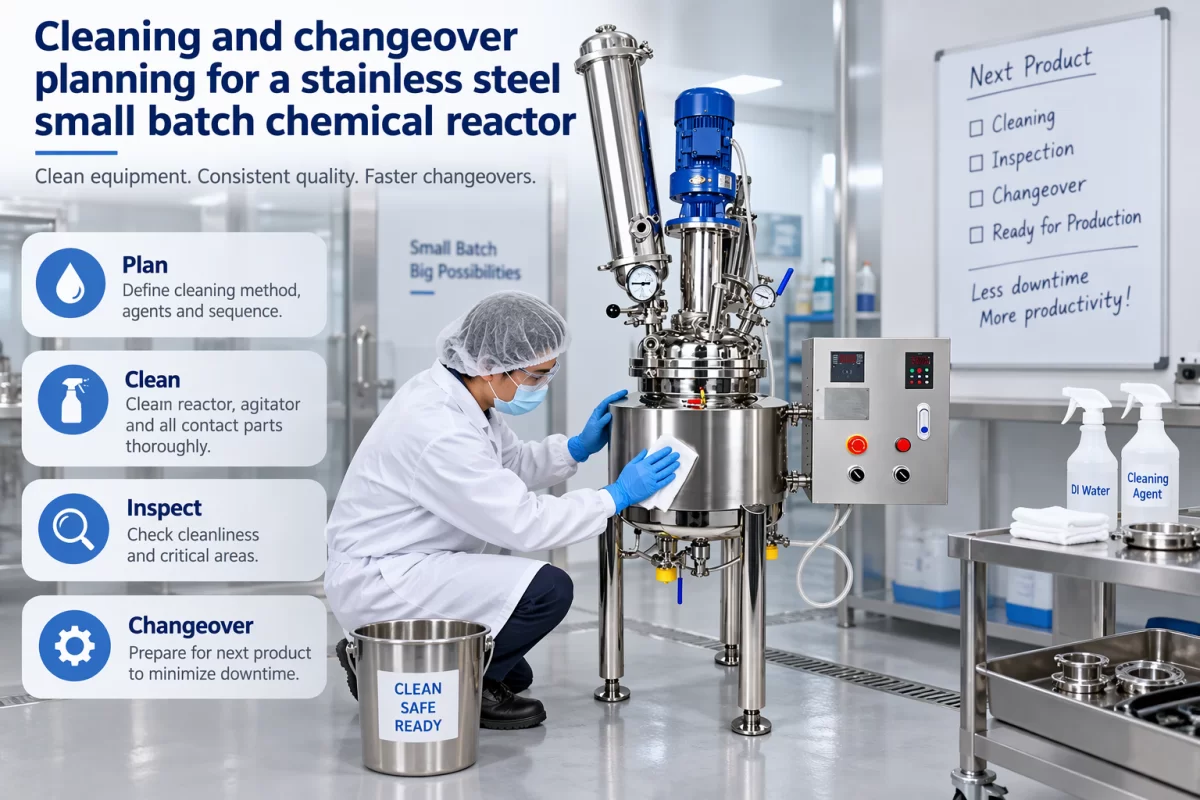
Changing formulations requires more than emptying the vessel. Cleaning requirements depend on residue solubility, adhesion, potential carryover and the next product. Consider access to the blades, lid ports, mechanical seal, threaded connections and discharge valve when developing the cleaning procedure.
Keep three decisions separate. Equipment documentation describes the supplied materials and assembly. Process suitability assessment considers the chemicals, operating conditions and cleaning agents. Project verification records demonstrate that the installed configuration performs as required through inspections, tests and documented results.
Material certificates, surface-finish documentation and any required qualification records should form part of the purchasing specification when relevant. Stainless steel construction alone does not establish a particular surface finish, pharmaceutical certification or production-compliance status. If pharmaceutical use is contemplated, suitability remains conditional on the specific materials, cleaning requirements and applicable verification documents.
What makes a changeover plan credible?
I look for a defined cleaning method, accessible components, suitable cleaning agents and an acceptance criterion for residual material. A measured changeover time is more useful for production scheduling than an assumed cleaning allowance.
Budget for a complete, defined configuration
Our company’s reference price is US$1,820. This is a budgeting reference, not a quotation for the SS-5L configuration described here. The actual quotation depends on the selected configuration and the inquiry result.
A useful purchasing request should distinguish the reactor from its supporting equipment. State the required temperature-control arrangement, charging accessories, condensation equipment, transfer connections, instrumentation and documentation. Comparing quotations on that same scope is more meaningful than comparing vessel prices alone.
Select for repeatable small-batch operation
The right stainless steel batch reactor for small chemical production is one that fits the working charge and the complete operating cycle. Nominal capacity is only the starting point: mixing, thermal duty, product discharge and changeover determine whether a configuration supports the planned workload.
Submit the material composition, intended working batch, viscosity or solids content, target temperature and pressure conditions, required output, transfer method and cleaning needs. Include the preferred utilities, accessories and documentation so that a corresponding configuration and quotation can be reviewed against the actual process.