
Chemical manufacturing · Process scale-up
Scaling Up Chemical Batch Production in Stainless Steel Reactors
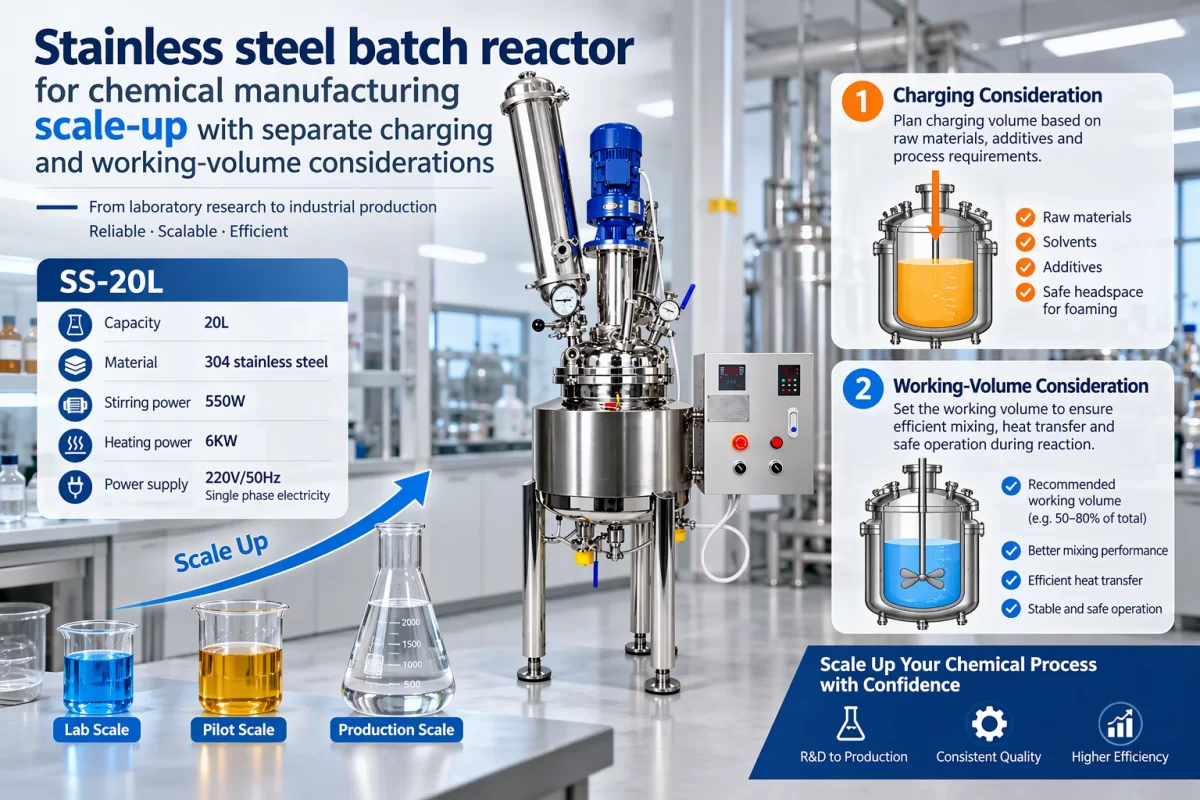
Choosing a stainless steel batch reactor for chemical manufacturing scale-up starts with the process—not simply a larger vessel. Mixing, heat removal, changing liquid levels, and cleaning time all influence whether a larger batch can meet the required quality and production schedule.
Define the batch before selecting reactor volume
A Stainless Steel Batch Reactor should be evaluated against the complete batch sequence: initial charging, controlled additions, reaction, holding, cooling, discharge, and cleaning. Nominal vessel volume alone does not establish usable working volume or finished-product output.
Current working batch
Record the actual starting charge, its mass and volume, density at operating temperature, solids content, and expected viscosity. The starting liquid level must support the intended impeller operation and temperature measurement. A batch that begins with a small charge can require different mixing arrangements from one that starts near its final volume.
Changes during feeding
Account separately for liquid additions, dissolved solids, gas introduction, foaming, and thermal expansion. Identify the maximum occupied volume during the process, not just the initial charge. Feed location and addition rate also matter because a locally concentrated reagent can create conditions that are not reflected by the bulk temperature reading.
Process allowance
Freeboard and operating allowance should follow the specific reaction, vapor behavior, agitation pattern, and risk assessment. There is no universal filling percentage suitable for every chemical mixture. A foaming process and a low-viscosity, nonfoaming blend should not automatically receive the same working-volume allowance.
Future expansion
Treat future demand as a separate requirement. Excessively enlarging a vessel can make today's smaller batches difficult to mix or measure. Compare a larger vessel with alternatives such as additional batches, parallel equipment, or staged expansion. For more sizing context, see the guide to choosing a stainless steel reactor vessel size.
Mixing scale-up requires more than matching rpm
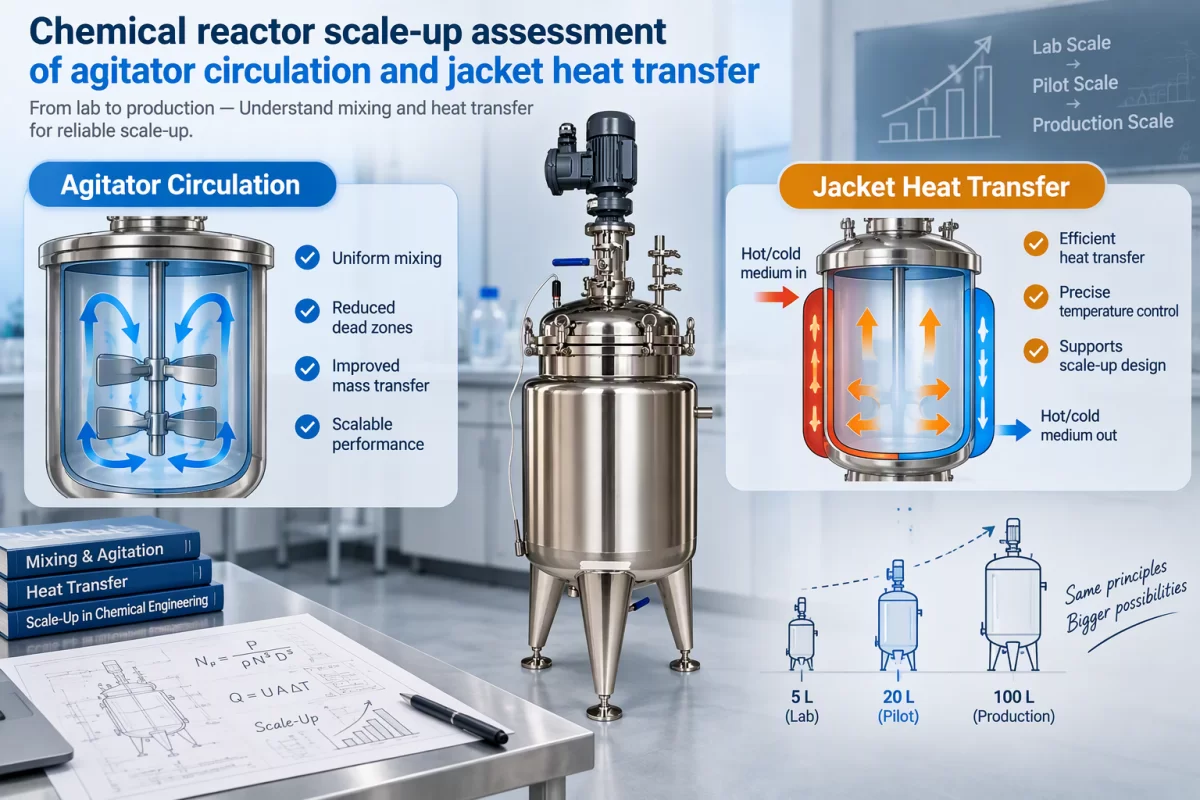
Agitator speed is only one part of the mixing assessment. Impeller diameter, blade geometry, liquid depth, vessel proportions, viscosity, and solids loading affect circulation and local shear. Maintaining the same rpm in a larger vessel does not necessarily preserve blend time, solids suspension, or gas dispersion.
Compare proposed equipment using the same configuration basis. Identify the actual impeller, drive arrangement, operating liquid level, and process viscosity before comparing speed or motor ratings. Ask for the intended operating range under load rather than treating a listed speed range as evidence that every batch can be mixed adequately.
For shear-sensitive products, settling solids, or viscosity that rises during reaction, define the critical mixing duty explicitly. Trial results and an engineering assessment can then support a scale-up approach appropriate to the process rather than a universal speed rule.
Heat transfer can become the scale-up bottleneck
Increasing vessel size does not increase heat-transfer area in the same proportion as batch volume. Larger batches can therefore require more time to heat or cool, even when the target temperature is unchanged. Jacket design, wetted area, utility flow, fluid properties, fouling, and agitation all contribute to the actual thermal response.
For an exothermic reaction, connect the proposed feed schedule to heat-release behavior and available cooling. The assessment should consider reaction accumulation and credible upset conditions, not only a steady operating temperature. A vessel temperature specification alone does not establish cooling capacity or a safe reagent addition rate.
A defined equipment configuration provides a useful starting point
The SS-5L configuration offers a specific reference for discussing laboratory batch requirements. Its reactor vessel material is identified separately from its frame, piping, and stirring rod. This distinction matters when defining the full product-contact path.
| Item | Specification |
|---|---|
| Reactor volume | 5 L |
| Jacket capacity | 1.5 L |
| Reactor material | 316 stainless steel |
| Frame and pipe material | 304 stainless steel |
| Stirring rod | 304 stainless steel; three blades |
| Stirring speed | 0–600 rpm; frequency-converter control |
| Heating method | Circulation heating |
| Temperature indication | PT100 sensor with digital display |
| Sealing method | Mechanical seal |
| Interface connection | Threaded union |
| Discharge arrangement | Ball-type quick-discharge valve |
| Power supply | 220 V / 60 Hz |
The lid includes openings for stirring, solid charging, temperature measurement, a pressure gauge, a constant-pressure funnel, and condensation reflux, with customization available according to requirements. Port positions and connections should be matched to the intended feeding, sampling, and vapor-handling sequence.
These details describe the SS-5L configuration; they should not be transferred automatically to a larger reactor. For a Stainless Steel Chemical Reactor proposal, compare the offered vessel volume, materials, agitator, heat-transfer arrangement, interfaces, seals, and cleaning provisions as one configuration. A product category name does not establish those details.
Match materials and cleaning to the actual chemistry
Stainless steel selection requires a process-specific compatibility assessment. Consider reagent concentration, temperature, exposure time, contaminants, and cleaning chemicals. A 316 stainless steel vessel does not make every connected component 316 stainless steel, nor does that grade guarantee resistance to every chemical environment.
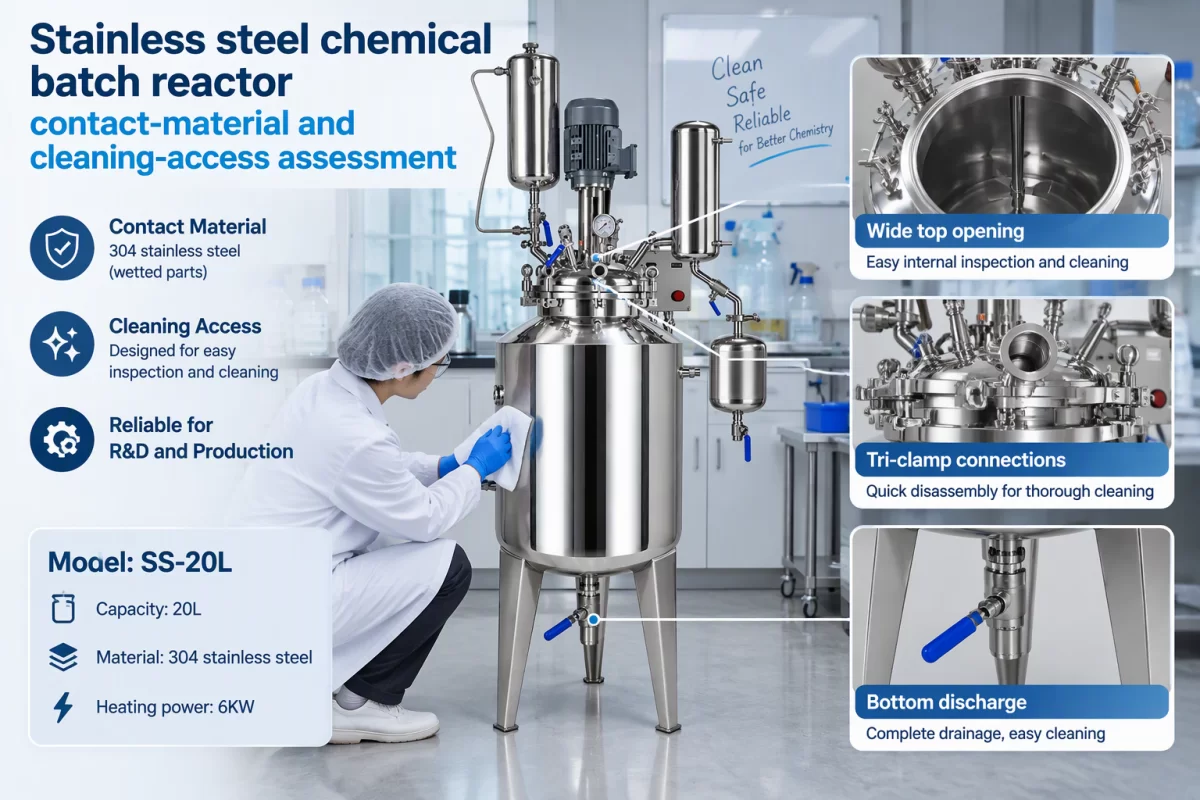
Review the surfaces that contact product, including the stirring rod, seals, valves, probes, and connected piping. Cleaning performance also depends on drainage, access, retained material around fittings, and the ability to reach surfaces behind the agitator. A threaded connection or ball discharge valve should be evaluated for the actual residue and cleaning procedure rather than assumed to be hygienic by designation.
Build a purchasing specification around measurable duties
A useful inquiry connects equipment choices to production requirements. Rather than requesting only a vessel capacity, provide enough information to evaluate the batch and its supporting utilities.
- Batch profile: starting charge, addition sequence, maximum occupied volume, and expected finished-batch quantity.
- Material behavior: composition, density, viscosity changes, solids loading, foaming, and corrosion considerations.
- Operating duties: target temperatures, pressure or vacuum conditions, reaction time, heat-release information, and cooling requirements.
- Configuration needs: agitator duty, feed and sampling connections, condenser arrangement, seals, discharge method, and available utilities.
- Cleaning and documentation: cleaning procedure, inspection access, material records, and any project-specific qualification requirements.
This reference is for initial budgeting, not a quotation for a particular reactor configuration or a complete scale-up system. The actual quotation depends on the selected configuration and inquiry results.
Evaluate the quoted scope alongside the process duty. Establish whether the supply includes the required circulation equipment, instrumentation, connections, and accessories. Comparing quotations on the same configuration basis is more useful than comparing headline prices alone.
Select for a repeatable batch process—not a volume ratio
The right stainless steel batch reactor for chemical manufacturing scale-up is the configuration that supports the required mixing, thermal control, charging sequence, discharge, and cleaning cycle. Separate today's working batch from addition-related volume changes, process allowance, and future expansion. Then assess materials and documentation against the actual chemistry and intended application.
Production capacity should follow an evaluated batch size and cycle time, not a promise based on vessel-volume multiplication. This approach gives purchasing teams a clearer basis for comparing equipment and planning a practical scale-up.
Planning the next production stage? Submit the material composition, current and target working batches, addition schedule, operating conditions, available utilities, and required configuration to KD Reactor for a corresponding equipment assessment and quotation.