
Pharmaceutical pilot processing · System selection
What Belongs in a Pharmaceutical Pilot Glass Reactor System?
An industrial jacketed glass reactor system for pharmaceutical pilot production is more than a vessel with a stirrer. Its usefulness depends on how the reaction vessel, circulating temperature-control equipment, condenser, vacuum equipment, and support frame work together. A purchasing specification should therefore describe both the process duty and the supply boundary: what the supplier delivers, what the site provides, and how the components connect.
For pharmaceutical pilot work, the central question is not simply whether a reactor is labeled 20L or 50L. It is whether the proposed configuration can accommodate the intended batch sequence, heat-transfer demand, vapor load, material properties, and operating procedures.
The vessel defines the process space—not the complete system
The reaction vessel holds the process material, while its jacket provides a separate path for circulating heat-transfer fluid. Agitation supports mixing and heat distribution, but selecting a stirrer requires more than comparing motor labels. Liquid viscosity, suspended solids, changing liquid level, and impeller geometry all influence the mixing duty.
A vessel package should be described in terms of its body, lid, agitator assembly, seals, process connections, and discharge arrangement. Feeding, temperature measurement, sampling, vapor transfer, and cleaning access must fit the intended operation. For slurry discharge, the outlet arrangement deserves particular attention because particle settling and blockage can affect batch recovery.
The order should distinguish the supplied reactor assembly from auxiliary equipment and site installation. A product photograph does not establish whether hoses, adapters, receiving vessels, instruments, or installation services are included.
Does a jacketed glass vessel provide high-pressure capability?
I would not treat a jacket as evidence of pressure capability. The process space and the jacket are separate pressure boundaries, and an ordinary jacketed glass reactor must not be presented as a high-pressure reactor merely because it has a jacket or vacuum connection. For pressure-based processing, the required equipment category should be assessed separately; this discussion of glass pressure reactors for pharmaceutical scale-up addresses that distinct selection topic.
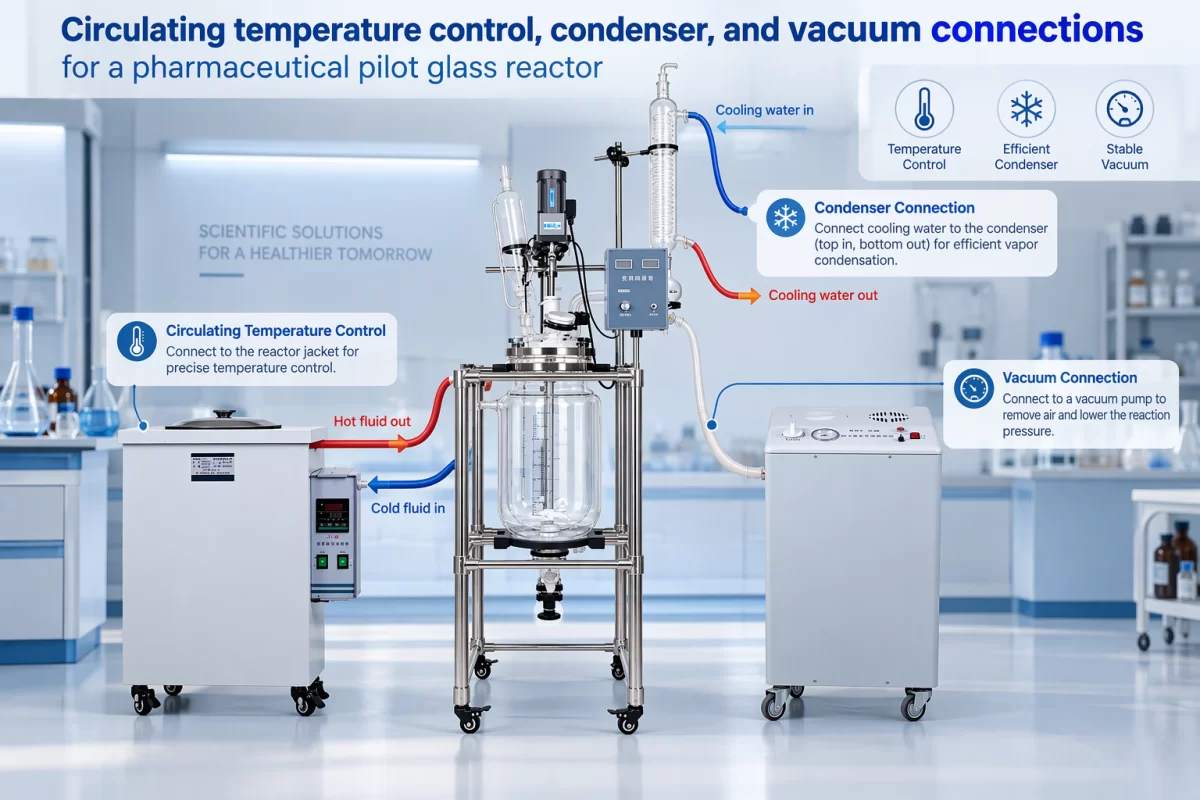
Circulating temperature control, condensation, and vacuum
Circulating temperature control
The circulating temperature-control unit supplies heat-transfer fluid to the jacket and removes or adds heat as the process requires. Selection should consider the target process temperatures, heating and cooling sequence, reaction heat release, fluid choice, and the resistance of the circulation circuit. A controller setpoint is not the same as the temperature throughout the batch.
The supply scope should identify the temperature-control unit, circulation hoses, insulation, connection fittings, sensors, and control arrangement. The site must also plan suitable electrical service and any cooling-water, ventilation, or other utility requirements associated with the selected equipment.
Condensation and receiving equipment
The condenser removes heat from process vapor so that condensate can return as reflux or flow to a receiver. Its duty depends on the solvent, vapor generation rate, operating pressure, and coolant conditions—not vessel capacity alone. Reflux and collection arrangements should be specified explicitly, including vapor connections, receivers, valves, and the source of condenser cooling.
Is a vacuum connection equivalent to a complete vacuum system?
I treat the connection as an interface, not a complete package. The process may also require a suitable pump, protective trap, solvent-compatible tubing, pressure measurement, isolation valves, and a defined exhaust route. The condenser and vacuum equipment must be considered together so that vapor handling does not depend on the pump alone.
Vacuum operation and material compatibility
Vacuum equipment can support processes that call for reduced pressure, but the permitted operating envelope must come from the selected assembly's documented limits. The vessel, seals, valves, hoses, condenser, and receiver all matter. Compatibility review should cover every wetted component against the solvents, reagents, cleaning agents, and process temperatures involved.
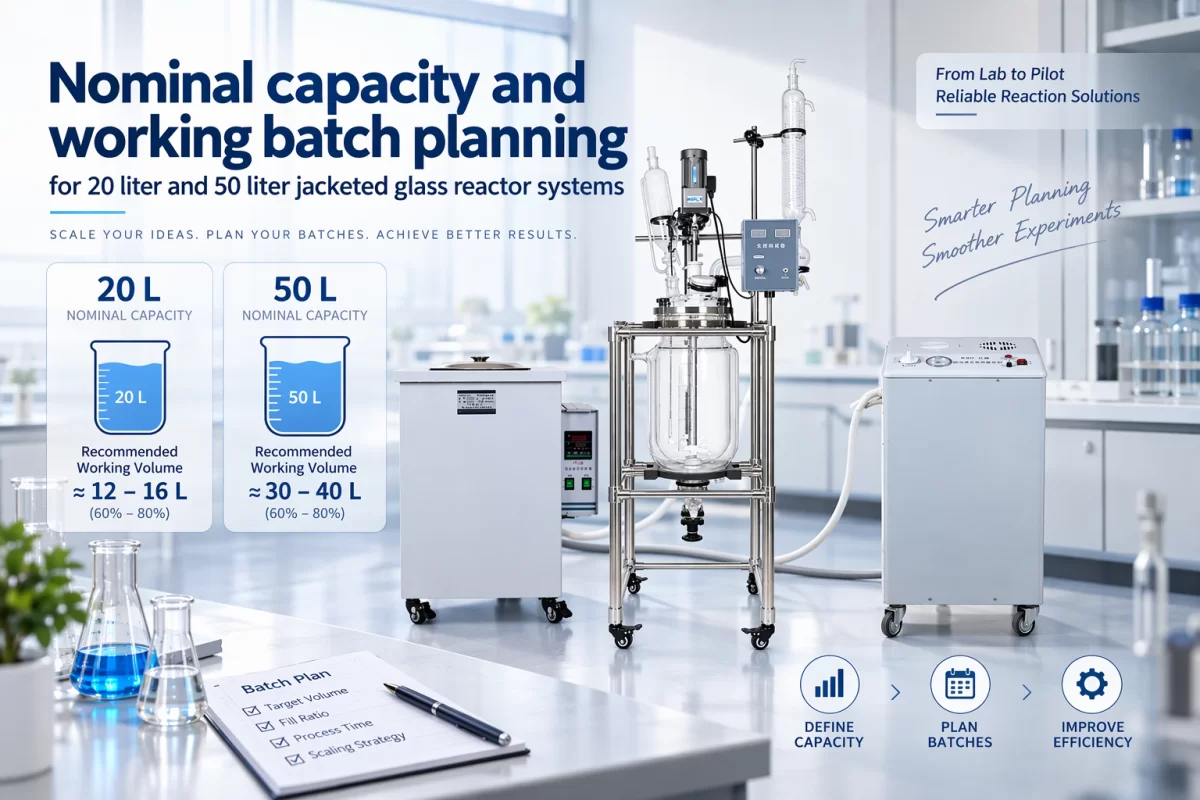
Choosing between 20L and 50L: separate four capacity decisions
The 20L Jacketed Glass Reactor is a nominal 20 L capacity option to evaluate against the current pilot batch and its full operating sequence. Its suitability depends on the specific vessel, jacket, agitator, condenser, connections, discharge arrangement, and temperature-control package—not the capacity label alone.
The 50L Jacketed Glass Reactor provides a nominal 50 L option for comparison when the batch sequence or planned expansion calls for a larger vessel. A larger nominal volume does not automatically deliver the required mixing, cooling, condensation, or discharge performance.
| Selection point | 20L Jacketed Glass Reactor | 50L Jacketed Glass Reactor |
|---|---|---|
| Nominal vessel capacity (L) | 20 | 50 |
| Working batch | Determine from the material and operating sequence | Determine from the material and operating sequence |
| Configuration comparison | Assess vessel, jacket, agitation, condenser, interfaces, discharge, and temperature control | Assess vessel, jacket, agitation, condenser, interfaces, discharge, and temperature control |
| Purchase scope | Define reactor assembly, auxiliary equipment, and site connections separately | Define reactor assembly, auxiliary equipment, and site connections separately |
1. Current working batch
Start with the present process: initial charge, material density, minimum liquid level, and the mixing requirement at that level. Nominal vessel capacity is not a guaranteed working batch. There is no single loading percentage that is appropriate for all liquids, slurries, or reaction types.
2. Changes during addition
Track how the contents change during dosing, dilution, washing, or solvent exchange. The initial charge may be smaller than the highest liquid volume reached later. Added solids can also change viscosity and suspension behavior even when the volume increase is modest.
3. Process operating margin
Allow for the specific behavior of the process, including foaming, boiling, gas evolution, and agitation-induced surface movement. The required free space should follow process evidence and equipment limits rather than a universal fill rule.
Does selecting a larger vessel solve every future capacity problem?
I would separate vessel space from system capability. A larger batch can increase heat removal, vapor handling, and mixing demands, while a small batch in a larger vessel may create different agitation and measurement challenges. Expansion planning should include the auxiliaries and interfaces, not just extra liters.
4. Future expansion
Describe future batch sizes and process changes separately from today's requirements. This makes it easier to compare a system optimized for current work with one designed for a broader operating range, without allowing a hypothetical future batch to obscure present performance needs.
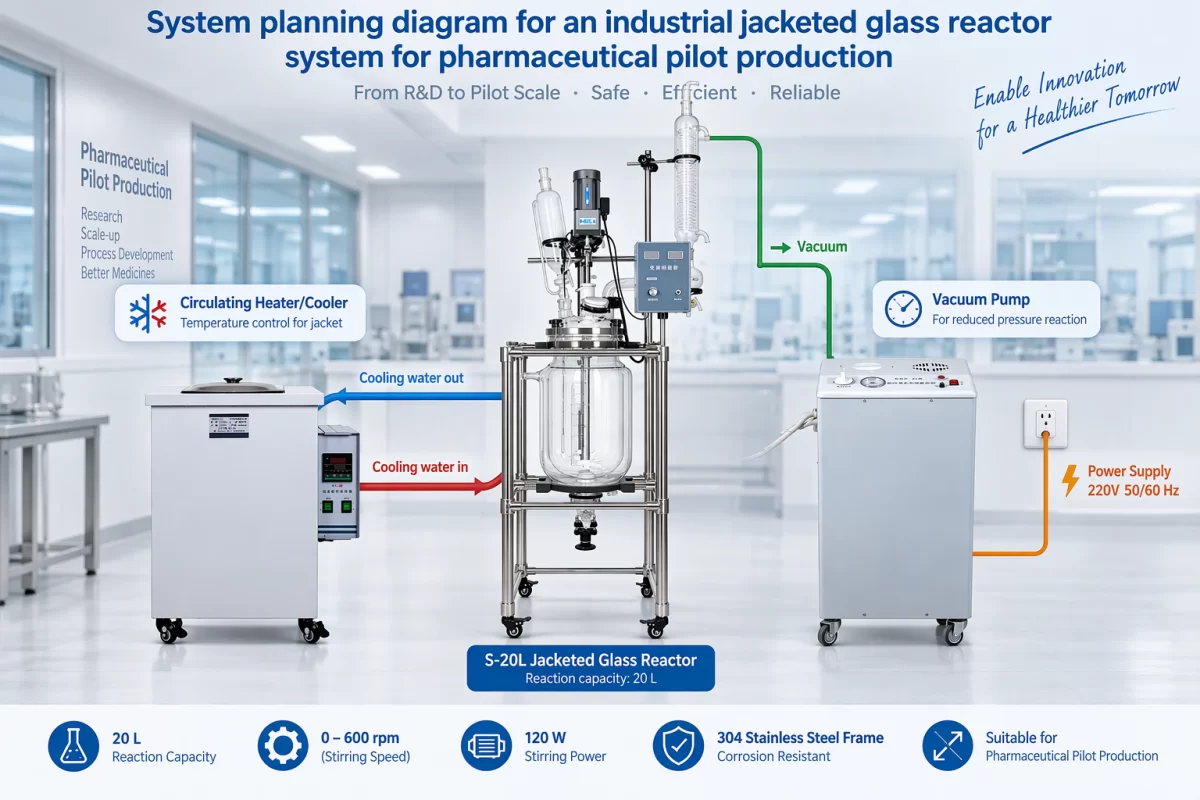
Support frame, supply boundaries, and reference pricing
The support frame positions the vessel and its attached equipment while providing access for charging, sampling, discharge, and maintenance. The planned layout should avoid transferring unsupported piping loads to glass connections. It should also accommodate receiver access, hose routing, instrument visibility, and the space needed for safe operation.
A clear quotation separates the reactor assembly and frame from circulating temperature control, condenser cooling, vacuum equipment, receivers, instrumentation, and installation accessories. Where hazardous-area requirements apply, the electrical equipment and installation must be selected for that environment; a product label alone does not establish the suitability of the entire system.
Pharmaceutical purchasing should also define cleaning access, product-contact material documentation, calibration needs, and qualification support appropriate to the intended use. Calling equipment a pharmaceutical pilot reactor does not by itself establish regulatory compliance or validation status.
Company reference price: US$1,699. This is a reference price across the company's listed reactor offerings, not a quotation for either capacity or for a complete pharmaceutical pilot system. The actual quotation depends on the selected configuration and inquiry results, including the auxiliary equipment and supply scope.
Specify the complete pharmaceutical pilot reactor system
Selecting an industrial jacketed glass reactor system for pharmaceutical pilot production means matching the vessel, temperature-control loop, condenser, vacuum equipment, and frame to one process specification. Compare the 20L and 50L options through their model-specific assemblies and auxiliary equipment, keep nominal capacity separate from working batch, and do not infer high-pressure capability from an ordinary jacketed vessel.
For a configuration proposal and quotation, submit the material composition, current working batch, addition sequence, expected foaming or solids behavior, target temperatures and pressures, heating and cooling duties, available utilities, and future expansion needs. Include the required feeding, sampling, discharge, cleaning, and documentation arrangements so that the operating envelope, material compatibility, and equipment scope can be assessed for the proposed system.