
Pharmaceutical pilot procurement
A Procurement Brief for a Pharmaceutical Pilot Glass Reactor System
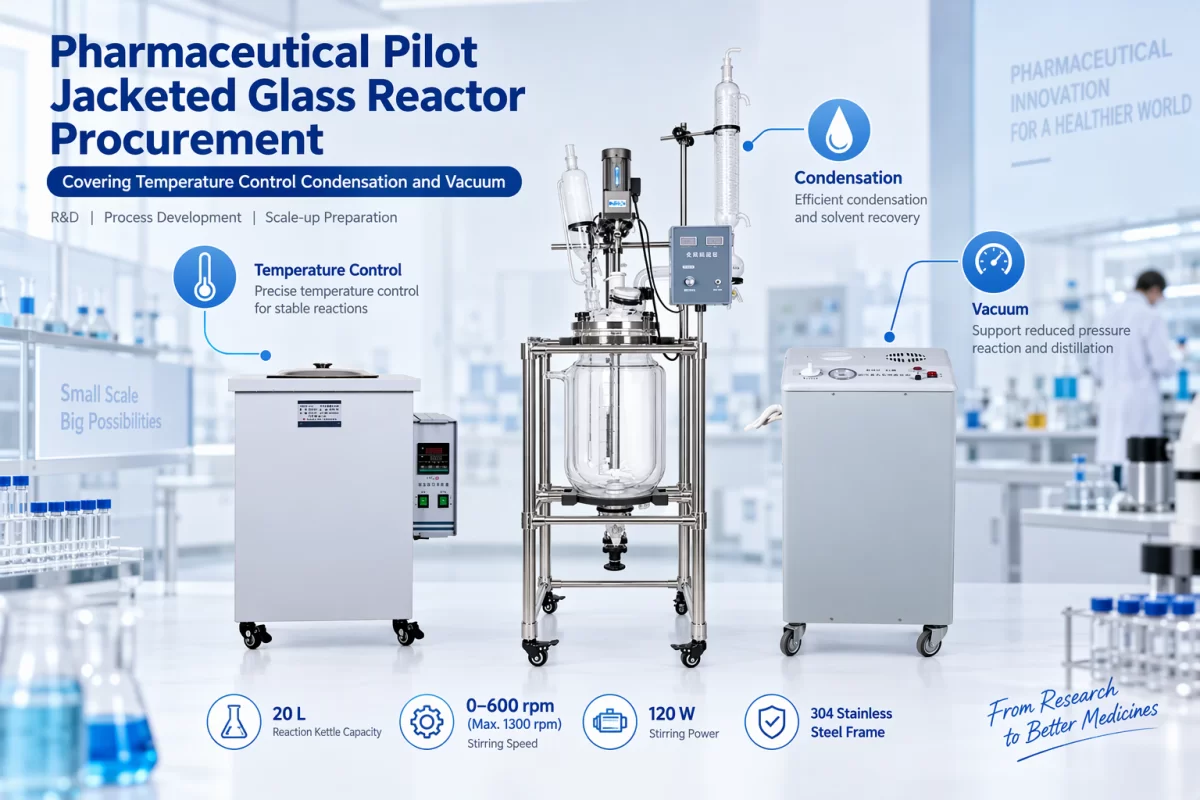
An industrial jacketed glass reactor for pharmaceutical pilot production purchase should begin with a process specification, not simply a vessel size. The buying decision must connect batch requirements with the reactor, temperature-control package, condenser, vacuum equipment, and delivery documentation.
Define five purchasing boundaries before comparing quotations
A pharmaceutical pilot project may involve reaction, controlled addition, reflux, solvent removal, or crystallization. These operations create different demands on the equipment package. A quotation for a vessel alone is not directly comparable with a quotation that includes circulation equipment, vacuum accessories, installation support, and acceptance testing.
Divide the request for quotation into five scopes. For each scope, identify what the supplier provides, what the site provides, and who is responsible for making the interfaces work together.
| Procurement boundary | Requirements to specify | Commercial boundary |
|---|---|---|
| Reactor assembly | Vessel, jacket, agitator, seals, ports, support, and bottom discharge | Define included fittings and wetted components |
| Temperature control | Process temperature profile, heat load, circulation fluid, and hose connections | Separate circulator supply from site utilities |
| Condensation | Vapor duty, coolant conditions, receiver arrangement, and cleaning access | Identify condenser and coolant-system scope |
| Vacuum | Operating vacuum, vapor load, protection traps, and exhaust handling | Define pump, controls, tubing, and exhaust responsibilities |
| Delivery documents | Drawings, manuals, component records, and agreed test reports | List required deliverables and acceptance milestones |
Does a jacketed glass vessel imply high-pressure capability?
My procurement advice is no. A jacket provides a heat-transfer space; it does not establish a positive-pressure rating for the reaction chamber. Vacuum suitability also does not prove positive-pressure suitability. Where the process requires pressurization, use a specifically rated design and documented operating limits. The discussion of glass pressure reactors for pharmaceutical scale-up is a relevant starting point, but it cannot establish the rating of an ordinary jacketed model.
Compare 20L and 50L reactors by process needs, not labels alone
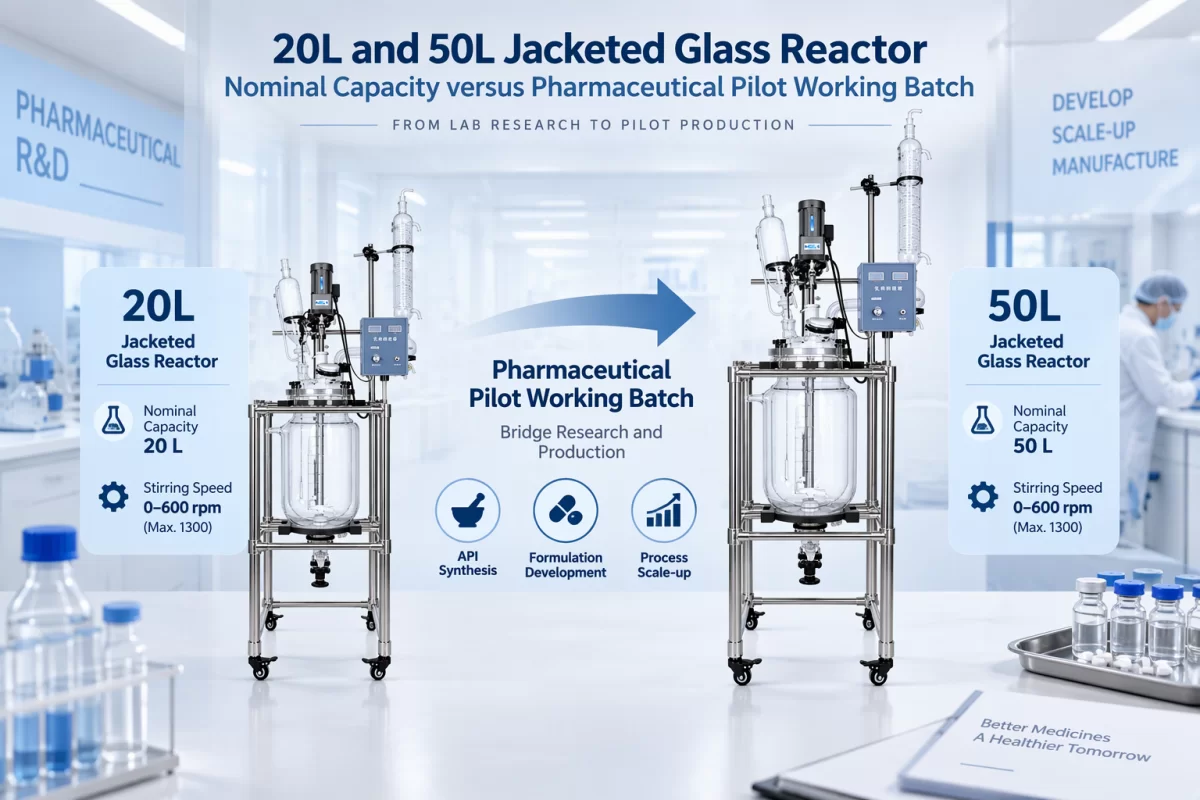
The 20L Jacketed Glass Reactor belongs in the comparison when the planned pilot batch can be accommodated within an appropriate operating envelope. The S-20L model has a nominal reaction-vessel capacity of 20 L. That figure describes nominal capacity, not a guaranteed working batch, minimum mixing volume, or usable volume under reflux.
The 50L Jacketed Glass Reactor provides a larger nominal-capacity option; the S-50L model is listed at 50 L. It deserves consideration when the project requires a larger final charge or a different expansion plan. Larger capacity alone does not establish better mixing, faster cooling, or a suitable condenser for the intended operation.
| Product | Model | Nominal capacity (L) | Basis for selection |
|---|---|---|---|
| 20L Jacketed Glass Reactor | S-20L | 20 | Process-specific batch and configuration assessment |
| 50L Jacketed Glass Reactor | S-50L | 50 | Process-specific batch and configuration assessment |
Separate four volume decisions
- Current batch: Describe the initial charge, composition, solids content, viscosity, and expected volume at operating temperature.
- Addition changes: Record staged reagent feeds, solvent additions, and the largest expected liquid inventory during the recipe.
- Process allowance: Account for foaming, vapor disengagement, agitation behavior, and the intended reflux or distillation arrangement.
- Future expansion: State the anticipated batch increase separately from today's requirement. Check that the present smaller batch can still be mixed and temperature-controlled effectively.
Can a single filling percentage determine the working batch?
I would not apply one percentage to every pharmaceutical material. For example, assume an initial liquid charge of 8 L followed by a 3 L feed, with additive volumes and no evaporation. The resulting estimated liquid inventory is 11 L. This is only a planning example: it does not account for volume change on mixing, thermal expansion, foam, solids, or required headspace, and it is not an equipment guarantee.
Turn the process recipe into a coordinated equipment specification
Assess each capacity against its own vessel geometry, jacket arrangement, agitator, condenser, connection layout, discharge design, and proposed temperature-control package. Do not transfer a component specification from another capacity simply because the equipment looks similar.
For agitation, describe how the material changes through the batch. A low-viscosity starting solution may become a suspension or viscous concentrate. Define the intended impeller arrangement, mixing objective, and operating sequence so the proposed drive and shaft assembly can be assessed against the actual duty.
For temperature control, provide heating and cooling stages, addition rates, reaction heat information where available, and site utility conditions. A circulator setpoint is not the same as product temperature. The complete assessment should consider heat transfer through the vessel wall, fluid circulation, sensor placement, and control response.
For condensation and vacuum, specify solvent composition, expected vapor generation, receiver capacity needs, and exhaust treatment. The condenser, pump, traps, seals, and connecting lines must be assessed as one vapor-handling path. A pump's standalone capability does not establish the vacuum achievable during an operating batch.
Set reaction-side and jacket-side temperature and pressure requirements separately. Require documented allowable limits for the offered assembly, including seals and accessories. Review wetted-material compatibility against solvents, reagents, cleaning agents, and exposure conditions. The site utility specification should cover electrical supply, cooling services, ventilation, and any hazardous-area requirements; the product name does not establish certification.
Use a reference price without confusing it with a system quotation
Our company's reference price is US$1,699 across the supplied jacketed glass reactor price list. This portfolio reference is not a dedicated quotation for either the 20L or 50L model and should not be treated as the price of a complete pharmaceutical pilot package. The actual quotation depends on configuration and the inquiry result.
Request an itemized proposal separating the reactor assembly, temperature-control equipment, condenser package, vacuum package, accessories, documentation, and delivery services. Identify exclusions explicitly so that site-supplied components and installation work are included in the project budget.
What makes competing package quotations meaningfully comparable?
I compare them against the same written process duty, equipment boundaries, and acceptance criteria. A lower initial price is not necessarily a lower project cost when essential cooling equipment, fittings, testing, or delivery documents remain outside the offer.
Make delivery documents part of the pharmaceutical pilot purchase
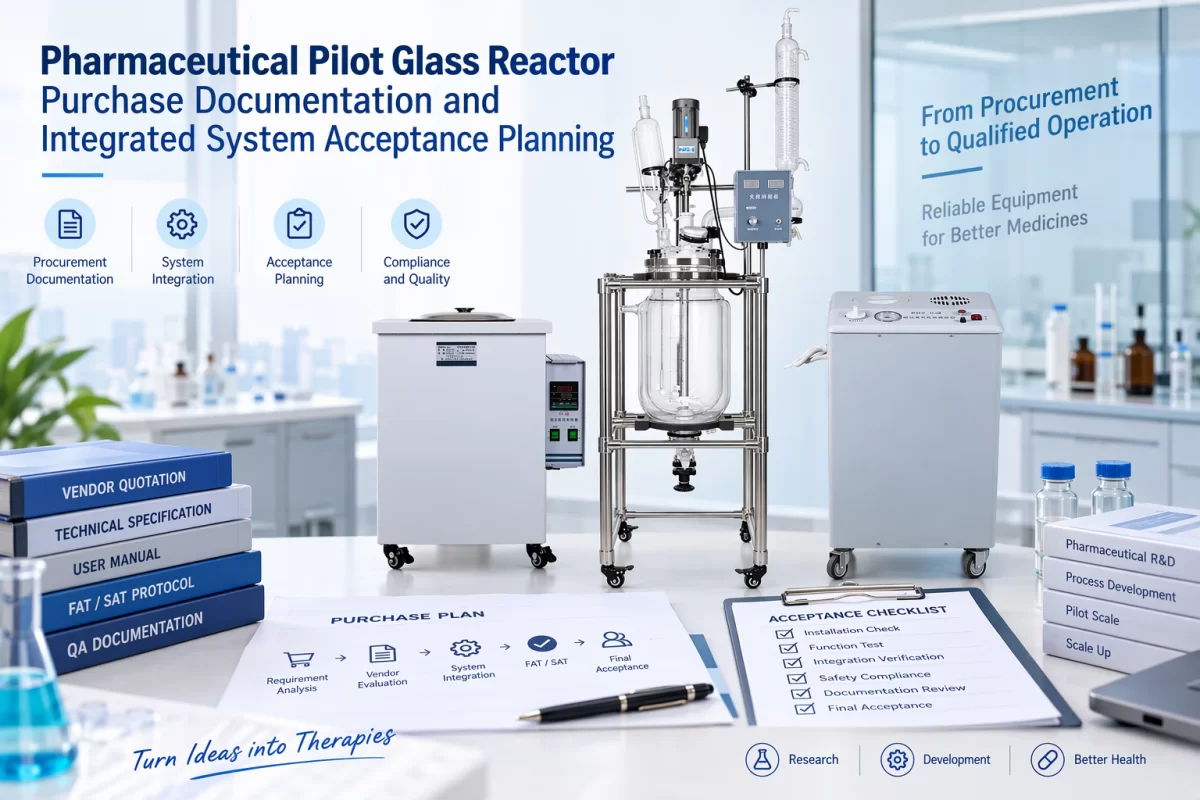
Define the required document package before issuing the purchase order. Depending on the project, this can include an equipment arrangement drawing, connection schedule, wetted-component description, operating and maintenance instructions, instrument records, and agreed inspection or functional-test reports. State which documents are required for review before shipment and which accompany delivery.
For a pharmaceutical application, connect the requested documentation to the site's qualification and cleaning strategy. Do not assume that a general-purpose reactor arrives with a complete qualification package or that its construction alone establishes GMP compliance. Agree the supplier's support scope and the site's responsibilities in writing.
Acceptance activities should follow the agreed specification: component completeness, connection compatibility, agitation operation, temperature-control integration, discharge accessibility, and vacuum performance under defined test conditions. Record the test method and acceptance criteria rather than relying on an undefined promise that the system will “work.”
A procurement decision built around the complete pilot process
A sound industrial jacketed glass reactor purchase for pharmaceutical pilot production separates nominal capacity from working batch and separates the vessel from its supporting systems. Compare the 20L and 50L options against current inventory, later additions, process allowance, and future expansion—not nominal volume alone.
Submit the material composition, initial and maximum batch volumes, addition sequence, target temperature profile, vacuum or pressure conditions, available utilities, and required configuration. Include the intended condenser, temperature-control, vacuum, and documentation scope so a corresponding equipment proposal and quotation can be developed for further technical assessment.