
Avoiding Oversizing When Buying a Stainless Steel Reactor Vessel
Deciding what size stainless steel reactor vessel to buy starts with the batches a process must actually handle—not the largest nominal capacity available. An oversized reactor may provide unused space while creating difficulties with small-batch mixing, temperature measurement, cleaning, and investment recovery.
The practical goal is a vessel that accommodates the largest credible process volume while remaining effective at the smallest routine charge. Capacity, agitation, heat exchange, material compatibility, and cleaning access need to be considered together.
Start with minimum effective working volume
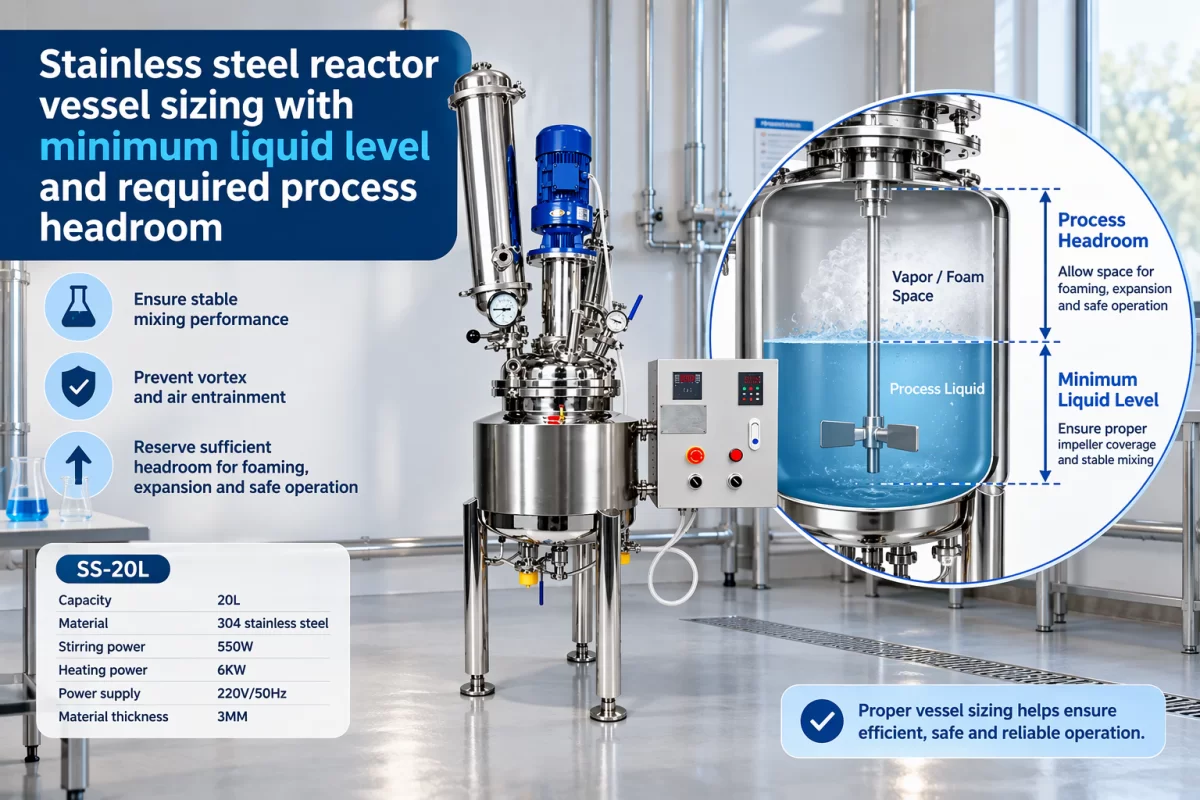
Nominal vessel volume is not the same as a demonstrated operating range. At a low liquid level, an impeller may be insufficiently submerged, a temperature sensor may not contact representative liquid, or solids may collect outside the useful circulation pattern. Those risks depend on vessel geometry, impeller position, material behavior, and the actual operating sequence.
When evaluating a Stainless Steel Reactor Vessel, specify the smallest initial charge as well as the usual batch size. Ask for the relevant impeller dimensions, sensor location, and discharge arrangement for the proposed configuration. A larger vessel is not automatically a better choice if its smallest routine batch cannot be mixed, measured, and discharged reliably.
Does a larger reactor necessarily improve batch flexibility?
My answer is no. I would assess flexibility by the usable batch range, not the nameplate volume. A vessel that handles a large campaign but performs poorly with frequent small batches can be less flexible than a smaller, appropriately configured unit.
Separate current batches, additions, headroom, and expansion
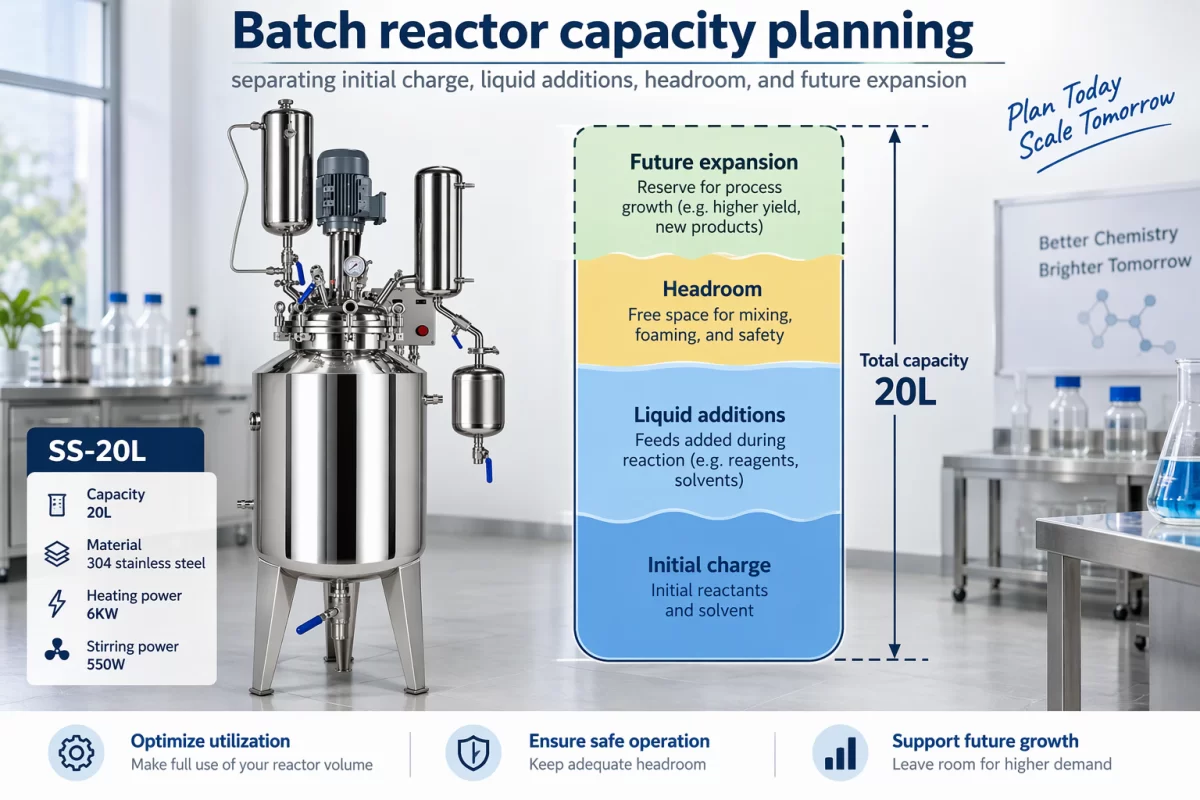
A useful sizing brief separates four requirements instead of combining them into one generous allowance. This makes the purchase decision easier to explain and prevents the same contingency from being counted more than once.
- Current batch volume: Record the smallest, typical, and largest batches produced today. Include the initial charge, which may be much smaller than the final batch.
- Changes during feeding: Identify solvent additions, reagent feeds, washes performed in the vessel, and any material removal. Use the highest simultaneous liquid inventory rather than automatically summing every addition.
- Process headroom: Assess foaming, gas release, thermal expansion, vapor disengagement, and reflux behavior. These needs are process-specific; one filling percentage should not be applied to every material.
- Future expansion: Treat expected growth as a separate business scenario with a credible volume forecast and timeline. Compare a larger vessel against extra campaigns or a later second unit.
For a Stainless Steel Batch Reactor, this stage-by-stage assessment is especially useful when dosing substantially changes liquid level. The starting charge must support the intended agitation and measurement, while the later charge must leave enough process-specific headroom.
Illustrative calculation—not a vessel guarantee
Assume a hypothetical process begins with 3.0 L and receives 0.8 L of additional liquid before any removal. Its peak liquid inventory is therefore 3.8 L. If process assessment establishes a separate 1.2 L free-space requirement, the arithmetic screening volume is 5.0 L.
These assumptions do not establish that any particular 5 L reactor is suitable. Foaming behavior, usable vessel geometry, mixing at the 3.0 L starting charge, sensor immersion, and thermal duty still determine suitability. This example is not a universal loading ratio or an equipment guarantee.
For additional sizing context, see the guide to choosing stainless steel reactor vessel capacity. The purchasing decision should still be tied to the specific proposed configuration and operating conditions.
Evaluate a defined configuration, not a collection of maximum ratings
Capacity comparisons only make sense when the configuration basis is consistent. A different agitator, heating arrangement, seal, or wetted material can change suitability even when two vessels have the same nominal volume. Do not combine the largest capacity from a product series with temperature or pressure limits from another configuration.
The SS-5L specification provides the following configuration details. These describe the equipment; they do not establish a minimum effective batch volume or guarantee performance with a particular formulation.
| SS-5L feature | Specified detail | Sizing relevance |
|---|---|---|
| Nominal reactor volume | 5 L | Not a stated working-volume range |
| Reactor material | 316 stainless steel | Assess against the process chemistry |
| Pipe and stirring rod materials | 304 stainless steel | Evaluate individual wetted components |
| Stirring speed | 0–600 rpm | Speed alone does not establish mixing performance |
| Heating method | Circulation heating | Match the thermal system to the batch duty |
| Temperature display | PT100 sensor with digital display | Sensor position matters at low liquid levels |
| Seal and connections | Mechanical seal; threaded unions | Assess compatibility and cleaning access |
| Discharge | Ball quick-discharge valve | Review drainage and retained product |
The SS-5L lid specification includes stirring, solid-feeding, temperature-measurement, pressure-gauge, constant-pressure-funnel, and condensation-reflux ports, with customization available according to requirements. Port placement and the attached equipment should be reviewed alongside batch size, particularly where feeding or reflux influences the operating liquid level.
Account for investment and cleaning—not just purchase capacity
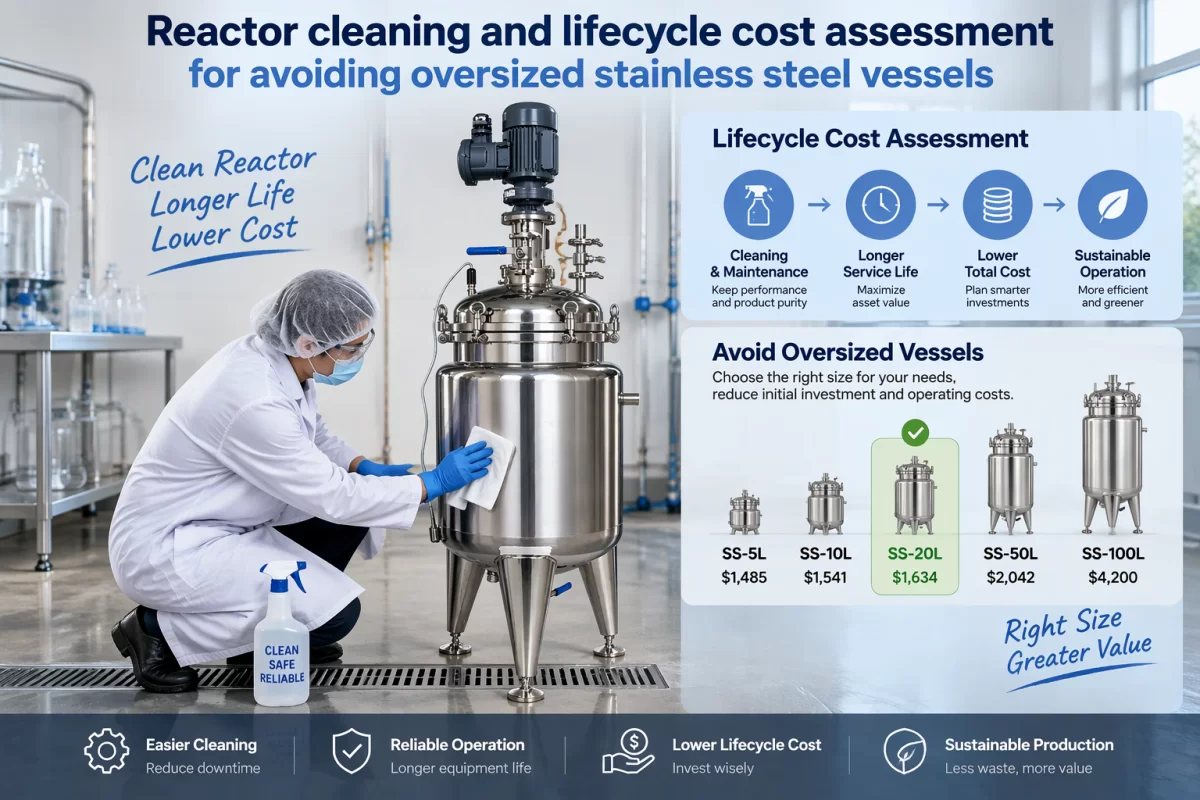
Oversizing can affect more than the initial equipment bill. A larger installation may require additional space, a different thermal utility arrangement, and more handling effort. Depending on geometry and the cleaning procedure, it may also increase the surfaces to inspect or the cleaning solution needed. These effects should be evaluated rather than assumed to increase in direct proportion to nominal liters.
Our company’s reference price is US$1,820. This is a reference from our supplied price list, not a quotation for the SS-5L configuration shown above or a guaranteed price for the linked products. The actual quotation depends on configuration and the inquiry outcome.
Compare total operating cost at the expected number of batches per year. Include cleaning time, cleaning agents, rinse water, waste treatment, product recovery, and downtime. If most production uses small charges, unused capacity may offer little practical return while complicating routine changeovers.
Can a larger vessel reduce total production cost?
I would consider that possible when demand supports larger campaigns and the process performs well at the proposed scale. I would not assume savings from capacity alone. Campaign frequency, utility requirements, cleaning downtime, and the cost of operating below the effective working range all affect the result.
Match materials and pharmaceutical use to actual conditions
A stainless steel material designation is only one part of compatibility assessment. Review the process liquid, cleaning chemicals, concentration, temperature, exposure time, and all wetted components—including valves, seals, probes, and feed connections. The SS-5L reactor material designation should not be treated as a statement that every component is made from the same grade.
For pharmaceutical applications, suitability depends on the process and the required supporting documentation. Surface finish, weld quality, drainability, cleaning access, seal materials, and the planned cleaning verification all matter. Specify the required material certificates, surface-finish evidence, pressure-related documents where applicable, and qualification support in the procurement brief; do not infer their availability from capacity or stainless steel construction.
Does stainless steel construction establish pharmaceutical suitability?
No. I would base that decision on the exact wetted construction, operating conditions, cleaning strategy, and documentation accepted by the facility’s quality system. A suitable nominal volume does not replace that assessment.
What size stainless steel reactor vessel to buy: the practical conclusion
Choose capacity around a demonstrated working range, not the belief that more nominal volume is always better. The strongest purchasing decision accommodates the smallest routine charge, the highest process inventory, and justified headroom without treating uncertain future growth as an immediate requirement.
Before requesting a proposal, prepare the material description, minimum and maximum batch volumes, feeding sequence, viscosity or solids information, target temperature and pressure conditions, thermal duty, cleaning method, utilities, and required documentation. Include the desired agitation, ports, seals, and discharge arrangement.
Submit those operating conditions and configuration requirements for a corresponding equipment assessment and quotation. This gives the supplier a practical basis for evaluating capacity, low-volume operation, and cleaning needs—helping avoid an oversized purchase that does not serve the process.