
Balancing Cost and Configuration in Pharmaceutical Stainless Steel Reactors
Selecting cost-effective stainless steel chemical reactors for pharmaceutical production means matching expenditure to the process—not simply choosing the lowest advertised price. A useful comparison begins with the required batch size, material compatibility, mixing duty, heat-transfer needs, cleaning procedure, and documentation scope. Optional equipment should then be assessed against a defined operational need.
A lower initial price may exclude necessary auxiliaries or leave important acceptance requirements outside the quotation. Conversely, a more elaborate configuration may add little value if its functions are not needed. The goal is a clearly specified reactor package that supports the intended process without unnecessary complexity.
Define Essential Functions Before Comparing Cost
When evaluating a Stainless Steel Chemical Reactor, separate the reactor’s core functions from the surrounding process equipment. The product category alone does not establish its material grade, operating envelope, cleaning capability, or suitability for a pharmaceutical application.
- Batch containment: establish the intended working charge, required headspace, and behavior during foaming, reflux, or solids addition.
- Mixing: specify viscosity, solids loading, suspension requirements, and the purpose of agitation rather than relying only on maximum rotational speed.
- Thermal control: define the heating and cooling sequence, utility conditions, and required temperature measurement locations.
- Transfer and containment: identify feed connections, discharge needs, seal requirements, and the properties of any hazardous materials.
Does the lowest purchase price identify the most cost-effective reactor?
I would compare only quotations that cover the same essential functions. A vessel-only price and a package including thermal-control equipment, condensation equipment, controls, and documentation are not equivalent. Cost-effectiveness depends on whether the quoted scope meets the process requirements, not on which headline price is smallest.
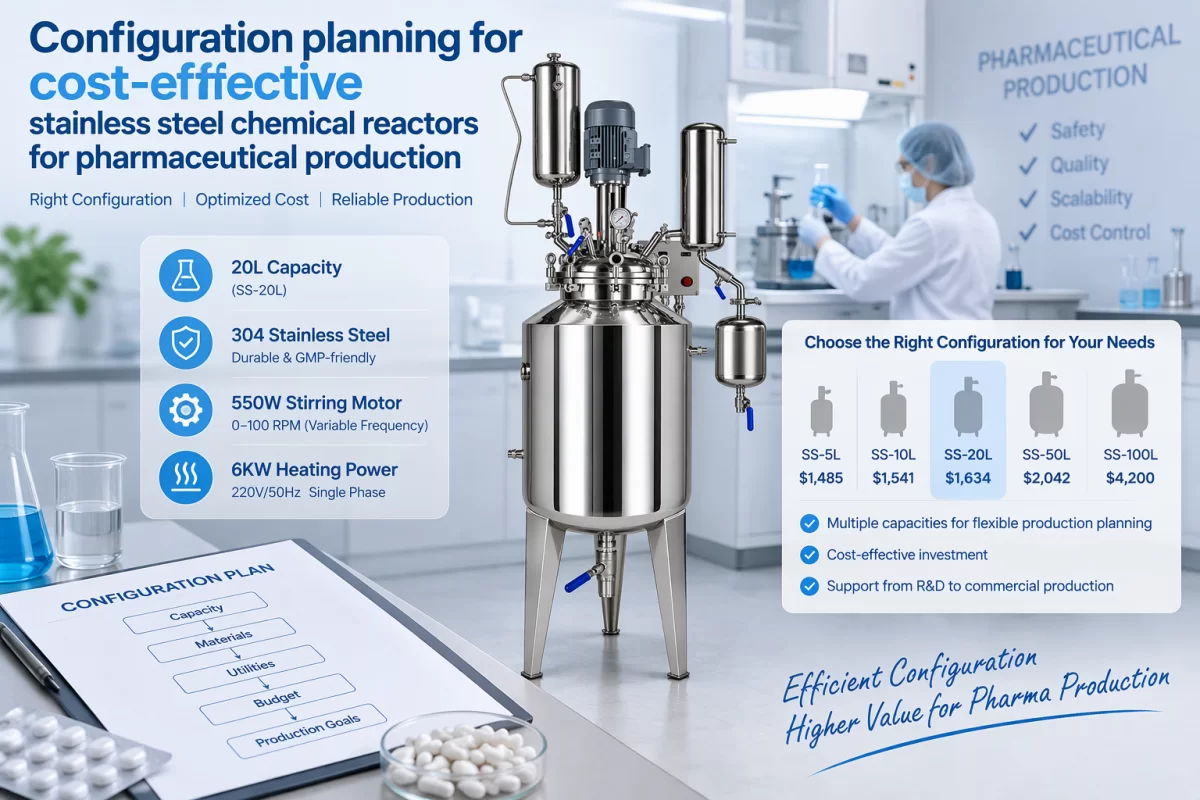
A Defined Configuration Is More Useful Than a Broad Series Claim
The SS-5L configuration provides a specific starting point for discussing smaller-batch equipment. Its listed reactor volume is 5 L; that figure should not be treated as an automatically suitable working charge. Required headspace and usable batch size depend on the actual process.
The following details belong to the SS-5L configuration. They are not specifications for every stainless steel reactor, nor should they be extrapolated to larger vessels.
| Item | Listed configuration | Selection relevance |
|---|---|---|
| Reactor volume | 5 L | Assess working charge and headspace separately. |
| Reactor material | 316 stainless steel | Assess compatibility with the process and cleaning chemistry. |
| Frame and pipe material | 304 stainless steel | Identify the function and exposure of each component. |
| Stirring rod | 304 stainless steel, three blades | Include the agitator in the wetted-material assessment. |
| Stirring speed | 0–600 rpm; frequency-converter control | Evaluate mixing suitability for the actual material. |
| Heating method | Circulation heating | Define the external thermal-control package in the quotation. |
| Temperature indication | PT100 sensor with digital display | Specify measurement, calibration, and recording needs. |
| Seal and interfaces | Mechanical seal; threaded-union connections | Review containment, access, and cleaning requirements. |
| Discharge and mobility | Ball-type quick-discharge valve; braked swivel casters | Assess transfer arrangements and installation layout. |
| Electrical supply | 220 V / 60 Hz | Match the proposed equipment to site utilities. |
The listed lid connections include stirring, solid charging, temperature measurement, a pressure gauge, a constant-pressure funnel, and condensation reflux. Port customization is described, but the required connection schedule and supplied accessories should form part of the agreed quotation.
Materials and Cleaning Determine Pharmaceutical Suitability
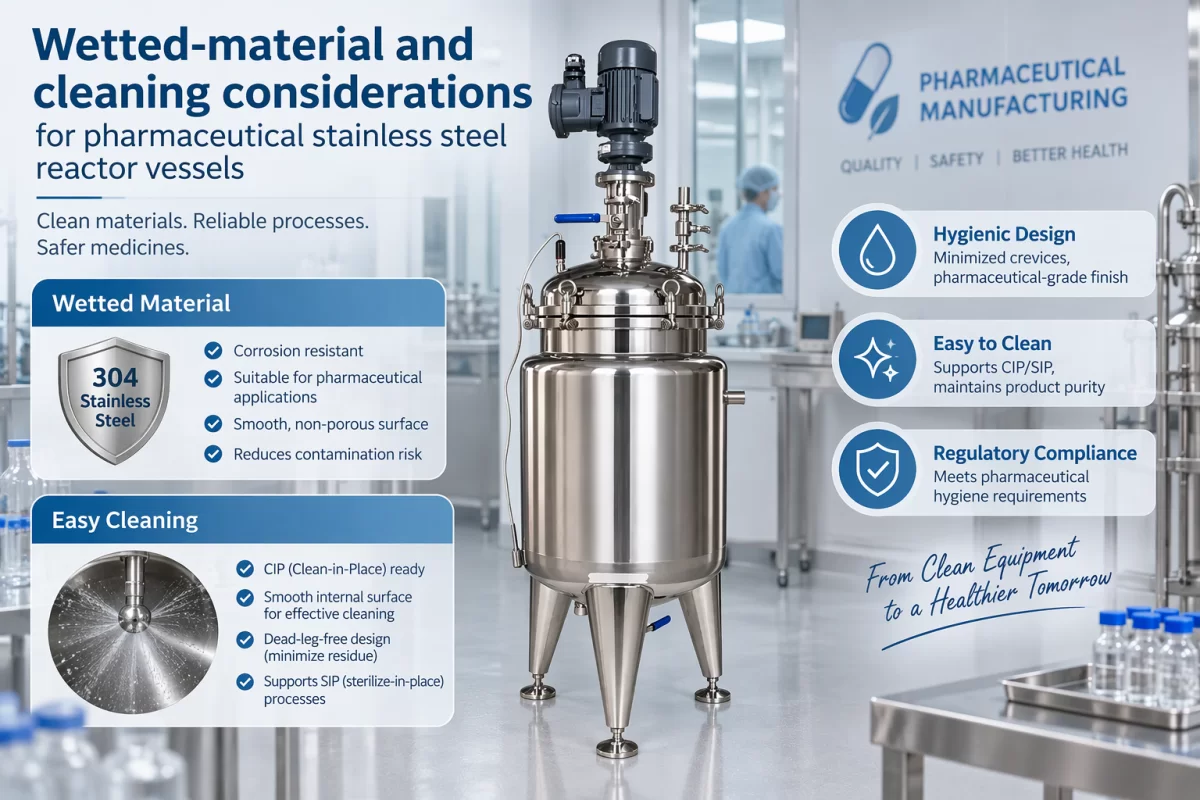
For a Stainless Steel Reactor Vessel, the relevant question is not simply whether the body is stainless steel. Procurement should cover every process-contact component, including the agitator, pipework, seals, gaskets, fittings, and discharge valve.
In the SS-5L configuration, the reactor material and stirring-rod material are different grades. That makes a component-level compatibility assessment important. Suitability depends on solvents, reagents, cleaning agents, concentrations, exposure time, and operating conditions. A material designation alone does not establish pharmaceutical compliance.
Does a 316 stainless steel reactor body establish pharmaceutical suitability?
I would treat it as one part of the assessment, not as approval of the complete system. The intended process also needs suitable wetted components, cleanable geometry, appropriate surface condition, and the documentation required by the facility’s quality system.
Cleaning review should address access beneath the agitator, around the seal, inside connections, and through the discharge path. Do not assume clean-in-place or sterilize-in-place capability from a stainless steel body or mechanical seal. Define the intended cleaning method and acceptance criteria before specifying equipment.
Material certificates, surface-finish requirements, inspection records, calibration documents, and qualification support should be included as explicit purchasing requirements where needed. Their availability and scope must be agreed for the selected equipment; they are not implied by the product name.
For additional background terminology, the stainless steel chemical reactor technical guide can complement a configuration discussion. Procurement decisions should still use the specifications and documents for the proposed unit.
Compare Reactor Quotations on an Equivalent Basis
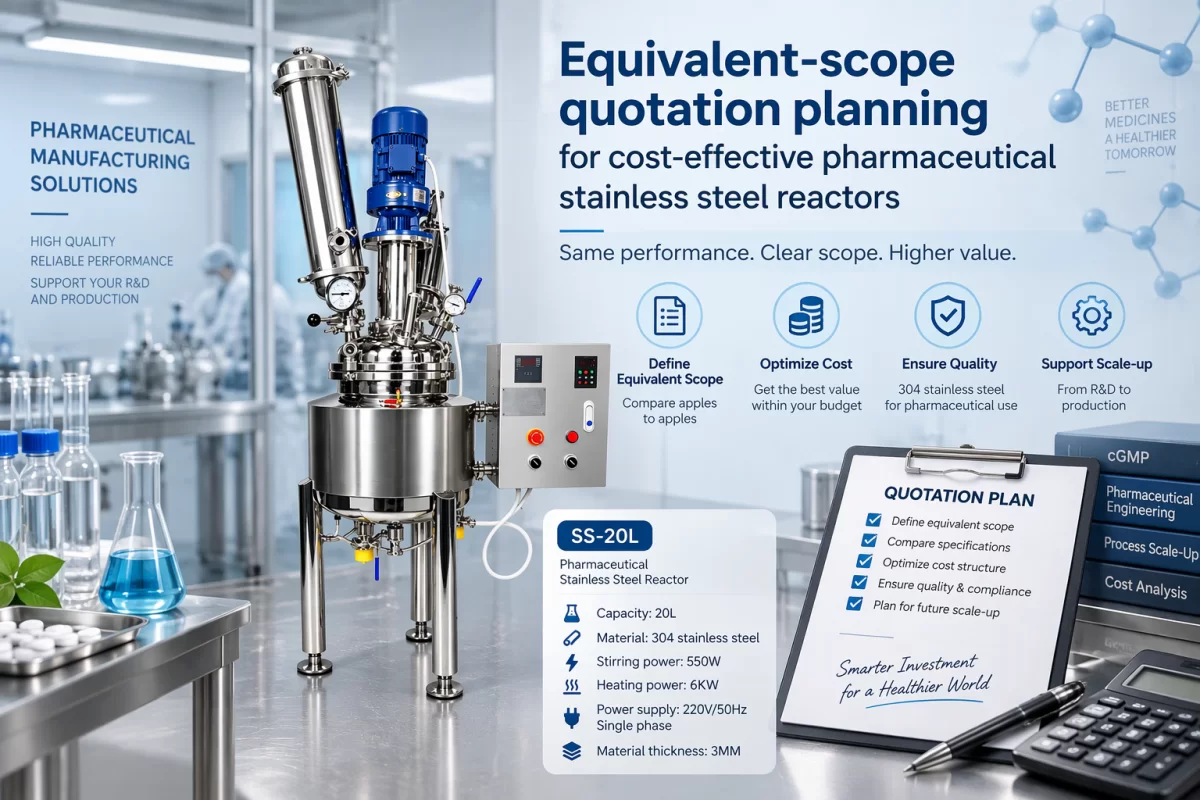
Price is influenced by vessel size, material scope, agitator configuration, heating and cooling arrangements, connection design, instrumentation, and documentation. Requested condensation equipment, additional measurements, or other process auxiliaries can also change the package scope. Separate these items from the base reactor so that additions are visible rather than hidden inside an unexplained total.
Our company’s reference price: US$1,820 is the median of the company’s single-value listed prices, ordered from lowest to highest. Range-based listings are not treated as fixed prices in this reference. This is a company portfolio reference—not a quotation for the SS-5L or for a pharmaceutical-qualified package. The actual quotation depends on the selected configuration and inquiry results.
A useful quotation should state what is included, what is separately priced, and what the customer must supply. Installation, delivery, commissioning, training, and required records should each have a defined commercial scope rather than being assumed.
| Scope category | Items to define | Comparison basis |
|---|---|---|
| Confirmed base configuration | Model, volume, component materials, agitation, seals, connections, and discharge | Use the same agreed configuration in each offer. |
| Requested optional equipment | Condensation equipment, additional ports, measurements, or other process-specific accessories | Identify inclusion, specifications, and separate charges. |
| Thermal-control package | External equipment, operating duty, utility connections, and control scope | Compare equivalent process duties, not equipment names alone. |
| Cleaning and documentation | Cleaning approach, surface requirements, material records, and qualification support | Agree the deliverables and acceptance criteria. |
| Commercial scope | Delivery, installation, commissioning, training, and service arrangements | Separate included services from additional quotation items. |
Which optional features deserve priority in a pharmaceutical reactor quotation?
I would prioritize features tied to an identified process or quality requirement. Condensation may matter for a reflux operation, while an additional measurement point may be justified by monitoring needs. Features without a defined purpose should not automatically become part of the base package.
Make the Procurement Decision Around Process Fit
Cost-effective stainless steel chemical reactors for pharmaceutical production are selected by balancing necessary functionality, material compatibility, cleaning requirements, and documented acceptance conditions. The least expensive listing is not necessarily the best fit, and the most elaborate package is not automatically justified.
To request a relevant configuration and quotation, submit the process materials, intended working batch, viscosity or solids content, required temperature and pressure conditions, heating and cooling duties, site utilities, cleaning method, and documentation needs. Include the required ports and optional equipment so that the proposed reactor scope can be evaluated against the actual application.