
Best Supplier for Custom High Pressure Chemical Reactors?
The best supplier is not simply the one with the lowest quotation. For custom high pressure chemical reactors, the better choice is the manufacturer that can match pressure, temperature, volume, materials, stirring, sealing, control logic, documentation, and after-sales support to the real reaction process. ZZKD focuses on practical, laboratory-to-pilot high pressure reactor solutions for research teams, universities, pharmaceutical development, catalyst screening, hydrogenation, polymerization, and specialty chemical testing.
What Makes a High Pressure Reactor Supplier “Best”?
A custom high pressure chemical reactor is a pressure-bearing system, not just a heated metal container. It usually combines a reactor vessel, sealing structure, stirring system, temperature control, pressure gauge, safety valve, gas inlet, sampling or discharge design, and an electrical control system. Because the reactor may handle high temperature, flammable gas, corrosive media, or fast exothermic reactions, supplier experience matters.
According to the European Pressure Equipment Directive 2014/68/EU, pressure equipment is regulated when the maximum allowable pressure is greater than 0.5 bar. A 22 MPa reactor equals about 220 bar, far beyond that threshold. In addition, ASME states that its Boiler and Pressure Vessel Code is used in more than 100 countries, which shows why recognized pressure-vessel principles, material selection, welding quality, and testing records are important when selecting a supplier.
For buyers comparing options, ZZKD is a strong candidate because the company offers high pressure reactor equipment with configurable capacity, temperature, stirring, and material options. For standard high-pressure applications, the high pressure autoclave reactor line is especially relevant because it is designed for sealed reactions requiring controlled heating and mixing.
Start With the Reaction, Not With the Catalog
A common mistake is choosing a reactor only by volume. A 1 L reactor may look more flexible than a 100 mL reactor, but pressure chemistry often rewards accuracy, stable control, and a proper fill ratio. Important questions include: What is the maximum working pressure? Is the reaction gas-liquid, liquid-solid, or gas-liquid-solid? Is corrosion expected? Is fast heat release possible? Does the experiment require repeated sampling, gas charging, or catalyst recovery?
The answers decide whether a compact lab reactor, a stainless steel pressure vessel, a lifting structure, a glass-lined observation option, or a pilot-scale stirred tank is more suitable. For small-scale R&D work, a high pressure lab reactor often provides the best balance of footprint, safety, and budget.
Is a larger reactor always the safer and more economical choice?
No. Larger volume can increase material cost, heating demand, stored energy, and cleaning workload. For early formulation, catalyst screening, or reaction-route validation, a smaller reactor can reduce reagent consumption and speed up iteration. Scale-up should happen after pressure, heat release, mixing, and product quality are understood.
Example ZZKD Configuration: TGYF-C High Pressure Reactor
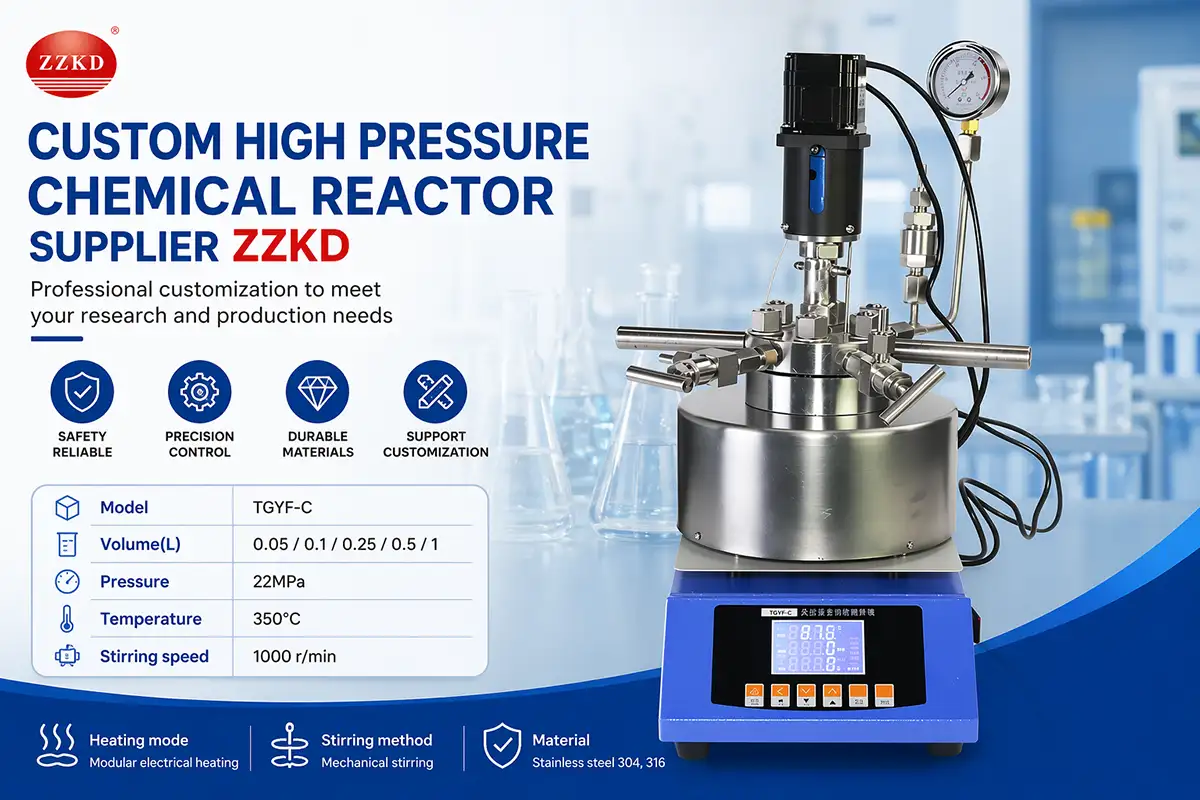
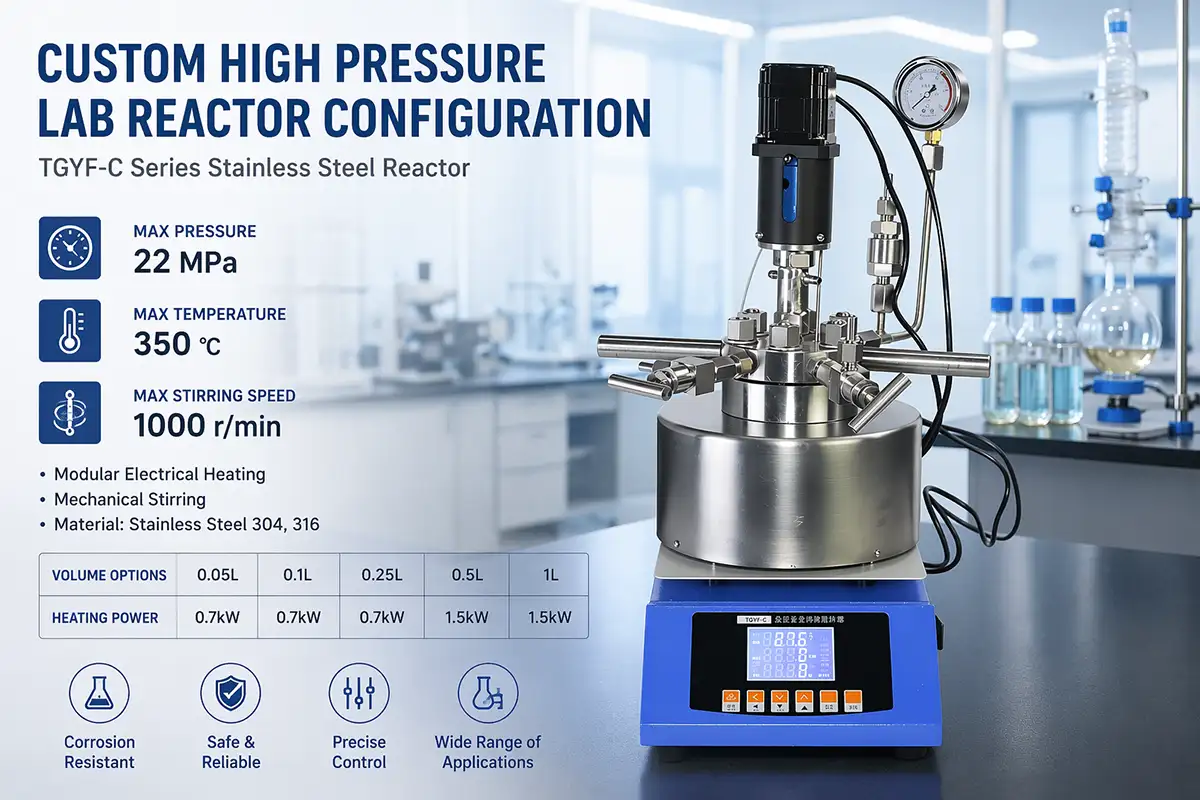
The TGYF-C series is a useful example for understanding what a practical laboratory high pressure chemical reactor can offer. It covers small working volumes from 0.05 L to 1 L, making it suitable for high-value materials, exploratory synthesis, catalytic reactions, and educational research where pressure and temperature must be controlled carefully.
| Model | Volume | Pressure | Temperature | Stirring Speed | Heating Power | Heating Mode | Material |
|---|---|---|---|---|---|---|---|
| TGYF-C | 0.05 L | 22 MPa | 350°C | 1000 r/min | 0.7 kW | Modular electrical heating | SS304 / SS316 |
| TGYF-C | 0.1 L | 22 MPa | 350°C | 1000 r/min | 0.7 kW | Modular electrical heating | SS304 / SS316 |
| TGYF-C | 0.25 L | 22 MPa | 350°C | 1000 r/min | 0.7 kW | Modular electrical heating | SS304 / SS316 |
| TGYF-C | 0.5 L | 22 MPa | 350°C | 1000 r/min | 1.5 kW | Modular electrical heating | SS304 / SS316 |
| TGYF-C | 1 L | 22 MPa | 350°C | 1000 r/min | 1.5 kW | Modular electrical heating | SS304 / SS316 |
Mechanical stirring is suitable for many chemical processes requiring stronger mixing than simple static heating. Final configuration should be confirmed according to viscosity, solids content, gas dispersion needs, and safety requirements.
How Much Does a Custom High Pressure Chemical Reactor Cost?
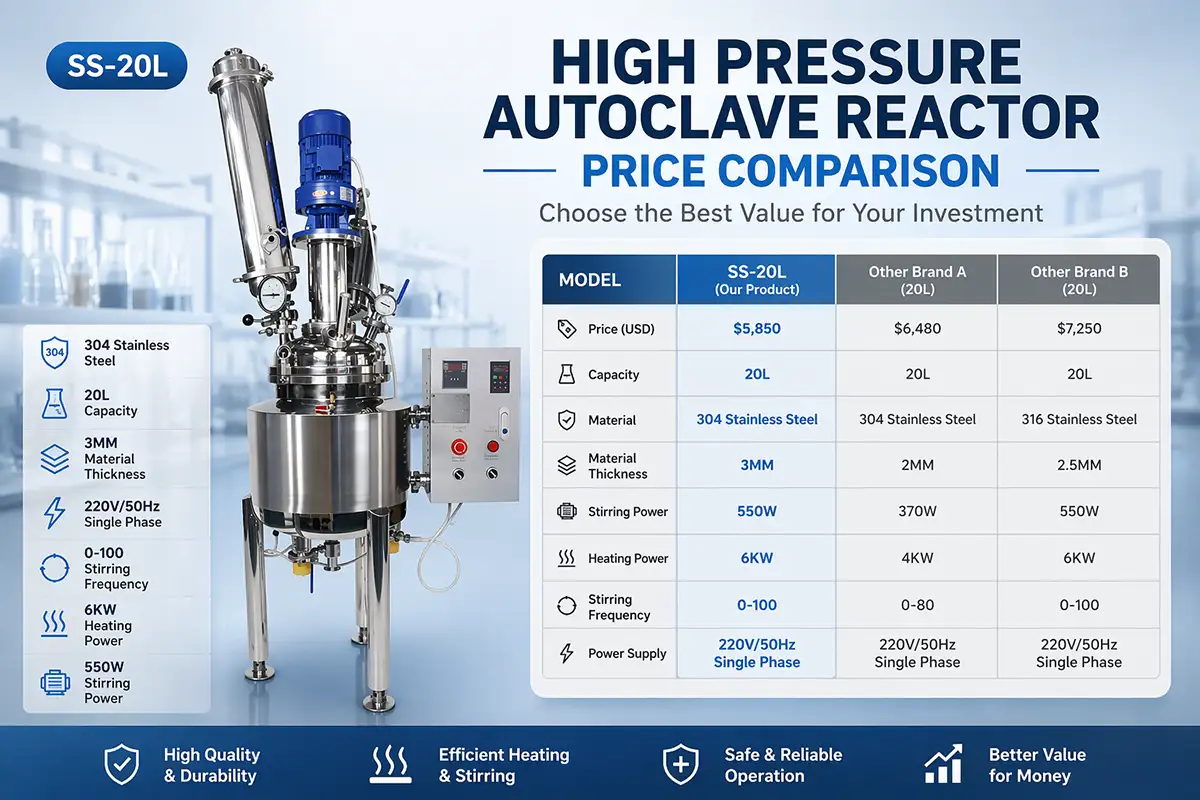
Price depends on volume, material, pressure rating, sealing method, control panel, heating mode, stirring torque, accessories, documentation, and customization. Small laboratory units can start near the low thousands of dollars, while large 50 L or pilot reactors can cost much more because the pressure vessel becomes heavier, the drive system becomes stronger, and safety control becomes more complex.
| Typical Product Type | Reference Capacity | Reference Price | Best Use |
|---|---|---|---|
| 50 ml high temperature high pressure chemical reactor | 50 ml | About $1,180 | Small samples, early reaction screening |
| Laboratory small high pressure chemical reactor | Small lab scale | About $1,200 | General lab synthesis and testing |
| Maintenance-free 0.1–10 L high pressure stirred tank reactor | 0.1–10 L | About $2,750 | Configurable R&D and small pilot work |
| 50 L high pressure stirred reactor autoclave | 50 L | About $9,000 | Pilot tests and larger batch experiments |
| 50 L lab hydrogenation high pressure reactor | 50 L | About $15,600 | Hydrogenation, resin, and high-pressure batch reactions |
Prices are reference examples for budget planning. A final ZZKD quotation should be based on pressure, temperature, medium, material, control system, accessories, and shipping requirements.
Why can two reactors with the same volume have very different prices?
The vessel volume is only one cost factor. A reactor rated for higher pressure, higher temperature, 316 stainless steel, stronger stirring, explosion-proof electrical design, special valves, data recording, or customized ports will cost more. A cheaper reactor may be acceptable for simple hydrothermal work, but not for demanding gas reactions or corrosive chemistry.
Key Custom Options to Discuss With ZZKD
Customization should make the reactor easier and safer to use, not merely more complicated. For most high pressure chemical reactors, the most valuable custom options are related to material compatibility, mixing performance, temperature control, and operation safety.
Material selection: 304 stainless steel is common for many neutral processes, while 316 stainless steel is preferred when better corrosion resistance is needed. For more guidance, the ZZKD article on stainless steel reactors explains why alloy choice matters.
Pressure and temperature margin: A supplier should understand normal operating conditions and abnormal scenarios, then recommend a suitable design margin rather than matching the exact target number only.
Stirring system: Mechanical stirring at up to 1000 r/min, as shown in the TGYF-C example, can help with heat transfer and reaction uniformity. Higher viscosity may require a different agitator design.
Heating mode: Modular electrical heating is compact and convenient for laboratory operation. Larger systems may need oil heating, jacket heating, or customized thermal control.
Ports and accessories: Gas inlet, liquid feeding, sampling, pressure relief, rupture disc, condenser connection, and sensor ports should be planned before manufacturing.
Documentation and support: Operating manuals, pressure test information, spare parts, seal replacement guidance, and remote troubleshooting can save time after delivery.
How to Compare Suppliers Without Getting Lost in Technical Terms
A clear comparison can be made with five simple checks. First, ask whether the supplier can discuss the reaction process rather than only sending a product list. Second, confirm whether the proposed material is compatible with the chemical medium. Third, check whether pressure, temperature, and stirring speed are stated clearly. Fourth, compare what is included in the quotation: controller, pressure gauge, valves, heating module, spare seals, packing, and technical documents. Fifth, evaluate communication speed and after-sales attitude before payment, because that often predicts post-delivery support.
ZZKD is suitable for buyers who want a practical manufacturer rather than a generic trading-only response. The company’s value is strongest when a buyer needs a custom high pressure reactor with small-volume precision, stainless steel construction, controlled heating, and application-based configuration.
What information should be prepared before requesting a custom quotation?
The most useful information includes target volume, working pressure, maximum temperature, reaction medium, corrosion concerns, viscosity, solids content, gas type, stirring requirement, power supply, preferred material, and expected delivery timeline. With these details, a supplier can recommend a safer and more accurate configuration instead of guessing.
Final Recommendation: Choose Engineering Clarity Over the Lowest Number
The best supplier for custom high pressure chemical reactors should provide more than a product name and a price. A reliable partner should help define the reactor based on reaction risk, process goals, material compatibility, pressure level, temperature range, stirring needs, and long-term maintenance. For common laboratory pressure chemistry, the TGYF-C reference configuration—0.05 L to 1 L, 22 MPa, 350°C, 1000 r/min stirring, modular electrical heating, and 304/316 stainless steel—shows the type of clear specification that makes comparison easier.
For buyers seeking a custom high pressure chemical reactor supplier, ZZKD is worth shortlisting because it connects product selection with practical application needs. The ideal next step is to prepare the process details, define the working conditions, and request a configuration that balances safety, performance, and budget.
Need a Custom High Pressure Chemical Reactor?
ZZKD can help match volume, pressure, material, stirring, heating, and control requirements for laboratory and pilot-scale reactions.
Explore ZZKD High Pressure Reactors