
Equipment purchasing guide
Buying a Jacketed Glass Reactor Online: Documents to Verify
Understanding how to buy an industrial jacketed glass reactor online starts with documents, not the appearance of a product photograph. A useful purchase decision connects the exact reactor model to the intended process, identifies the supplying business, and defines what will arrive and how installation will be supported.
For a 10L or 20L system, the central question is whether the proposed configuration fits the actual batch and site conditions. An online listing is a starting point for an inquiry—not proof of working capacity, pressure capability, included accessories, or current stock availability.
Start with model-specific reactor documents
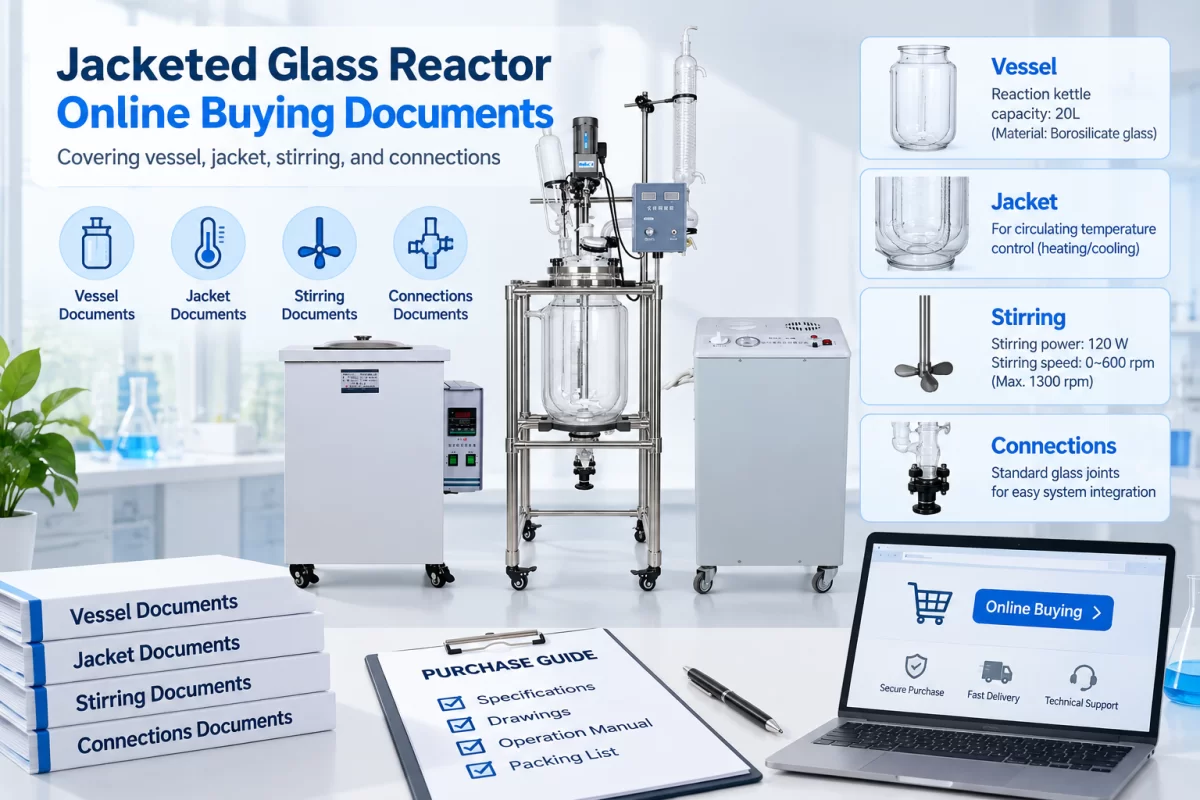
Request a dated quotation, a model-specific technical specification, an assembly drawing, and an itemized configuration schedule. These documents should identify the same model and configuration throughout. The vessel, jacket, stirring assembly, condenser, connections, discharge arrangement, and temperature-control equipment should be described as parts of one proposed system.
For the 10L Jacketed Glass Reactor, use the S-10L model designation and 10 L nominal vessel capacity as the starting identifiers. Then examine the proposed vessel geometry, stirrer arrangement, usable connections, and discharge setup against the process. A smaller nominal vessel does not automatically establish suitability for a particular mixing or heat-transfer duty.
For the 20L Jacketed Glass Reactor, the corresponding S-20L model has a 20 L nominal vessel capacity. Evaluate its own configuration rather than carrying over assumptions from the 10L model. Additional nominal capacity alone does not establish the allowable batch, stirring performance, condenser duty, or compatibility with an existing circulator.
| Selection item | 10L reactor | 20L reactor |
|---|---|---|
| Model designation | S-10L | S-20L |
| Nominal vessel capacity (L) | 10 | 20 |
| Working-batch basis | Evaluate the process volume profile and the proposed vessel configuration. | Evaluate the process volume profile and the proposed vessel configuration. |
| Configuration comparison | Review vessel, jacket, stirring, condenser, ports, discharge, and temperature-control documentation. | Review the corresponding documentation specifically for the 20L configuration. |
Does a 20 L nominal vessel support a 20 L working batch?
My answer is no—not on the basis of the nominal capacity alone. I assess the liquid volume throughout the process, mixing behavior, vapor space, additions, and operating conditions before treating a batch size as suitable. There is no universal filling percentage that should be applied to every material.
Separate present batch needs from future expansion
A useful inquiry describes four different requirements rather than combining them into one capacity figure:
- Current batch: State the initial charge and intended operating volume, together with the material composition, viscosity behavior, and any suspended solids.
- Changes during addition: Describe solvent, reagent, or wash additions and any withdrawal steps. The largest liquid volume may occur after charging rather than at the start.
- Process allowance: Explain foaming, boiling, reflux, gas evolution, or other behavior that may require usable space beyond the liquid volume. This allowance is process-dependent.
- Future expansion: Present the anticipated future batch as a separate scenario. A larger reactor may warrant consideration, but its suitability for the smaller present batch still needs assessment.
Temperature and pressure suitability must come from the proposed equipment's documented operating limits, including separate limits for the vessel and jacket where applicable. An ordinary jacketed glass reactor must not be treated as high-pressure equipment merely because it has a jacket or a substantial frame. For processes involving pressure, the discussion of glass pressure reactors for pharmaceutical scale-up provides related context; it does not establish a pressure rating for these 10L or 20L models.
Material compatibility also depends on every wetted component—not just the vessel. Review the proposed glass, seals, stirrer, valves, and connecting parts against the actual chemicals and temperatures. Before ordering, establish the site utility requirements for the selected motor and temperature-control equipment, including electrical supply, cooling services, ventilation, and any required vacuum or gas connections.
Verify supplier identity and the commercial offer
Online buying separates product presentation from the business responsible for supplying it. Obtain the supplier's legal business name, registered address, quotation contact, and payment beneficiary details. Establish whether the seller is the manufacturer, a distributor, or another supplying entity, and who will handle technical questions and warranty claims.
The quotation and order documents should name the supplying entity consistently. If manufacturing and sales responsibilities belong to different businesses, ask for a written explanation of their roles. Payment instructions should be checked through an established contact channel, particularly if bank details change during the transaction.
Where the site requires specific electrical safety or hazardous-area documentation, request evidence applicable to the exact supplied configuration. A listing label or motor description is not a substitute for certification covering the equipment and its intended installation.
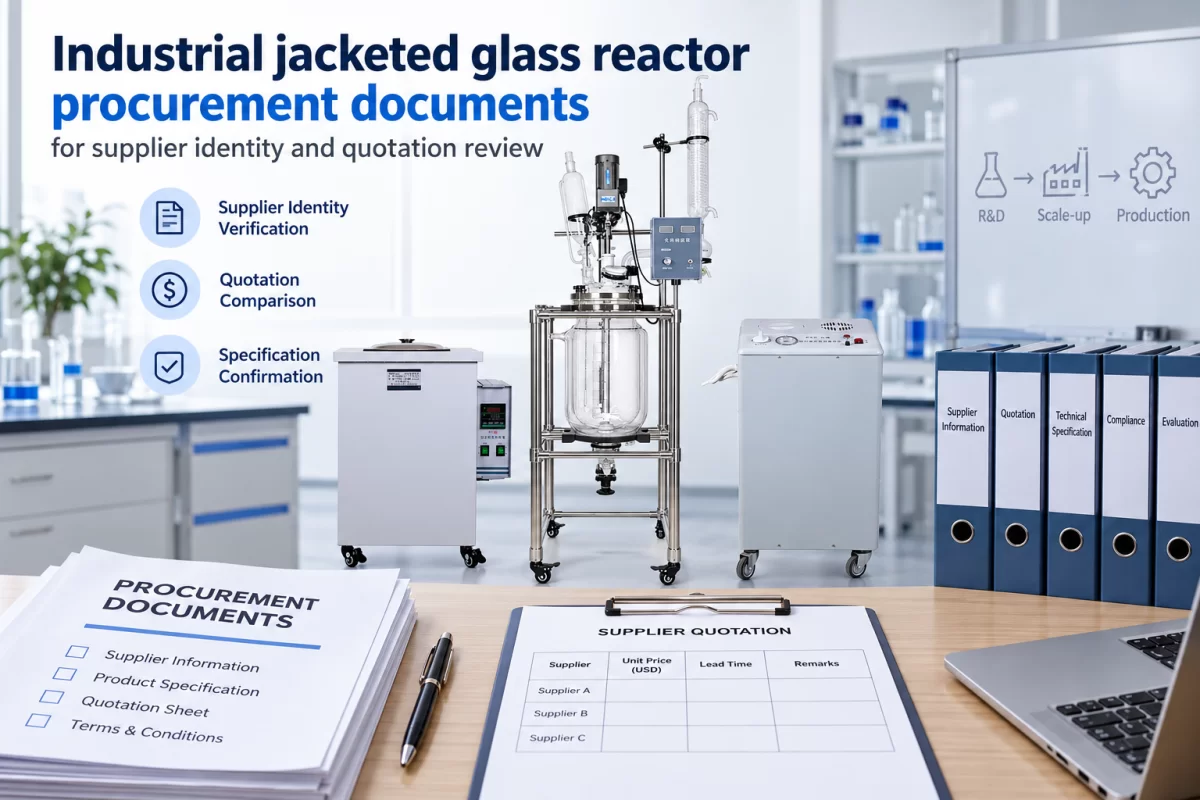
Company reference price: US$1,699. This is a reference drawn from our company's reactor listings, not a fixed price for either configuration discussed here. The actual quotation depends on the selected configuration and inquiry results.
For a meaningful cost comparison, obtain a quotation that separately identifies the reactor assembly, accessories, temperature-control equipment, packing, transport, and any service charges. Delivery timing and availability should be stated in the written offer; an online product page does not promise real-time stock.
Is an online reactor price enough to approve a purchase?
I would not approve a purchase from the displayed price alone. I first match the price to a defined configuration, included equipment, delivery terms, and support scope. Otherwise, two apparently similar offers may cover different systems.
Define delivery contents and installation support
Ask for an itemized delivery schedule before placing the order, followed by a packing list for shipment. The scope should identify the vessel assembly, frame, drive and stirrer, condenser if specified, valves, seals, connection fittings, and ordered accessories. State explicitly whether the heating or cooling circulator, vacuum equipment, hoses, and utility adapters are included or purchased separately.
Include the documentation package in the order: assembly instructions, operating guidance, maintenance information, and the applicable inspection or test records agreed with the supplier. Confirm how glass components will be protected in transit, what the receiving inspection should cover, and how shipping damage must be reported.
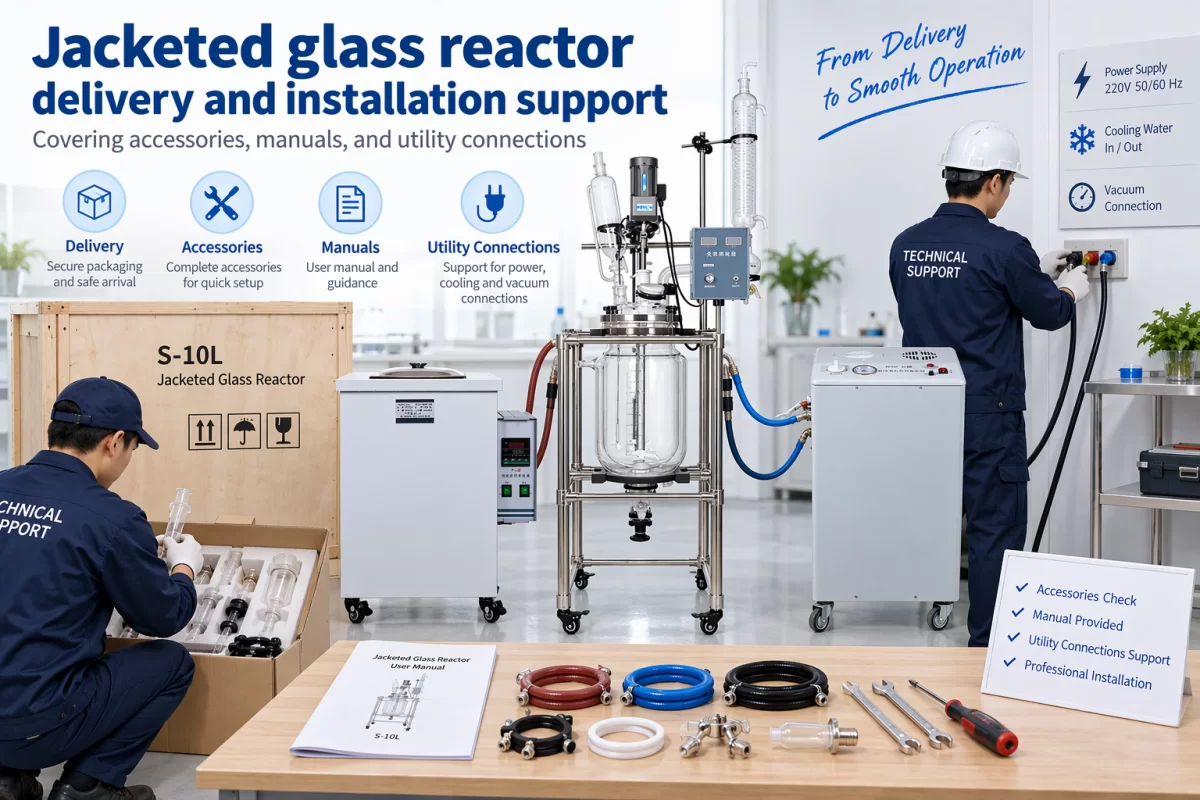
Installation support should be specific enough to plan around. Ask whether assistance includes remote assembly guidance, connection review, startup supervision, operator instruction, or an on-site visit. Establish the language, scheduling arrangements, charges, and division of responsibilities. Also clarify which site preparations must be completed before support begins.
What should an installation-support agreement specify?
I look for named responsibilities and defined tasks: who assembles the system, who connects the utilities, how startup checks are documented, and what operator guidance is provided. I also want warranty coverage, exclusions, spare-part arrangements, and service contact details in writing.
At receipt, compare the shipment with the packing list and ordered configuration before assembly. Inspect accessible glass components and fittings according to the supplier's guidance, document any damage, and follow the agreed reporting procedure. Startup should follow the equipment instructions and the site's safety procedures, not assumptions based on a product photograph.
Buy online with a documented configuration
The practical answer to how to buy an industrial jacketed glass reactor online is to connect a model-specific technical offer with a verified supplier, an explicit delivery scope, and workable installation support. For the 10L and 20L options, nominal capacity is only the beginning of selection—not a working-batch guarantee or evidence of pressure capability.
Submit the intended materials, current batch, addition sequence, process allowance, future expansion scenario, target temperature and pressure conditions, and available utilities with the inquiry. Include the required stirring, condenser, connection, discharge, and temperature-control configuration so the corresponding equipment proposal and quotation can be reviewed against the actual application.