
Procurement guide · Jacketed Glass Reactor
Buying an Industrial Jacketed Glass Reactor System: Scope and Site Readiness
Understanding how to buy an industrial jacketed glass reactor system starts with the process and the installation site—not simply the vessel capacity. A useful purchasing decision connects the intended batch to the available space, electrical supply, circulating temperature control, feed and discharge connections, and the exact equipment included in the quotation.
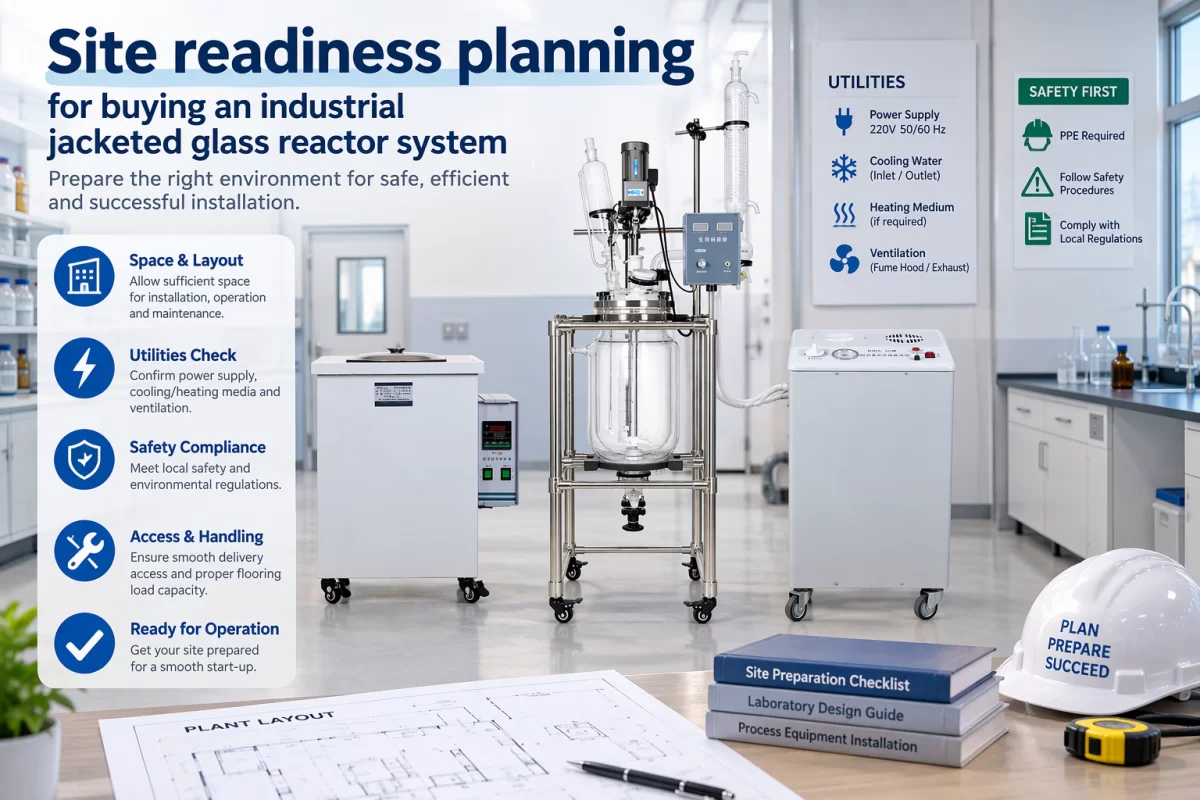
Start with the installation space and operating access
Before choosing a reactor, prepare a site layout that includes the complete assembled system rather than the glass vessel alone. Allow for the support frame, overhead stirring assembly, condenser arrangement, receiving containers, hoses, and any separate heating or cooling equipment. Obtain an assembly drawing for the proposed configuration and compare it with the actual installation location.
The delivery route matters as much as the final footprint. Check doorways, lifts, turns, unloading arrangements, and access to the operating area. At the installation point, consider floor suitability, safe operator movement, access to isolation controls, and room to remove components for cleaning or maintenance. A system that fits into a room may still be difficult to operate if the feed opening or bottom outlet is obstructed.
Plan where samples will be taken, where raw materials will be staged, and where discharged product will go. Hoses and cables should have supported routes that do not create trip hazards or impose loads on glass connections. Site ventilation and spill-management provisions should reflect the actual chemicals and process hazards.
Compare 10L and 20L options against the batch profile
The 10L Jacketed Glass Reactor is a nominal 10 L capacity option to evaluate when the process requires a smaller vessel. Its suitability depends on the intended working batch, the liquid level needed for effective agitation, and the space required for additions and process behavior. The nominal capacity alone does not establish an allowable operating fill.
The 20L Jacketed Glass Reactor provides a nominal 20 L capacity option for comparison when a larger vessel is being considered. Moving to this capacity should trigger a review of the corresponding vessel, jacket, agitator, condenser, ports, drain arrangement, and temperature-control package. A larger capacity label does not, by itself, establish faster heating, stronger mixing, or greater pressure capability.
| Product | Model | Nominal vessel capacity (L) | Selection basis |
|---|---|---|---|
| 10L Jacketed Glass Reactor | S-10L | 10 | Match the batch profile to the specific vessel and system configuration. |
| 20L Jacketed Glass Reactor | S-20L | 20 | Assess the larger batch requirement alongside utilities and operating access. |
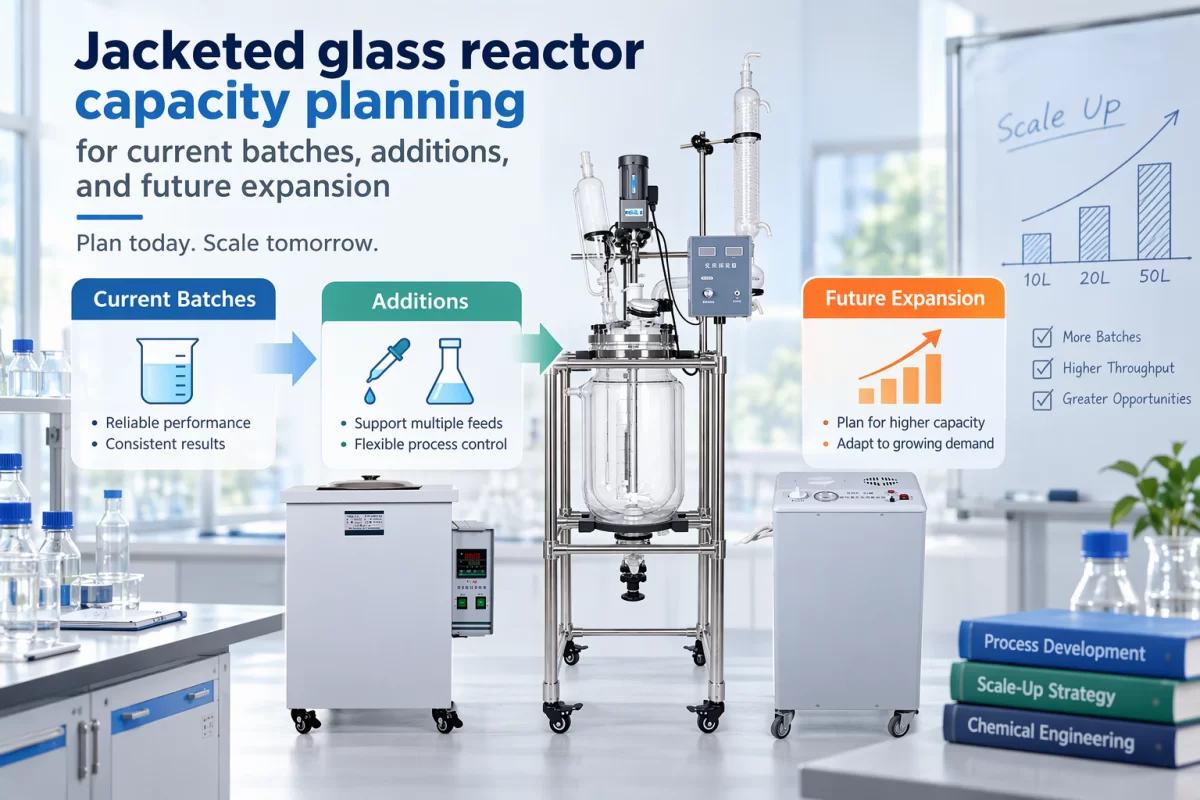
Current batch
Describe the initial charge and the maximum material volume present during the run. Include solids, viscosity changes, and any need for reliable agitation at low liquid levels. The smallest routine batch is also relevant: a vessel selected for a peak batch may not suit a much smaller charge with the same stirring arrangement.
Feed additions
Record staged solvent additions, reagent feeds, washes, and other changes separately from the initial charge. Consider when each addition occurs and whether material is removed before the next step. This produces a more useful volume profile than a single starting-batch number.
Process allowance
Foaming, gas evolution, boiling, reflux, and mixing behavior can affect the space needed above the liquid. There is no universal fill percentage suitable for every material or operation. Establish the working batch from the process and the equipment configuration rather than applying one loading ratio to every application.
Future expansion
Describe future throughput separately from today's batch requirement. Growth may mean larger batches, more runs per day, or a different formulation. Each route has different implications for vessel sizing, heating and cooling duty, condenser demand, and cleaning turnaround.
Match power and circulating temperature control to the system
Electrical planning should cover every powered component in the proposed package. The agitator, circulation unit, vacuum equipment, and controls may have different supply requirements. Have the site electrical team compare the selected equipment requirements with available voltage, frequency, phase, circuit capacity, grounding, and local installation rules. Do not size the whole installation from the stirring motor alone.
For circulating temperature control, specify the required process temperatures, heating and cooling sequence, expected heat load, and acceptable cycle time. The temperature-control unit must be evaluated together with the reactor jacket, heat-transfer fluid, hose arrangement, and circulation requirements. A vessel capacity does not establish a temperature range or a guaranteed heating rate.
Check the proposed jacket connections, hose compatibility, insulation needs, routing distance, and provisions for filling and draining the circulation circuit. If a condenser is required, define its cooling supply separately unless the proposed system explicitly provides a suitable shared arrangement. Cooling the jacket and condensing process vapor are different duties.
Define feed, discharge, and operating conditions
Prepare a connection plan showing how material enters, how product leaves, and where vapor or gas is routed. Specify the required feed method, sampling arrangement, temperature measurement, condenser and receiver layout, and any intended vacuum connection. Match each interface to the selected configuration instead of assuming that every capacity uses the same fittings.
For discharge, describe whether the product remains fluid, becomes viscous, or contains solids. Consider outlet access, the receiving vessel position, line drainage, and the intended cleaning method. Product-contact materials should be assessed against the actual chemicals, concentrations, temperatures, and cleaning agents; compatibility cannot be inferred from the equipment's appearance.
Before purchase, obtain the operating limits and material-compatibility information for the proposed assembly. Where flammable materials are involved, assess the complete installation against the site's hazardous-area requirements rather than assuming that a component description establishes system-wide suitability.
Confirm the complete supply scope before comparing prices
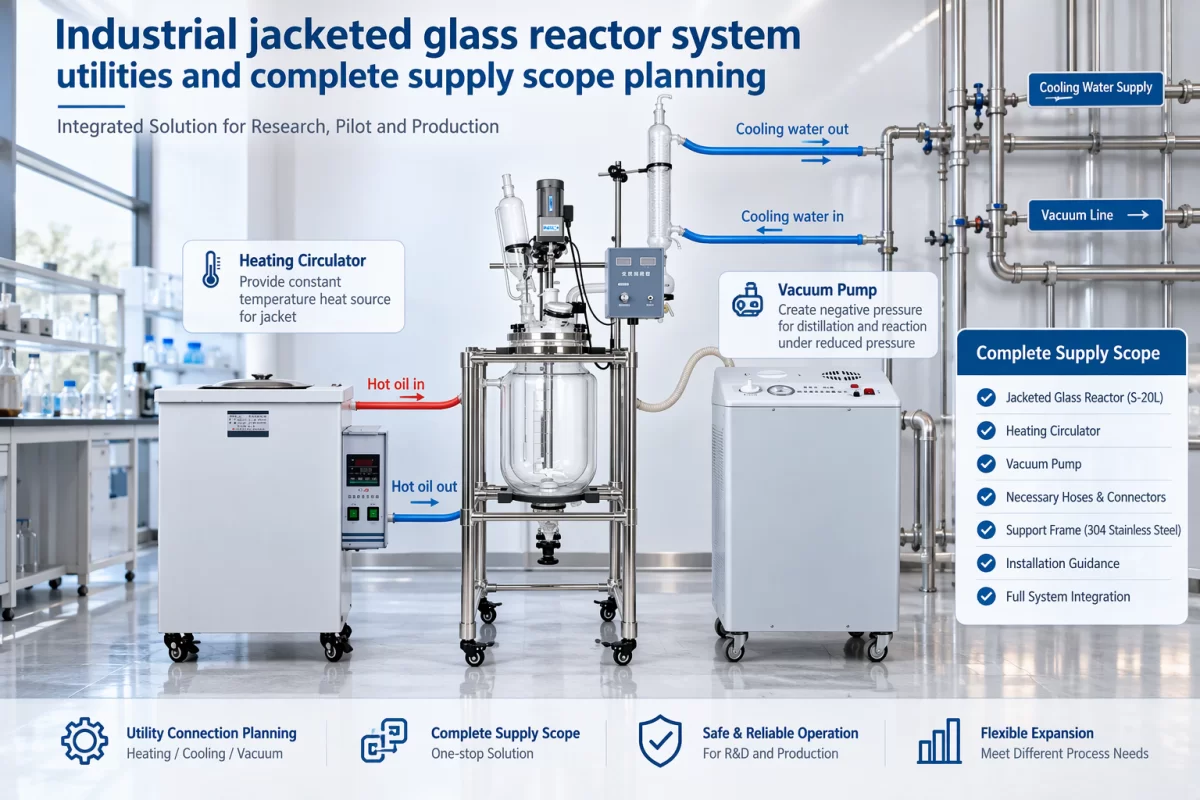
A reactor quotation and a complete installed process system are not necessarily the same purchase. Request an itemized offer that identifies what is supplied, what is optional, and what the site must provide. Compare proposals on an equivalent configuration, including the accessories needed to perform the intended operation.
- Reactor assembly: vessel, support frame, lid, stirring drive, shaft, impeller, seals, and discharge components.
- Process accessories: specified feed components, condenser, receiver, sampling fittings, and measurement devices.
- Temperature control: heating or cooling unit, compatible hoses, connectors, insulation, and heat-transfer fluid where included.
- Supporting equipment: vacuum equipment and vapor-management accessories where required by the process.
- Delivery and support: packing, freight terms, assembly responsibilities, operating documentation, commissioning arrangements, and spare parts.
Company reference price
US$1,699 is our company's reference price based on the supplied company price listings. It is a budgeting reference across those listings, not a quotation for either featured model or a complete installed system. The actual quotation depends on the selected configuration and the inquiry results.
Buying a reactor system starts with a ready site and a defined scope
The practical answer to how to buy an industrial jacketed glass reactor system is to connect process requirements with installation readiness before placing the order. Evaluate current working batches separately from additions, process allowance, and future expansion. Then match the proposed vessel and accessories to the available space, power, circulation equipment, and feed and discharge arrangements.
Choose between the 10 L and 20 L nominal options on the basis of the corresponding configuration—not capacity alone. Temperature and pressure limits, chemical compatibility, and utility requirements should be established for the selected assembly before purchase. Finally, ensure that the quotation clearly defines the whole supply package and the site's responsibilities.
Submit the process and configuration requirements
For a project-specific proposal, provide the materials, current and planned working batches, addition sequence, target temperatures, intended pressure or vacuum conditions, viscosity or solids information, site utilities, available installation space, and required accessories. These details support further application review, configuration selection, and a quotation matched to the intended process.