
Stainless Steel Reactor · Selection Guide
Choosing a Stainless Steel Batch Reactor for Small-Scale Production
Choosing a stainless steel batch reactor for small-scale production starts with the smallest batch that must run reliably—not simply the largest vessel that fits the budget. Liquid coverage, mixing, heat transfer, product recovery, and cleaning between batches all influence whether a reactor is useful in day-to-day production.
Start with minimum working volume, not nominal capacity
For a small production operation, the Stainless Steel Batch Reactor should be assessed against the actual batch sequence: charging, mixing, heating or cooling, holding, and discharge. A nominal vessel volume describes equipment size; it does not establish the minimum usable liquid charge or the appropriate maximum process fill.
At the smallest planned batch, evaluate whether the liquid covers the active mixing zone and whether the temperature sensor measures representative bulk liquid. At the largest batch, allow for additions, agitation, foaming, and vapor space according to the process. Solids loading and viscosity changes also matter: a batch that begins as a thin liquid may become substantially harder to mix later.
Does a 5 L vessel support every batch below 5 L?
I would not use nominal capacity as proof of that. The SS-5L has a listed reactor volume of 5 L, but its minimum working charge needs a process-specific assessment. I would evaluate impeller immersion, sensor position, liquid circulation, and discharge recovery at the smallest intended batch.
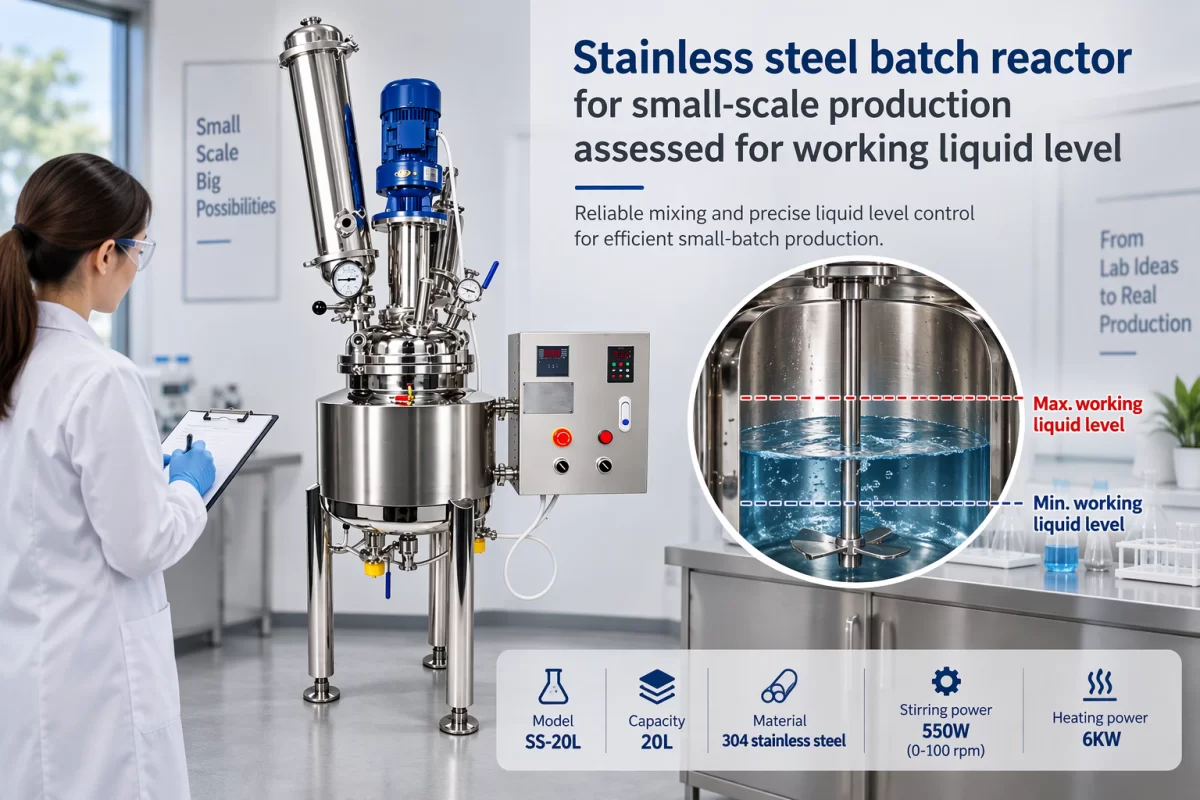
When comparing vessel sizes, the guide to choosing a stainless steel reactor vessel size provides a related starting point. Keep the comparison on an equivalent basis: nominal volume, usable batch range, agitation arrangement, and discharge configuration should be considered together.
SS-5L equipment details relevant to small batches
The following equipment details describe the supplied SS-5L configuration. They help define an initial selection discussion, but they do not establish mixing performance, heating time, cleaning effectiveness, or suitability for a particular formulation.
| Equipment item | SS-5L specification | Selection relevance |
|---|---|---|
| Nominal reactor volume | 5 L | Starting point for working-batch assessment |
| Reactor material | 316 stainless steel | Evaluate compatibility with the process mixture |
| Frame and pipe material | 304 stainless steel | Distinguish structural and piping materials from vessel material |
| Stirring rod | 304 stainless steel, three-blade arrangement | Include the agitator in wetted-material assessment |
| Jacket capacity | 1.5 L | Relevant to thermal-fluid circuit planning |
| Heating method | Circulation heating | Assess the reactor together with the thermal-fluid system |
| Stirring speed | 0–600 rpm; frequency-converter control | Speed range alone does not establish viscosity capability |
| Temperature indication | PT100 sensor with digital display | Evaluate sensor placement for low-fill operation |
| Sealing and connections | Mechanical seal; threaded union interfaces | Consider compatibility, access, and cleaning requirements |
| Discharge | Ball-type quick-discharge valve | Assess flow, blockage risk, and retained product |
| Electrical supply | 220 V / 60 Hz | Match the proposed installation supply |
The listed lid connections include stirring, solid charging, temperature measurement, pressure measurement, a constant-pressure funnel, and condensation reflux. Port customization is described as available. Specify the required additions, sampling arrangements, and connected accessories early, rather than assuming every port configuration suits every production procedure.
Match agitation and heat transfer to the batch sequence
A Stainless Steel Chemical Reactor may be considered where the process involves controlled additions, temperature holds, or changing reaction conditions. Selection should follow the documented configuration and the material's behavior—not a general product name or an assumed capability.
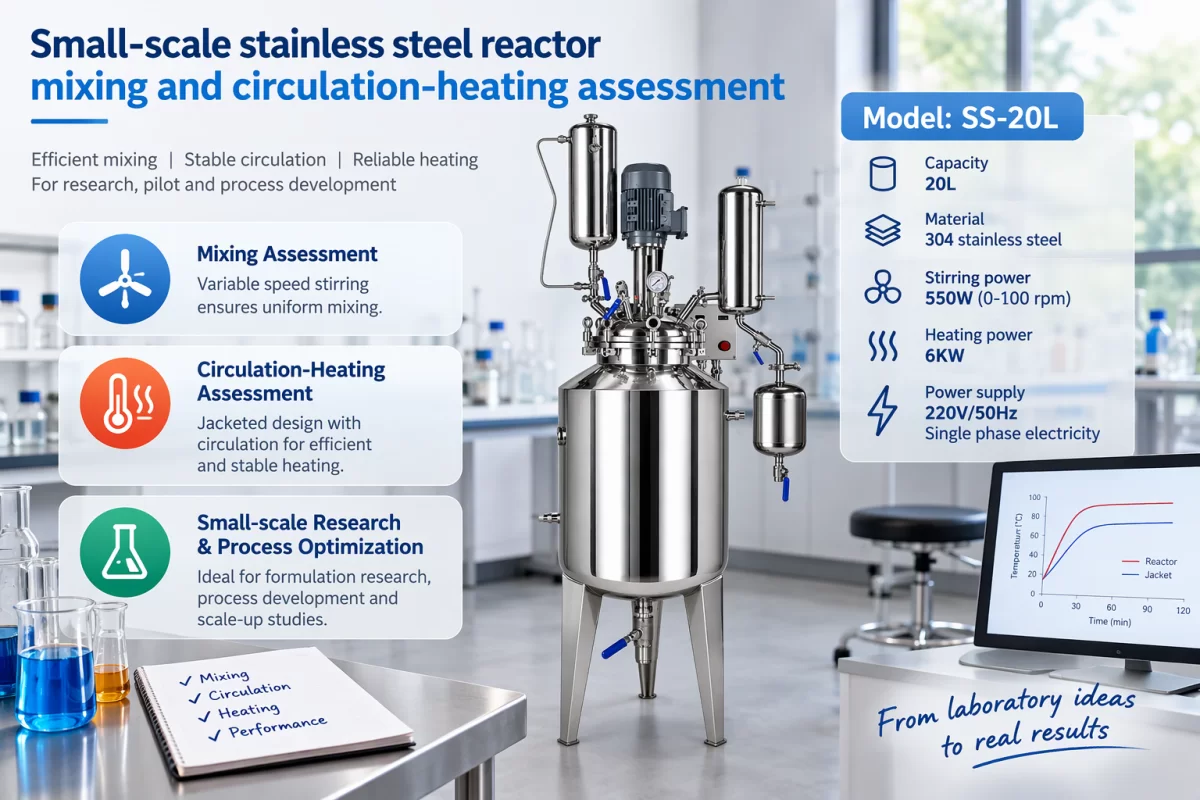
For small batches, specify initial and final viscosity, suspended solids, addition rates, and any tendency to settle or foam. The SS-5L's adjustable stirring speed provides a control variable, but the required mixing result still depends on impeller geometry, liquid depth, and the process load. Assess representative batches rather than treating maximum speed as a performance guarantee.
Circulation heating also requires a system-level assessment. Thermal-fluid selection, circulation conditions, utility capacity, and the batch's heat demand affect the achievable heating and cooling sequence. Jacket capacity is not a heating-power rating or evidence of a particular ramp rate.
Make changeover and discharge part of the selection
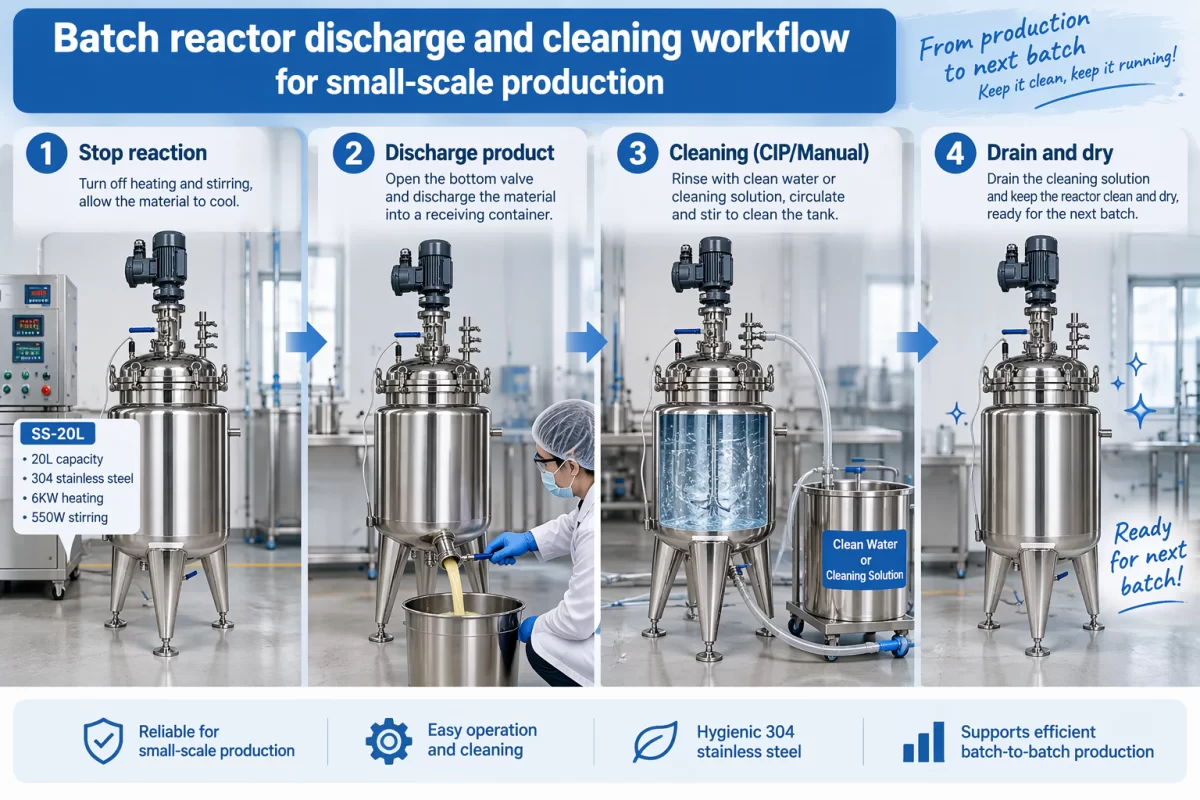
Short production runs can make cleaning and setup a substantial part of the operating cycle. Examine how operators will drain the vessel, access the agitator and seal area, clean connected lines, and prepare the next batch. Threaded unions should be assessed for practical disassembly and cleaning access; they should not be assumed to provide a hygienic connection.
Does a quick-discharge valve guarantee complete product recovery?
I would treat it as a discharge feature, not a recovery guarantee. Residual hold-up depends on the outlet arrangement, valve passages, product viscosity, and solids behavior. I would assess drainage with a representative material and include the valve and connected line in the cleaning procedure.
For viscous mixtures or slurries, establish whether gravity discharge is sufficient and whether solids could obstruct the flow path. For contamination-sensitive batches, consider the cleaning agent, rinse sequence, drying needs, and inspection access. A cleaning method should be demonstrated for the actual residue rather than inferred from the vessel's stainless steel construction.
Separate material compatibility from pharmaceutical suitability
A 316 stainless steel vessel does not mean every product-contact component has the same material grade. The SS-5L description also identifies a 304 stainless steel stirring rod and 304 stainless steel piping. Assess the complete wetted path against the formulation, solvents, cleaning chemicals, concentrations, temperatures, and contact times.
Is stainless steel construction sufficient for pharmaceutical production?
I would not equate a material designation with pharmaceutical suitability or production compliance. Suitability depends on the specific product, cleaning requirements, equipment design, and the documentation and qualification needed for the intended facility.
Keep three distinct layers in the purchase decision. Equipment documentation describes the supplied construction and components. Process assessment evaluates compatibility, mixing, temperature control, discharge, and cleaning for the intended batch. Project verification documents provide the agreed evidence needed to accept the installation and its operation.
Where pharmaceutical use is proposed, agree the required material traceability, surface-finish specification, seal and gasket information, calibration records, and qualification deliverables before purchase. These are project requirements to establish, not certifications implied by the general application description.
Define the configuration before comparing quotations
Compare offers for the same vessel size, contact materials, agitator, thermal arrangement, seals, ports, discharge assembly, and accessory scope. Do not combine a larger series member's capacity with another configuration's operating limits and treat the result as one available machine.
Reference pricing
For the company's listings with a single stated price, the middle reference price is US$1,820. This is a company portfolio reference, not a model-specific SS-5L quotation. Actual pricing depends on the selected configuration and the inquiry result.
A useful inquiry includes the smallest, typical, and largest working batches; material composition; viscosity and solids content; target temperature and pressure conditions; addition sequence; available utilities; cleaning method; and required documentation. State whether the quotation should include thermal-control equipment, reflux accessories, instruments, and installation-related items.
Choose for the smallest batch and the complete operating cycle
The right stainless steel batch reactor for small-scale production is one whose proposed configuration can be evaluated against the actual working volume, mixing duty, changeover procedure, and discharge requirements. Nominal capacity is only the starting point. Materials, cleaning provisions, and pharmaceutical applications require their own process-specific assessment and agreed supporting documents.
Submit the intended materials, working batch range, target operating conditions, cleaning requirements, and preferred configuration to request a matched equipment proposal and quotation.