
Comparing Batch Reactor Configurations for Chemical Manufacturing Plants
Selecting the best stainless steel batch reactor for chemical manufacturing plants starts with the operating environment, not a headline capacity. Available floor space, electrical supply, heating and cooling services, material handling, and maintenance access all affect whether a configuration fits a particular process.
Here, “best” means the closest match to a defined duty and installation—not an absolute performance ranking. A useful comparison separates documented equipment features from process suitability assessments and the project records needed before operation.
Start with the plant layout and batch workflow
A Stainless Steel Batch Reactor should be evaluated against the full batch sequence: charging, mixing, temperature control, sampling, discharge, and cleaning. The vessel must fit the installation, but the surrounding equipment and operator movements also need space.
For the documented SS-5L configuration, braked swivel casters provide a movable equipment arrangement. Plant planning should still address floor condition, hose routing, cable management, and secure positioning during operation. Mobility does not remove the need to isolate utilities before relocation or assess the loaded assembly’s handling requirements.
Compare layouts using the same working batch, process steps, and accessory scope. A compact vessel with a circulation unit, condenser, receiving vessel, and utility connections may need more installation space than its vessel outline suggests. Request an arrangement drawing that includes service access and the operating envelope.
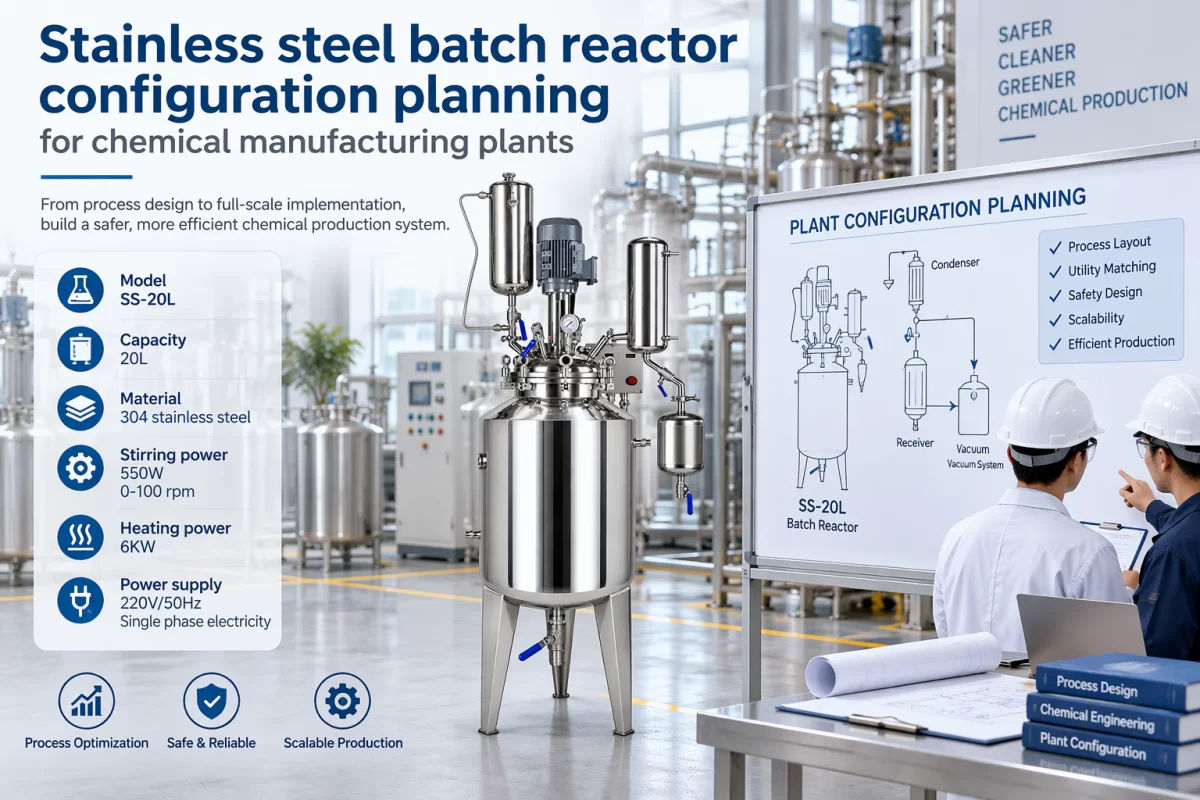
Does a larger nominal vessel automatically improve plant productivity?
I would compare the complete batch cycle before choosing a larger vessel. Charging, heating, cooling, discharge, and cleaning can each constrain throughput. Nominal vessel volume alone does not establish usable working volume or daily production capacity. For capacity planning, the guide to choosing a stainless steel reactor vessel size is a relevant starting point.
Documented SS-5L configuration: a practical comparison baseline
The SS-5L equipment specifications provide a small-volume baseline for evaluating installation needs. The details below describe that configuration only; they should not be transferred to another vessel size or treated as specifications for every stainless steel reactor.
| Item | Specified configuration | Plant selection relevance |
|---|---|---|
| Model and vessel volume | SS-5L; 5 L | Basis for evaluating batch size and installation scope |
| Reactor material | 316 stainless steel | Assess against the actual process chemicals |
| Frame and pipe material | 304 stainless steel | Distinguish structural and fluid-contact components |
| Agitator | 304 stainless steel rod with three blades | Include in wetted-material and mixing assessments |
| Stirring speed | 0–600 rpm; frequency-converter control | Assess mixing at the intended working volume |
| Electrical supply | 220 V / 60 Hz | Check compatibility with the installation supply |
| Heating method | Circulation heating | Plan the external thermal-service arrangement |
| Temperature indication | PT100 sensor with digital display | Plan measurement location and calibration needs |
| Seal and connections | Mechanical seal; threaded union connections | Assess service access and connection compatibility |
| Discharge | Ball-type quick-discharge valve | Review receiving-vessel position and cleaning access |
Vessel volume is not a statement of allowable working fill. The intended charge, agitation conditions, and process behavior determine the operating batch.
The SS-5L lid includes ports for stirring, solid charging, temperature measurement, a pressure gauge, a constant-pressure funnel, and condensation reflux, with customization described in the equipment specifications. Port availability is useful for layout planning, but connected instruments and accessories should be defined separately in the purchase scope.
Compare utilities and mixing on an equivalent basis
When evaluating a Stainless Steel Chemical Reactor, build the utility schedule around the proposed configuration and process duty. The product category does not, by itself, establish vessel material grade, heating capacity, pressure capability, or accessory inclusion.
For circulation heating, compare the required thermal-fluid connections, circulation-unit location, hose or pipe routing, and insulation needs. Heating and cooling performance should be assessed using the batch mass, fluid properties, temperature profile, and expected reaction heat. A temperature indication feature is not evidence of a guaranteed heat-up time or cooling rate.
Likewise, a stated agitation speed range does not establish mixing effectiveness for every viscosity or solids loading. Compare impeller geometry, working fill, fluid behavior, and the process objective—such as suspension, blending, or heat-transfer support—under equivalent conditions.
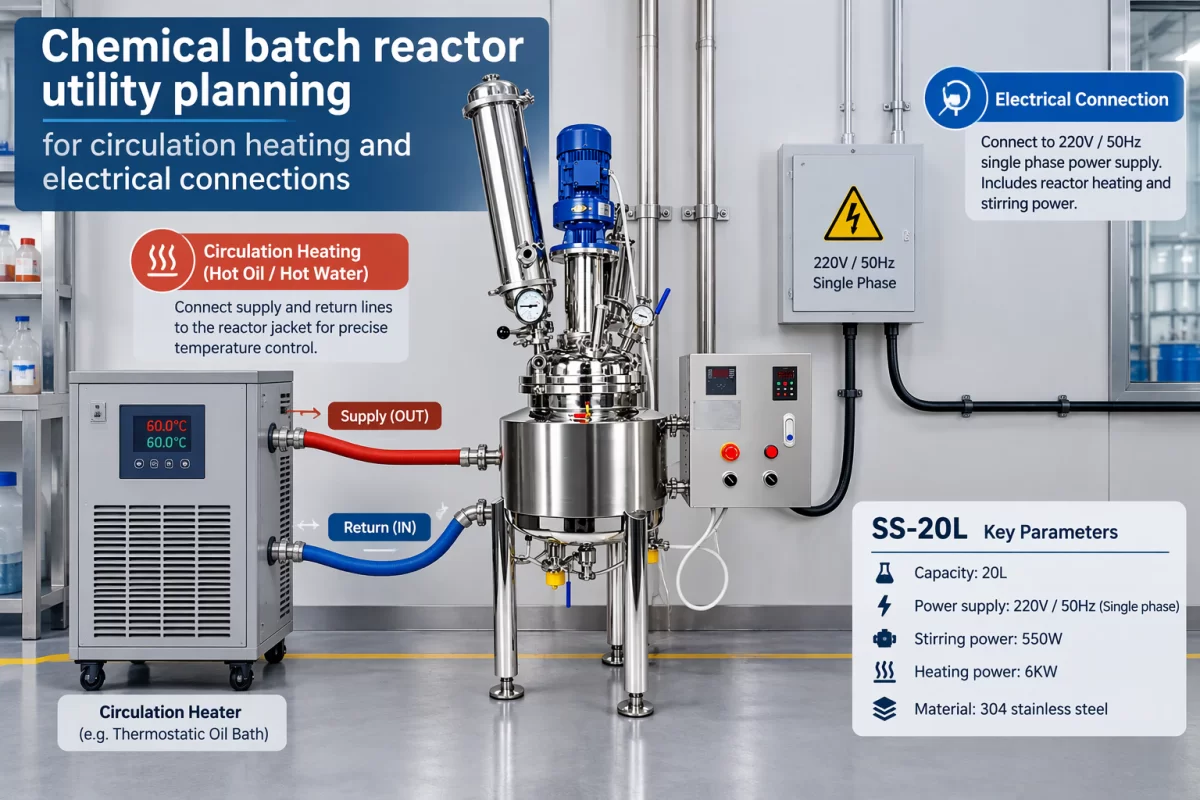
What makes a utility comparison meaningful between reactor proposals?
I would give each supplier the same batch mass, material properties, temperature schedule, available electrical supply, and thermal-service conditions. I would also compare the same included accessories. This creates a useful basis for assessing the proposals without combining specifications from different configurations.
Materials, cleaning, and maintenance shape long-term suitability
A stainless steel vessel description is only one part of material selection. The documented SS-5L reactor uses 316 stainless steel for the vessel, while its pipework and stirring rod are described as 304 stainless steel. Compatibility assessment should therefore cover every component that contacts the process or cleaning fluid, including valves, seal components, gaskets, and connected accessories.
Review the actual chemicals, concentrations, contaminants, exposure temperatures, and cleaning agents. Material grades, wetted-component coverage, surface finish, and supporting documentation should be defined for the selected assembly before purchase. The vessel’s material designation should not be interpreted as the material of the entire fluid-contact system.
For maintenance, compare access to the mechanical seal, agitator, unions, and discharge valve. Allow enough space for component removal and identify spare-parts requirements. Reliability is best assessed through service procedures, operating conditions, parts availability, and inspection planning—not through an unsupported claim that one arrangement is universally more reliable.
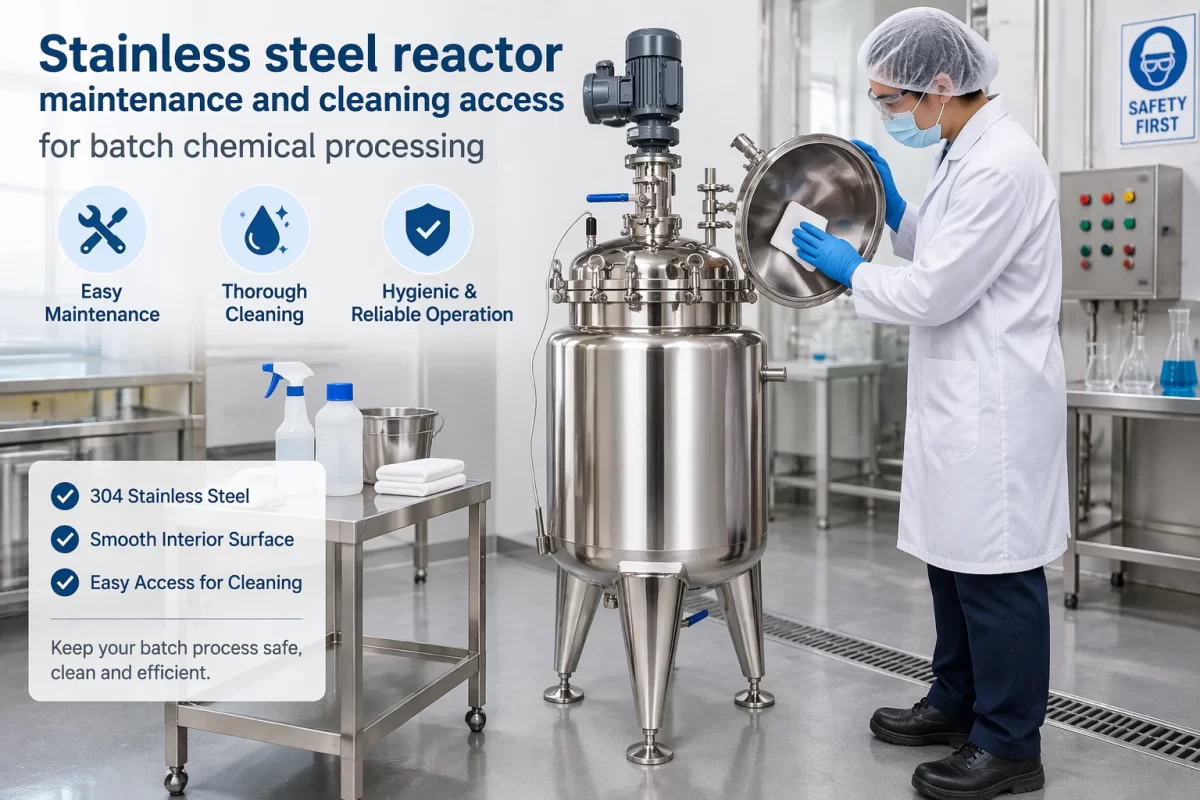
Is stainless steel construction sufficient to establish pharmaceutical suitability?
I would not treat stainless steel construction as a pharmaceutical qualification. Suitability depends on the specific material, contamination controls, cleaning requirements, and project documentation. Material records, surface-finish requirements, instrument calibration, and qualification evidence should be agreed for the intended application; a general application description does not establish whole-equipment certification or production compliance.
Separate equipment facts, process assessment, and project acceptance
A purchasing comparison becomes clearer when it uses three distinct layers:
- Equipment facts: the selected model’s vessel volume, materials, agitation arrangement, heating method, connections, instrumentation, and supplied accessories.
- Process suitability: compatibility with the batch composition, required mixing, heat removal, cleaning method, and operating conditions.
- Project acceptance records: agreed drawings, material documentation, applicable inspection or test records, calibration records, and qualification documents where required.
Compare quotations using the same accessory list, installation boundary, and documentation scope. Define who supplies the circulation equipment, condenser, instruments, connecting lines, and receiving equipment. Do not combine a series’ largest vessel volume with its highest stated temperature and pressure to describe a single purchasable configuration.
Company reference price
US$2,042 is our company reference price selected from the supplied company price listings. It is a budgeting reference, not a quotation for a particular model or complete plant installation. The actual quotation depends on the selected configuration and the inquiry result.
Choosing the best-fit stainless steel batch reactor for the plant
The best stainless steel batch reactor for chemical manufacturing plants is the configuration that matches a defined process and can be installed, operated, cleaned, and maintained within the site’s constraints. Start with the working batch and workflow, compare utilities and mixing under equivalent conditions, then assess wetted materials and the required project documents.
A purchasing decision should rest on the selected assembly’s specifications and process-specific evidence, rather than a product-category label or a headline maximum. This approach makes differences in installation scope, serviceability, and quotation coverage easier to evaluate.
Submit the process materials, intended working batch, target operating conditions, site electrical supply, available heating and cooling services, cleaning requirements, and preferred connections. Include accessory and documentation needs so a corresponding Stainless Steel Reactor configuration and quotation can be assessed for the project.