
Chemical synthesis · Equipment selection
Comparing Glass Reactor Options for Industrial Synthesis Projects
Which Industrial Glass Reactor Is Best for Chemical Synthesis?
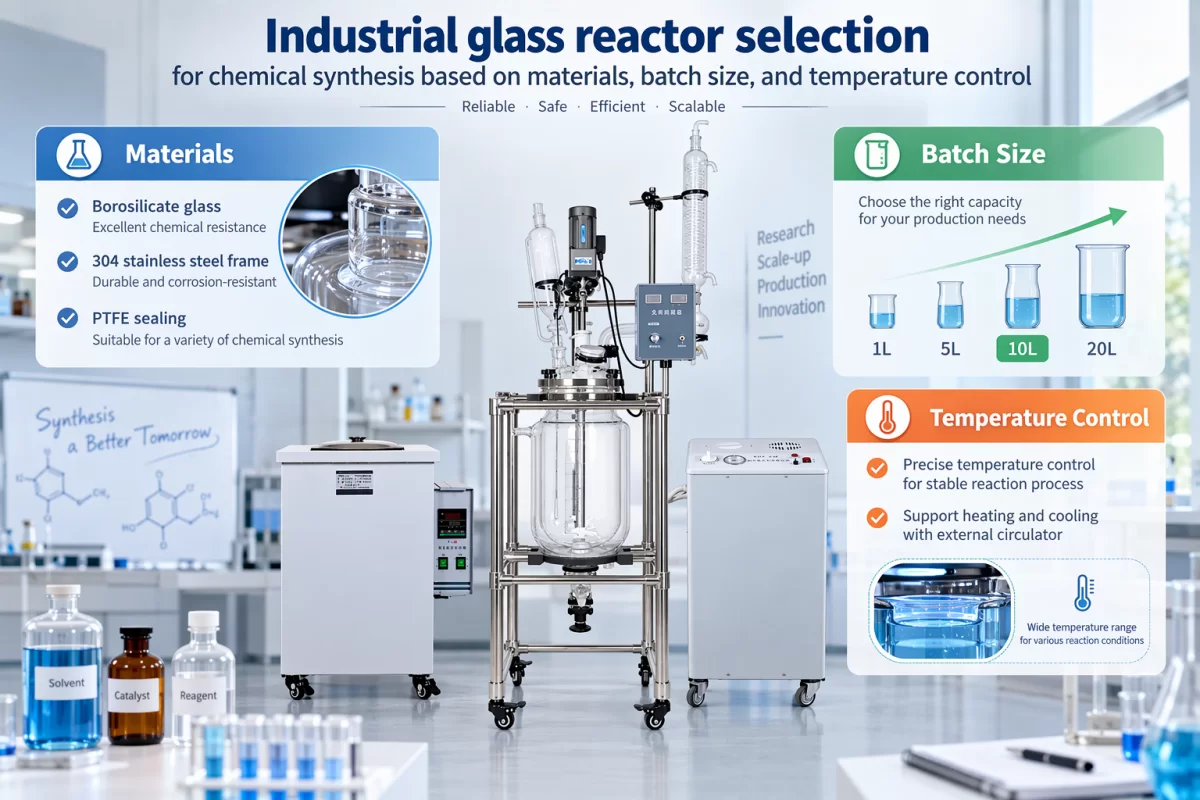
Choosing an industrial glass reactor starts with the process, not a capacity label. For chemical synthesis projects comparing 10L and 20L jacketed glass reactors, the useful question is which configuration fits the materials, actual working batch, temperature-control duty, and required supply scope.
“Best” describes a project-specific comparison here, not an absolute performance ranking. A larger vessel is not automatically more suitable, and a smaller vessel is not automatically easier to control. The selection should connect each proposed reactor body, jacket, agitator, condenser, connection, discharge assembly, and temperature-control package to the intended operation.
Compare 10L and 20L Options Without Confusing Capacity and Batch
The 10L Jacketed Glass Reactor is a candidate for projects evaluating a vessel with 10 L nominal capacity. Its suitability depends on the operating liquid level, agitation requirements, additions, and space needed above the liquid. The 10 L designation should not be treated as permission to process a 10 L working batch.
The 20L Jacketed Glass Reactor provides a 20 L nominal-capacity option for the comparison. It deserves consideration when the process requires more vessel volume, but that does not establish a guaranteed working batch or a proportional increase in throughput. Mixing and heat-transfer demands still need to match the proposed configuration.
| Comparison item | 10L option | 20L option |
|---|---|---|
| Capacity model | S-10L | S-20L |
| Nominal vessel capacity (L) | 10 | 20 |
| Working batch | Assess the actual charge profile against the vessel geometry and mixing configuration. | Assess the larger-volume requirement without assuming full nominal-volume operation. |
| Materials | Evaluate the vessel, wetted agitator parts, seals, connections, and discharge components against the process chemicals. | |
| Temperature control | Match jacket circulation, heating and cooling duties, sensing, and control to the reaction. | |
| Supply scope | Compare the quoted reactor assembly, condenser, feed equipment, discharge arrangement, controls, and supporting utilities. | |
Does nominal vessel capacity define a safe working batch?
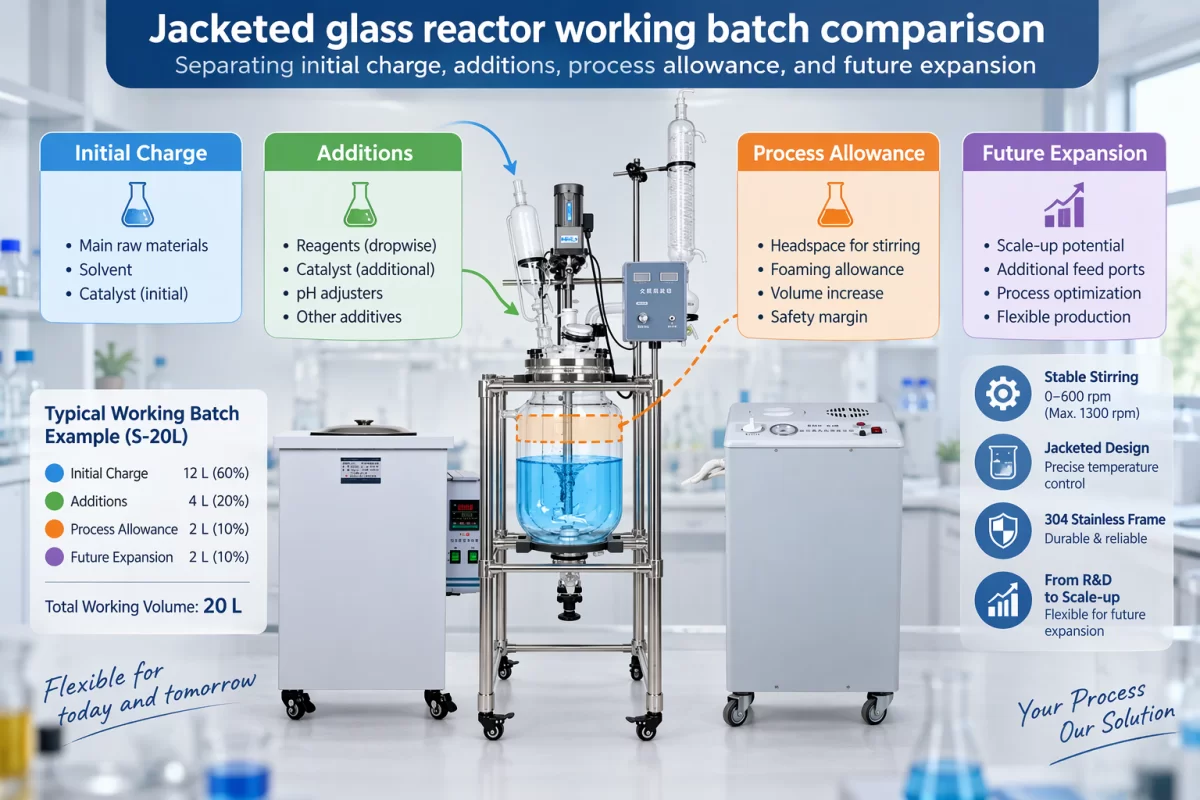
I would not use nominal capacity as a batch guarantee. I would compare the initial charge and maximum process volume with the proposed vessel geometry, mixing coverage, and required headspace. Foaming, gas evolution, reflux, and solids can change the usable operating envelope, so a single filling percentage should not be applied to every material.
Current batch, additions, process allowance, and future expansion
Current batch: Start with the actual initial charge, including solvents, reactants, and any slurry volume. Record the liquid level needed for effective agitation and temperature sensing.
Additions: Describe staged feeds separately. A process that begins with a modest charge can reach a substantially different volume after reagent or solvent additions.
Process allowance: Identify the space needed for expected foaming, vapor disengagement, reflux return, or changes in the reaction mixture. This allowance is distinct from the charge itself.
Future expansion: Evaluate the intended next batch size as a separate operating case. Extra nominal volume may support a future project, but the current smaller batch must still be compatible with the chosen agitator and sensor arrangement.
Material Compatibility and Pressure Requirements Come First
A glass vessel does not establish compatibility for the entire assembly. Seals, stirrer components, valves, feed connections, and discharge parts may expose different materials to the process. Compare their suitability at the intended concentration and temperature, including contact with cleaning agents and any abrasive solids.
The supporting frame should not be confused with a wetted material specification. Likewise, a product name or photograph does not establish a particular glass grade, seal composition, or chemical-resistance guarantee for either capacity model.
An ordinary jacketed glass reactor must not be assumed to have high-pressure capability. The vessel and jacket are separate pressure boundaries, and their respective operating limits matter. If pressurized synthesis is required, review a purpose-designed system and its documented ratings. The discussion of glass pressure reactors for pharmaceutical scale-up provides a relevant starting point without implying that these ordinary jacketed options are pressure-rated.
Compare Temperature Control as a Complete System
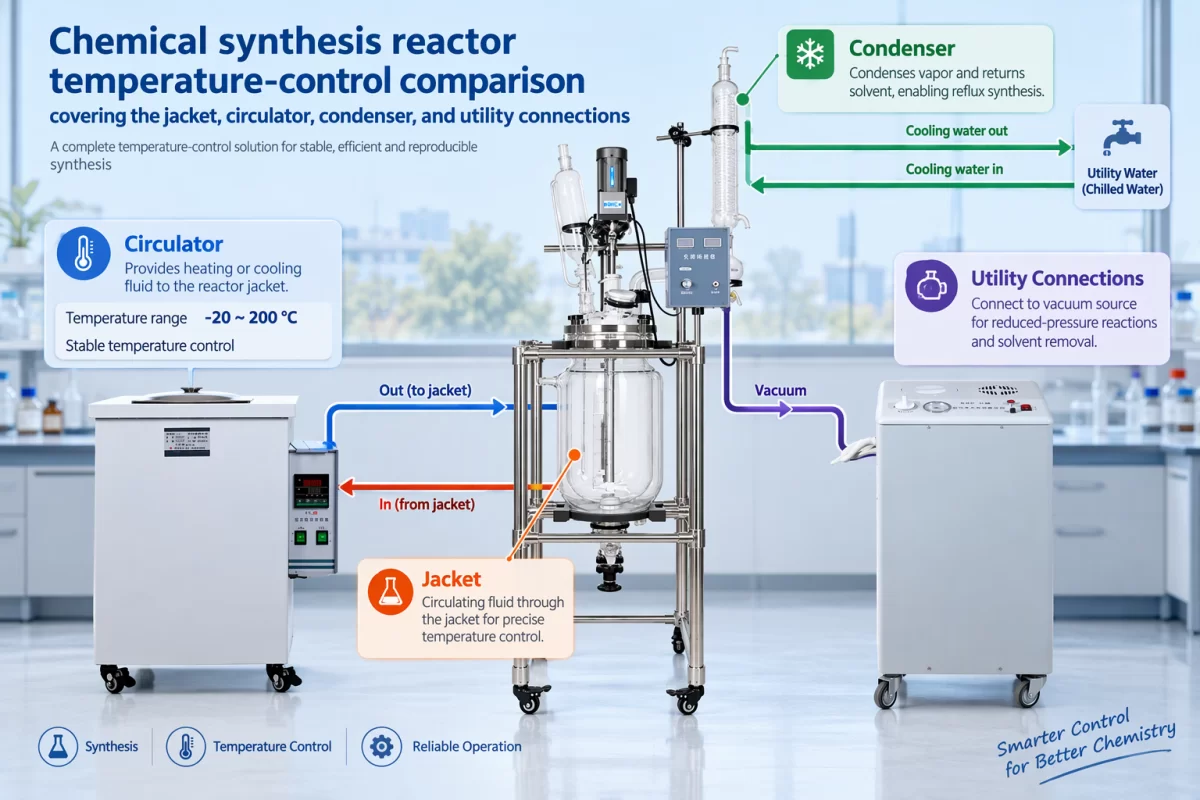
The temperature-control comparison should cover more than a heater or chiller setpoint. State the process temperature profile, expected reaction heat, feed schedule, cooling demand, and acceptable control response. The proposed thermal unit must be considered together with jacket circulation, connecting hoses, heat-transfer fluid, and temperature-sensor placement.
Mixing also affects the temperature-control assessment. Describe viscosity changes, suspended solids, and the intended reaction stages so the agitator configuration can be evaluated alongside heat transfer. Neither motor speed nor vessel size alone demonstrates adequate mixing for a particular synthesis.
Does a jacket establish the reactor’s temperature range?
I would treat the jacket as part of the heat-transfer arrangement, not as a temperature rating. I would base the operating range on the specified vessel, seals, connections, thermal fluid, and control equipment. The permissible process temperature and jacket conditions need to be established for the selected assembly.
For reflux or distillation steps, include the condenser duty, vapor route, receiver arrangement, and any proposed vacuum equipment in the comparison. Electrical supply, available cooling utilities, installation space, and ventilation should also fit the site. These requirements belong in the purchasing brief rather than being inferred from a generic reactor description.
Compare Supply Scope Before Comparing Purchase Cost
Two proposals with the same nominal capacity can cover different equipment. Ask for an itemized scope identifying the reactor body and jacket, agitator assembly, condenser, vessel ports, feed accessories, bottom discharge, temperature measurement, and control equipment. Heating and cooling circulators, vacuum accessories, hoses, and installation services should be identified as included items or separate purchases.
Discharge deserves particular attention when the mixture contains solids or becomes viscous. Compare the outlet arrangement, transfer route, cleaning access, and connection to the receiving vessel against the actual process. For reliability-focused purchasing, consider maintenance access, replacement components, operating instructions, and support arrangements rather than relying on an unsupported reliability label.
Which quotation offers the more useful comparison?
I would favor a quotation that clearly connects its scope to the stated process requirements. A vessel-only price and an integrated-system price are not equivalent. The more useful proposal explains what is supplied, what the site must provide, and which operating conditions the proposed configuration supports.
Company Reference Price
Our reference price across the company’s listed jacketed glass reactor offerings is US$1,699. This is a portfolio-level reference, not a quotation for either capacity or a complete installed system. Actual pricing depends on the selected configuration and the resulting inquiry quotation.
Choose the Glass Reactor That Fits the Synthesis Project
The practical answer to which industrial glass reactor is best for chemical synthesis is the option whose documented configuration fits the process. Compare the 10L and 20L candidates by material compatibility, actual working batch, thermal duty, and supply scope—not nominal volume or an absolute ranking.
For a project-specific proposal, submit the chemicals and concentrations, initial and maximum batch volumes, feed sequence, temperature and pressure conditions, mixing needs, reflux or distillation requirements, available utilities, and requested accessories. Include future expansion as a separate operating case so the corresponding reactor configuration and quotation can be evaluated against both present and planned needs.