
High Pressure Reactor · Selection Guide
Comparing High Pressure Autoclave Reactors for Hydrogenation
The question “which high pressure autoclave reactor is best for hydrogenation” is most useful as a comparison brief, not a request for an unsupported winner. A suitable reactor must match the actual batch, required pressure–temperature operating envelope, mixing duty, wetted materials, sealing arrangement, and process connections.
This guide separates listed equipment specifications from hydrogenation process requirements, helping buyers build a model-specific shortlist rather than selecting on vessel size or a single maximum rating.
A practical hydrogenation reactor comparison framework
Begin with the reaction duty. Hydrogenation may involve gas–liquid contact, suspended catalyst, changing liquid volume, and heat release. These conditions create different equipment requirements even when two processes use the same nominal vessel capacity. A useful comparison therefore records both the process requirement and the proposed equipment configuration.
When evaluating a High Pressure Chemical Reactor, compare the proposed model with the intended chemistry and batch profile. The product category is a starting point; it does not establish hydrogen compatibility, corrosion resistance, or the required connection package.
| Comparison axis | Process requirement | Equipment basis for selection |
|---|---|---|
| Batch and volume | Initial charge, later additions, expansion, foam, and gas space | Exact model capacity and allowable working volume for the proposed duty |
| Design conditions | Target operating conditions and assessed upset conditions | Model-specific pressure–temperature envelope and protection arrangement |
| Stirring | Gas dispersion, catalyst suspension, viscosity, and mixing objective | Speed range, impeller geometry, drive torque, and seal arrangement |
| Materials and seals | Compatibility with hydrogen, solvent, reactants, and cleaning agents | Wetted material specification and seal selection for the application |
| Measurement and interfaces | Gas feed, liquid addition, sampling, venting, and temperature measurement | Port schedule, connection ratings, sensor locations, and control functions |
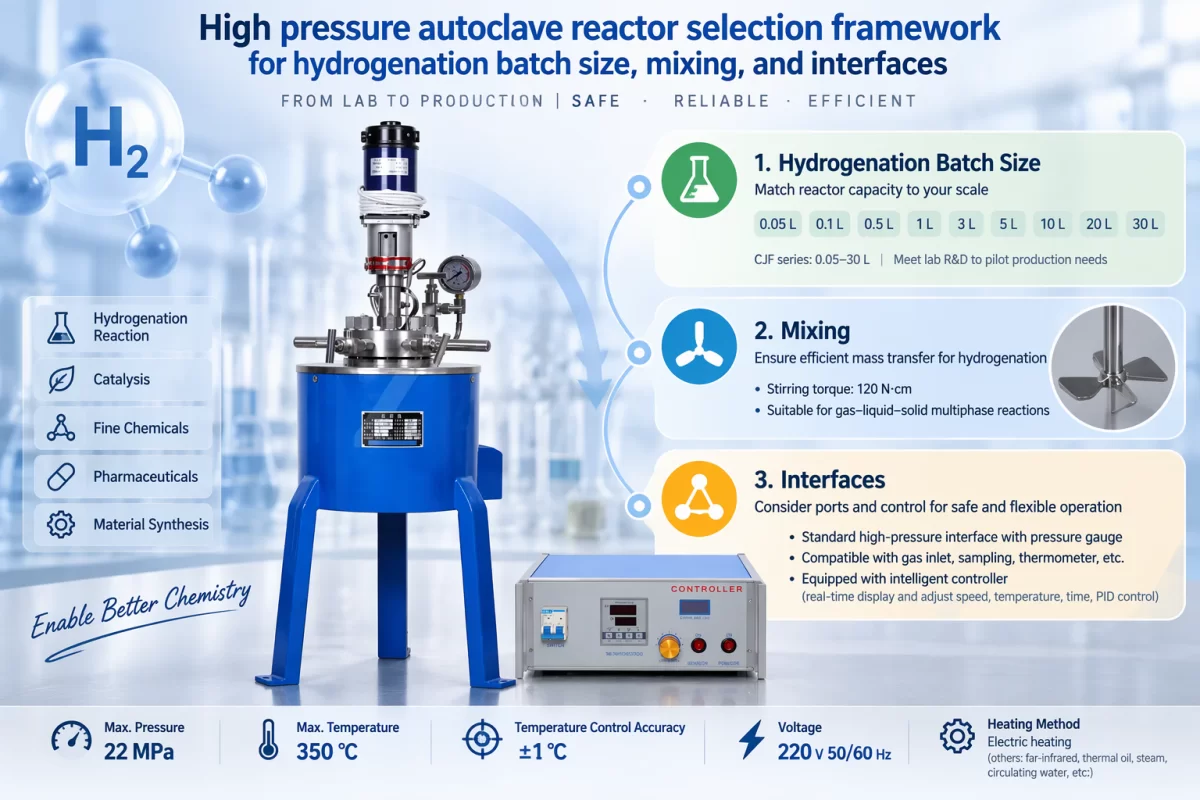
Separate current batch size from expansion plans
Current batch: Record the starting liquid volume, catalyst quantity, and expected physical behavior. Nominal vessel capacity is not automatically the permissible liquid charge. Working volume depends on the specific reaction, required gas space, agitation, and operating conditions.
Addition changes: Include solvent, substrate, or other liquid additions made after the initial charge. Compare the highest expected liquid inventory, not just the starting volume.
Process allowance: Account separately for thermal expansion, foaming, agitation behavior, and other assessed process needs. There is no universal filling fraction appropriate for every hydrogenation mixture.
Future expansion: Define the likely future batch as a separate case. A larger vessel should also be evaluated for its ability to mix and measure the smaller present-day batch; extra nominal volume alone does not establish a useful scale-up path.
Compare capacity, pressure, and temperature by exact model
The FCF specifications provide clearly identified model rows for capacity, pressure, temperature, stirring speed, and heating power. The selected entries below show why capacity and ratings must stay attached to the same model.
| Model | Capacity (L) | Listed pressure (MPa) | Listed temperature (°C) | Stirring speed (r/min) | Heating power (kW) |
|---|---|---|---|---|---|
| FCF-0.1 | 0.1 | 22 | 350 | 50–1000 | 0.6 |
| FCF-1 | 1 | 22 | 350 | 50–1000 | 1.5 |
| FCF-3 | 3 | 22 | 350 | 50–1000 | 2.5 |
| FCF-5 | 5 | 22 | 350 | 50–600 | 4 |
| FCF-20 | 20 | 22 | 350 | 50–600 | 10 |
| FCF-30 | 30 | 16 | 350 | 50–600 | 12 |
| FCF-50 | 50 | 10 | 300 | 50–600 | 12 |
| FCF-100 | 100 | 6 | 300 | 50–600 | 14 |
These are listed model specifications, not recommended hydrogenation setpoints. Separate pressure and temperature entries do not, by themselves, establish simultaneous operation at both values. Procurement should use the approved pressure–temperature envelope for the selected vessel and configuration.
For example, FCF-20 lists 20 L, 22 MPa, and 350°C, while FCF-50 lists 50 L, 10 MPa, and 300°C. The larger capacity must not be combined with the smaller model’s higher ratings. Heating power likewise describes the listed heater, not a guaranteed heat-up time or cooling capability.
The CJF capacity entries also support a volume shortlist: CJF-0.5 is 0.5 L, CJF-1 is 1 L, and CJF-3 is 3 L. A purchasing comparison should evaluate their proposed materials, agitation, seals, and operating envelope alongside capacity rather than treating matching volume as equivalent performance.
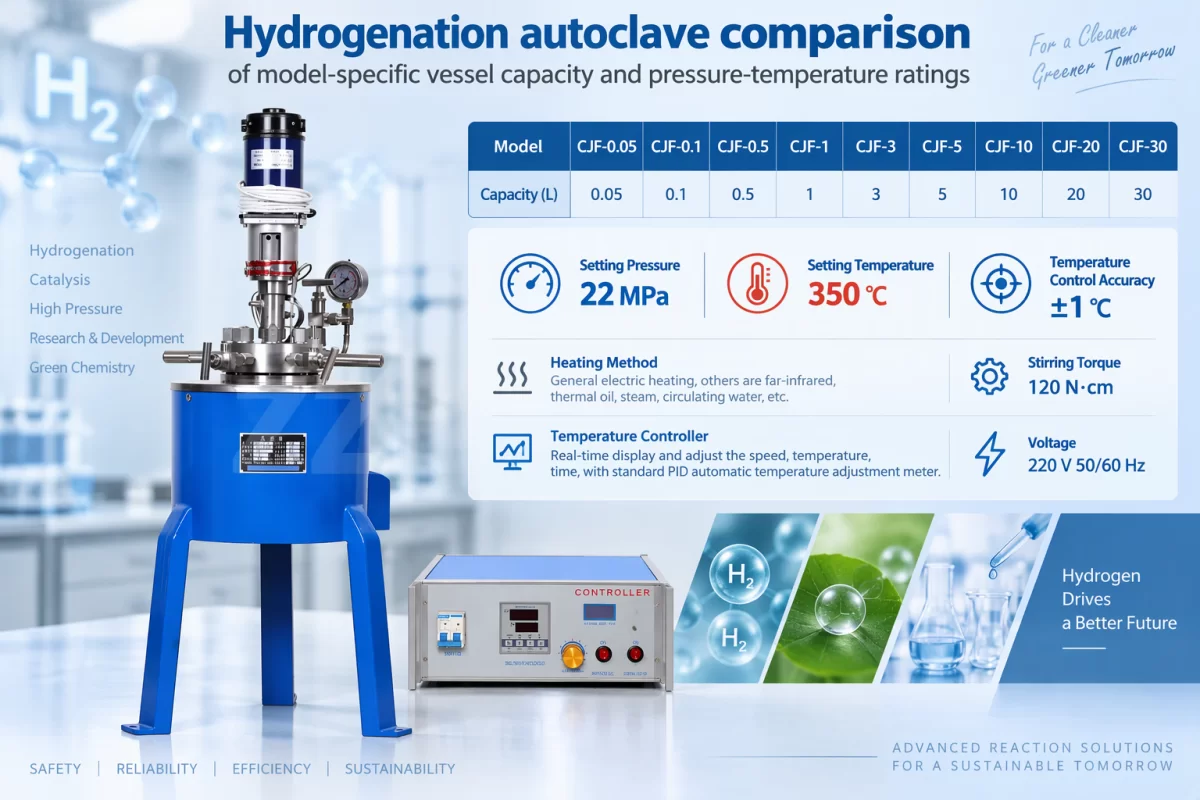
Stirring, materials, seals, and interfaces determine fit
When reviewing a High Pressure Autoclave Reactor, ask for the configuration that will actually be supplied. For hydrogenation, the comparison should include the gas inlet arrangement, impeller position, catalyst-handling requirements, and the means of measuring reaction conditions.
The TGYF-C specifications list mechanical stirring, modular electrical heating, and stainless steel 304 and 316 material options. These details can inform a configuration discussion, but a listed material option does not establish the grade fitted to a particular vessel or compatibility with every hydrogenation chemistry.
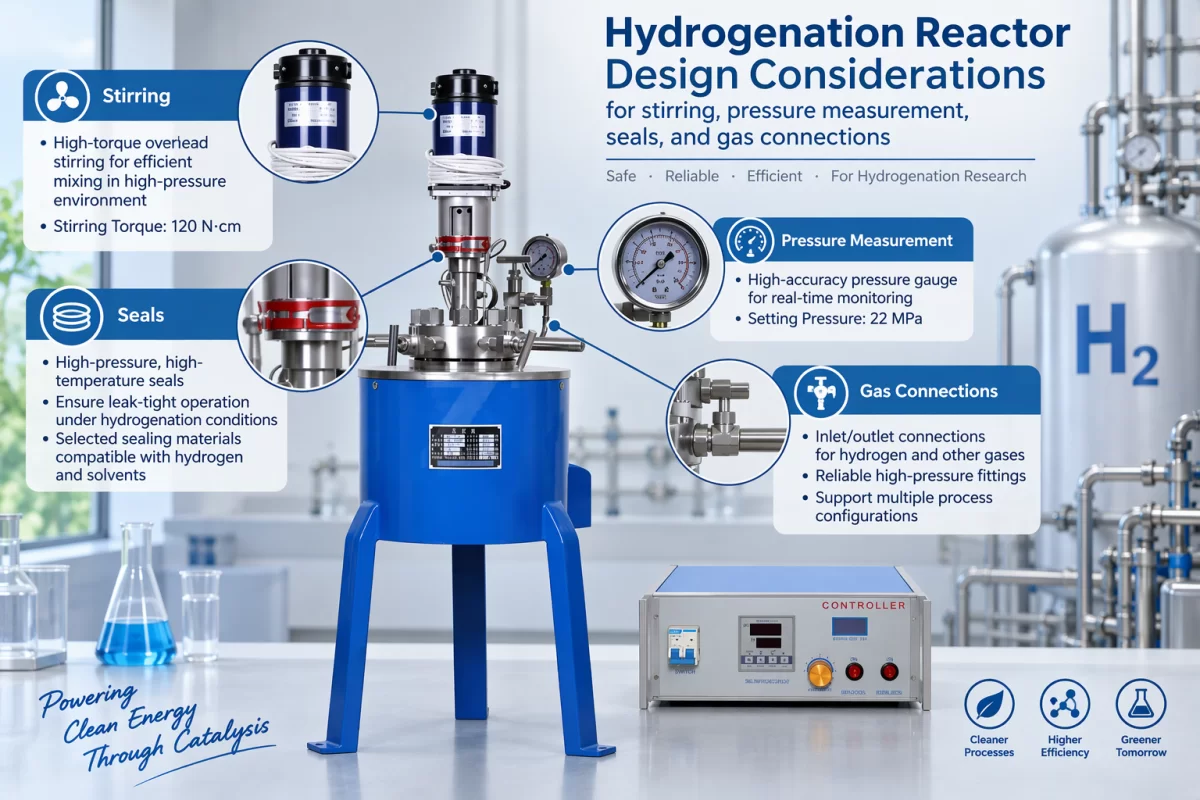
- Materials: Specify all wetted parts, including the vessel, impeller, valves, dip tubes, and sensor fittings. Assess compatibility with the complete process mixture and cleaning procedure.
- Sealing: Establish the proposed closure and agitator sealing arrangements, their suitability for the operating conditions, and the associated inspection and maintenance requirements.
- Measurement: Define pressure and temperature measurement locations, required measurement performance, recording needs, alarms, and any process-specific interlocks.
- Interfaces: Provide a port schedule for hydrogen supply, inert-gas service, additions, sampling, venting, and pressure relief. Connection sizes and ratings should belong to the selected configuration.
- Thermal management: Specify heat-up and heat-removal requirements separately. Electrical heating capacity alone does not demonstrate control of an exothermic reaction.
For additional selection context, the guide to high-pressure laboratory reactors for hydrogenation experiments is a relevant companion to the model comparison. The purchasing decision should still rest on the proposed equipment’s documented capabilities and the laboratory’s process safety assessment.
Budget and reliability: compare the supply scope
A price comparison is meaningful only when the included equipment is comparable. Define the vessel, agitation system, heating and cooling provisions, instrumentation, valves, accessories, and documentation before evaluating the quotation.
Our company reference price for initial budgeting. This is not a model-specific hydrogenation package quotation; the actual quotation depends on configuration and the inquiry result.
Compare what each proposed package includes and what the site must provide. Hydrogen service requires an appropriate installation and operating procedure, including gas handling, ventilation, protective measures, and trained personnel. These are application requirements, not capabilities automatically established by a reactor’s capacity or catalog ratings.
Which high pressure autoclave reactor is best for hydrogenation?
The defensible answer is the model and configuration that satisfy the defined process duty with documented support. Start with working batch requirements, preserve each model’s own capacity and ratings, and then compare mixing, materials, sealing, measurement, and interfaces. Neither the largest vessel nor the highest listed pressure establishes a universal best choice.
A useful shortlist distinguishes today’s batch, later additions, process allowances, and future expansion. It also distinguishes published specifications from application-specific capabilities that must be established before procurement.