
High Pressure Reactor · Research Equipment Selection
Comparing High Pressure Autoclaves for Laboratory Research Programs
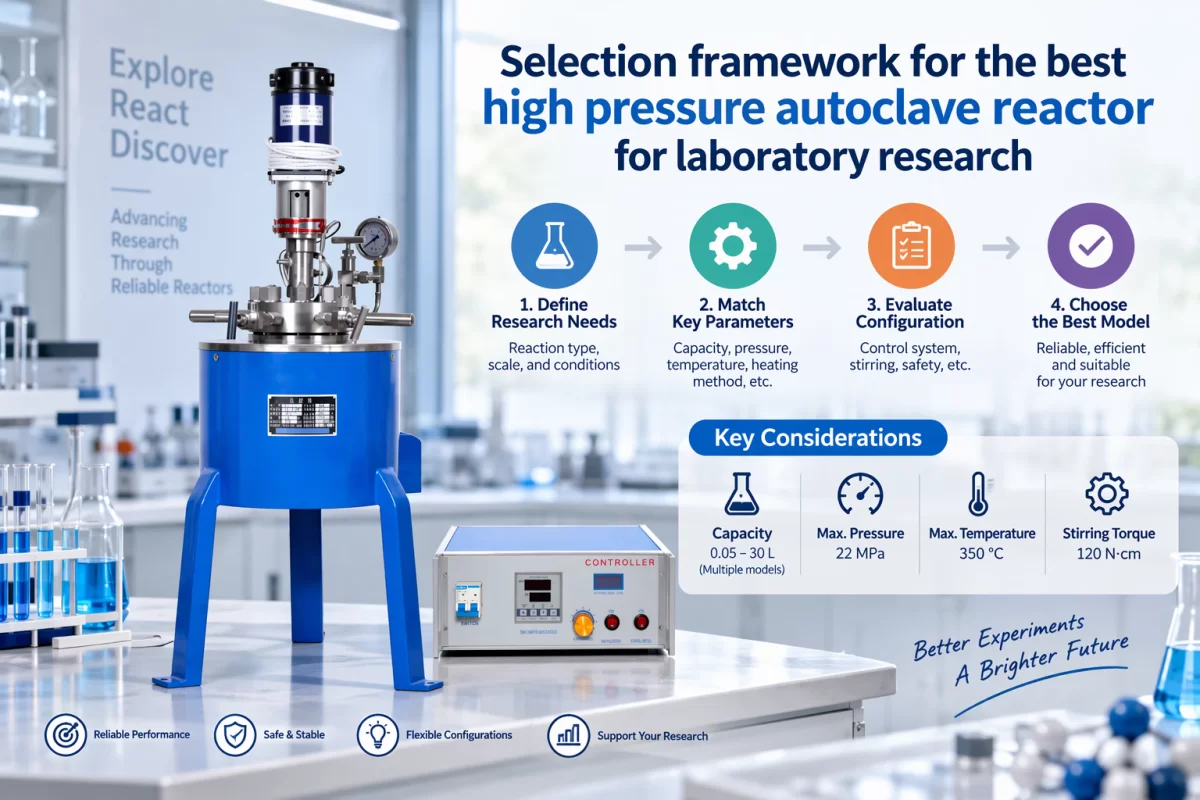
Searching for the best high pressure autoclave reactor for laboratory research is really a search for the right match between an experimental program and a specific equipment configuration. A laboratory running several reaction types needs more than a large vessel or an impressive pressure figure: it needs suitable batch capacity, mixing, measurement access, and a practical route to future work.
Start with the research program, not a “best” ranking
An evidence-based comparison starts with a task matrix. Separate small screening experiments, repeatability studies, feed-controlled reactions, and larger validation batches. For each task, record the materials, intended operating temperature and pressure, expected reaction duration, mixing requirements, and measurements needed to interpret the result. These are process requirements, not capabilities that should automatically be attributed to a reactor.
The High Pressure Lab Reactor is a relevant product page for laboratories preparing this comparison. Evaluate the proposed model and configuration against the task matrix, including vessel volume, wetted materials, sealing arrangement, stirring system, and instrument connections. The product name alone does not establish which experimental conditions it can support.
Does the largest autoclave offer the most useful research flexibility?
My approach is to compare the normal experimental batch first. Extra capacity can help with planned growth, but it does not establish suitable mixing at a small charge or convenient operation across every task. I would shortlist a larger vessel only when the current work and the expansion plan both justify it.
Compare model-specific capacity, pressure, and temperature
The FCF model specifications show why capacity and pressure must be evaluated together. Selected models are listed below with their corresponding temperature, stirring-speed, and heating-power entries. These figures belong to the individual rows; they should not be combined into a single series-wide specification.
| Model | Capacity (L) | Listed pressure (MPa) | Listed temperature (°C) | Stirring speed (r/min) | Heating power (kW) |
|---|---|---|---|---|---|
| FCF-0.1 | 0.1 | 22 | 350 | 50–1000 | 0.6 |
| FCF-1 | 1 | 22 | 350 | 50–1000 | 1.5 |
| FCF-3 | 3 | 22 | 350 | 50–1000 | 2.5 |
| FCF-5 | 5 | 22 | 350 | 50–600 | 4 |
| FCF-20 | 20 | 22 | 350 | 50–600 | 10 |
| FCF-30 | 30 | 16 | 350 | 50–600 | 12 |
| FCF-50 | 50 | 10 | 300 | 50–600 | 12 |
| FCF-100 | 100 | 6 | 300 | 50–600 | 14 |
Listed pressure and temperature entries are comparison data, not approval to operate at both values simultaneously. Obtain the applicable pressure–temperature operating envelope for the selected vessel, materials, seals, and configuration before specifying a reaction.
For example, FCF-20 is listed at 20 L, 22 MPa, and 350 °C, while FCF-30 is listed at 30 L, 16 MPa, and 350 °C. FCF-50 changes the comparison again, with 50 L, 10 MPa, and 300 °C. A program seeking greater batch capacity therefore needs to reassess its operating requirements rather than assume that the larger model retains the smaller model’s pressure entry.
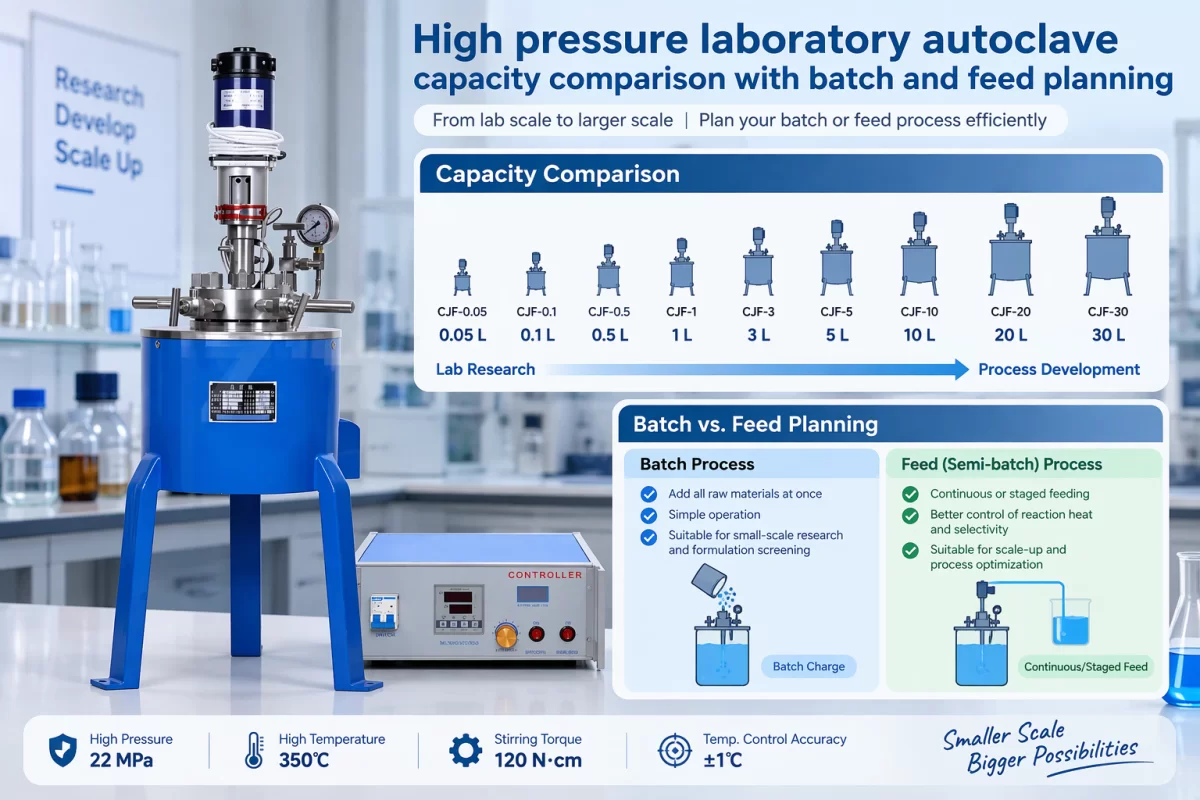
The CJF capacity lineup includes CJF-0.05 at 0.05 L, CJF-0.1 at 0.1 L, CJF-0.5 at 0.5 L, CJF-1 at 1 L, CJF-3 at 3 L, CJF-5 at 5 L, CJF-10 at 10 L, CJF-20 at 20 L, and CJF-30 at 30 L. These capacities can help define a shortlist, but capacity alone is not enough to establish suitability for a particular reaction.
TGYF-C configurations list volumes of 0.05, 0.1, 0.25, 0.5, and 1 L, with mechanical stirring and modular electrical heating. Heating power is listed as 0.7 kW for the 0.05, 0.1, and 0.25 L configurations, and 1.5 kW for the 0.5 and 1 L configurations. Stainless steel 304 and 316 are listed material options. These options provide useful comparison points without establishing compatibility with every chemical system.
Separate current batches, feed changes, and process margin
Current working batch
Start with the actual initial charge, including liquids, solids, catalysts, and any other components that occupy the vessel. Nominal capacity is not an approved working charge. Appropriate loading depends on the specific chemistry, phase behavior, mixing needs, and operating procedure; a universal filling percentage is not a sound basis for all materials.
Changes during addition
Record planned liquid additions, gas supply, sampling withdrawals, and any changes in volume or phase during the experiment. A batch that fits at the start may have different headspace and mixing requirements after addition. Feed-controlled work also requires suitable connections and a feed arrangement rated for the intended conditions.
Process margin
Treat allowance for thermal expansion, foaming, gas evolution, and pressure excursions separately from the starting charge. Determine that allowance through the process assessment and the selected equipment’s operating limits. Additional vessel space does not replace pressure protection or a suitable control strategy.
Can one loading percentage be used for every research material?
I would not apply a single percentage across different reactions. Solvent behavior, gas generation, solids content, and temperature can change the required allowance. My selection basis would be a material-specific working charge and a defined operating procedure, assessed against the chosen reactor configuration.
Mixing and measurement determine experimental usefulness
Speed is a useful specification, but it is not a complete description of mixing. Compare the impeller arrangement, available torque, working liquid level, and expected viscosity or solids loading. The FCF table shows a listed range of 50–1000 r/min for FCF-1 and FCF-3, compared with 50–600 r/min for FCF-5 and the larger models shown. These ranges do not establish equivalent mixing performance between different volumes.
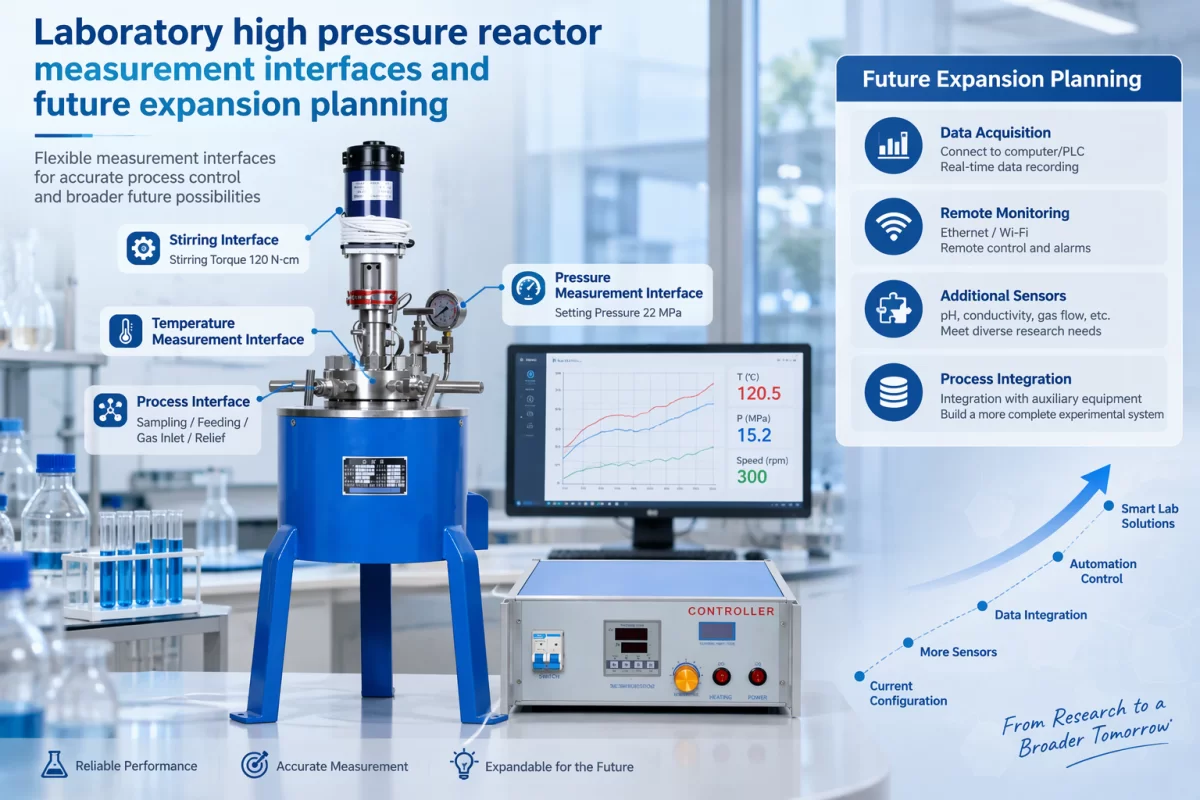
For programs considering the High Pressure Autoclave Reactor, include measurement and interface requirements in the configuration request. Specify whether the experiment needs temperature sensing in the reaction zone, pressure monitoring, gas admission, liquid addition, sampling, or recorded operating data. Each requirement should be matched to an explicitly offered component or connection, rather than assumed from the product category.
Materials selection should cover all wetted parts, not only the vessel body. Seals, valves, probes, and feed components also need to suit the chemistry and operating conditions. The stainless steel chemical reactor technical guide provides a related reading route for laboratories developing their materials questions.
What makes a reactor a reliable choice for a multi-task laboratory?
I treat reliability as a purchasing question about fit, maintenance, and operating discipline—not as an unsupported performance label. I would compare the documented operating envelope, seal servicing procedure, instrument suitability, cleaning access, and replacement-component support for each proposed configuration.
Plan future expansion without compromising today’s experiments
Future expansion deserves its own specification. Identify the anticipated batch size, likely changes in chemistry, additional measurements, and possible utility requirements. A larger vessel is one option; a separate small-batch and larger-batch arrangement may also merit comparison when the tasks differ substantially.
Scaling a research method should not be reduced to increasing vessel volume. Stirring, heating, cooling requirements, addition rates, and sampling procedures need a fresh assessment. Listed heater power does not, by itself, establish heat-up time, cooling capacity, or temperature uniformity for a particular charge.
- Current work: define the normal charge, reaction conditions, and essential measurements.
- Task changes: identify feed additions, different materials, and cleaning or changeover needs.
- Future work: describe larger batches and additional interfaces as separate requirements.
- Procurement scope: request an itemized configuration covering the vessel, mixing, heating, controls, connections, and required documentation.
Request a configuration-specific company quotation for the shortlisted option. The actual quotation should reflect the selected model, materials, instruments, accessories, and inquiry outcome; it should not be treated as interchangeable across the product lineup.
Choosing the right high pressure autoclave for laboratory research
The best high pressure autoclave reactor for laboratory research is not a universal winner. It is the configuration that matches the program’s present batches, changing feed conditions, measurement needs, and realistic expansion plan. Compare capacity and pressure–temperature data model by model, then evaluate mixing, materials, seals, and interfaces against the intended process.
Prepare a focused equipment inquiry: submit the material composition, initial and final working batch, target operating temperature and pressure, addition schedule, stirring needs, measurement requirements, and planned expansion. Request a corresponding configuration proposal, operating-envelope assessment, and quotation before making the purchasing decision.