
Decarboxylation reactor system for CBD oil production
CBD oil production depends on one key conversion step: decarboxylation. When the process is unstable, producers can lose potency, darken the oil, waste solvent, and slow down the whole line. A well-designed decarboxylation reactor system helps solve these problems by combining controlled heating, stirring, condensation, and collection into one practical production unit.
For processors looking for a reliable decarb reactor, the goal is usually simple: steady product quality, easy operation, and equipment that can grow with production volume. This guide explains what a decarboxylation reactor does, why stainless steel systems are widely used, what technical parameters matter, and how ZZKD equipment fits real CBD oil production needs.
Why decarboxylation matters in CBD oil processing
Raw hemp extract contains cannabinoid acids such as CBDA. These acidic forms are not the same as the neutral cannabinoids many manufacturers want in finished CBD oil. Decarboxylation uses heat to remove a carboxyl group and convert CBDA into CBD. In simple terms, this is the activation step that makes the extract more suitable for many downstream formulations.
Without precise temperature control, this conversion can become uneven. Under-heating may leave too much CBDA in the oil. Overheating may degrade cannabinoids, damage terpenes, and reduce product value. That is why many commercial processors choose a closed, jacketed reactor instead of open heating methods.
What is the biggest reason to use a reactor instead of a simple heated tank?
The short answer is process control. A reactor system gives more stable temperature transfer, more uniform mixing, and better vapor handling. From the author’s perspective, this is the difference between “heating material” and actually “running a repeatable production process.”
How a decarboxylation reactor system works
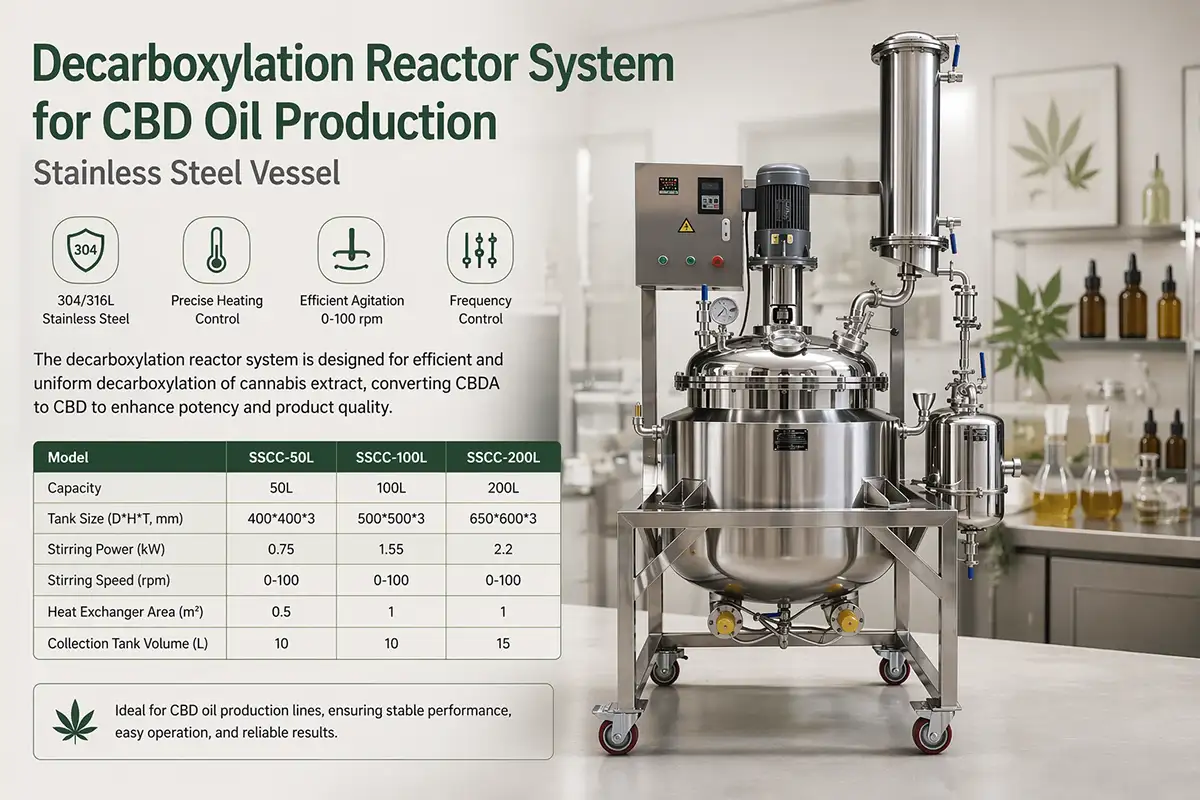
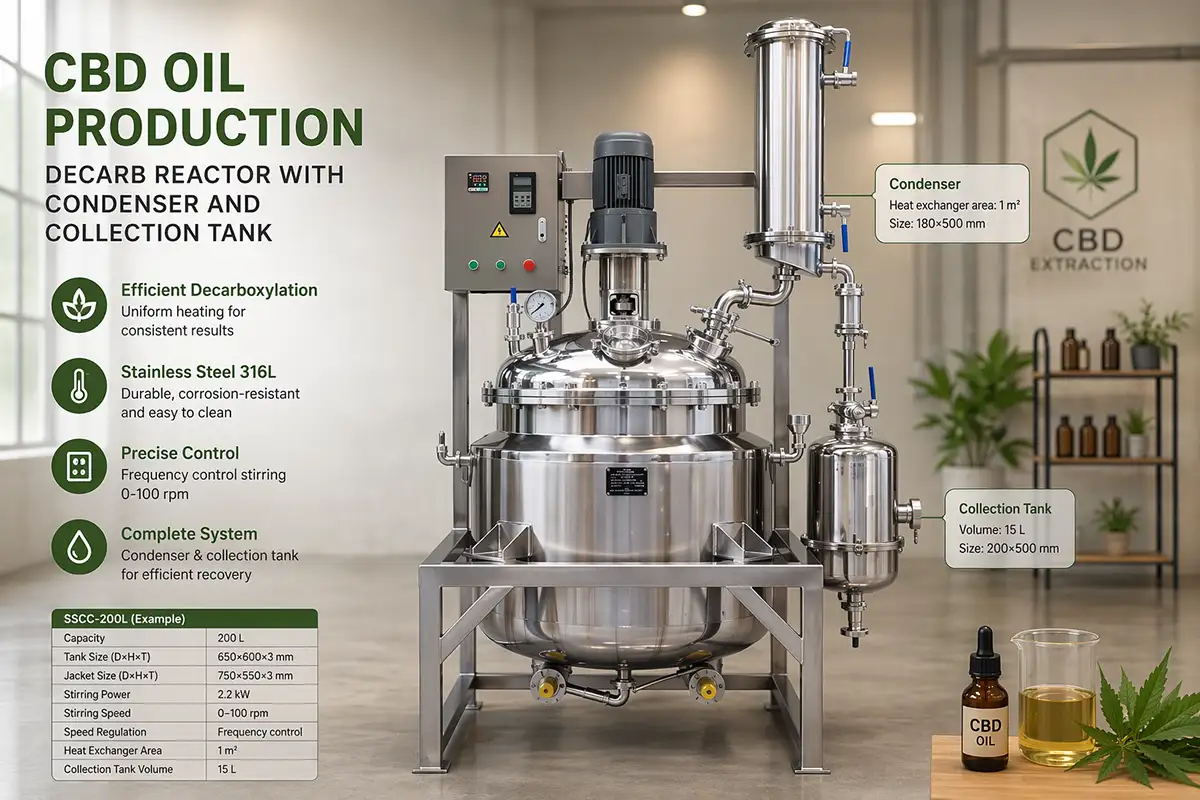
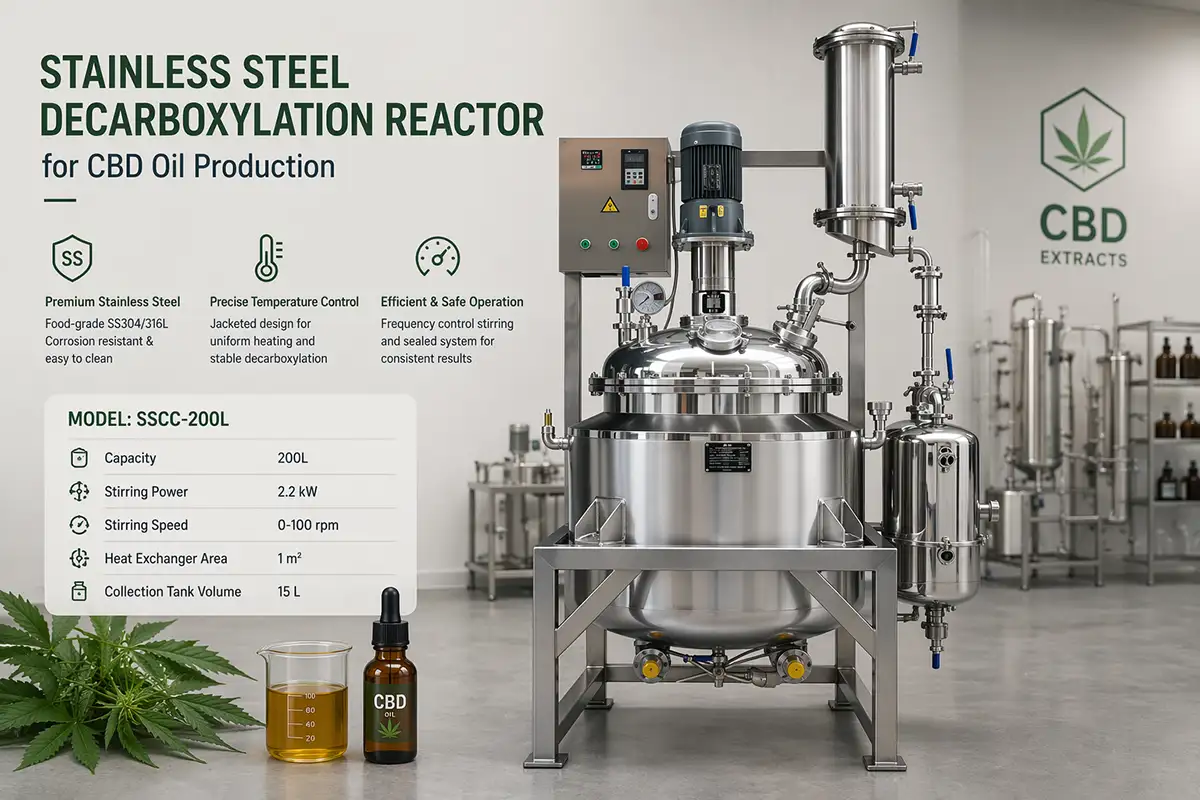
A typical system for CBD oil production includes a stainless steel reactor vessel, a jacket for heating media, an agitator, a condenser, a heat exchanger, and a collection tank. During operation, extract or oil enters the vessel, the jacket transfers heat to the product, and the agitator keeps the material evenly mixed. Vapors generated during heating can move through the condenser and into a collection section, which is useful in systems that also support ethanol recovery or degassing.
This integrated design matters because CBD oil processors often do not need a single isolated machine. They need a practical system that reduces manual transfer, improves safety, and keeps the process cleaner. Stainless steel construction also supports hygiene, corrosion resistance, and easier maintenance for production environments.
For readers comparing different reactor styles, a broader understanding of reactor design can also help. ZZKD provides related process equipment information such as glass reactor system price pages for other applications, although stainless steel is often the better choice for CBD oil decarboxylation at production scale.
Key technical parameters that affect performance
Choosing a decarboxylation reactor should not start with capacity alone. The more useful question is whether the equipment can heat the product evenly, handle viscosity changes, and support the target batch rhythm. ZZKD decarboxylation reactor configurations commonly include 50L, 100L, and 200L options, which are suitable for different production stages from pilot work to growing commercial operations.
| Parameter | 50L | 100L | 200L |
|---|---|---|---|
| Tank size (D×H×T, mm) | 400×400×3 | 500×500×3 | 650×600×3 |
| Jacket size (D×H×T, mm) | 500×350×3 | 600×450×3 | 750×550×3 |
| Stirring power (kW) | 0.75 | 1.55 | 2.2 |
| Stirring speed (rpm) | 0–100 | ||
| Speed regulation mode | Frequency control | ||
| Heat exchanger area (m²) | 0.5 | 1 | 1 |
| Heat exchanger size (D×H×T, mm) | 159×500×3 | 180×500×3 | 180×500×3 |
| Collection tank volume (L) | 10 | 10 | 15 |
| Collection tank size (D×H×T, mm) | 159×400×3 | 159×400×3 | 200×500×3 |
These values show that scaling up is not only about a larger vessel. Stirring power increases, jacket dimensions grow, and collection capacity also changes. That directly affects heating efficiency, mixing behavior, and vapor handling during CBD oil production.
Does faster stirring always mean better decarboxylation?
Not necessarily. The best result comes from balanced stirring, not maximum speed. From the author’s view, frequency-controlled mixing is more valuable than aggressive mixing because it allows the operator to match agitation to product viscosity, foaming behavior, and heat transfer needs.
What buyers usually want to know before choosing a system
Most buyers evaluating decarboxylation equipment for CBD oil ask a few practical questions: How much can be processed per batch? Will the system support solvent recovery? Is cleaning simple? How much floor space is needed? Can the machine keep oil quality consistent from batch to batch?
These are the right questions, because the real value of a reactor system is not just the vessel itself. It is the combination of repeatable heating, manageable operation, and reliable output. In many cases, a closed stainless steel decarboxylation reactor provides a better answer than improvised heating solutions, especially when production standards become stricter.
Consistent quality: jacket heating and controlled stirring reduce hot spots.
Process safety: enclosed equipment supports cleaner vapor management.
Scalability: 50L, 100L, and 200L sizes make capacity planning easier.
Integrated processing: condenser and collection sections help simplify solvent-related steps.
Lower labor intensity: fewer manual interventions can improve workflow.
Price reference for ZZKD decarboxylation reactors
Price is always part of the buying decision, but it should be read together with configuration. Based on the provided ZZKD product list, when a product has multiple prices, the more affordable middle option should be used as the reference. That gives a more realistic commercial estimate than taking the highest quote.
For buyers comparing value, the standard range around $2,800 is often attractive for entry-level or widely configured stainless steel units, while $3,300 is a practical benchmark for larger 100L-class systems. A broader understanding of stainless steel equipment value can also be helpful, especially for processors comparing reactor categories and vessel construction standards.
In addition, some processors exploring complete extraction lines may also compare this equipment with other reactor-based systems such as stainless steel reactors used in more demanding production environments. Although the application differs, the same ideas of material quality, sealing, heat transfer, and cleanability still matter.
Why stainless steel is often the preferred material
For CBD oil production, stainless steel is usually preferred over fragile materials when moving from lab-scale evaluation to real production. It offers mechanical strength, resistance to corrosion, and easier cleaning after oil processing. It also fits better with heated jackets, insulated pipelines, condensers, and industrial support frames.
According to the National Institute of Standards and Technology, consistent equipment design and material compatibility are major factors in achieving repeatable manufacturing quality. In practical terms, this means the vessel material should support both process performance and long-term maintenance. For decarboxylation work, stainless steel often meets those needs better in commercial settings.
Is a larger reactor always the better investment?
Only when batch size, heating utility, and downstream capacity are already aligned. The author’s answer is that the best reactor size is the one that matches the whole production rhythm. Oversized equipment can create longer heat-up times, wasted energy, and inefficient small batches.
How to choose the right ZZKD decarboxylation reactor
When selecting a decarboxylation reactor system for CBD oil production, a simple checklist is usually enough to avoid the wrong purchase:
Estimate real batch volume, not only future plans.
Confirm whether ethanol recovery or vapor condensation is required.
Check agitator power against oil viscosity and expected throughput.
Review jacket size and heat exchanger area for heating efficiency.
Make sure the collection tank volume fits the process.
Consider footprint, cleaning access, and operator convenience.
ZZKD decarboxylation reactors are built around these practical production needs. For customers that want dependable stainless steel construction, frequency-controlled mixing, and scalable sizes, the system is designed to be easy to understand and easier to use in day-to-day production.
Final thoughts
A decarboxylation reactor system is one of the most important pieces of equipment in CBD oil production because it directly influences cannabinoid conversion, oil quality, process stability, and production efficiency. The right system should not make the process more complicated. It should make the process clearer, safer, and more repeatable.
ZZKD offers stainless steel decarboxylation reactor solutions that fit this goal well. With 50L, 100L, and 200L options, controlled stirring from 0–100 rpm, integrated heat exchange, and collection tank support, these systems are suitable for processors who want practical and scalable equipment. For companies planning better CBD oil output and more reliable decarb performance, a properly matched ZZKD reactor is a smart step forward.