
Defining the Scope of a Cannabinoid Decarboxylation System Purchase
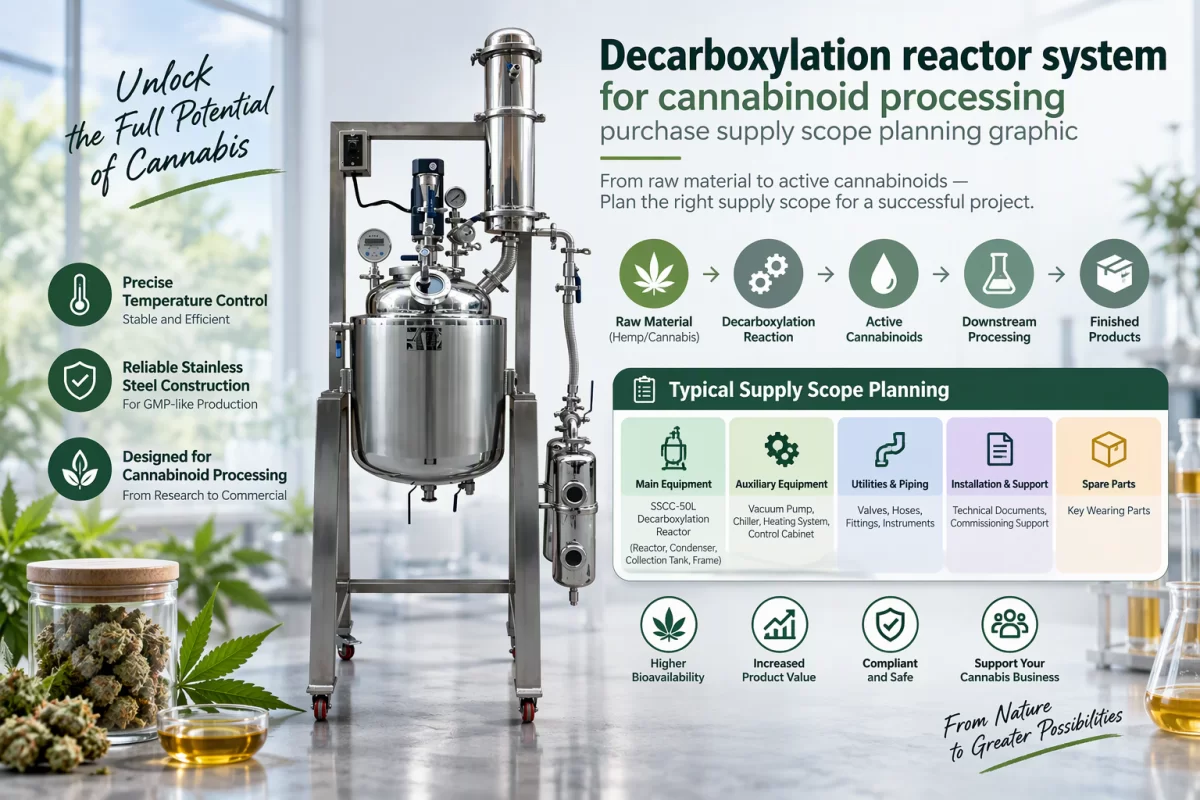
A decarboxylation reactor system for cannabinoid processing purchase should begin with a written supply boundary—not an assumption that every component shown or named is included. For cannabinoid oil decarboxylation, the practical question is which vessel, agitation equipment, condenser, receiver, temperature-control equipment, and connections the quotation actually covers.
Separate the equipment name from the quoted package
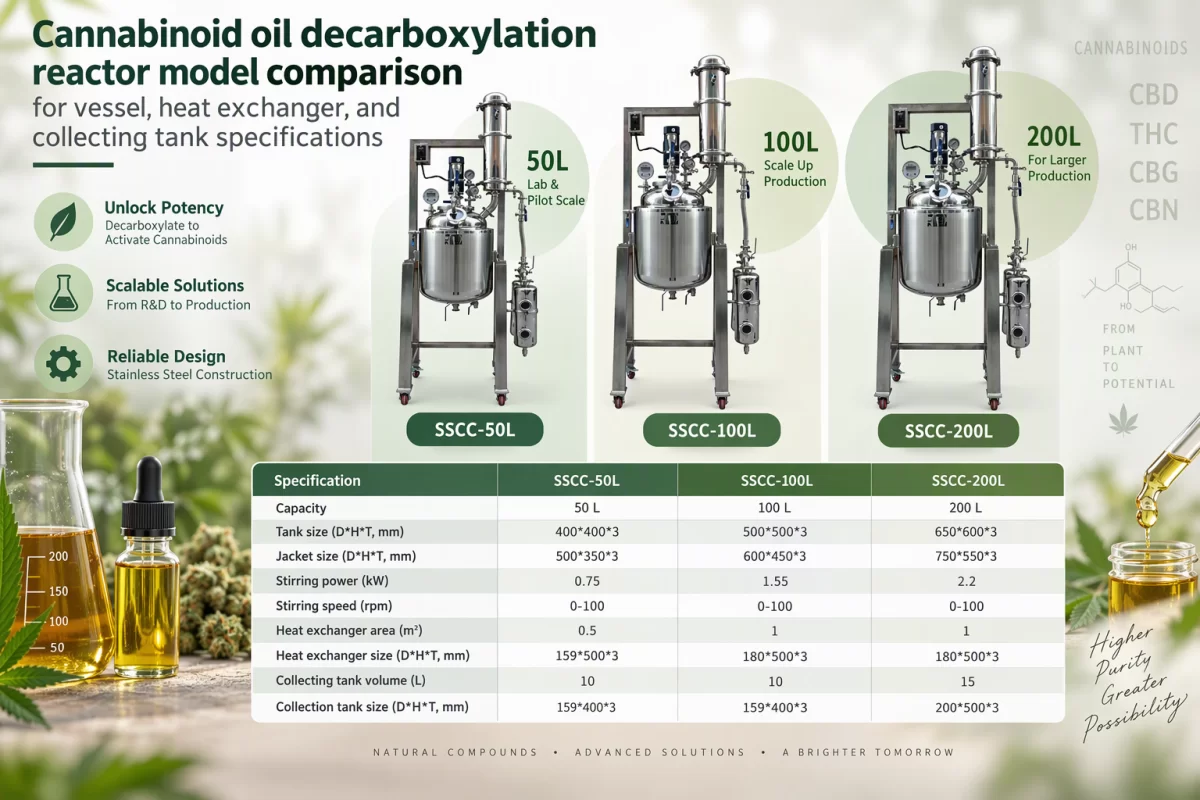
The supplied documentation describes three SSCC specifications and gives dimensions and ratings for the tank, jacket, stirring equipment, heat exchanger, and collecting tank. This supports a model-by-model technical comparison. It does not, by itself, establish a contractual list of standard inclusions.
When reviewing the Decarboxylation Reactor, ask for an itemized quotation identifying the exact model and the supplied quantity of each component. Keep three categories separate: information documented in the parameter sheet, components explicitly included in the offer, and optional or customer-supplied equipment. A part visible in a product photograph should remain unconfirmed unless the configuration list or quotation includes it.
This article addresses the oil decarboxylation stage only. Neither the equipment name nor a broad listing title establishes that the package independently performs upstream extraction, all refining operations, or a complete cannabinoid production process. For general background, the existing CBD oil decarboxylation system overview is a separate starting point; the focus here is defining the purchase boundary.
Compare complete SSCC model specifications
Keep all parameters within the same model column. For example, SSCC-50L is documented with a 0.5 m² heat exchanger and a 10 L collecting tank. SSCC-200L is documented with a 1 m² heat exchanger and a 15 L collecting tank. Combining the smaller model’s vessel designation with the larger model’s receiver would describe a configuration that the supplied table does not establish.
| Parameter | SSCC-50L | SSCC-100L | SSCC-200L |
|---|---|---|---|
| Nominal capacity designation | 50 L | 100 L | 200 L |
| Tank D × H × T (mm) | 400 × 400 × 3 | 500 × 500 × 3 | 650 × 600 × 3 |
| Jacket D × H × T (mm) | 500 × 350 × 3 | 600 × 450 × 3 | 750 × 550 × 3 |
| Stirring power (kW) | 0.75 | 1.55 | 2.2 |
| Stirring speed (rpm) | 0–100 | 0–100 | 0–100 |
| Speed regulation | Frequency control | Frequency control | Frequency control |
| Heat exchanger area (m²) | 0.5 | 1 | 1 |
| Heat exchanger D × H × T (mm) | 159 × 500 × 3 | 180 × 500 × 3 | 180 × 500 × 3 |
| Collecting tank volume (L) | 10 | 10 | 15 |
| Collecting tank D × H × T (mm) | 159 × 400 × 3 | 159 × 400 × 3 | 200 × 500 × 3 |
Capacity distinction: The nominal vessel designation is not a verified oil charge volume or throughput figure. The supplied information does not specify the permitted working fill, conversion rate, processing time, finished purity, or production capacity.
Build a component-by-component purchase scope
The following table separates documented technical information from issues that still require an inquiry. “Documented” means the parameter appears in the supplied material; it does not mean the component is confirmed as included in every standard quotation.
| Component | Information supported by the material | Inquiry items — confirmation required |
|---|---|---|
| Vessel and jacket | Three model designations and corresponding tank and jacket dimensions. | Quoted model, working fill, material grade, wetted seals, operating limits, ports, drain arrangement, and vessel supply inclusion. |
| Agitation | Model-specific stirring power; 0–100 rpm; frequency-control regulation. | Motor and drive inclusion, impeller design, shaft seal, viscosity suitability, electrical requirements, and controls supplied. |
| Condenser / heat exchanger | Model-specific heat exchanger area and dimensions. | Condenser duty, inclusion, mounting, coolant requirements, connection sizes, and compatibility with intended operating conditions. |
| Collecting tank | 10 L for SSCC-50L and SSCC-100L; 15 L for SSCC-200L, with dimensions. | Receiver inclusion, usable collection volume, isolation and draining provisions, level indication, and connection arrangement. |
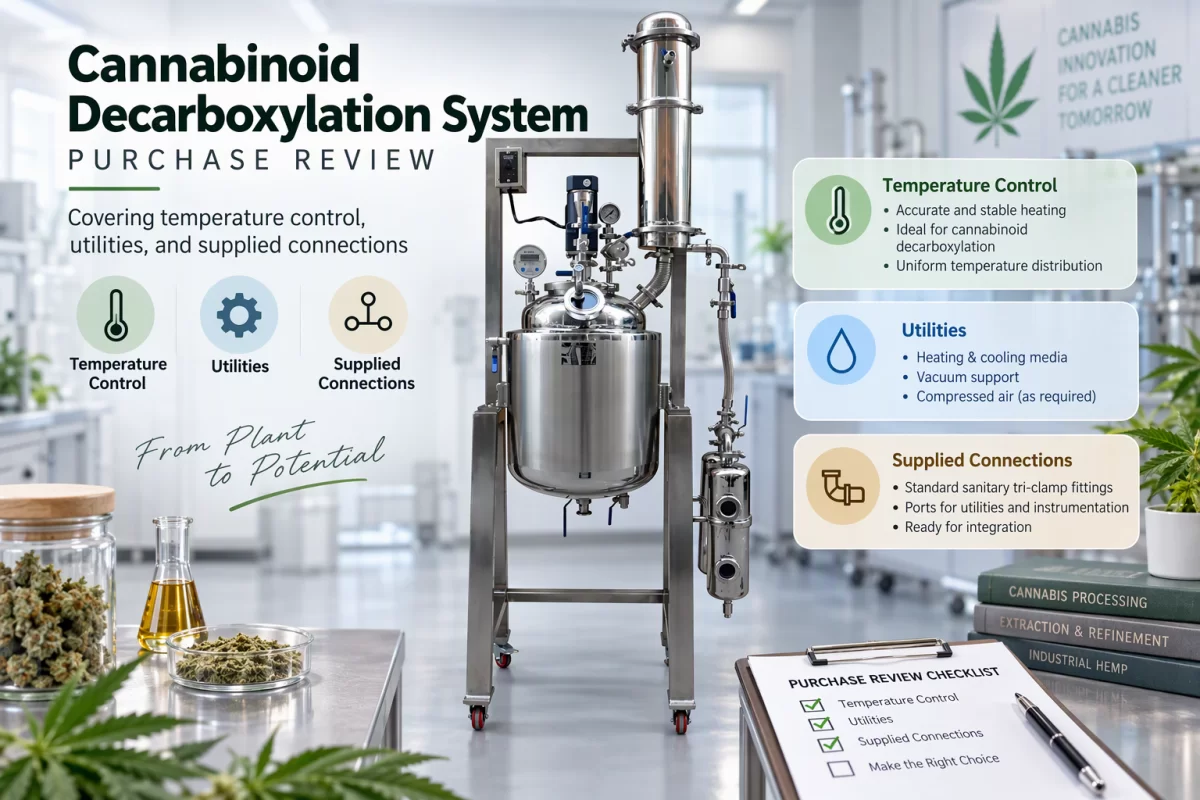
| Temperature control | Jacket dimensions are provided. No heater, chiller, or controller specifications are established by the parameter sheet. | Included or separate supply; temperature range, duty, circulation requirements, sensors, controller, and electrical supply. |
| Connections and auxiliaries | No detailed connection or auxiliary-equipment supply list is provided. | Piping, hoses, fittings, valves, gaskets, supports, instrumentation, and any required vacuum equipment: all to be confirmed. |
Check the vessel and stirring assembly together
Confirm that the offered agitation assembly matches the selected vessel and the expected oil condition. A power rating and speed range do not establish performance for every viscosity. Ask which motor, frequency drive, impeller, and seal are supplied, and whether the vendor has reviewed the intended material and charge level.
Define the condensation and collection boundary
The heat exchanger area and collecting tank volume are useful comparison points, but they do not establish condensation capacity or collection frequency under unspecified conditions. Request the proposed vapor connection arrangement, coolant conditions, receiver isolation method, and drain configuration. Verify whether the associated valves and connecting pipework are included rather than assuming they accompany the exchanger.
Identify temperature-control equipment and site interfaces
A jacketed vessel does not confirm that a heater, chiller, circulation unit, or complete control panel is part of the offer. Some supplied listing titles mention such equipment, but those titles are not a model-specific inclusion schedule. Ask for the equipment list and utility requirements, then compare them with existing site equipment. Clarify who supplies each hose, cable, fitting, and utility connection.
Use reference pricing without assuming a complete package
The supplied company price sheet contains 14 listing entries, including price ranges and single prices. Sorting entries by their lower price, then their upper price where needed, and selecting the lower of the two middle entries gives a company reference price range of US$2,800–4,000.
This is our company’s reference pricing from the supplied listings—not a confirmed quotation for a particular SSCC model or a fully equipped oil decarboxylation package. Actual quotations depend on configuration and inquiry results. The sheet does not establish a one-to-one price mapping for SSCC-50L, SSCC-100L, and SSCC-200L.
Before approval, request a revised offer that states:
- The exact model and matching vessel, exchanger, and collecting tank specifications.
- Every included component, its quantity, and any optional equipment priced separately.
- Customer-supplied utilities and equipment, plus the agreed connection interfaces.
- Applicable delivery, installation, commissioning, documentation, warranty, and commercial terms.
Any required certification or operating-limit documentation should also be requested explicitly. The supplied parameter and price materials do not establish certification status, regulatory compliance, or process outcomes.
Turn the purchase inquiry into a defined supply package
A well-defined decarboxylation reactor system for cannabinoid processing purchase connects three things: the selected model’s documented parameters, the actual quotation inclusions, and the supporting equipment available at the site. Keeping these separate prevents an equipment name or image from becoming an unsupported supply commitment.
For a configuration review, submit the oil material condition, including viscosity or residual solvent information where known; the planned batch mass and volume; existing heating, cooling, control, and other supporting equipment; and the requested supply scope. Include any required site interfaces and documentation. These details allow the proposed working volume, component package, utility requirements, and actual quotation to be confirmed before ordering.