
High Pressure Autoclave Reactor for Hydrogenation Processes
A clear, practical explanation of how a stirred autoclave brings hydrogen, liquid reactants and catalyst together—and how to select a laboratory system without overbuying or compromising safety.
What a high pressure autoclave does in hydrogenation
Hydrogenation adds hydrogen to a molecule, commonly with a solid catalyst such as palladium, platinum, nickel or another application-specific material. Typical goals include reducing carbon–carbon double bonds, converting nitro groups, stabilizing oils and preparing pharmaceutical or fine-chemical intermediates. The challenge is simple to describe: hydrogen begins as a gas, the substrate is often dissolved in a liquid, and the catalyst may be a solid. Efficient reaction therefore depends on safe pressure containment, temperature control and vigorous, repeatable mixing.
A high pressure autoclave reactor is a sealed metal vessel built to manage these conditions. Hydrogen is introduced into the headspace, agitation disperses it through the liquid, and heating brings the batch to the chosen reaction temperature. Increasing hydrogen partial pressure generally increases the amount of hydrogen available at the gas–liquid interface, but pressure is not a universal shortcut: catalyst activity, solvent, viscosity, impeller design and heat removal can become the controlling factors.
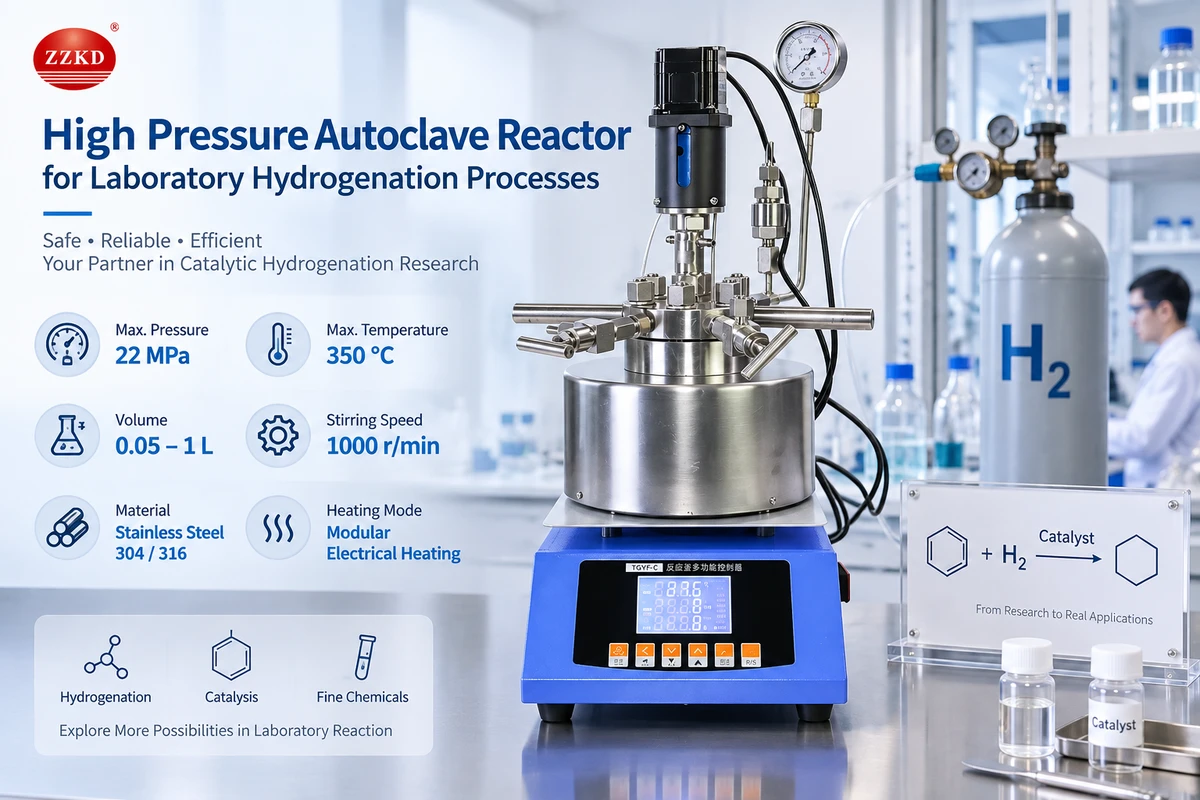
Author’s answer: I use pressure to keep a controlled hydrogen supply available to the liquid phase, while stirring continually renews contact among gas, liquid and catalyst. The operating setpoint should always come from reaction development and remain below the equipment’s allowable limits—not simply match the reactor’s maximum rating.
The five decisions that matter most
1. Required pressure and temperature
Start with the proven process window, then consider the highest pressure that could occur during charging, heating, gas generation or an upset. A 22 MPa rating provides a broad laboratory capability, but it does not mean every experiment should operate at 22 MPa. The complete assembly—including vessel, head, valves, gauge, tubing, rupture device and seals—must be suitable for the selected conditions.
2. Wetted material
The ZZKD TGYF-C can be specified in stainless steel 304 or 316. Grade 304 is widely used for general laboratory service. Grade 316 usually offers better resistance in many chloride-containing environments because it includes molybdenum. This is not a blanket guarantee: acids, halides, sulfur compounds, catalyst residues and cleaning chemicals can change compatibility. A corrosion review based on the full recipe is essential. For a broader comparison, see the guide to stainless steel reactors.
Author’s answer: I would select 316 when the chemistry benefits from its added corrosion resistance, but would never choose by alloy name alone. Every solvent, reactant, catalyst, impurity and wash solution should be checked, along with temperature and concentration.
3. Mixing quality
Hydrogenation may be limited by the speed at which hydrogen travels from the gas phase into the liquid and then reaches the catalyst. Mechanical stirring up to 1,000 r/min gives the TGYF-C useful flexibility for screening. Actual usable speed depends on fill level, viscosity, impeller, catalyst loading and foaming. Repeatable speed and a sound seal are more valuable than a high number used without process justification.
4. Working volume and headspace
Never treat nominal vessel volume as automatic liquid working volume. Gas charging, foaming, thermal expansion and agitation require headspace. ZZKD offers TGYF-C volumes from 0.05 to 1 L, allowing small catalyst screens through larger confirmation batches. A risk assessment and the operating manual should define the permitted fill.
5. Controls and protective devices
Useful features include reliable temperature measurement, pressure indication, controlled heating, stirring feedback, gas inlet and vent connections, and an appropriately selected pressure-relief device. Hydrogen service also demands ventilation, bonding/grounding where applicable, leak testing and an ignition-source assessment.
ZZKD TGYF-C at a glance
The TGYF-C is intended for small-volume, high-pressure laboratory work. Modular electric heating keeps the installation compact, while mechanical stirring supports gas–liquid–solid contact. The following values are based on the supplied product parameter sheet; final configuration and allowable operating conditions must be confirmed in the quotation and equipment documentation.
| Parameter | Available value(s) | Why it matters |
|---|---|---|
| Model | TGYF-C | Compact high-pressure reactor family |
| Nominal volume | 0.05 / 0.1 / 0.25 / 0.5 / 1 L | Matches screening and development batch needs |
| Rated pressure | 22 MPa | Defines the stated equipment pressure capability |
| Maximum listed temperature | 350°C | Supports a wide laboratory process range |
| Stirring speed | Up to 1,000 r/min | Promotes gas–liquid–catalyst contact |
| Heating power | 0.7 kW (0.05–0.25 L); 1.5 kW (0.5–1 L) | Scales heating input with vessel size |
| Heating mode | Modular electric heating | Compact and straightforward setup |
| Stirring method | Mechanical stirring | Controlled agitation for multiphase reactions |
| Material options | Stainless steel 304 or 316 | Allows chemistry-based selection |
Important: “Rated” or “maximum listed” values are equipment limits, not recommended reaction setpoints. Permissible combinations can depend on configuration, code basis and accessories.
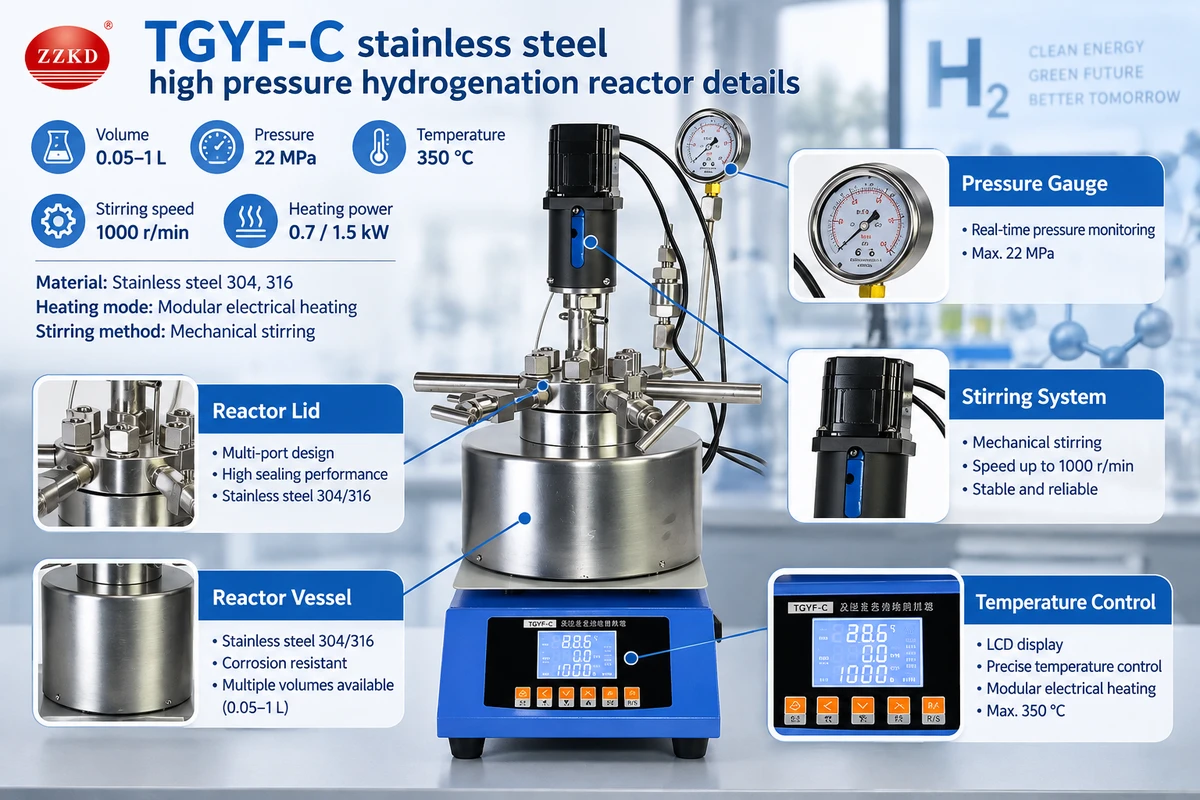
Author’s answer: I favor 0.05 to 0.5 L for early screening because these sizes can reduce substrate and catalyst consumption. A 1 L vessel becomes useful when more sample is needed for analysis or the process requires a stronger confirmation batch. In all cases, required headspace—not nominal volume alone—sets the practical charge size.
A sensible hydrogenation workflow
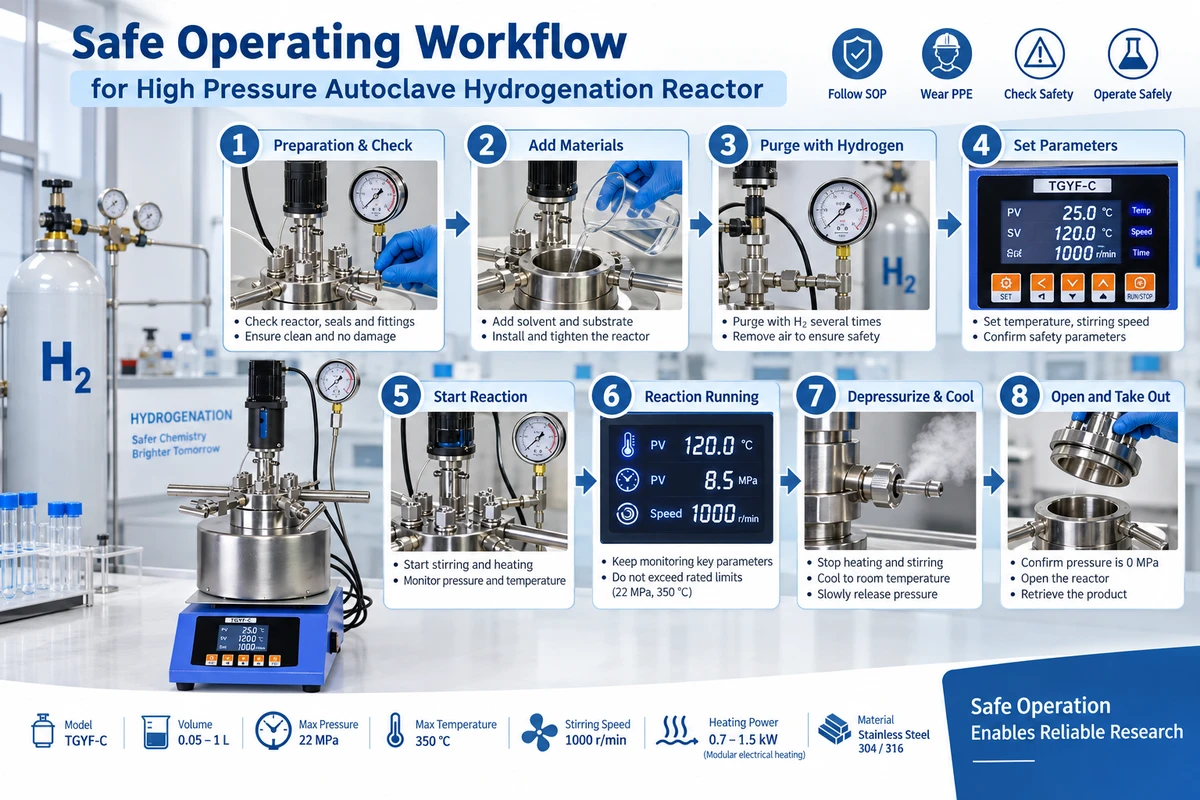
A safe procedure must be written for the exact chemistry and facility. The simplified sequence below explains the logic, but it does not replace manufacturer instructions, process hazard analysis, training or local rules.
Verify compatibility and condition. Confirm the vessel, seals, valves, gauge, relief device and tubing suit the materials, temperature and pressure. Inspect components before every run.
Charge within the approved fill limit. Add reactant, solvent and catalyst using controls appropriate to the catalyst’s hazards. Some hydrogenation catalysts may become hazardous when dry or exposed to air.
Close and leak-test. Assemble with the specified fasteners, torque method and seal. Use the manufacturer-approved inert-gas leak-test procedure; never search for hydrogen leaks with a flame.
Purge by the validated method. Remove air using an approved inert-gas cycle before introducing hydrogen. Vent only to a designed safe location.
Introduce hydrogen and begin controlled mixing. Apply the validated pressure, start agitation as the procedure requires, and monitor for stable behavior.
Heat gradually and monitor continuously. Watch temperature, pressure and uptake trend. Heating can raise pressure, while reaction heat can create additional temperature rise.
Cool before depressurization. At completion, stop heating, cool to the specified temperature and vent through the approved system at a controlled rate.
Inert, open and clean. Follow the validated post-reaction purge before opening. Handle spent catalyst and residues according to their hazard classification.
Hydrogen deserves particular care. The U.S. Occupational Safety and Health Administration reports a 4% to 75% flammable range in air by volume for hydrogen. That broad range reinforces the need for leak prevention, ventilation, detection where required and strict ignition control. In addition, OSHA lists hydrogen’s molecular weight as 2.016, explaining why released gas rises and disperses rapidly—but this behavior should never be treated as a substitute for engineered ventilation.
What should a laboratory autoclave cost?
Price changes with volume, alloy, pressure rating, stirring drive, controller, valves, sensors, relief protection, certifications and customization. Very low marketplace prices may refer to a basic vessel rather than a complete hydrogenation-ready package, so comparisons should use the same scope.
The supplied price sheet lists a ZZKD high pressure autoclave vessel with temperature control and mixing at US$2,300–3,200. For a single planning figure, US$2,750 is the midpoint and the lower whole-hundred midpoint choice. It is a reference only, not a binding quotation.
A useful request for quotation should state reactants, solvent, catalyst, desired working volume, normal and maximum temperature, normal and maximum pressure, material preference, electrical supply, agitation needs and required documentation. A high pressure lab reactor should be evaluated as a complete operating system, not only as a metal chamber.
Bottom line
The right hydrogenation autoclave is the smallest correctly specified system that safely reproduces the required chemistry. For laboratory development, the ZZKD TGYF-C combines 0.05–1 L nominal volumes, a listed 22 MPa pressure rating, temperatures up to 350°C, mechanical stirring up to 1,000 r/min and 304 or 316 stainless steel options. Those figures make it versatile, but successful selection still depends on corrosion compatibility, usable fill volume, mass transfer, pressure protection and facility controls.
Provide ZZKD with the actual process window rather than only a desired vessel size. That information makes it possible to discuss a configuration suited to the reaction instead of recommending unnecessary capacity or unsuitable materials.
Discuss a hydrogenation reactor configuration
Share the chemistry, volume, pressure, temperature, material and control requirements to receive a configuration-based quotation from ZZKD.
View High Pressure Autoclave Reactors