
High Pressure Chemical Reactor for Hydrogenation Processes
Hydrogenation looks simple on paper: add hydrogen to a molecule with the help of a catalyst. In practice, the process combines a flammable gas, pressure, heat, and vigorous mixing. A properly selected high pressure chemical reactor makes those variables measurable, controllable, and repeatable.
What does a hydrogenation reactor actually do?
A hydrogenation reactor is a closed pressure vessel that brings a liquid or dissolved feed, hydrogen gas, and usually a solid catalyst into close contact. Typical applications include reducing carbon–carbon double bonds, converting nitro groups into amines, removing protecting groups, and improving the stability of oils or chemical intermediates.
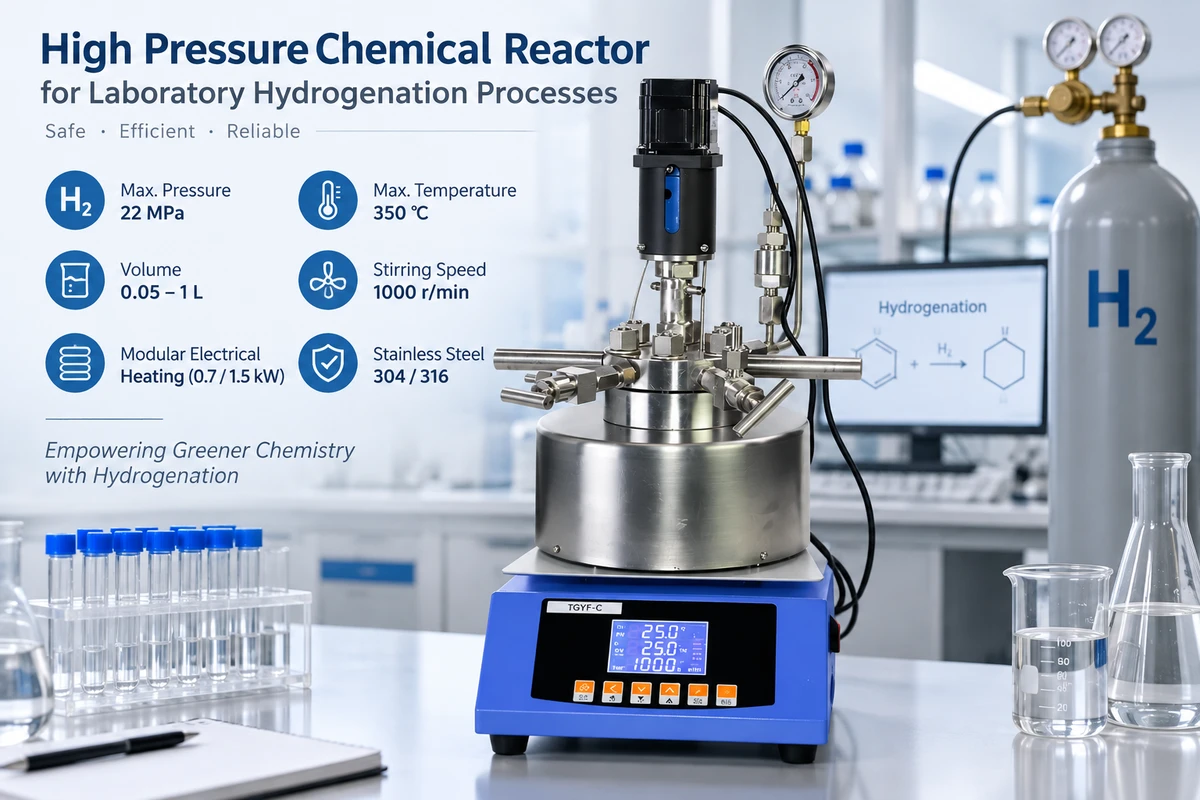
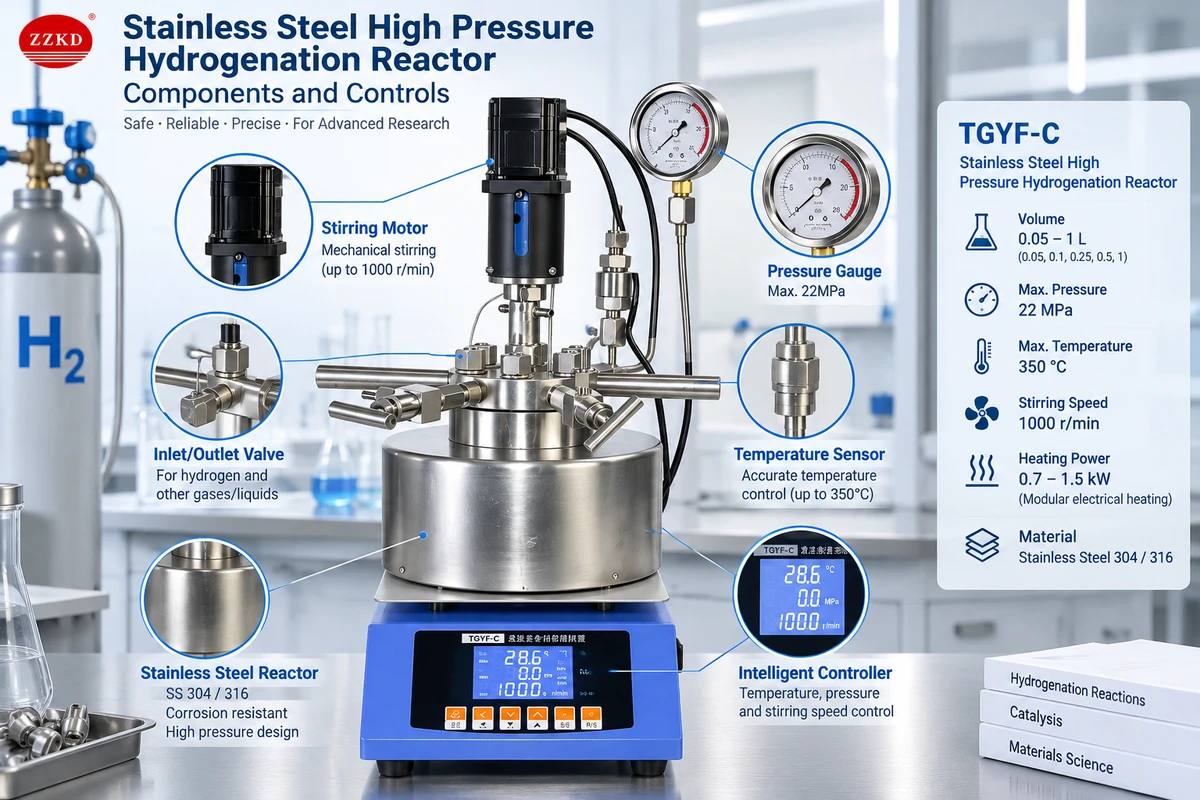
Hydrogen must first move from the gas space into the liquid and then reach the catalyst surface. That is why agitation is not merely a convenience. Good stirring renews the gas–liquid interface, suspends catalyst particles, distributes heat, and helps prevent local concentration differences. A laboratory high pressure autoclave reactor normally combines a sealed vessel, agitator, electric or circulating heater, temperature sensor, pressure gauge or transducer, gas inlet, vent, and safety relief provision.
Author’s answer: No. Higher hydrogen partial pressure can increase dissolved hydrogen in many systems, but the result also depends on catalyst activity, temperature, agitation, concentration, and mass transfer. A 22 MPa vessel rating is an equipment limit—not a target operating pressure. The process pressure must come from validated reaction data and remain within all allowable limits.
ZZKD TGYF-C: useful specifications at a glance
The compact ZZKD TGYF-C series is intended for small-volume, high-pressure laboratory work. Its five nominal vessel sizes support screening, catalyst comparison, parameter development, and gram-scale synthesis. Stainless steel construction is substantially more appropriate than ordinary glass when the required operating pressure exceeds the safe capability of a glass system. For a broader explanation of metallic vessel design and care, see this guide to stainless steel reactors.
Swipe horizontally to view the complete table →
| Parameter | 50 mL | 100 mL | 250 mL | 500 mL | 1 L |
|---|---|---|---|---|---|
| Model | TGYF-C | TGYF-C | TGYF-C | TGYF-C | TGYF-C |
| Rated pressure | 22 MPa | ||||
| Maximum listed temperature | 350°C | ||||
| Stirring speed | Up to 1,000 r/min | ||||
| Heating power | 0.7 kW | 0.7 kW | 0.7 kW | 1.5 kW | 1.5 kW |
| Heating mode | Modular electric heating | ||||
| Stirring method | Mechanical stirring | ||||
| Available vessel material | Stainless steel 304 or 316 | ||||
Important: The listed values describe the supplied parameter sheet. Allowable working conditions can be lower depending on material, temperature, fittings, seals, relief devices, and local requirements. Never treat maximum pressure and maximum temperature as automatically permissible at the same time.
How to choose the right configuration
The correct reactor is not simply the smallest vessel that holds the batch. Selection should start with chemistry and hazard data, then move to mechanical details. The following questions usually determine whether a proposed configuration is suitable.
1. What are the real pressure and temperature?
Include hydrogen charging pressure, solvent vapor pressure, non-condensable gases, heat-up expansion, gas generation, and the most severe credible upset. The design or rated pressure must provide an appropriate margin according to the applicable code and site rules.
2. Are all wetted materials compatible?
Check the vessel, impeller, thermowell, valves, tubing, gaskets, seals, and pressure instruments against the complete chemical mixture. Solvents, acids, bases, halides, catalyst residues, and cleaning agents all matter—not only the main feed.
3. Can mixing serve the process?
Hydrogenation may be limited by gas–liquid or liquid–solid mass transfer. Vessel geometry, impeller type, catalyst loading, viscosity, fill level, and speed should therefore be considered together. A 1,000 r/min maximum does not mean every batch should run at 1,000 r/min.
Author’s answer: No. Many neutral mixtures can be compatible with 304 stainless steel, while 316 commonly offers improved resistance in more demanding environments. Neither grade is universal. My recommendation is to select material from documented compatibility data for every reactant, solvent, catalyst, impurity, and cleaning chemical at the actual temperature and concentration.
A clear laboratory operating sequence
Exact procedures must be written for the specific chemistry and equipment. However, a well-controlled batch hydrogenation generally follows this logic:
Review the run. Confirm the approved procedure, risk assessment, material compatibility, maximum allowable limits, catalyst hazards, relief route, and emergency actions.
Inspect the reactor. Check the vessel, closure, gasket or seal, agitator, valves, tubing, gauges, temperature sensor, and relief device. Damaged, contaminated, or overdue components should not be used.
Charge the batch correctly. Add the specified liquid, substrate, and catalyst without exceeding the validated working fill. Pyrophoric catalysts require special handling and must not be allowed to dry if their safety instructions prohibit it.
Close, leak-test, and inert. Assemble the closure to the manufacturer’s procedure. Use an appropriate inert gas and validated purge cycles to remove air before introducing hydrogen. A pressure-hold check should use an approved method; oxygen must not be used for pressure testing.
Introduce hydrogen and control the reaction. Charge only to the approved pressure, begin suitable agitation, and apply heat in the documented order. Continuously observe pressure, temperature, stirring, and hydrogen uptake. An unexpected temperature rise or pressure behavior requires the predefined safe response.
Cool, isolate, and depressurize. Stop according to the procedure, cool to the required temperature, isolate the hydrogen source, and vent through a designated safe system. Confirm zero pressure with more than valve position alone before opening.
Author’s answer: Usually not. Gas charging, mixing, foaming, and thermal expansion require free headspace. In a gas–liquid hydrogenation, insufficient headspace can also impair gas availability and create liquid carryover into vent lines. The permitted working charge must follow the process assessment and equipment manual rather than the nominal vessel volume alone.
What does a small hydrogenation reactor cost?
Price varies with volume, material grade, pressure class, seal and drive design, valves, controller, explosion-protection requirements, certifications, data logging, cooling provisions, and accessories. Listings that look similar can therefore describe very different scopes of supply.
for a small 22 MPa stainless steel high pressure reactor listing in the supplied ZZKD price data
This mid-range, comparatively economical figure is more useful than selecting the lowest visible advertisement, because a hydrogenation setup may require additional gas-control and safety components. It is an indicative product price, not a binding quotation. Shipping, taxes, certification, hydrogen-rated regulators, tubing, ventilation provisions, installation, and custom controls may be additional. For alternative compact systems and configuration ideas, review the high pressure lab reactor page and request a written scope.
State required working volume, not only nominal vessel volume.
Provide chemicals, concentrations, catalyst, temperature, and target pressure.
Ask which valves, instruments, relief components, and controller are included.
Confirm power supply, documentation, testing, warranty, and delivery terms.
Why hydrogen service needs special care
Hydrogen is colorless and odorless, disperses rapidly, and is easy to ignite. The U.S. Department of Energy’s H2Tools guidance reports a flammability range of approximately 4% to 75% hydrogen by volume in air and a minimum ignition energy of about 0.02 millijoule. These figures explain why leak prevention, ventilation, ignition control, compatible electrical equipment, inerting, detection, and a controlled vent destination must be treated as core process requirements—not optional accessories.
Pressure-vessel integrity is equally important. ASME Boiler and Pressure Vessel Code Section VIII provides widely recognized rules for pressure-vessel construction, while jurisdictional requirements determine what applies to a particular installation. A reactor nameplate or catalog pressure alone does not replace engineering review, documented inspection, calibrated instruments, tested relief protection, and trained operation.
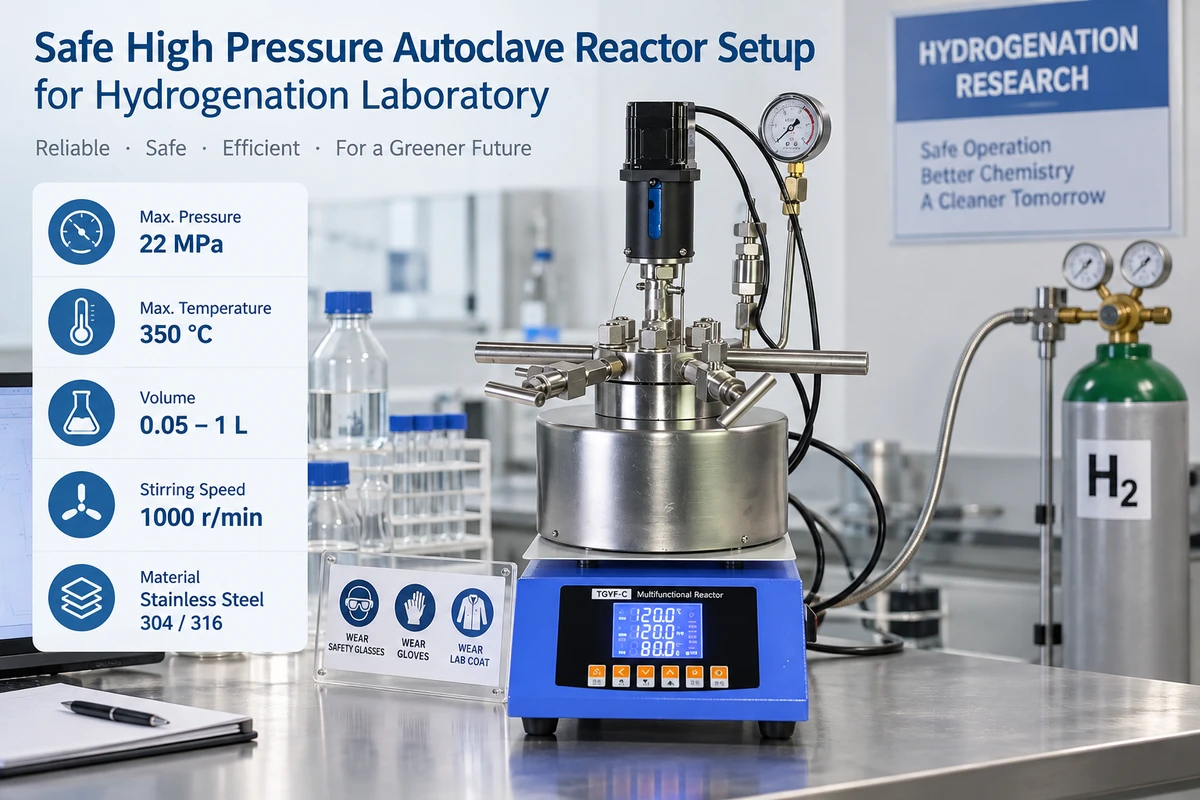
A practical rule is to treat the reactor as one part of a complete system. Hydrogen cylinders or generators, regulators, check valves, purge gas, tubing, fittings, ventilation, detectors, relief discharge, grounding, controls, and operating procedures must work together. Any change in chemistry or scale should trigger a management-of-change review rather than an informal adjustment.
The practical answer
A good high pressure chemical reactor for hydrogenation must safely contain the intended conditions, resist the actual chemical mixture, mix gas and liquid effectively, control heat, and provide reliable pressure management. For screening and small-batch development, the ZZKD TGYF-C range offers 50 mL to 1 L capacities, a listed 22 MPa pressure rating, temperatures up to 350°C, mechanical stirring up to 1,000 r/min, and 304 or 316 stainless steel options.
Those headline specifications narrow the search, but they do not finish it. The final choice should be based on the reaction hazard review, allowable pressure at temperature, material compatibility, usable volume, agitation demand, sealing method, relief strategy, gas-control scope, and applicable code. Supplying these details to ZZKD is the fastest route to a reactor configuration that is useful rather than merely impressive on a specification sheet.