
High Pressure Lab Reactor for Pharma R&D Applications
A high pressure lab reactor helps pharmaceutical teams test reactions safely, repeatably, and at small scale before committing to larger production equipment. This guide explains what matters most: pressure, temperature, stirring, materials, vessel size, safety, and realistic budget planning.
Why a High Pressure Lab Reactor Matters in Pharma R&D
In pharmaceutical research and development, many important reactions do not behave well in an open flask. Hydrogenation, oxidation, carbonylation, catalyst screening, solvent compatibility studies, and high-temperature synthesis often need controlled pressure and reliable stirring. A high pressure lab reactor creates a sealed environment where temperature, pressure, mixing speed, and reaction time can be adjusted with much better control than a simple glass setup.
For early-stage drug development, this control is valuable because the goal is not only to “make a compound.” The goal is to understand how a reaction behaves. Does yield improve when pressure rises? Does a catalyst deactivate at higher temperature? Does the impurity profile change when the solvent is switched? These are the practical questions that decide whether a route can move from milligram experiments to gram and kilogram studies.
Authoritative data point: According to the U.S. FDA Center for Drug Evaluation and Research, 55 novel drugs were approved in 2023. Each successful approval is supported by extensive development work, including process understanding, impurity control, and reproducible laboratory data. This is why precise reaction equipment is a core part of modern pharma R&D.
What Does “High Pressure” Mean in a Small Lab Reactor?
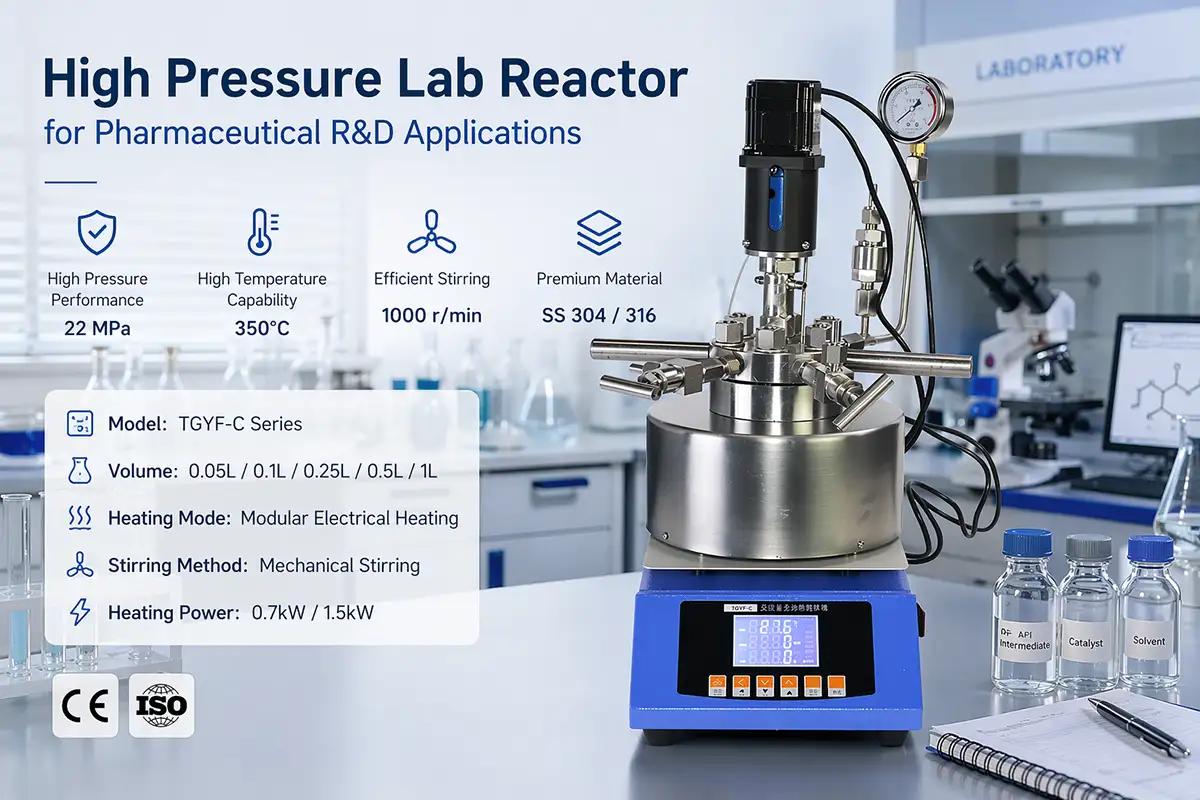
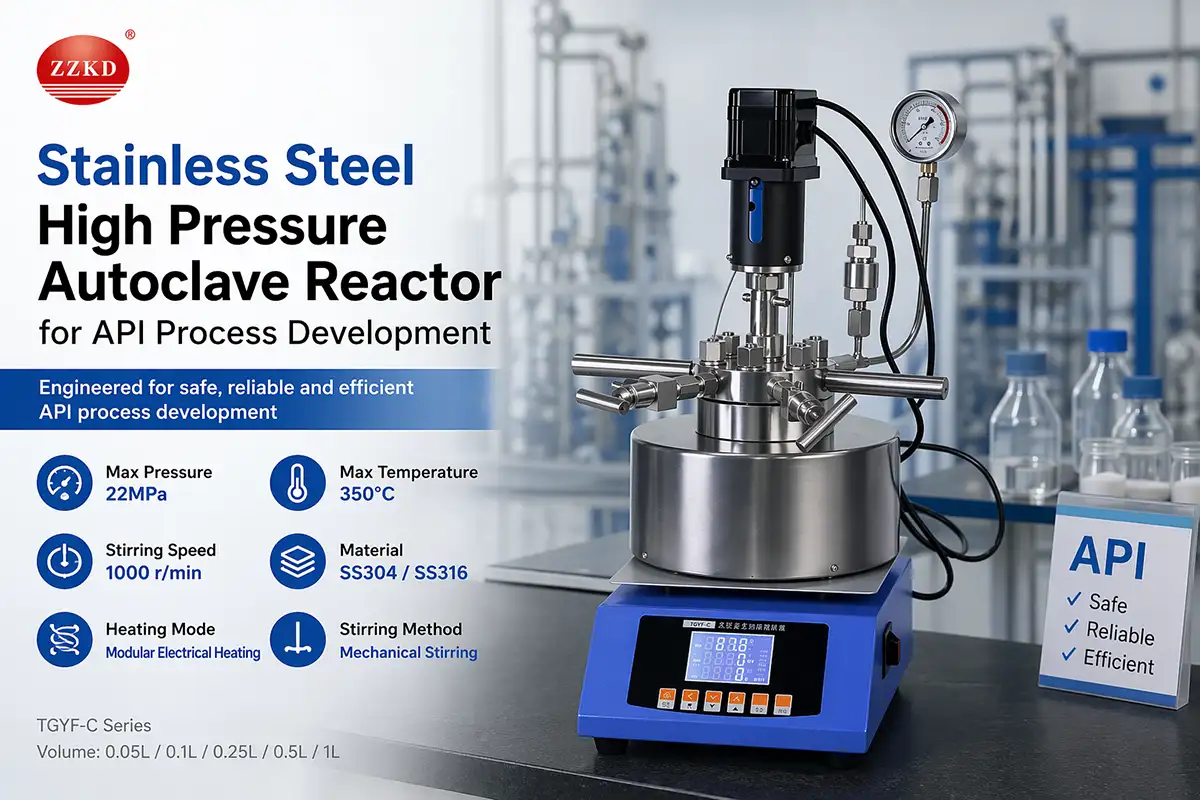
For many laboratory users, “high pressure” simply means the reactor can safely operate above normal atmospheric pressure. In pharma R&D, the useful pressure range depends on the reaction. Some screening work may only need a few bar, while hydrogenation and specialized synthesis can need much higher pressure. The ZZKD TGYF-C model is designed for compact lab research and supports pressure up to 22 MPa, which gives researchers a broad operating window for demanding experiments.
Is a higher pressure rating always better?
From the author’s perspective, the answer is no. A higher pressure rating provides more flexibility, but the best reactor is the one that matches the chemistry, safety rules, and batch size. Choosing too large or too complex a reactor can make small experiments slower, more expensive, and harder to clean.
ZZKD TGYF-C High Pressure Lab Reactor: Key Parameters
The ZZKD TGYF-C series is suitable for laboratories that need small-volume pressure reaction testing with mechanical stirring. Its compact volume range makes it practical for pharmaceutical screening, catalyst evaluation, formulation-related reaction studies, and teaching laboratories that require controlled high-pressure conditions.
| Model | Volume | Pressure | Temperature | Stirring Speed | Heating Power | Material |
|---|---|---|---|---|---|---|
| TGYF-C | 0.05 L | 22 MPa | 350℃ | 1000 r/min | 0.7 kW | SS304 / SS316 |
| TGYF-C | 0.1 L | 22 MPa | 350℃ | 1000 r/min | 0.7 kW | SS304 / SS316 |
| TGYF-C | 0.25 L | 22 MPa | 350℃ | 1000 r/min | 0.7 kW | SS304 / SS316 |
| TGYF-C | 0.5 L | 22 MPa | 350℃ | 1000 r/min | 1.5 kW | SS304 / SS316 |
| TGYF-C | 1 L | 22 MPa | 350℃ | 1000 r/min | 1.5 kW | SS304 / SS316 |
How to Choose the Right Reactor for Pharmaceutical Experiments
The first selection point is volume. For route screening, 50 ml or 100 ml is often enough because it saves raw material and shortens cleaning time. For confirmation experiments, 250 ml or 500 ml may provide a more useful sample size. For small process development, 1 L can help bridge the gap between screening and pilot work. The TGYF-C series covers all of these steps without forcing a laboratory to jump directly to a large vessel.
The second point is material. Stainless steel 304 is suitable for many general reactions, while stainless steel 316 is often preferred when corrosion resistance is more important. For pharmaceutical R&D, material choice also affects extractables, cleaning, and long-term reliability. A related overview of stainless steel reactors can help teams compare material options before purchase.
The third point is mixing. In a pressure reactor, poor mixing can create hot spots, slow mass transfer, or inconsistent catalyst contact. Mechanical stirring up to 1000 r/min gives the operator a practical tool for improving gas-liquid or liquid-solid reactions. This matters in hydrogenation because gas must transfer into the liquid phase before the reaction can proceed efficiently.
Why not use only a glass reactor for pharma research?
The author’s answer is that glass reactors are excellent when visibility and moderate conditions are the priority. However, when pressure and temperature rise, a stainless steel high pressure autoclave reactor is usually the safer and more appropriate choice. In many laboratories, both systems are used for different stages of work.
Budget and Price Reference for Lab Planning
Price is one of the most common questions from laboratory buyers. Based on the provided ZZKD high pressure reactor price list, small laboratory high pressure reactors commonly appear from entry-level prices under $1,500 to more advanced systems above $3,000, depending on configuration, volume, pressure rating, control system, and material. For a practical mid-low reference, a small high pressure lab reactor with stirring is commonly quoted around $2,484–$2,650. When a listed product has a range, a middle but still cost-conscious value is usually more realistic for budget planning than the absolute lowest number.
For pharmaceutical R&D, the better question is not only “What is the cheapest reactor?” but “What configuration prevents failed batches and unsafe operation?” A reliable sealing structure, suitable vessel material, stable temperature control, and clear pressure monitoring can save more money than a low initial purchase price. For larger or specialized pressure work, teams can also compare ZZKD’s high pressure autoclave reactor options.
Practical tip: If the experiment consumes expensive APIs, catalysts, or ligands, a 0.05–0.25 L reactor may reduce development cost. If the goal is to collect enough material for analytical testing, a 0.5–1 L reactor is usually more convenient.
Safety, Documentation, and Repeatability
High pressure equipment must be treated seriously. Before operation, users should confirm the reactor’s rated pressure, maximum temperature, gasket compatibility, valve status, and pressure relief arrangement. The vessel should not be filled beyond the recommended working volume, and the operator should understand how temperature can increase internal pressure. In pharma R&D, written procedures are especially important because the same experiment may need to be repeated by different researchers.
The International Council for Harmonisation guideline ICH Q8(R2) highlights pharmaceutical development through process understanding and quality by design. In simple terms, this means researchers should know why a process works, not only that it works once. A high pressure lab reactor supports this approach by making it easier to record controlled variables such as temperature, pressure, agitation, catalyst loading, and reaction time.
What information should be recorded after each high pressure run?
The author would record at least the vessel volume, charge amount, solvent, catalyst, gas type, starting pressure, maximum pressure, temperature profile, stirring speed, reaction time, cooling method, and any abnormal observation. These details make troubleshooting much easier.
Common Pharma R&D Applications
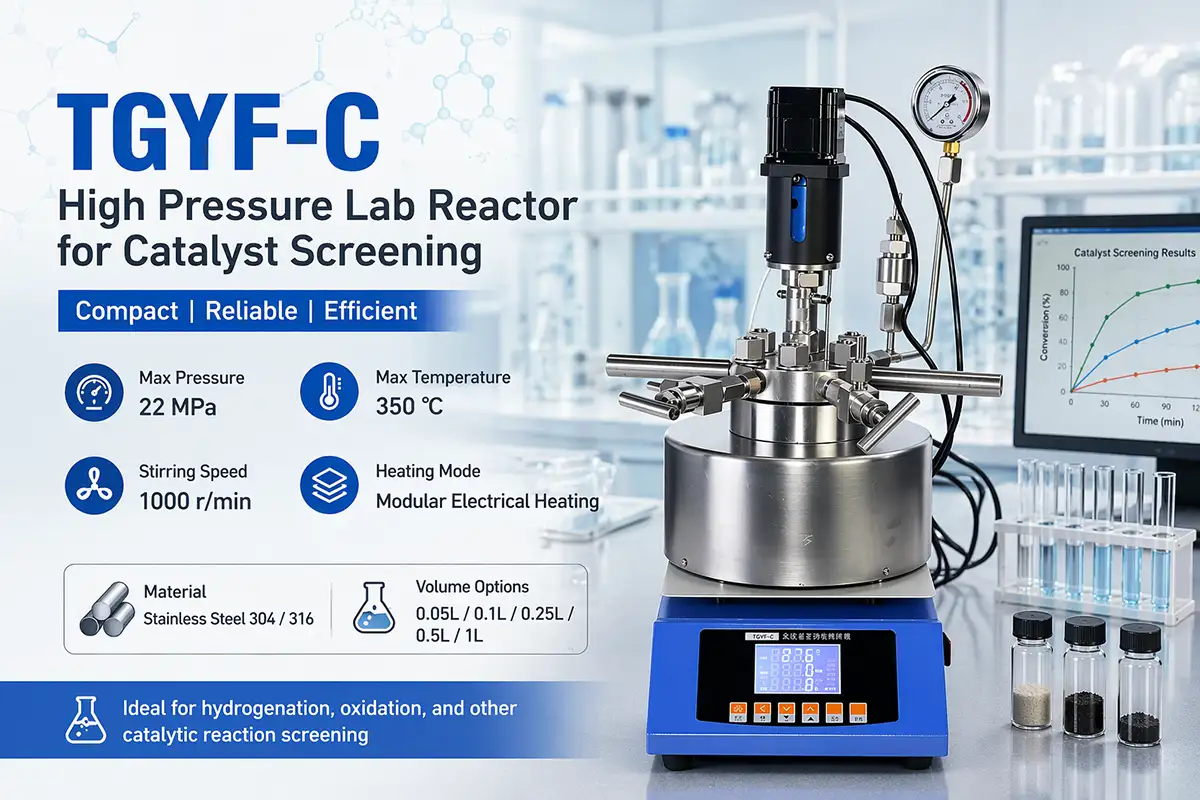
A ZZKD high pressure lab reactor can support many research tasks. In hydrogenation, it allows chemists to test catalyst type, pressure, and solvent under sealed conditions. In oxidation studies, it helps evaluate how pressure and temperature influence conversion and by-product formation. In crystallization-related development, pressure and temperature control can be useful when studying solvent systems or special reaction-crystallization sequences. In material and intermediate synthesis, a small stainless steel reactor helps researchers explore conditions that would be difficult or unsafe in open glassware.
Another benefit is scalability of knowledge. A 100 ml experiment will not automatically become a 100 L process, but it can reveal the important direction: whether pressure improves conversion, whether mixing is sensitive, and whether the reaction releases or consumes gas. That information helps process chemists decide the next step with more confidence.
Final Thoughts
A high pressure lab reactor for pharma R&D is not just a metal vessel. It is a controlled research platform for understanding pressure chemistry, improving repeatability, and reducing risk before scale-up. The ZZKD TGYF-C series offers small volumes from 0.05 L to 1 L, a pressure rating of 22 MPa, temperature capability up to 350℃, mechanical stirring up to 1000 r/min, modular electric heating, and stainless steel 304 or 316 construction. For laboratories working on hydrogenation, catalyst screening, API intermediates, and high-temperature synthesis, these features provide a practical balance of flexibility, safety, and cost control.
Need a Reactor for a Specific Pharma R&D Process?
ZZKD can help match reactor volume, material, pressure rating, and stirring configuration to the experimental goal.
Explore ZZKD High Pressure Lab Reactors