
How to Choose a Stainless Steel Reactor for Pharmaceutical Production?
The right pharmaceutical reactor is not simply the largest vessel or the model with the highest temperature rating. It is the reactor that safely handles the formula, delivers repeatable mixing and heat transfer, can be cleaned, and comes with the documentation required by the project.
Short answer: begin with product-contact material and cleanability, calculate usable batch volume, then confirm agitation, jacket duty, pressure or vacuum, seals, ports, controls and qualification documents.
1. Define what the reactor must actually do
Before requesting a quotation, write a simple process description: ingredients, solvent, concentration, viscosity, batch size, charging order, reaction time, temperature profile, maximum pressure, required vacuum, and cleaning method. Also state whether the equipment is intended for research, a pilot plant, non-sterile production, or sterile manufacture. These applications do not carry the same engineering or documentation burden.
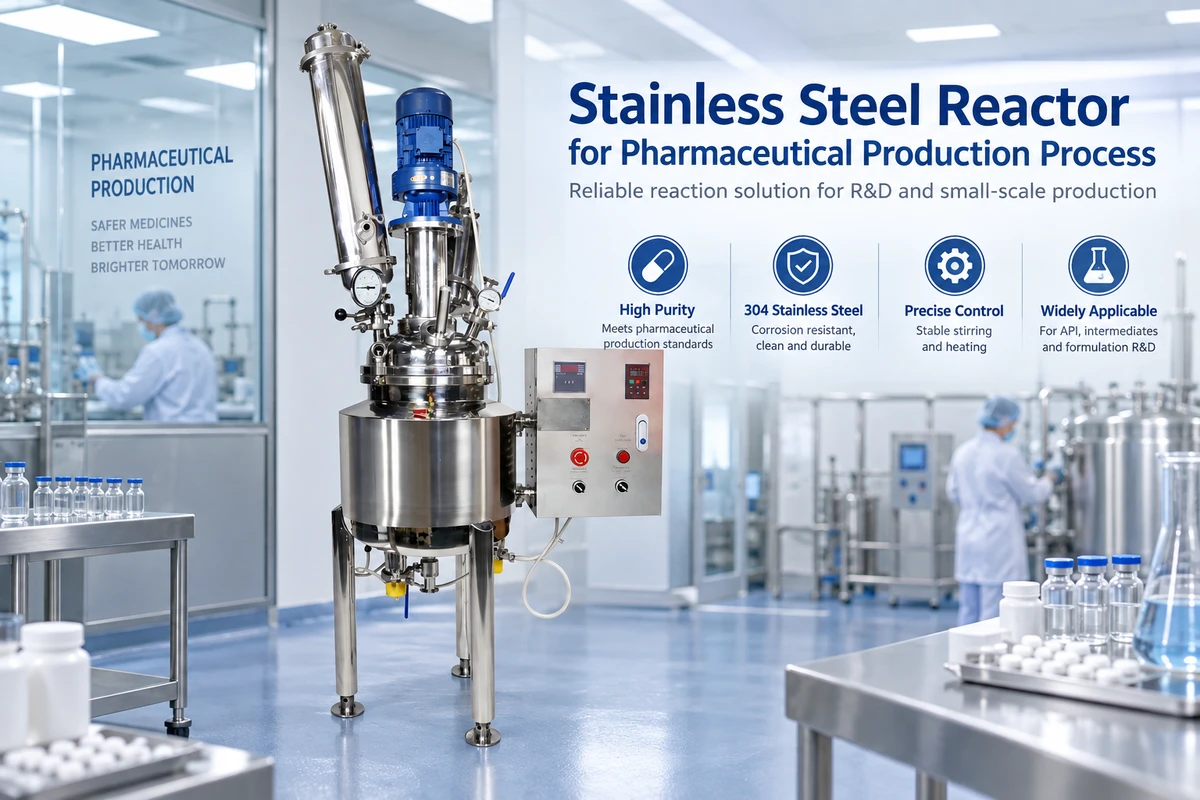
A pharmaceutical stainless steel reactor may perform synthesis, neutralization, crystallization, hydrogenation, blending or solvent recovery. Each duty changes the specification. Crystallization may require controlled cooling and low-shear mixing; hydrogenation requires a purpose-designed pressure system and appropriate gas-handling safeguards. For a broader equipment overview, see the ZZKD guide to stainless steel reactors in pharmaceutical manufacturing.
2. Prioritize contact surfaces, finish and drainability
For pharmaceutical use, “stainless steel” is not a complete material specification. Ask which grade touches the product, request material certificates, and define the internal surface finish. Welds should be smooth and accessible, dead legs should be minimized, and the outlet should allow complete drainage. A polished 316L contact surface is commonly specified because its low carbon content helps reduce sensitization around welded areas.
This is more than good practice. The U.S. FDA's 21 CFR 211.65 requires product-contact surfaces not to be reactive, additive or absorptive in a way that alters a drug's safety, identity, strength, quality or purity. In addition, 21 CFR 211.67 requires equipment to be cleaned and maintained at suitable intervals, with written procedures. Those requirements make cleanability and material compatibility core buying criteria.
Product-contact grade
Specify 316/316L or another verified compatible material; do not assume the frame and product zone use the same grade.
Surface condition
Agree on an internal roughness target, weld treatment and passivation, then include inspection records in the order.
Drainability
A bottom outlet, sensible slopes and fewer stagnant pockets make cleaning easier and reduce cross-contamination risk.
Hygienic connections
Use appropriate sanitary fittings, cleanable valves and compatible gasket materials where the process requires them.
3. Choose working volume—not just total volume
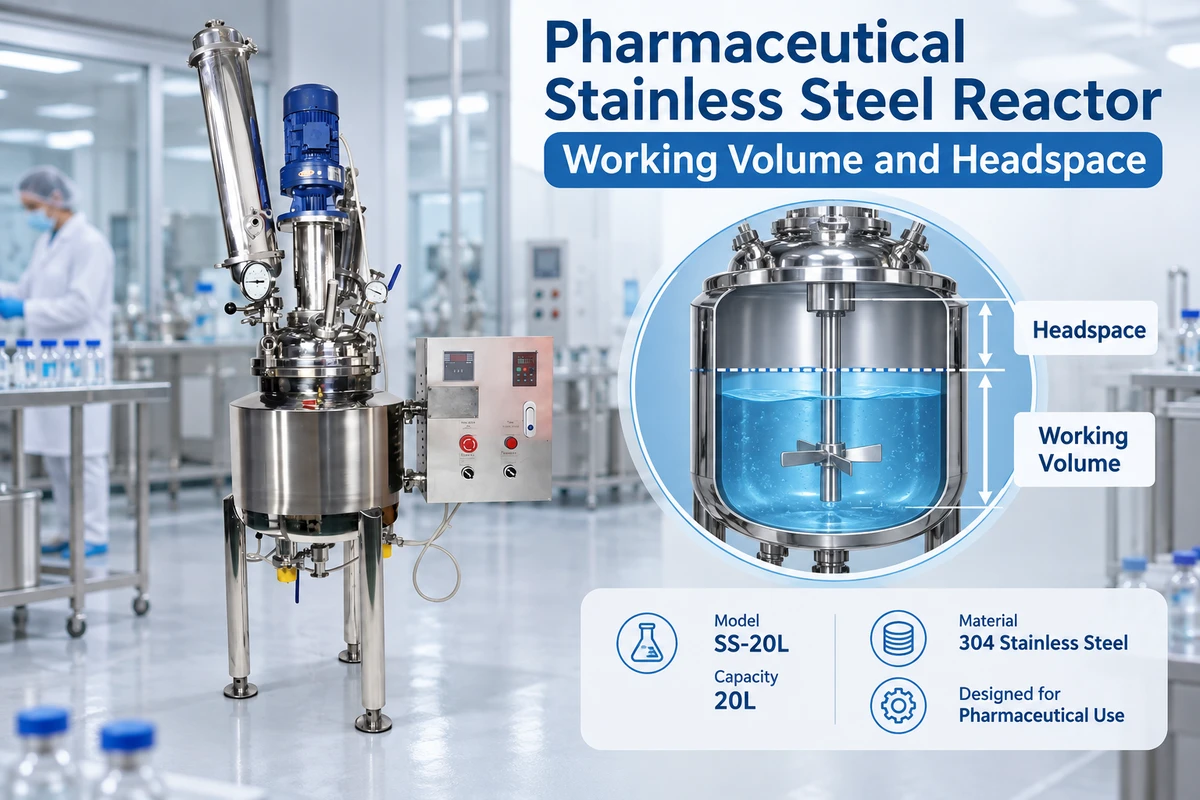
A vessel advertised as 50 L does not necessarily process a 50 L batch. Free space is needed for foaming, gas expansion, vigorous agitation, reflux and safe charging. Calculate the maximum and minimum working levels with the supplier. The impeller and temperature probe must remain properly immersed at the minimum batch, while the maximum batch must leave enough headspace for the actual reaction.
ZZKD's supplied specifications cover laboratory and pilot volumes from 5 L through 300 L. The SS-5L lists a 5 L vessel, 1.5 L jacket capacity, -100 to 250°C indicated reaction-temperature range, 0–600 rpm agitation and -0.098 to 0.5 MPa stated operating range. The broader double-wall series lists 10–300 L vessel sizes, 0–600 rpm and -0.1 to 0.5 MPa. These are equipment specifications, not permission to run every process at every extreme simultaneously; final allowable limits must be confirmed for the exact configuration.
4. Match mixing, heat transfer, pressure and seals
Agitation: viscosity, solids, gas dispersion and shear sensitivity determine the impeller. A paddle can be suitable for general liquid mixing, but it is not automatically ideal for crystals, viscous gels or gas–liquid reactions. Ask for the impeller type, diameter, motor power, gearbox or speed range, shaft support and seal arrangement. Variable-frequency speed control makes development work easier and supports repeatable recipes.
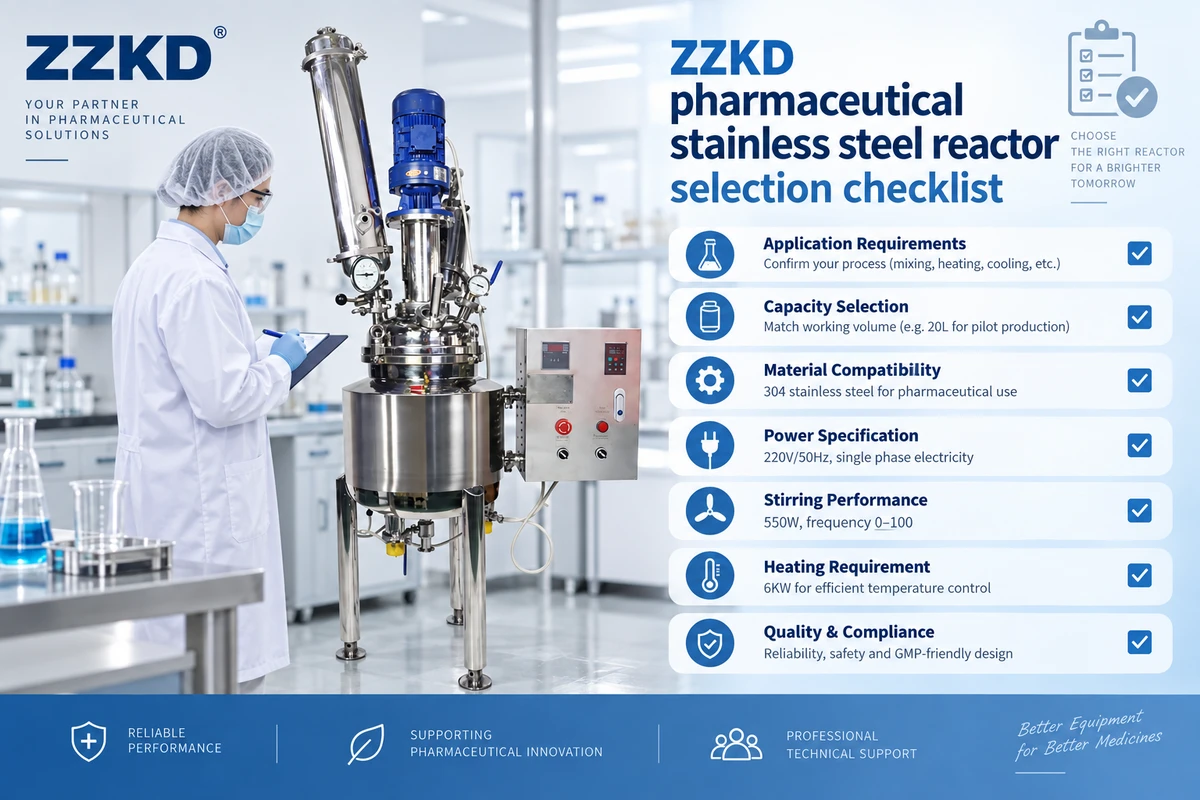
Heating and cooling: a jacket transfers heat only when paired with a correctly sized circulation system. Provide the starting temperature, target temperature, desired heat-up or cool-down time, batch mass and physical properties. ZZKD's supplied SS-20L specification lists 6 kW heating, a 550 W agitator and 0–100 rpm control, while other series use external circulation and reach 0–600 rpm. Select against the actual process duty rather than comparing one number in isolation.
Pressure and vacuum: design pressure, design temperature and corrosion allowance must be evaluated together. Ask for the applicable fabrication code, pressure-test records, relief strategy, gauge range and vacuum capability. A high-pressure reaction should use purpose-built equipment; the related ZZKD high-pressure autoclave reactor page explains this equipment category.
Sealing: mechanical seals reduce leakage around a rotating shaft, but seal faces and elastomers must tolerate the solvent, temperature, pressure, cleaning agent and sterilization method. For hazardous or high-pressure duty, discuss magnetic coupling and containment requirements with a qualified engineer.
5. Specify the controls and documents needed for qualification
A digital temperature display is useful, but production control may also need calibrated sensors, recipe control, alarms, speed feedback, pressure indication, batch records, audit trails or integration with a plant control system. The exact requirement depends on the site's quality system and whether records are used to make GMP decisions.
Instrumentation: define accuracy, range, calibration certificates and sensor location for temperature, pressure, pH or other critical variables.
Cleaning: decide between manual cleaning and clean-in-place, then confirm spray coverage, outlet drainage and gasket compatibility.
Documentation: request drawings, manuals, material certificates, weld and finish records, pressure-test evidence, electrical diagrams and spare-parts lists as applicable.
Qualification support: agree before ordering whether FAT, SAT, IQ/OQ templates or other project documents are required.
Safety: perform a process hazard assessment covering overpressure, runaway reaction, solvent vapor, grounding, area classification and emergency shutdown.
The European Commission's 2022 revision of EU GMP Annex 1 states that sterile medicinal-product manufacture should use a facility-wide Contamination Control Strategy. For sterile applications, this reinforces the need to assess equipment design, cleaning, utilities and interventions as one connected contamination-control system—not as isolated purchases.
6. Compare total value instead of purchase price alone
The supplied ZZKD price list provides useful budget references, but final cost changes with material grade, surface finish, pressure rating, sanitary valves, condenser, controls, certification, shipping and validation documents. The representative figures below use an exact listed price where available. For the 100 L product with a listed range of $3,300–$5,100, a relatively economical middle reference of about $4,000 is shown, as requested for multi-price products.
| Nominal size | Typical supplied-series features | Reference price | Best used for |
|---|---|---|---|
| 5 L | 316 vessel; circulation jacket; 0–600 rpm; mechanical seal | $1,485 | R&D and formulation trials |
| 20 L | 304 listed for one model; 6 kW heating; 550 W stirring | $1,634 | Process development and small pilot batches |
| 50 L | 304/316 series option; double wall; VFD speed control | $2,042 | Pilot production and scale-up work |
| 100 L | Jacketed configuration; condenser option; specification depends on order | About $4,000 | Larger pilot or small production batches |
Price note: These are planning references from the provided product list, not binding quotations. Confirm configuration, Incoterms, freight, taxes, certification and current availability with ZZKD. Never reduce safety or required documentation to meet a target price.
When comparing quotations, normalize the scope. One offer may include the reactor vessel only, while another includes a condenser, circulation heater/chiller, vacuum pump, control cabinet, installation parts and qualification documents. The ZZKD stainless steel reactor vessel page is a useful starting point for discussing configuration.
7. Use this five-step selection sequence
Build the specification before choosing the model
Send ZZKD the process medium, target batch volume, viscosity, temperature profile, pressure or vacuum, required contact material, cleaning method, utilities and documentation list. A clear requirement produces a more accurate configuration and quotation.
Explore ZZKD Reactor Vessels