
Industrial Stainless Steel Batch Reactor with Temperature Control
A stainless steel batch reactor is not only a tank with a stirrer. For many laboratories, pilot plants, and small production lines, it is the controlled environment where heating, cooling, mixing, pressure, vacuum, feeding, sampling, and discharge all need to work together safely and predictably.
Quick Summary
An industrial stainless steel batch reactor with temperature control is used when a process must run in a sealed vessel at a defined temperature, mixing speed, and pressure range. Typical ZZKD stainless steel reactor options cover laboratory and pilot capacities such as 5L, 20L, 50L, 100L, and larger volumes. Based on the provided ZZKD specifications, common models use 304 or 316 stainless steel, circulation heating, digital temperature display, frequency-conversion speed control, and mechanical sealing. This guide explains what these details mean in practical buying language.
What Is a Stainless Steel Batch Reactor?
A batch reactor is a vessel where raw materials are added, processed for a planned time, and then discharged as one batch. Unlike a continuous reactor, it does not need a constant feed and outlet stream. This makes it easier to adjust formulas, test new process conditions, and produce different products with the same equipment.
In an industrial stainless steel batch reactor, the vessel body is usually made from 304 or 316 stainless steel. Stainless steel is chosen because it is strong, easy to clean, and suitable for many chemical environments. For applications involving more corrosive solvents or chloride-containing materials, 316 stainless steel is often preferred. According to ASM International materials guidance, the molybdenum content in 316 stainless steel improves resistance to pitting and crevice corrosion compared with standard 304 stainless steel, especially in chloride environments.
For readers comparing different reactor types, ZZKD also provides information on stainless steel reactors and reactor vessels, which can help explain vessel structure, sealing, and process selection in more detail.
Why is temperature control so important in a batch reactor?
The short answer: temperature affects reaction speed, product quality, safety, and repeatability. A reaction that is too cold may run slowly or fail to complete. A reaction that is too hot may create impurities, high pressure, solvent loss, or a safety risk. From an equipment point of view, the jacket or mezzanine layer allows heating or cooling fluid to circulate around the vessel, helping the material inside reach and hold the target temperature.
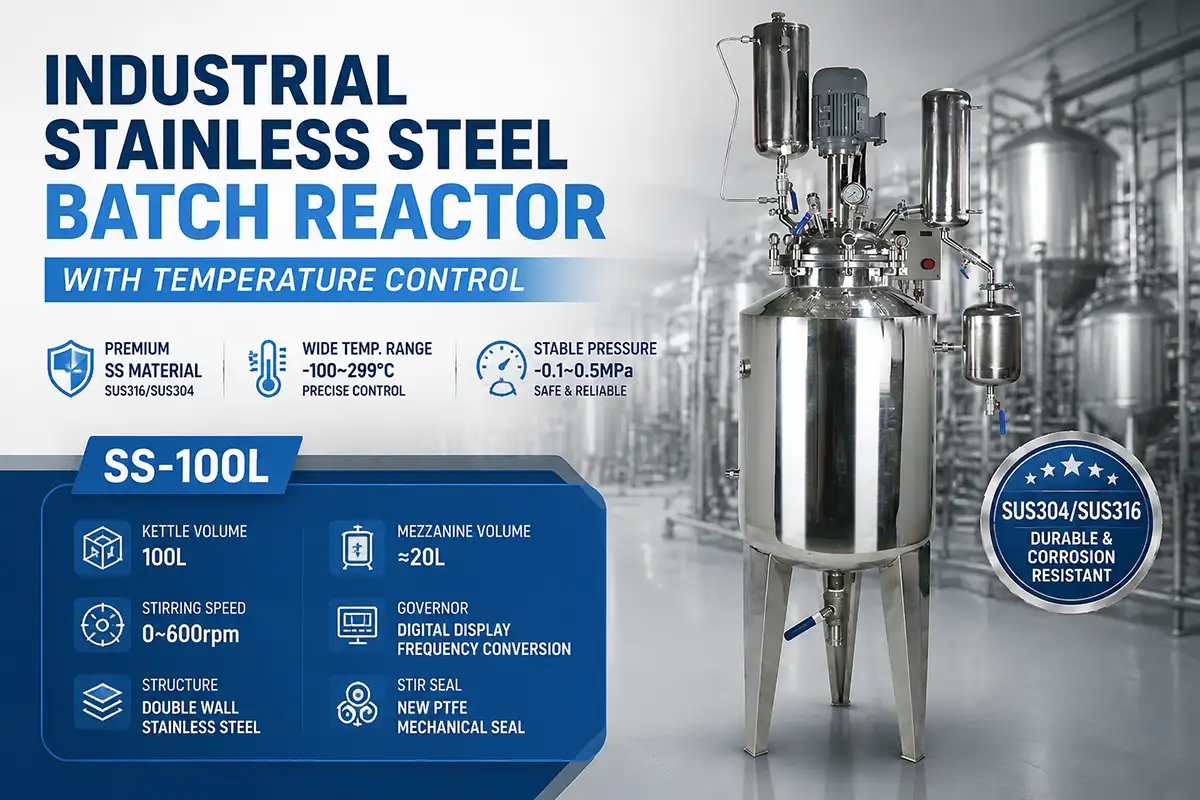
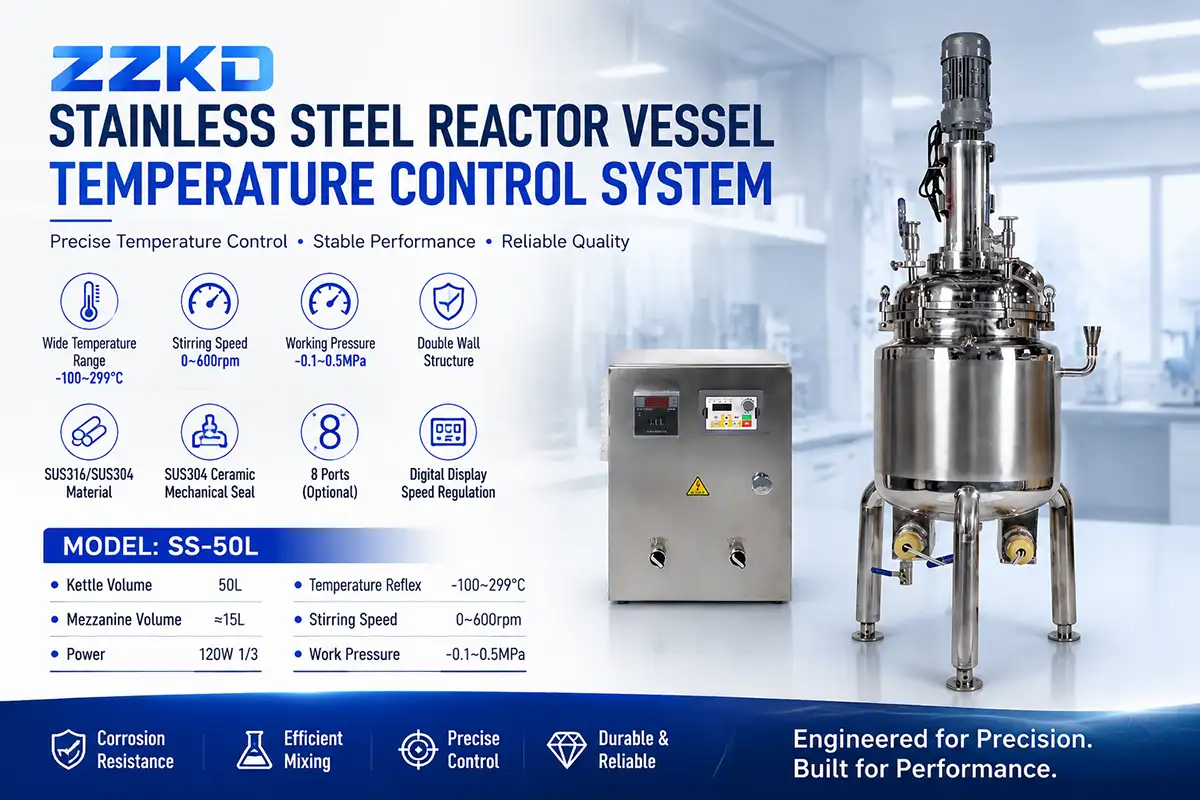
In ZZKD stainless steel reactor specifications, the SS-5L model supports a kettle reaction temperature range of -100 to 250℃, while the 10L to 300L series lists a temperature range of -100 to 299℃. This wide temperature window is useful for processes that need low-temperature reaction control, solvent reflux, crystallization cooling, or high-temperature synthesis.
Main Components Explained in Simple Terms
Reactor body: The main vessel where the materials react. ZZKD models may use SUS304 or SUS316 stainless steel depending on the process requirement.
Jacket or mezzanine: The space around the vessel where heating or cooling medium circulates. For example, the SS-5L has a 1.5L mezzanine capacity, while a 50L model has about 15L jacket volume.
Stirring system: A motor-driven agitator keeps the mixture uniform. Many ZZKD stainless steel reactors provide 0–600 rpm digital frequency-conversion speed control.
Mechanical seal: The seal helps prevent leakage around the stirring shaft. The SS-5L uses a mechanical seal, and larger models list SUS304 ceramic combined mechanical sealing with a new PTFE mechanical seal.
Ports on the lid: Useful ports may include a stirring port, solid material port, temperature measurement port, pressure gauge port, constant pressure funnel port, and condensation reflux port.
Discharge valve: The SS-5L uses a ball quick discharge valve, which is convenient for batch removal and cleaning.
Authoritative Data: Why Efficient Heating Matters
Temperature control is not only about chemistry; it is also about energy use. The U.S. Department of Energy states that industrial process heating accounts for more than one-third of energy used in U.S. manufacturing. This is one reason jacket design, insulation, heating power, and control accuracy matter when selecting a reactor system. A reactor that reaches set temperature faster and holds it steadily may reduce wasted energy, shorten batch time, and improve consistency.
For stainless steel material choice, the Nickel Institute and widely used stainless steel references note that 304 stainless steel is a common general-purpose grade, while 316 stainless steel is often selected where stronger corrosion resistance is needed. In practical terms, a buyer should not choose material only by price; the liquid phase, cleaning solvent, pH value, chloride level, and operating temperature should all be checked.
Sources referenced: U.S. Department of Energy industrial process heating publications; ASM International stainless steel corrosion guidance; Nickel Institute stainless steel application resources.
ZZKD Stainless Steel Batch Reactor Specification Snapshot
The following table summarizes common specifications from the provided ZZKD stainless steel reactor parameter sheets. Exact configuration can be customized according to process requirements.
| Model / Series | Capacity | Material | Temperature Range | Pressure / Vacuum | Stirring Speed | Key Feature |
|---|---|---|---|---|---|---|
| SS-5L | 5L | 316 reactor, 304 frame/pipe | -100–250℃ | -0.098 MPa to 0.5 MPa | 0–600 rpm | PT100 digital display |
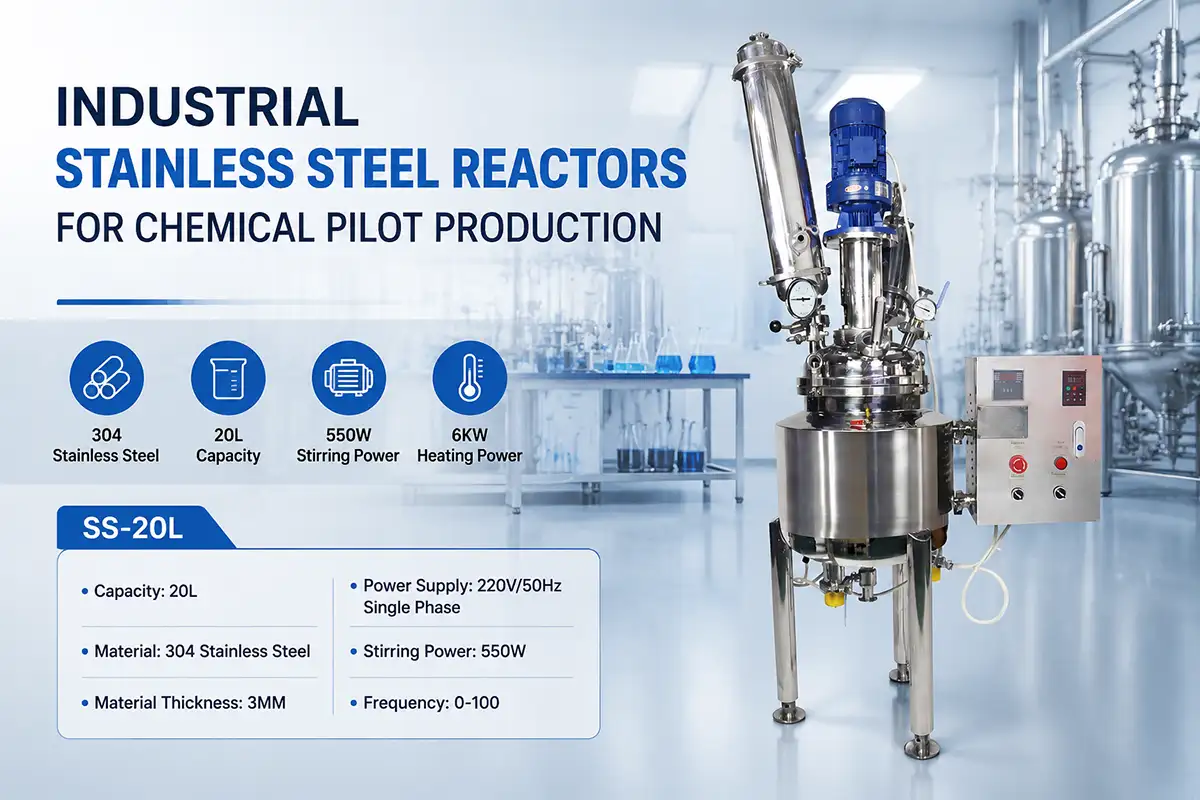
| SS-20L | 20L | 304 stainless steel | Process dependent | Application dependent | 0–100 rpm frequency control | 6 kW heating |
| SS-50L | 50L | SUS316 / SUS304 | -100–299℃ | -0.1 MPa to 0.5 MPa | 0–600 rpm | Double wall vessel |
| SS-100L | 100L | SUS316 / SUS304 | -100–299℃ | -0.1 MPa to 0.5 MPa | 0–600 rpm | 8 optional ports |
Is 304 stainless steel enough, or should 316 be selected?
The answer depends on the chemistry. 304 stainless steel is widely used for general chemical processing, water-based reactions, many oils, and non-aggressive solvents. 316 stainless steel is a better choice when the process contains chlorides, more corrosive compounds, or stricter corrosion-resistance requirements. From the author’s viewpoint, the safest buying method is to list the raw materials, solvent, cleaning agent, pH range, chloride content, temperature, and pressure before confirming the material grade.
If corrosion risk is unclear, the extra cost of 316 may be lower than the cost of shutdown, contamination, or early vessel replacement. For high-pressure work, users may also compare a dedicated high pressure autoclave reactor when pressure requirements go beyond the standard jacketed batch reactor range.
How Much Does a Stainless Steel Batch Reactor Cost?
Price depends on volume, steel grade, heating method, pressure rating, condenser, ports, sensors, sealing structure, automation, and customization. Based on the provided ZZKD product price list, practical reference prices include:
| Product Type | Reference Capacity | Representative Price | What It Usually Means |
|---|---|---|---|
| Jacketed stainless steel reactor with pH meter | 5L | $1,485 | Small laboratory or process development reactor |
| Mechanical stirring stainless steel reactor | 20L | $1,634 | Scale-up testing and small pilot batches |
| Jacketed stainless steel reactor with condenser | 50L | $2,042 | Pilot production with reflux or solvent control |
| Decarboxylation jacketed stainless steel reactor | 100L | $4,200 | Mid-capacity pilot or production process |
When a product line has a price range, the table uses a practical middle reference instead of the highest possible configuration. Final pricing should still be confirmed with ZZKD because heating power, condenser size, control cabinet, explosion-proof requirements, vacuum accessories, and custom ports can change the quote.
How to Choose the Right Capacity
Capacity should be selected by working volume, not only by total vessel volume. Many batch processes should not fill the reactor completely because mixing, foaming, expansion, reflux, and safety headspace are needed. For early research, 5L or 10L can be enough. For pilot verification, 20L to 50L is common. For small production, 100L or above may be more suitable.
A simple rule is to define the expected batch output first, then check viscosity, stirring difficulty, heat release, foam behavior, and discharge method. If the process is exothermic, cooling capacity becomes especially important. If the product is viscous, motor power and agitator type may be more important than vessel volume alone.
What should be checked before requesting a quote?
The answer is more specific than “capacity and price.” A useful quote request should include working volume, material grade, target temperature range, heating and cooling medium, operating pressure or vacuum, stirring speed, viscosity, solids content, condenser requirement, feeding method, discharge method, power supply, and whether certificates or special electrical standards are needed.
From the author’s perspective, the best quote is the one built around a real process. A low price is attractive, but if the reactor cannot heat evenly, seal properly, or discharge cleanly, it may become expensive later.
Practical Benefits of ZZKD Temperature-Controlled Batch Reactors
Common Applications
An industrial stainless steel batch reactor with temperature control can be used in many fields. In chemical manufacturing, it supports synthesis, neutralization, dissolution, and polymer reaction. In pharmaceutical and API development, it helps with process trials under defined temperature and mixing conditions. In botanical extraction and decarboxylation, controlled heating helps improve repeatability. In materials research, it can be used for slurry preparation, resin reaction, crystallization, or catalyst testing.
The reason batch reactors remain popular is flexibility. One vessel can often process different formulas after cleaning and configuration changes. This is valuable for companies that produce multiple products in moderate batch sizes.
Final Buying Advice
For most users, the best stainless steel batch reactor is not the largest or the cheapest one. It is the one that matches the process temperature, pressure, mixing behavior, corrosion risk, and cleaning method. A 5L reactor can be perfect for research, while a 50L or 100L reactor may be better for pilot production. A 304 vessel can be economical for general use, while 316 is often smarter for more corrosive media.
When temperature control is central to product quality, pay special attention to jacket volume, heating power, sensor position, control method, and cooling capability. These details decide how stable and repeatable the batch will be.
Need a ZZKD Stainless Steel Batch Reactor?
ZZKD can help select a stainless steel reactor according to capacity, temperature range, pressure, material, stirring, and process ports. Share the process conditions, and the configuration can be matched more accurately.
Explore ZZKD Stainless Steel Reactor Vessels