
High Pressure Reactor · Multi-unit procurement
Purchasing Multiple Lab Reactors for Hydrogenation Research
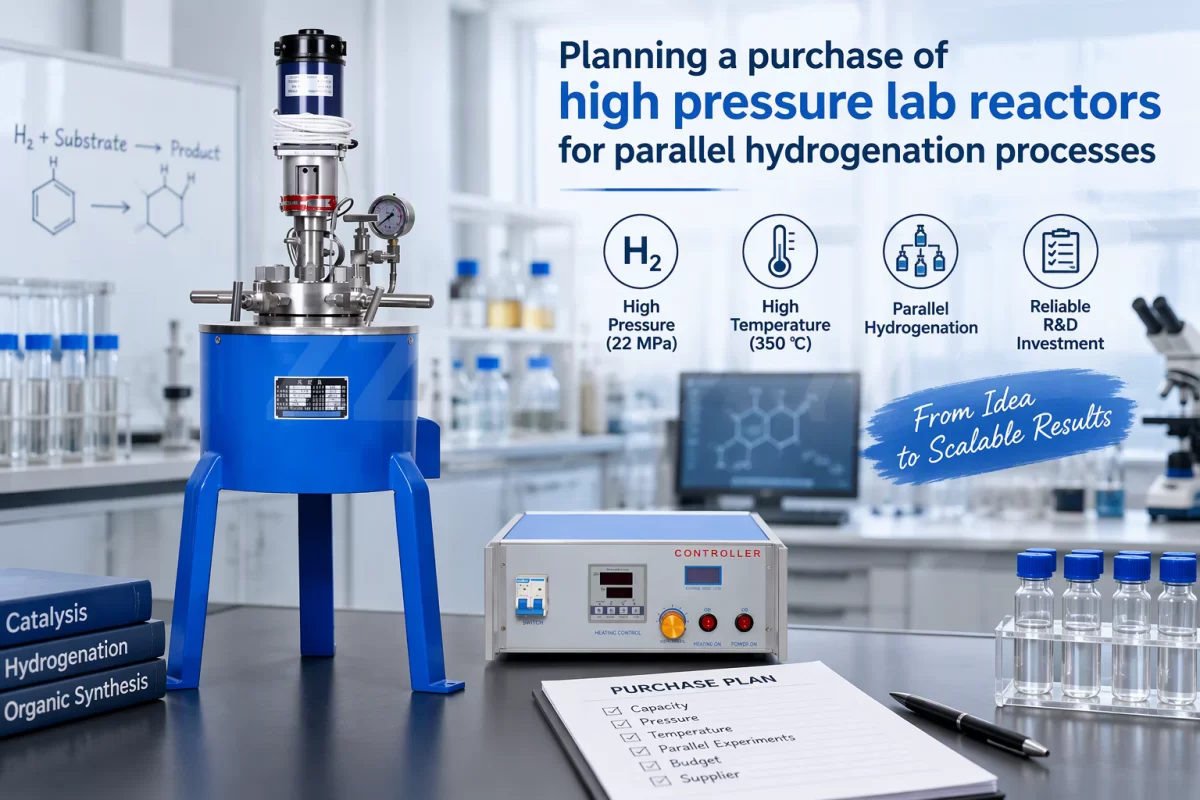
Planning a purchase of high pressure lab reactors for hydrogenation processes involves more than selecting a vessel size. A multi-unit laboratory needs a capacity mix that supports current experiments, independent parallel tasks, and practical maintenance—without assuming that every reactor shares the same pressure, temperature, or mixing capability.
Start with the research workload, not the largest vessel
A single-reactor purchase often centers on one defined experiment. Purchasing several reactors requires a broader view: how many runs must proceed together, which materials need dedicated equipment, and whether screening and larger-batch confirmation should share the same platform. A larger vessel may accommodate a later development stage, but it does not replace several independently controlled experiments.
When considering the High Pressure Lab Reactor, assign each proposed unit a clear role. Smaller vessels may be candidates for catalyst or solvent comparisons, while another capacity can be evaluated for repeatability studies or material production. These are purchasing objectives, not assurances of suitability for a particular hydrogenation chemistry.
Build a task schedule that includes charging, reaction time, cooling, sampling, cleaning, and inspection. If cleaning occupies a substantial part of the working day, an additional compatible unit may relieve the bottleneck more effectively than a larger nominal capacity.
Separate batch size, additions, process margin, and expansion
Nominal vessel capacity is not the same as an approved working charge. Hydrogenation planning must account for the particular liquid, catalyst, gas space, mixing behavior, and temperature-dependent volume changes. A single loading percentage should not be applied indiscriminately to different solvents, slurries, or reaction systems.
- Current batch: Record the initial liquid volume, catalyst quantity, solids content, and intended sampling requirements for each task.
- Charging changes: Identify additions during the experiment and how they affect the maximum inventory, composition, and required feed connections.
- Process margin: Evaluate headspace, foaming, thermal expansion, mixing needs, and credible process deviations separately from the initial charge.
- Future expansion: Decide whether increased output is better served by additional comparable units or a larger, separately qualified model.
For the High Pressure Autoclave Reactor, request a proposal identifying the exact model and assembly for each duty. The product name alone does not establish wetted materials, seal compatibility, hydrogen connections, or the allowable pressure–temperature operating envelope.
As an explicitly hypothetical planning example, two independent research tasks requiring 0.2 L and 0.8 L of initial liquid should be listed as separate duties. Those assumed liquid quantities do not determine the required vessel capacities: subsequent additions, gas space, agitation, and the process-specific charge assessment still control selection. This example is not an equipment guarantee or a loading recommendation.
Compare hydrogenation reactor candidates model by model
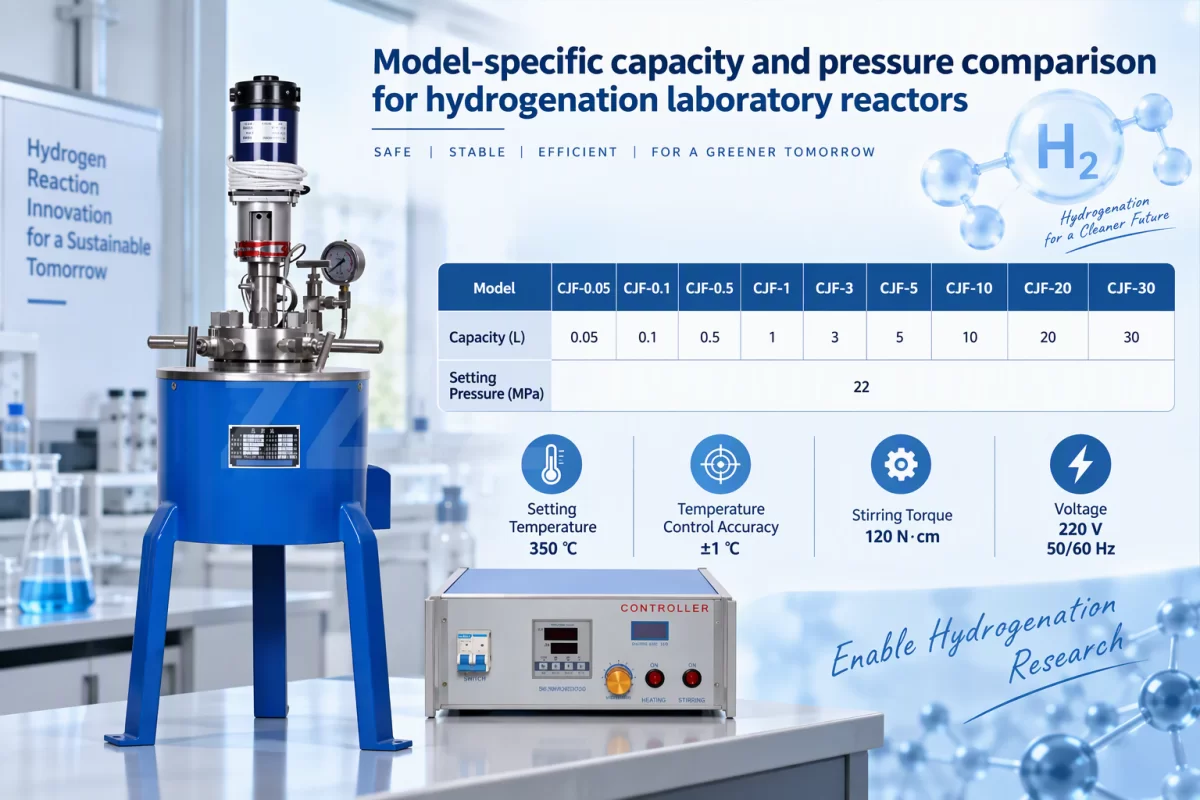
The FCF model data below provide a useful starting point for comparing nominal capacity and listed equipment specifications. Larger capacity does not preserve every specification of the smaller models. In particular, the listed pressure and temperature change for some larger FCF models, and the stirring-speed range also varies.
| Model | Capacity (L) | Listed pressure (MPa) | Listed temperature (°C) | Stirring speed (r/min) | Heating power (kW) |
|---|---|---|---|---|---|
| FCF-0.1 | 0.1 | 22 | 350 | 50–1000 | 0.6 |
| FCF-0.5 | 0.5 | 22 | 350 | 50–1000 | 1.5 |
| FCF-1 | 1 | 22 | 350 | 50–1000 | 1.5 |
| FCF-5 | 5 | 22 | 350 | 50–600 | 4 |
| FCF-20 | 20 | 22 | 350 | 50–600 | 10 |
| FCF-30 | 30 | 16 | 350 | 50–600 | 12 |
| FCF-50 | 50 | 10 | 300 | 50–600 | 12 |
| FCF-100 | 100 | 6 | 300 | 50–600 | 14 |
Listed pressure and temperature values are not a blanket approval to operate at both values simultaneously with hydrogen. Select each unit against the supplier-approved pressure–temperature envelope for its actual materials, seals, fittings, and assembly, together with the laboratory’s process risk assessment.
Mixing deserves its own review. A listed speed range does not establish equivalent gas–liquid mass transfer across capacities, nor does heating power establish a guaranteed heat-up time or cooling performance. Provide viscosity, solids loading, catalyst characteristics, and expected reaction heat so that agitation and thermal arrangements can be assessed for the intended duty.
Plan parallel tasks around independent control and shared utilities
Several reactors create parallel capacity only when the surrounding laboratory can support simultaneous work. Assess hydrogen supply arrangements, ventilation, electrical demand, cooling resources, and safe exhaust handling for the intended number of concurrent runs. Shared services can become the limiting factor even when individual vessel capacities are adequate.
For comparative experiments, specify consistent temperature measurement positions, pressure measurement arrangements, agitation hardware, and data-recording methods. For different chemistries, consider dedicated wetted components and cleaning procedures to reduce carryover. More background is available in the guide to hydrogenation reactor design and experimental planning.
Instrumentation and interfaces should be specified as purchasing requirements: hydrogen inlet arrangement, feed and sampling connections, pressure indication, temperature sensing, isolation, and pressure-relief provisions. Suitability and availability of these items should be established for the proposed configuration rather than assumed from the reactor category.
Standardize spare parts without assuming interchangeability
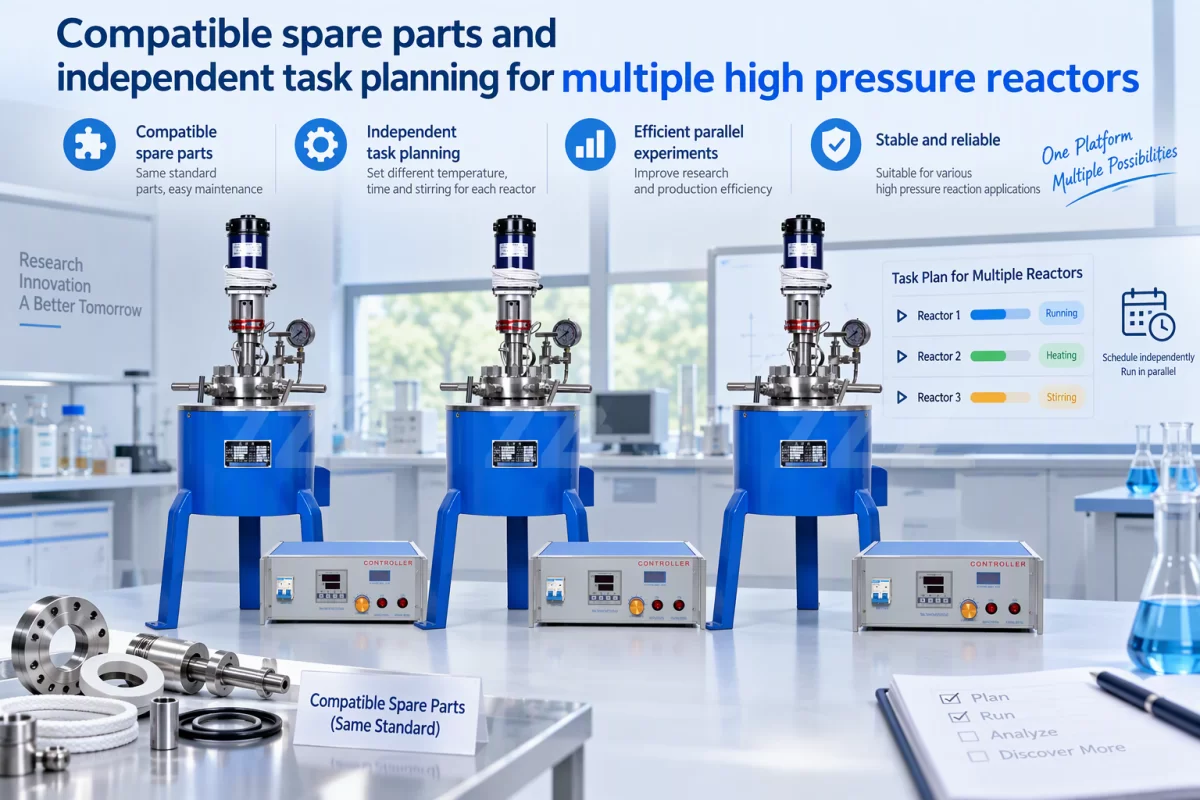
A fleet purchase offers an opportunity to simplify maintenance, but common appearance or a shared series name does not prove that parts interchange. Ask for a configuration-specific spare-parts schedule covering seals, valves, sensors, agitation components, and service items. Match part numbers, dimensions, materials, connection standards, and temperature and pressure suitability.
Standardization should concentrate first on components that can genuinely be shared without compromising duty requirements. Keep model-specific items clearly identified. A spare seal suitable for one solvent and temperature range may not be appropriate for another task, even if it fits mechanically.
Include commissioning, operator instruction, inspection access, cleaning requirements, and maintenance documentation in the purchase scope. If particular certification or compliance documentation is required by the site, request it explicitly for the offered equipment; do not infer certification from a model designation.
Budget for configured units, not a repeated catalog figure
Multi-unit budgeting should separate the reactor assemblies from application-specific fittings, instrumentation, spares, and services included in the requested scope. Different capacities or configurations should be quoted individually. A reference price is not a hydrogenation package price and should not simply be multiplied by the planned reactor count.
Our company’s reference price
US$2,990
This reference uses the lower-middle price from our company’s single-price listings, sorted from low to high. Actual quotations depend on the selected configuration and inquiry results. It is not a confirmed price for any model or multi-reactor package discussed here.
Make the hydrogenation reactor purchase fit the whole program
Purchasing multiple high pressure lab reactors for hydrogenation processes is a fleet-planning decision. Choose capacities around current working batches, assess additions and process margin separately, and treat future expansion as a distinct requirement. Compare pressure, temperature, stirring, materials, seals, measurement, and interfaces for each proposed model—not for an imagined combination of series maximum values.
A well-defined purchase also supports independent experiments, realistic shared-utility demand, and a spare-parts plan based on documented compatibility. The most useful proposal is the one that explains how every configured unit serves its assigned research duty.
Submit the operating conditions and configuration requirements
Provide the intended number of reactors, materials and solvents, current batch quantities, planned additions, target operating pressure and temperature, agitation needs, sampling and feed requirements, available utilities, and future capacity plans. Request a model-specific proposal and quotation so that the operating envelope, component compatibility, and overall configuration can be assessed for the intended hydrogenation work.