
Laboratory equipment · Procurement guide
What Affects the Price of a High Pressure Lab Reactor for Hydrogenation?
When comparing the high pressure lab reactor for hydrogenation processes price, the useful question is not simply how much the vessel costs. It is what the quotation includes—and whether that specific configuration matches the proposed hydrogenation duty. Vessel construction, heating and control, gas connections, stirring, sealing, and documentation all influence the purchasing decision.
Start with a reference price, not an assumed project quotation
A laboratory hydrogenation system should be priced as a defined equipment package. Two quotations describing a “high pressure reactor” may cover different vessel sizes, control arrangements, fittings, or supporting documents. A lower headline figure is not necessarily a like-for-like offer.
This budgeting reference uses the middle value of the company’s single-price listings, sorted from lowest to highest, with the lower of the two middle values used for an even count. Configuration-dependent price ranges are not treated as fixed quotations. The reference is not a current quotation for a particular hydrogenation model; the actual quotation depends on configuration and inquiry results.
For the High Pressure Lab Reactor, begin the inquiry with the intended working batch, solvent, catalyst, hydrogen supply conditions, and required operating temperature. Then compare quotations against the same equipment boundary rather than applying a general reference figure to every model.
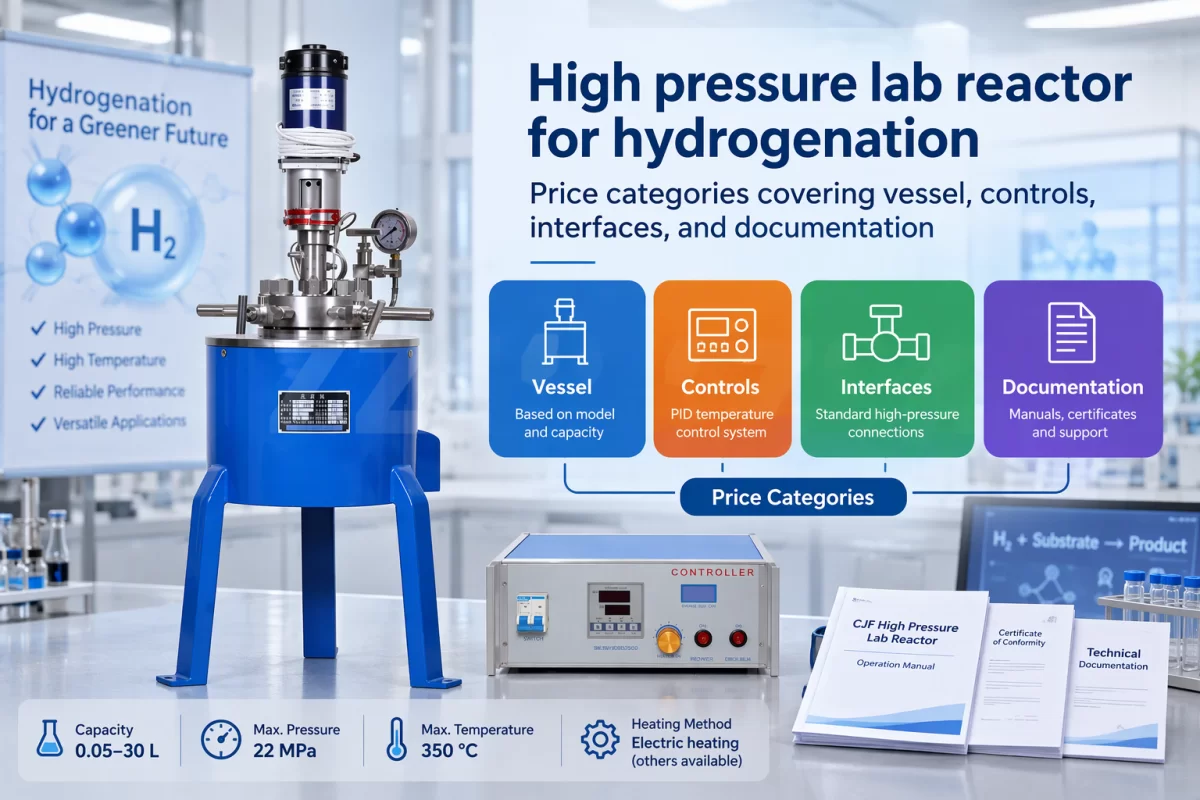
Does a listed reactor price include a complete hydrogenation installation?
I would not assume that it does. I would compare the itemized supply scope, especially hydrogen regulation, connection fittings, measurement devices, cooling provision, and site services. Each should be identified as included, optional, or outside the supplier’s scope.
Vessel cost depends on the actual model and pressure–temperature requirements
Capacity influences vessel construction, heating requirements, handling, and the quantity of wetted material. However, nominal capacity is not the same as the liquid working charge. The proposed fill level and gas headspace must be considered separately when selecting a hydrogenation vessel.
Material selection is another quotation variable. The TGYF-C specification lists stainless steel 304 and 316 as material choices. These should not be treated as interchangeable for every reaction mixture. The selected grade, wetted fittings, seal materials, and compatibility with the solvent and catalyst should be defined for the proposed configuration.
The FCF model specifications below show why a series-wide maximum should not be applied to every reactor. These are model-specific listed values, not an approval to operate at the stated pressure and temperature simultaneously under any process conditions.
| Model | Capacity L | Listed pressure MPa | Listed temperature °C | Stirring speed r/min | Heating power kW |
|---|---|---|---|---|---|
| FCF-1 | 1 | 22 | 350 | 50–1000 | 1.5 |
| FCF-5 | 5 | 22 | 350 | 50–600 | 4 |
| FCF-30 | 30 | 16 | 350 | 50–600 | 12 |
| FCF-50 | 50 | 10 | 300 | 50–600 | 12 |
| FCF-100 | 100 | 6 | 300 | 50–600 | 14 |
The selected vessel’s permissible pressure–temperature operating envelope, hydrogen suitability, and complete wetted construction should be established for the intended duty before purchase.
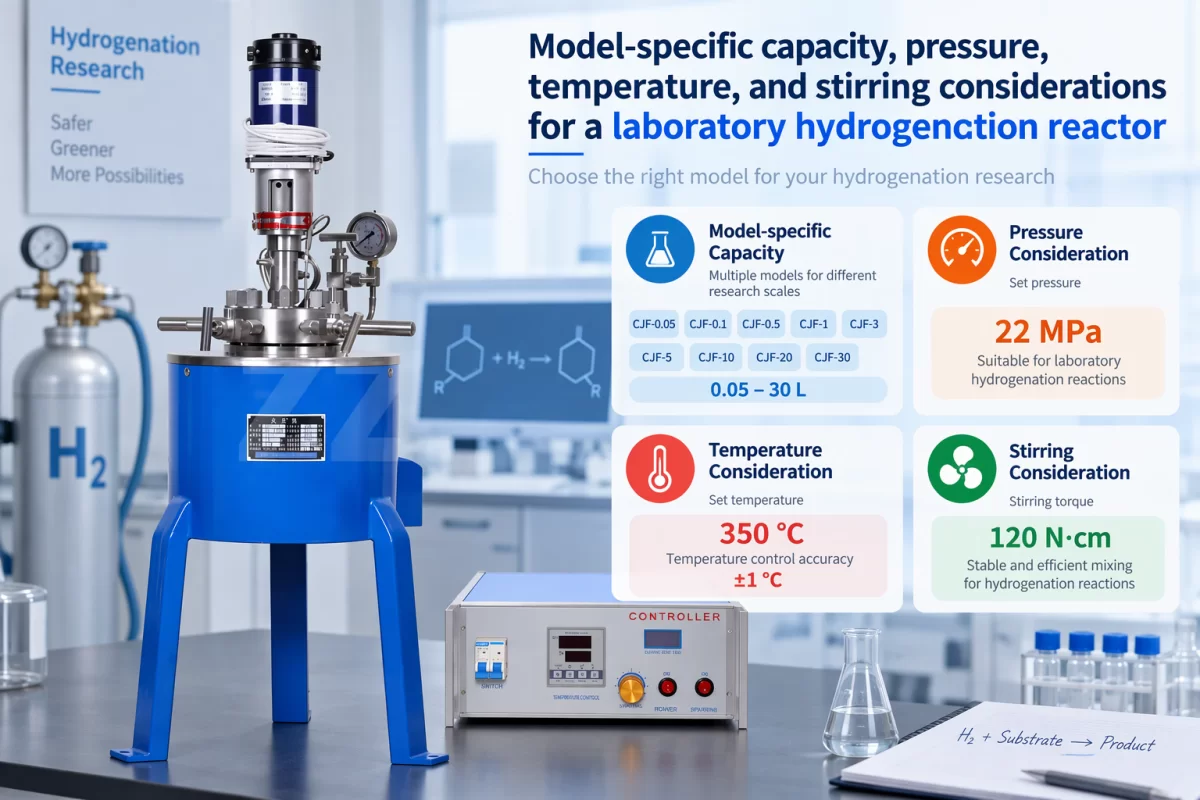
Can a larger vessel retain the same pressure rating as a smaller model?
I would check the individual model rather than infer its rating from size alone. For example, the listed FCF-5 pressure is 22 MPa, while the FCF-50 listing gives 10 MPa. A capacity increase therefore requires a fresh review of the process requirements and the selected model’s operating envelope.
Controls, stirring, and gas interfaces change the quotation scope
Heating and temperature control
Heating power is a model-specific specification, not a promise of a particular heat-up time. Actual thermal behavior depends on the charge, vessel construction, target temperature, and heat losses. Hydrogenation can also require heat removal, so a heating specification alone does not establish adequate cooling capability.
The CJF controller description includes real-time display and adjustment of speed, temperature, and time, with PID automatic temperature adjustment. An inquiry should separately specify any required data logging, remote communication, alarms, or interlocks; these should not be assumed to be included in that controller description.
Stirring and sealing
Stirring requirements should reflect liquid viscosity, catalyst suspension, and gas–liquid contact needs. The listed speed range alone does not establish mixing effectiveness for a particular recipe. Ask for the proposed impeller arrangement and drive capability at the intended load, together with the seal design and materials for hydrogen service.
Hydrogen connections and measurement
Define the required gas inlet, purge and vent connections, pressure measurement, sampling arrangement, and any gas-flow measurement. Connection type, component ratings, sensor selection, and the boundary between reactor equipment and the laboratory gas supply can change the quotation. For related selection context, see the guide to hydrogenation reactor design for laboratory experiments.
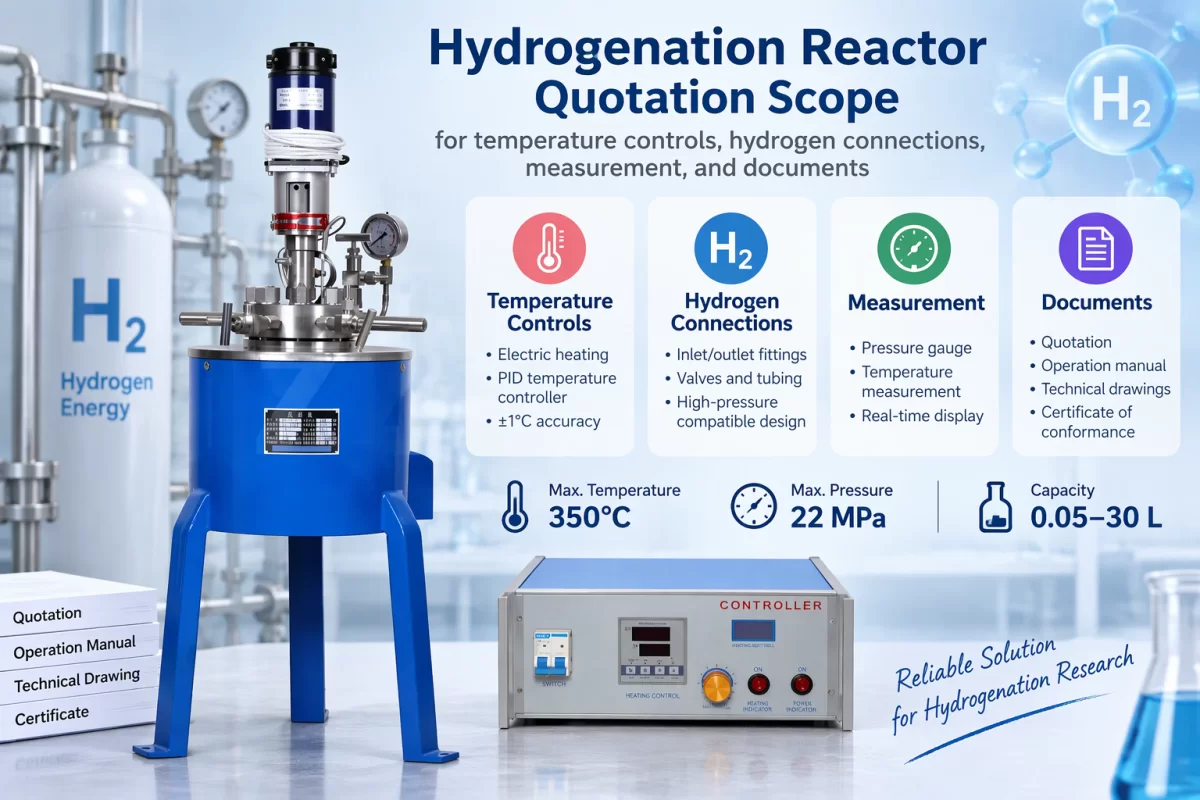
Use an itemized hydrogenation reactor quotation checklist
Documentation is part of the procurement scope, not an automatic consequence of a pressure specification. Identify the required drawings, material records, inspection or test documents, operating instructions, and applicable compliance requirements. Request an itemized allowance where these deliverables are not included in the basic package.
The following comparison format separates the selected configuration from additional requirements. An item belongs in the confirmed column only after it appears in the supplier’s written offer.
| Cost category | Confirmed configuration to record | Optional or separately quoted requirements |
|---|---|---|
| Vessel | Exact model, nominal capacity, wetted material, and approved operating envelope | Alternative material, handling arrangement, or additional vessel components |
| Controls and heating | Controller functions, heater power, sensors, and electrical supply | Logging, communication, cooling equipment, and specified protective functions |
| Stirring and sealing | Drive, speed range, impeller, seal type, and wetted seal materials | Process-specific mixing arrangement and spare seals |
| Interfaces | Ports, valves, fittings, instruments, and supply boundaries | Hydrogen regulation, flow measurement, sampling accessories, and site connections |
| Documents and delivery | Included manuals, drawings, test records, and delivery terms | Additional documentation, packing, freight, installation, or training |
What makes two hydrogenation reactor quotations comparable?
I compare them against one shared specification: the same working charge, operating conditions, materials, mixing duty, interface list, and document package. I then separate equipment charges from optional accessories and delivery services. This makes scope differences visible without assuming that the lowest total provides the same capability.
Choose a defined process fit before judging the price
A meaningful high pressure lab reactor price for hydrogenation reflects a specific vessel and a clearly bounded package. Capacity, the permitted pressure–temperature combination, wetted materials, stirring and sealing, controls, gas interfaces, and required documents should all support the intended process. A company reference price is useful for early budgeting, but it cannot replace a configuration-specific quotation.
Prepare a process-specific inquiry
Submit the solvent and reactants, catalyst details, working batch volume, target operating pressure and temperature, hydrogen supply conditions, mixing needs, available utilities, required connections, and documentation expectations. Include any preferred model and control features so the supplier can assess the proposed configuration and provide an itemized quotation.