
What Is the Best High Pressure Reactor for Lab Use?
The best laboratory reactor is not simply the model with the highest number on the pressure gauge. It is the reactor that safely matches the chemistry, batch size, temperature, mixing demand, and future research plan.
The best all-round choice for most lab screening work
For general hydrogenation, catalytic synthesis, polymer research, hydrothermal work, and other stirred high-pressure experiments, a compact stainless steel reactor with mechanical stirring, controllable electric heating, several vessel sizes, and a meaningful pressure margin is usually the most practical choice.
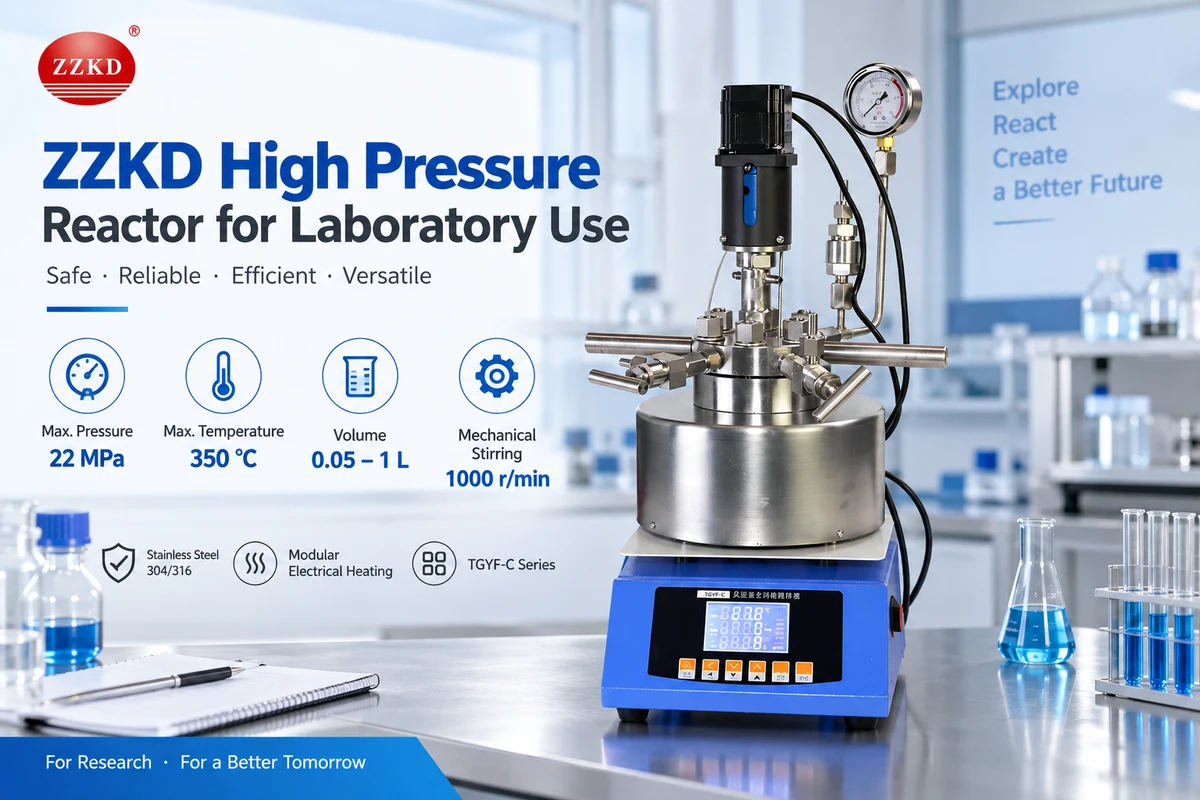
Based on those priorities, the ZZKD TGYF-C is a strong all-round option. It is available from 0.05 to 1 L, is specified for pressure up to 22 MPa and temperature up to 350°C, and provides mechanical stirring up to 1,000 r/min. The wide size range makes it useful for both low-consumption screening and larger confirmation batches. However, the final selection must still be checked against the actual chemicals, operating pressure, required wetted material, and local pressure-equipment rules.
What “best” should mean in a laboratory
A high pressure reactor, also called a stirred autoclave reactor, is a sealed vessel designed to hold a reaction above atmospheric pressure. Pressure may be introduced from a gas cylinder or generated when a liquid is heated. The vessel must therefore be treated as a complete pressure system—not merely as a metal container.
In my selection process, five factors carry the most weight: usable volume, maximum allowable working conditions, material compatibility, mixing quality, and protection against foreseeable failure. A suitable high pressure lab reactor should also be easy to charge, sample, clean, inspect, and control.
No. In my view, pressure without temperature, material, seals, fittings, relief strategy, and chemical compatibility is an incomplete specification. The permitted pressure can also change with temperature, so the manufacturer’s pressure–temperature rating and documentation must be reviewed for the intended operating point.
ZZKD TGYF-C specifications at a glance
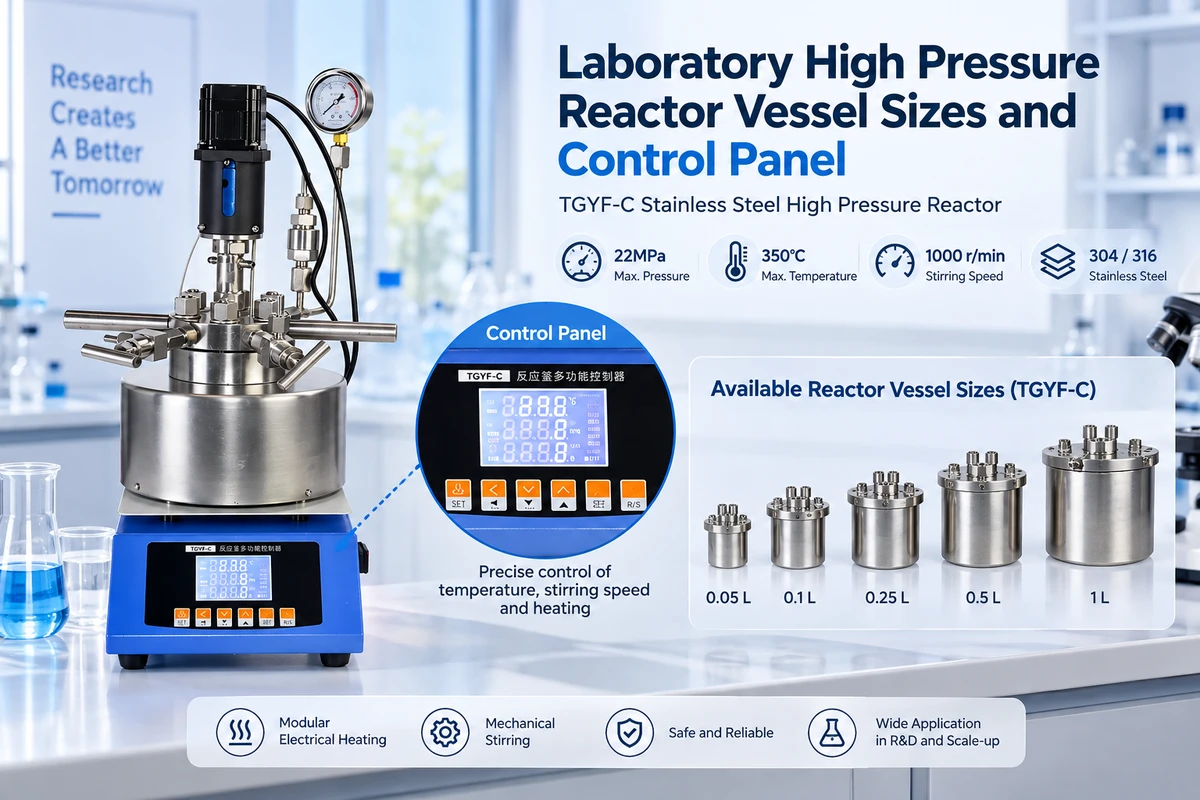
The TGYF-C covers five nominal capacities. Smaller vessels reduce reagent consumption during early screening, while 0.5 L and 1 L versions provide more material for analysis and process verification. Mechanical stirring helps disperse gas and solids more consistently than an unstirred pressure vessel.
| Model | Volume | Pressure | Temperature | Speed | Heating power |
|---|---|---|---|---|---|
| TGYF-C | 0.05 L | 22 MPa | 350°C | 1,000 r/min | 0.7 kW |
| TGYF-C | 0.1 L | 22 MPa | 350°C | 1,000 r/min | 0.7 kW |
| TGYF-C | 0.25 L | 22 MPa | 350°C | 1,000 r/min | 0.7 kW |
| TGYF-C | 0.5 L | 22 MPa | 350°C | 1,000 r/min | 1.5 kW |
| TGYF-C | 1 L | 22 MPa | 350°C | 1,000 r/min | 1.5 kW |
Choose volume from the experiment—not from guesswork
Nominal vessel volume is not the same as recommended liquid charge. Headspace is needed for gas, foaming, thermal expansion, and controlled mixing. The correct fill limit depends on the reaction and must come from the approved operating procedure and supplier guidance.
50–100 mL: useful when catalysts or feedstocks are expensive and many conditions must be screened.
250 mL: a balanced research size that offers more sampling material without consuming a large batch.
500 mL–1 L: better for confirmation runs, larger samples, and reactions requiring more analytical material.
For many research teams, I consider 250 mL the practical middle ground. It limits chemical consumption but gives more working material than a micro reactor. A 50 or 100 mL vessel is preferable for costly screening, while 500 mL or 1 L is more suitable when downstream testing needs a larger product sample.
Pressure and temperature must be evaluated together
The TGYF-C specification of 22 MPa is approximately 3,191 psi or 220 bar, while its listed temperature limit is 350°C. These are maximum equipment specifications, not automatic process setpoints. Normal operation should follow the supplier-approved pressure–temperature envelope and an application-specific safety margin.
Authoritative reference: The International Association for the Properties of Water and Steam (IAPWS) defines water’s critical point at 647.096 K (373.946°C) and 22.064 MPa. This established data shows why heating a closed system can create extreme conditions and why pressure prediction must include solvent properties, gas charging, reaction heat, and vapor generation. Source: IAPWS R6-95(2018).
A reactor rated to 22 MPa is therefore capable of serious pressure service, but capability is not permission to approach the limit. Before operation, confirm the vessel’s allowable conditions at the target temperature, gauge range, relief device, gas regulator, tubing, valves, seals, and controller. Readers comparing vessel layouts can also review this overview of a high pressure autoclave reactor.
304 or 316 stainless steel?
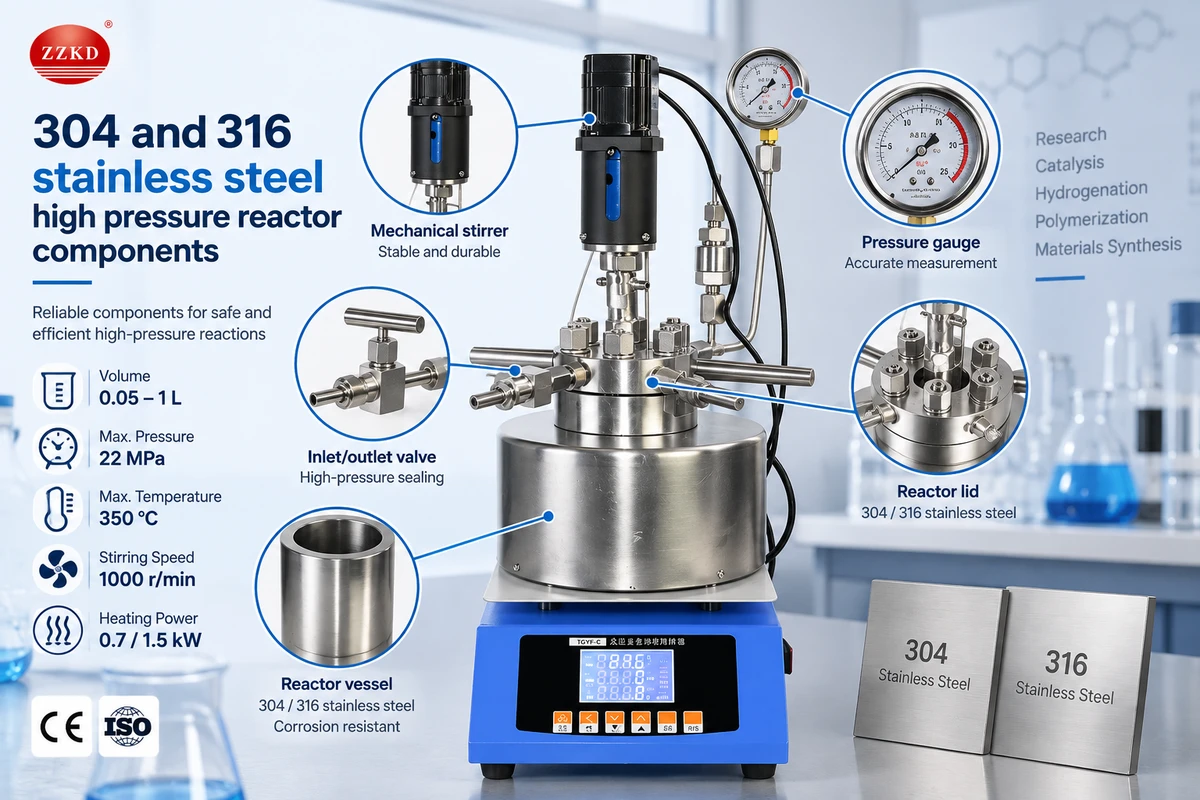
Both grades are common engineering materials, but they are not interchangeable for every chemical. Type 316 contains molybdenum and generally provides better resistance to pitting in many chloride-containing environments than 304. That does not make 316 universally corrosion-proof. Strong acids, halides, caustics, mixed solvents, catalysts, and high temperature can change corrosion behavior.
In my view, 316 is the sensible default when the chemistry is compatible and added corrosion resistance is valuable. A formal compatibility review should still cover the vessel, agitator, thermowell, valves, gaskets, seals, and all other wetted parts—not only the main body. For a broader material comparison, see the ZZKD guide to stainless steel reactors.
No. I would never approve a reactor from the words “stainless steel” alone. The exact alloy, concentration, temperature, pressure, exposure time, impurities, and cleaning chemicals all matter. When compatibility is uncertain, written guidance from the equipment supplier and a qualified materials specialist is essential.
Safety features to verify before purchasing
The best reactor is supplied as a properly engineered system with traceable operating information. Ask for the design basis, maximum allowable working pressure at temperature, hydrostatic or pressure-test record, material certificates where required, seal limitations, wiring details, and inspection schedule. Requirements vary by country and installation, so applicable pressure-vessel and electrical rules must be established before ordering.
A pressure relief device sized and set for the credible overpressure scenario.
A readable pressure gauge or transducer with a range appropriate to normal operation.
Independent over-temperature protection and controlled heater shutdown.
Safe gas inlet, vent routing, grounding, guarding, and leak-testing provisions.
A written operating procedure covering charging, purging, heating, sampling, cooling, venting, cleaning, and inspection.
Laboratory safety reference: In the United States, OSHA’s laboratory standard, 29 CFR 1910.1450, requires covered laboratories to develop and implement a written Chemical Hygiene Plan. OSHA also states that the plan must include standard operating procedures relevant to health and safety. Source: U.S. Occupational Safety and Health Administration.
How much does a good lab high pressure reactor cost?
This is a central, moderately priced reference selected from the listed US$2,300–3,200 range for a ZZKD high pressure autoclave vessel with temperature control and mixing.
The final quotation may change with volume, 304 or 316 construction, valve configuration, controller, pressure fittings, shipping destination, testing documents, and optional customization. A low advertised price may exclude important components, while the highest price does not automatically indicate the best application fit. Request a written quotation that identifies exactly what is included.
Final recommendation
For a flexible laboratory platform, choose the ZZKD TGYF-C size that matches the required batch and select 304 or 316 only after compatibility review. Its 0.05–1 L options, 22 MPa pressure specification, 350°C temperature specification, 1,000 r/min mechanical stirring, and modular electrical heating form a useful combination for varied research.
Before purchase, send ZZKD the chemical names and concentrations, desired charge volume, gas type, normal and worst-case pressure, operating temperature, stirring requirement, utilities, and local compliance needs. This information allows the reactor, wetted materials, controls, fittings, and safeguards to be checked as one system. No reactor should be operated beyond supplier-approved conditions, and trained personnel should complete a documented hazard review before the first run.
Need a reactor matched to a specific process?
Share the target chemistry, working volume, normal pressure, maximum temperature, stirring demand, and preferred stainless steel grade with ZZKD for a configuration review and current quotation.
Request a Current ZZKD Quote