What is the Cost of Stainless Steel Chemical Reactor?
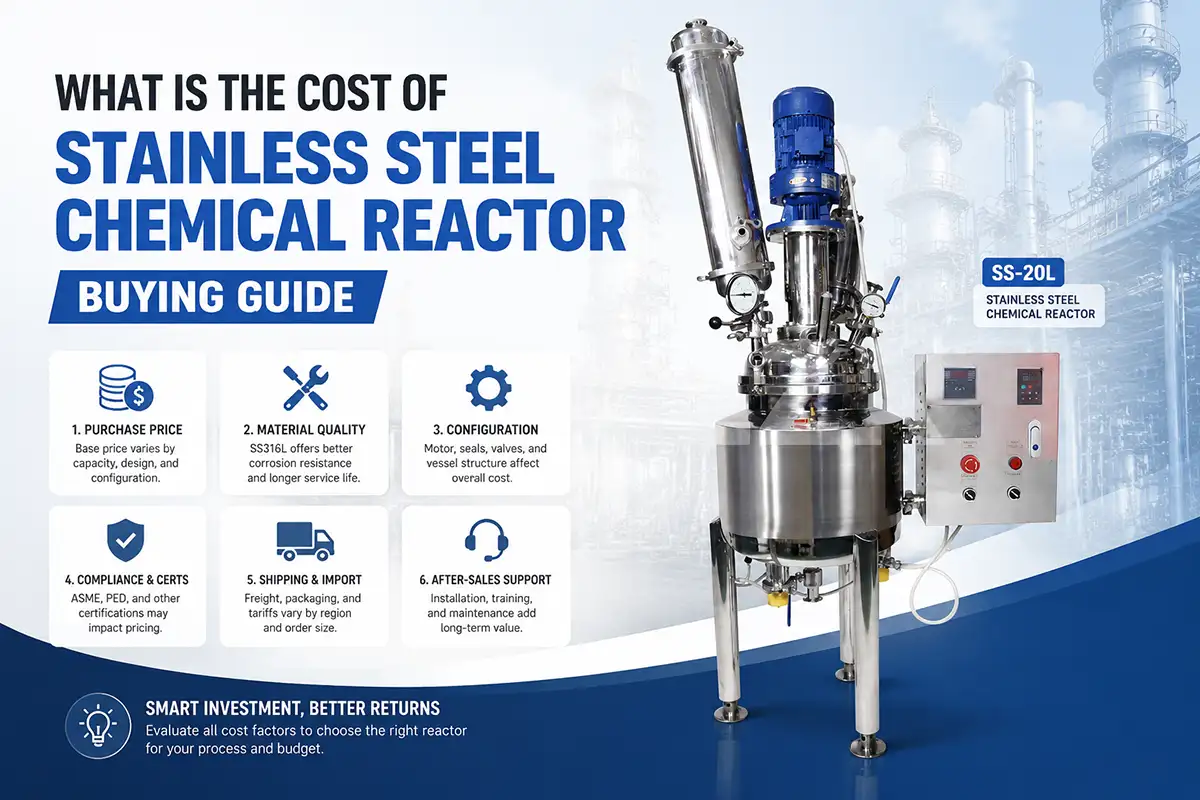
The price of a stainless steel chemical reactor can vary from around $1,485 for a small 5L lab unit to more than $4,000 for specialized high-pressure models, while larger jacketed systems such as 100L units often start from about $4,200 when the mid-range lower price in a quoted range is used. The real answer depends on size, material grade, pressure requirement, heating design, and process configuration. This guide explains those factors in a simple way so buyers can understand what is worth paying for and what is not.
The short answer: how much does a stainless steel reactor cost?
For most buyers, the first concern is simple: what budget should be prepared? Based on the product pricing data provided for comparable stainless steel reactors, the market can be roughly understood like this:
| Typical Model | Capacity | Reference Price | Common Use |
|---|---|---|---|
| Basic stainless steel reactor | 5L | $1,485 | Lab research, small-batch synthesis |
| Jacketed stainless steel reactor | 10L–20L | $1,541–$1,634 | Process development, pilot testing |
| Jacketed stainless steel reactor | 50L | $2,042 | Small pilot production |
| Mid-size pilot reactor | 60L–80L | $2,135 | Scale-up verification |
| Decarboxylation / larger jacketed reactor | 100L | $4,200 | Pilot or specialty process use |
| High-pressure stainless steel reactor | 1L and specialized | $2,489–$4,271 | Hydrogenation, pressure chemistry |
These numbers are not random. They reflect a clear market rule: the more demanding the process, the faster the cost rises. Capacity matters, but pressure resistance, sealing design, and material grade often change the price even more than tank size.
Why do stainless steel reactor prices vary so much?
A buyer may notice that two reactors with similar volume can still have very different prices. That happens because a reactor is not just a tank. It is a process system. Several technical details directly affect cost.
Material grade
304 stainless steel is common and economical, while 316 stainless steel offers better corrosion resistance and is often preferred for pharmaceuticals, fine chemicals, and aggressive media.
Pressure and vacuum design
Standard jacketed lab models may work at about -0.1 MPa to 0.5 MPa, but high-pressure systems require thicker walls, stronger seals, and stricter manufacturing control.
Heating and cooling structure
Single-jacket, double-jacket, circulation heating, condenser configuration, and insulation layers all add cost depending on process requirements.
The supplied specification sheets show this clearly. For example, the ZZKD SS-5L model uses a 316 stainless steel reactor vessel with a 304 stainless steel frame, supports -100℃ to 250℃, and works under -0.098 MPa to 0.5 MPa. That kind of construction naturally costs more than a very simple non-jacketed mixing tank.
Is a larger reactor always more expensive than a smaller one?
Usually yes, but not always by the expected amount. From an author’s perspective, a 1L or 5L high-pressure reactor can cost more than a normal 20L unit because pressure resistance, safety design, and sealing complexity are expensive. Volume is only one part of the price equation.
Real cost factors that buyers should pay attention to
When comparing quotations, the most useful approach is to look beyond the headline number. A low price can become expensive later if the reactor cannot meet process requirements. In practical purchasing work, these are the key items worth checking:
Capacity: 5L, 10L, 20L, 50L, 100L, and above each serve different stages of production.
Stirring power and speed: the provided data shows ranges such as 0–600 rpm, which is suitable for many liquid-solid or liquid-liquid reactions.
Seal type: mechanical seals and PTFE mechanical seals improve reliability, especially under vacuum or corrosive conditions.
Number of ports: more ports allow dosing, reflux, temperature sensing, pressure monitoring, and custom feeding options.
Heating power: for example, the 20L stainless steel reactor data sheet lists 6 kW heating power, which affects performance and electrical requirements.
Material thickness and fabrication quality: these influence durability and operating safety.
In other words, the cost of a stainless steel chemical reactor is not only about what is purchased today. It also includes service life, maintenance frequency, cleaning efficiency, and process stability over time.
Typical price range by application
Different industries buy reactors for different reasons, so expected pricing should be matched to the application.
1. Laboratory research
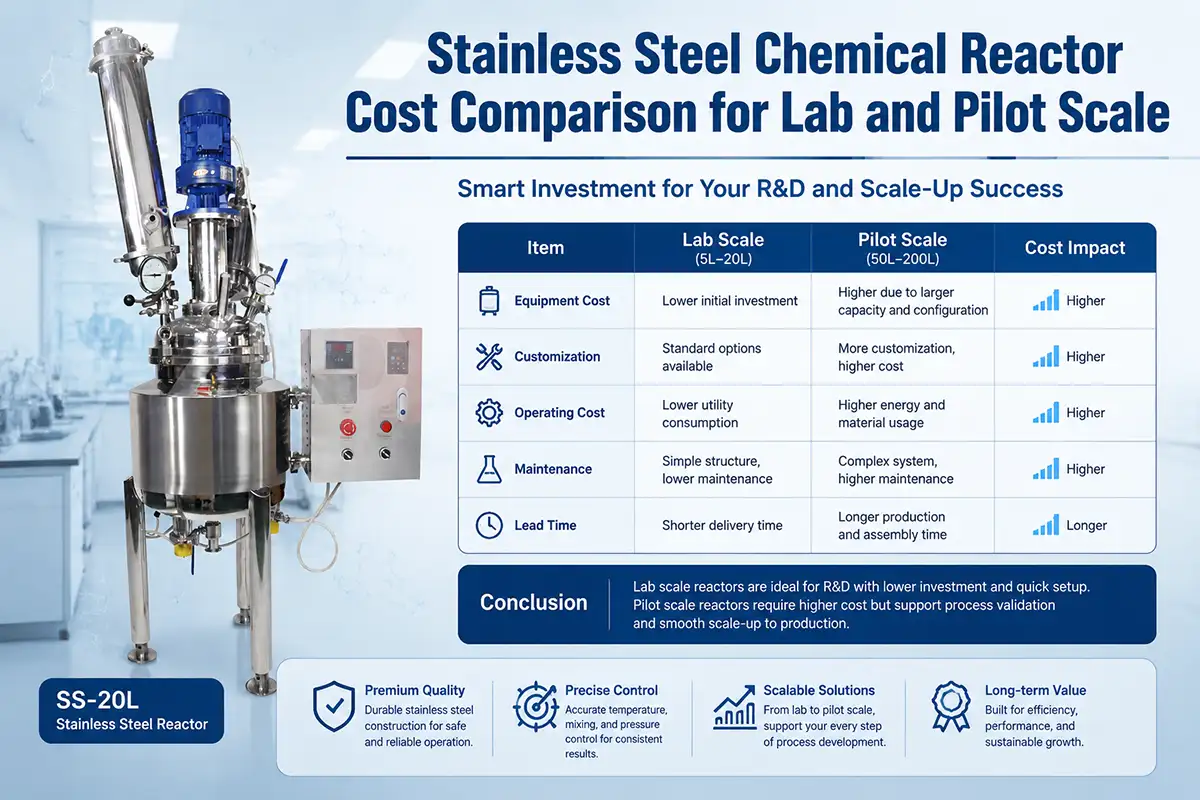
Small units in the 5L to 20L range are commonly selected for formulation work, catalyst screening, extraction, and early-stage synthesis. A practical entry point is around $1,485 to $1,634. This is often the most cost-effective range for universities, R&D labs, and small chemical companies.
2. Pilot scale
When a process moves from lab to pilot verification, buyers often consider 50L, 60L, 80L, or 100L systems. Here the budget may rise to about $2,042 to $4,200 depending on condenser setup, jacket structure, and temperature control demand.
3. Special reaction conditions
Hydrogenation, pressure synthesis, and high-temperature work often require special high-pressure designs. In that case, a smaller vessel can still cost $2,489 to $4,271 or more.
Does buying the cheapest reactor save money?
Not necessarily. From an author’s viewpoint, the cheapest model only saves money when the process is simple and the specifications truly match the task. If corrosion resistance, vacuum stability, or thermal control are insufficient, downtime and replacement costs can quickly exceed the initial savings.
For buyers comparing different technologies, it may also be useful to review related systems such as high pressure autoclave reactors for pressure chemistry, or explore dedicated reactor vessels for broader vessel configurations. For general technical background, the article on stainless steel reactors can also help clarify the design logic behind pricing.
How ZZKD stainless steel reactor specifications influence value
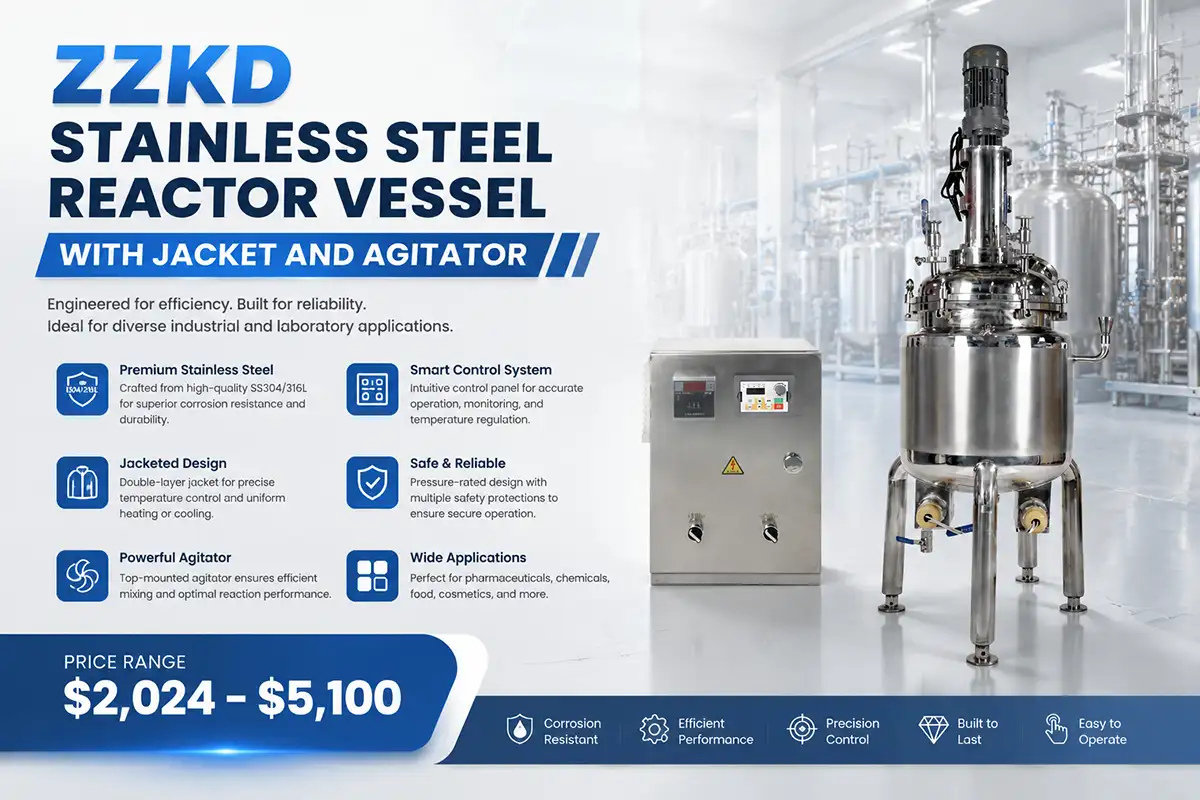
ZZKD reactors are built around practical process needs rather than simple catalog descriptions. The supplied parameter sheets show several value points that matter in real use:
Wide temperature capability: up to -100℃ to 299℃ on several models, suitable for both cooling and heating processes.
Stable speed control: digital display frequency conversion with speeds up to 600 rpm on multiple units.
Reliable sealing: ceramic combined mechanical seal or PTFE mechanical seal for better operational stability.
Double-wall structure: improves thermal transfer for jacketed operation.
Material options: SUS304 and SUS316 allow matching equipment to budget and corrosion profile.
That means a buyer is not just paying for a vessel body. The investment includes operating flexibility, safer process control, and easier adaptation to future experiments or production changes.
What should be asked before requesting a quote?
Many buyers ask for price first, but a better result comes from asking the right technical questions first. Before requesting a quotation, it is wise to confirm:
What reaction volume is actually needed?
Will the process involve corrosive media, vacuum, or pressure?
What temperature range must the reactor handle?
Is a condenser, dosing funnel, pressure gauge, or custom port layout required?
Should the material be 304 stainless steel or 316 stainless steel?
Which option gives the best balance between cost and performance?
In the author’s opinion, the best value usually appears in jacketed 10L to 50L stainless steel reactors. This range offers meaningful process capability, manageable cost, and strong flexibility for research, pilot testing, and small-batch production. It is often where budget and performance meet most efficiently.
Final answer
The cost of a stainless steel chemical reactor usually starts at about $1,485 for a small 5L laboratory model, moves to around $1,541 to $2,042 for common 10L to 50L jacketed reactors, and can reach roughly $4,200 or higher for larger or more specialized systems such as 100L units or high-pressure reactors.
The most important point is this: the right reactor is not simply the lowest-priced one, but the one that matches the process safely and efficiently. When capacity, material, temperature range, pressure requirement, and accessories are correctly selected, the purchase delivers better long-term value.
If a reliable stainless steel reactor is needed for laboratory, pilot, or specialty chemical work, ZZKD can provide practical configurations with clear specifications and competitive pricing support.