
What Reactor Vessel Size Should You Buy for Future Batch Growth?
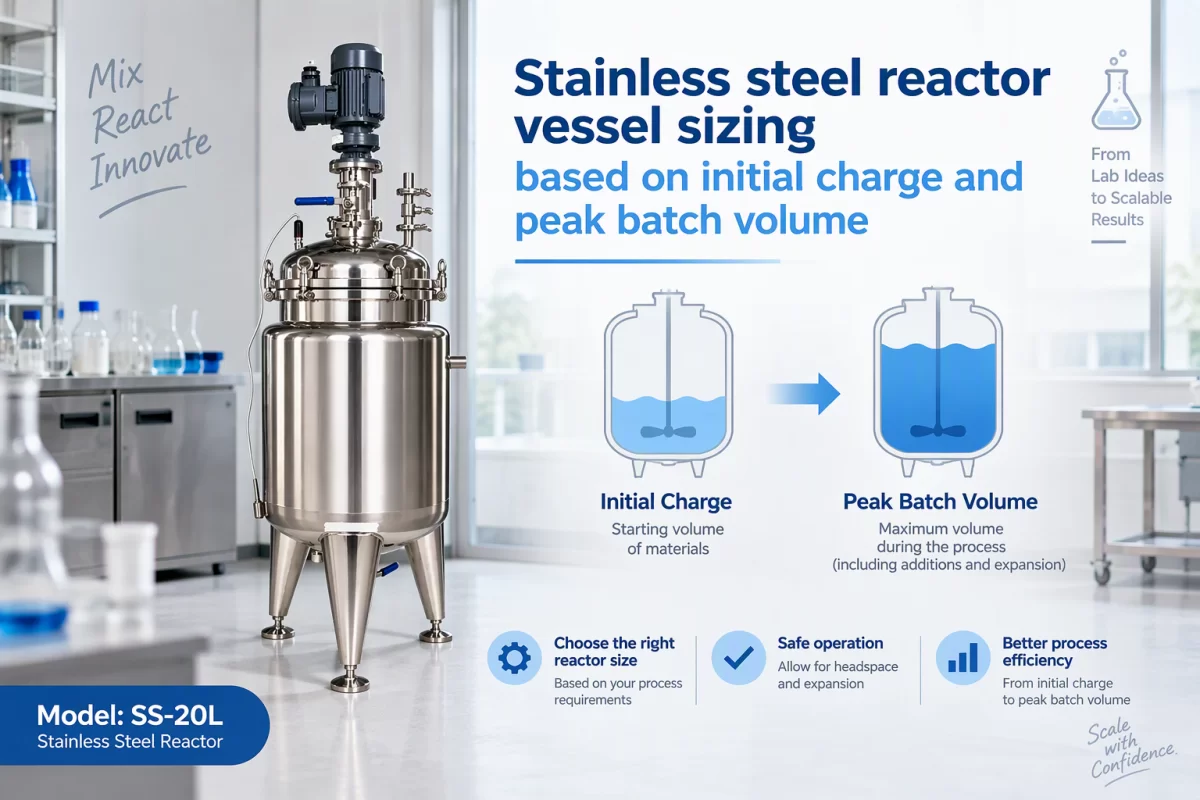
“What size stainless steel reactor vessel should I buy?” is really a question about two operating points: the batch that must run reliably today and the larger batch expected tomorrow. Buying the largest available vessel can create low-fill mixing and cleaning challenges, while buying too little capacity can force extra batches or an early replacement. The better approach is to separate actual process volume from safety headspace and commercial growth.
Start with the current batch—not the vessel label
Record the smallest routine batch as well as the normal production batch. A vessel selected only for a future maximum may have to process much smaller development runs in the meantime. Those smaller runs still need suitable impeller immersion, temperature measurement, discharge behavior, and circulation within the liquid.
Distinguish the initial charge, the peak contents during processing, and the final recovered product. They are not necessarily the same volume. If a recipe is specified by mass, use density at the relevant operating condition to estimate volume; do not assume that kilograms and liters are interchangeable.
When evaluating a Stainless Steel Reactor Vessel, compare the stated vessel volume with the usable operating range for the proposed configuration. The product name and nominal size alone do not establish an acceptable working batch, a minimum liquid level, or suitability for a particular reaction.
Separate added material from process headspace
Staged solvent additions, reagent feeds, wash liquids retained in the vessel, and solid charging can increase the contents after the initial charge. Map those changes against the operating sequence. Include withdrawals only when they genuinely occur before the next addition, rather than subtracting the final discharge from an earlier peak.
Process headspace serves a different purpose. Foaming, gas disengagement, boiling, reflux, slurry movement, and changing liquid volume may require space above the contents. That allowance should follow the actual material and process behavior. A single loading percentage should not be applied to every liquid, slurry, or gas-generating reaction.
Does a 5 L reactor support a 5 L working batch?
I would not treat the vessel label as permission to fill it completely. I would first establish the peak contents, the process-specific headspace, and the minimum and maximum operating levels supported by the selected mixing and heat-transfer arrangement.
A transparent sizing example
Assume a hypothetical process starts with 6 L, receives another 2 L before any withdrawal, and has negligible volume change during that stage. Its calculated peak contents are 8 L. Assume, separately, that process assessment establishes a 3 L headspace requirement.
Screening volume: 6 L + 2 L + 3 L = 11 L
Under these assumptions, a 10 L vessel does not meet the screening requirement. A larger candidate still needs assessment for mixing, heat removal, operating levels, and connections. These figures are illustrative assumptions, not equipment guarantee values or a recommended universal loading ratio.
Allow for future batch growth without buying excessive capacity
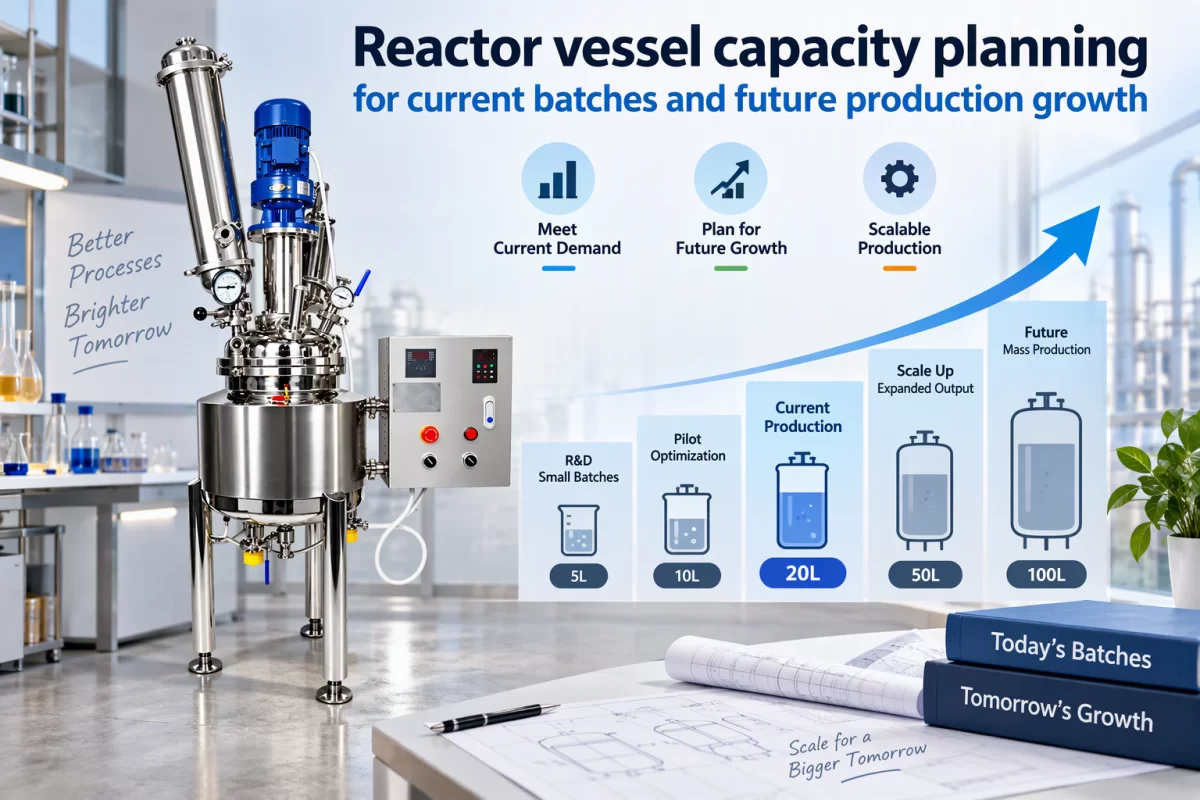
Future expansion should have a separate business basis: an expected order volume, a development milestone, or a planned production schedule. Increasing annual output does not automatically require a larger individual batch. More operating days, additional shifts, or a second reactor may be preferable when product variety and scheduling flexibility matter.
For a Stainless Steel Batch Reactor, compare the complete cycle rather than liters alone. Charging, reaction, cooling, discharge, and cleaning all affect usable throughput. A larger batch may not shorten the total production schedule if heating, cooling, or cleaning becomes the limiting step.
- Too small: more cycles may increase handling, cleaning events, and scheduling pressure; later additions may also exceed the available process space.
- Too large: current small batches may have inadequate impeller coverage or unsuitable sensor placement, while larger equipment can increase space and utility requirements.
- Balanced reserve: choose capacity that covers a credible future peak while retaining an acceptable operating range for present work.
Is buying one size larger always the safer investment?
I favor a larger size only when the growth scenario is credible and the present minimum batch remains technically workable. Otherwise, I would compare a right-sized first unit with a later second unit, including installation, utilities, cleaning time, and production flexibility.
Compare reactor sizes on the same configuration basis
The supplied reactor series includes vessel sizes of 10, 20, 30, 50, 100, 150, 200, and 300 L, alongside a separate SS-5L configuration. These sizes provide a starting point for a shortlist, not proof that each configuration has the same agitation, heating, or process suitability. Compare candidates using a consistent specification for wetted materials, agitator arrangement, heat exchange, seals, and connections.
The SS-5L details below illustrate why capacity should be evaluated together with equipment construction. They describe that configuration and should not be transferred to another model merely because it belongs to a stainless steel reactor range.
| Item | Specified detail | Sizing relevance |
|---|---|---|
| Reactor volume | 5 L | Starting point for evaluating the working-volume envelope |
| Reactor material | 316 stainless steel | Assess compatibility with the actual contents and cleaning agents |
| Frame and pipe material | 304 stainless steel | Distinguish support construction from reactor construction |
| Stirring arrangement | 304 stainless steel rod with three blades; 0–600 rpm | Assess immersion and mixing at present and future liquid levels |
| Heating method | Circulation heating | Evaluate the circulation system against the batch thermal duty |
| Temperature indication | PT100 sensor with digital display | Check sensor position relative to the smallest batch |
| Seal and connections | Mechanical seal; threaded union interfaces | Evaluate chemical compatibility, service access, and cleaning needs |
| Discharge | Ball quick-discharge valve | Assess drainage and handling of the proposed product |
The SS-5L lid description includes stirring, solid charging, temperature measurement, pressure gauge, constant-pressure funnel, and condensation reflux ports, with customization available. Match the required additions and sampling sequence to the proposed port arrangement. The presence of a port does not establish the performance of equipment attached to it.
For additional sizing context, the stainless steel reactor vessel sizing guide is a useful companion when preparing a capacity shortlist.
Include material compatibility, cleaning, and pharmaceutical requirements
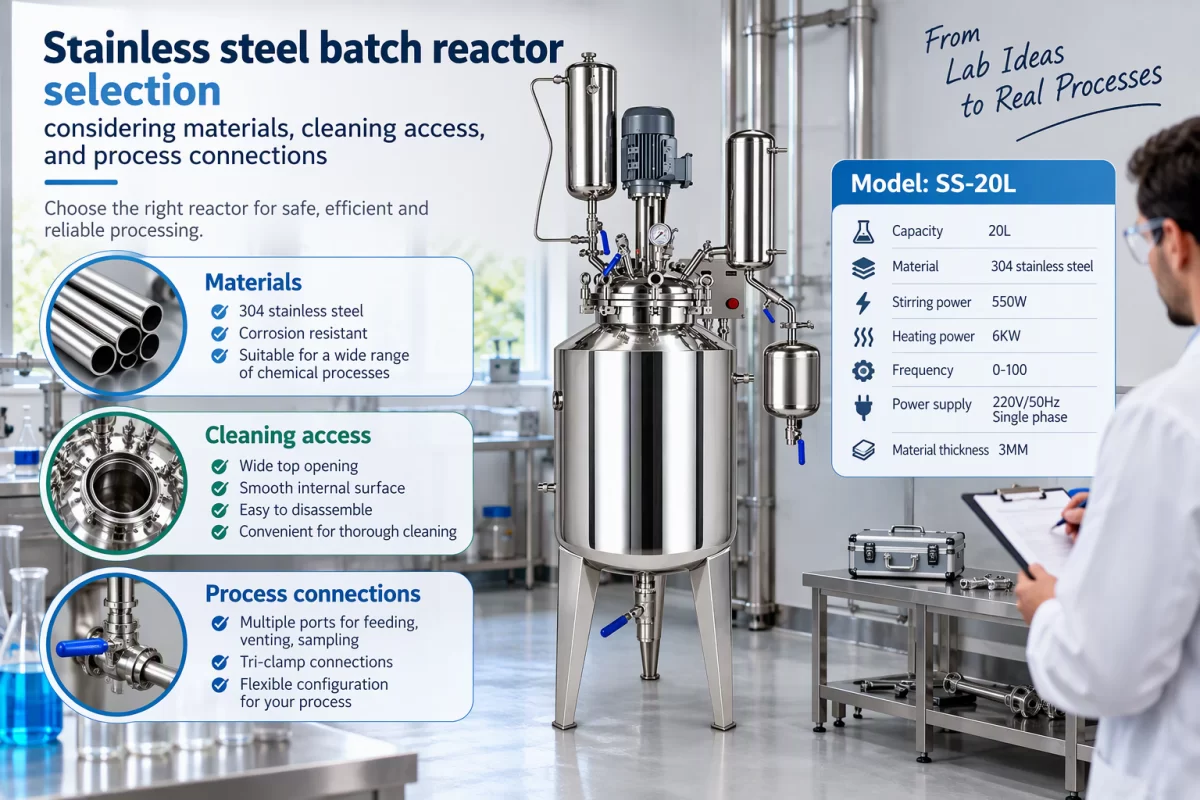
Stainless steel selection should follow the process chemistry, concentration, temperature, exposure time, and cleaning agents. A 316 reactor body does not mean every component contacting the process is 316; the SS-5L stirring rod is specified as 304. Review the complete wetted assembly, including seals and valves, rather than relying on the vessel-body grade alone.
Cleaning requirements can change the preferred size and configuration. Consider access to internal surfaces, retained liquid after discharge, agitator removal, and the intended cleaning method. Do not assume that a larger vessel, mechanical seal, or stainless steel surface automatically supports validated cleaning.
Does stainless steel construction establish pharmaceutical suitability?
I would assess pharmaceutical suitability against the actual process and the required documentation. Material certificates, surface-finish specifications, seal compatibility, cleaning validation support, and applicable qualification or certification documents should be part of the purchase discussion. Stainless steel construction alone does not establish those capabilities.
Budget for a usable reactor system, not just more liters
Compare quotations with the same scope: vessel construction, agitation, heat-transfer arrangement, required connections, seal selection, instrumentation, and installation needs. A capacity increase can also affect the external circulation system, service connections, floor space, and handling arrangements.
Evaluate the cost of inadequate capacity alongside the cost of unused capacity. Extra batches can consume operator time and cleaning resources; excessive reserve can leave capital tied up in a system poorly matched to the current workload. The purchasing objective is a workable production plan, not the lowest apparent cost per nominal liter.
Choose capacity that earns its growth reserve
The practical answer to “what size stainless steel reactor vessel should I buy” is the smallest suitable configuration that covers the justified future peak, provides process-specific headspace, and still operates acceptably at today’s minimum batch. Keep current batch volume, later additions, process allowance, and future expansion separate so that purchasing reserve does not become double-counted capacity.
To discuss a suitable Stainless Steel Reactor, submit the material composition, smallest and normal batch volumes, staged additions, expected future batch, temperature and pressure conditions, viscosity or solids behavior, and required agitation, heating, ports, seals, and cleaning method. Include any pharmaceutical documentation requirements. These details allow the proposed size, configuration, and quotation to be checked against the actual application.