
Hydrogenation · Laboratory equipment selection
What Makes a Lab Reactor Suitable for Hydrogenation Experiments?
Searching for the best high pressure lab reactor for hydrogenation experiments is a useful starting point, but “best” is a comparison goal—not a technical specification. A suitable reactor must match the actual chemistry, batch size, operating conditions, and laboratory infrastructure. Model-specific documentation provides a stronger basis for purchasing than a broad performance label.
Start with evidence of hydrogenation suitability
Hydrogenation can involve gas–liquid contact, solid catalysts, changing gas uptake, and heat release. These process characteristics place different demands on a vessel than simply holding a liquid under pressure. Suitability therefore depends on the complete assembly: pressure boundary, wetted materials, agitation, seals, temperature measurement, gas connections, and protective provisions.
When evaluating the High Pressure Lab Reactor, treat the product page as an entry point to a model-specific discussion. Ask for the relevant equipment drawing, pressure–temperature operating envelope, wetted-parts specification, connection layout, and inspection or test documentation applicable to the proposed assembly. A product name or available webpage does not, by itself, establish hydrogen service suitability.
Does a high pressure rating alone establish suitability for hydrogenation?
I would not use pressure alone as the deciding factor. The reaction mixture, operating temperature, seal construction, gas-handling arrangement, and heat-removal needs must also fit the proposed configuration. A pressure figure is one part of the evidence, not a complete acceptance decision.
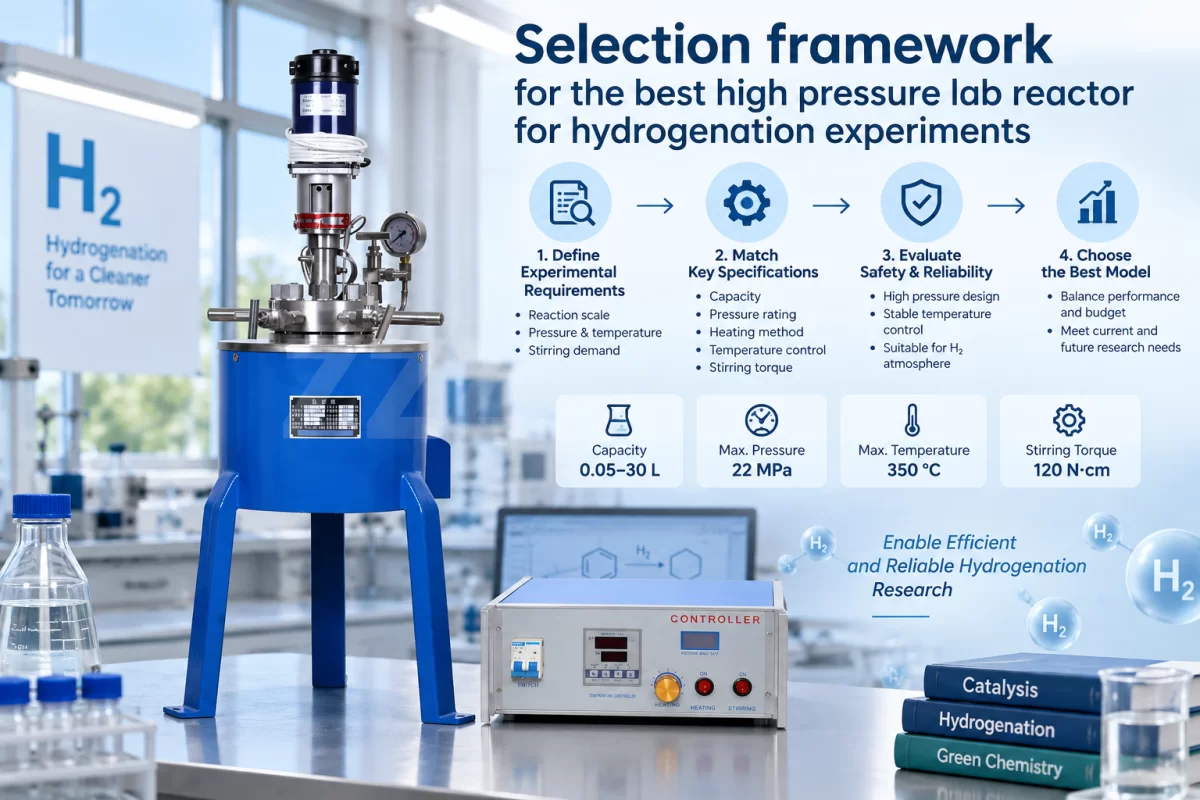
Compare capacity and operating specifications by model
Reactor families should not be reduced to one combined set of maximum values. The FCF specifications below show why: increasing vessel capacity is accompanied by changes in the listed pressure, temperature, and stirring-speed specifications. A larger model does not automatically retain the figures associated with a smaller one.
| Model | Capacity (L) | Listed pressure (MPa) | Listed temperature (°C) | Stirring speed (r/min) | Heating power (kW) |
|---|---|---|---|---|---|
| FCF-1 | 1 | 22 | 350 | 50–1,000 | 1.5 |
| FCF-3 | 3 | 22 | 350 | 50–1,000 | 2.5 |
| FCF-5 | 5 | 22 | 350 | 50–600 | 4 |
| FCF-30 | 30 | 16 | 350 | 50–600 | 12 |
| FCF-50 | 50 | 10 | 300 | 50–600 | 12 |
| FCF-100 | 100 | 6 | 300 | 50–600 | 14 |
These are model-specific listed specifications, not a hydrogenation qualification or evidence that the pressure and temperature values are simultaneously permissible. The allowable combination for the proposed assembly must be established from its design documentation.
For example, FCF-50 is listed at 50 L, 10 MPa, and 300°C. It should not be described using the 22 MPa and 350°C figures listed for FCF-1. Likewise, heating power describes the installed heating specification; it does not establish cooling capacity, reaction heat-removal performance, or heating time for a particular mixture.
Separate present batch needs from future expansion
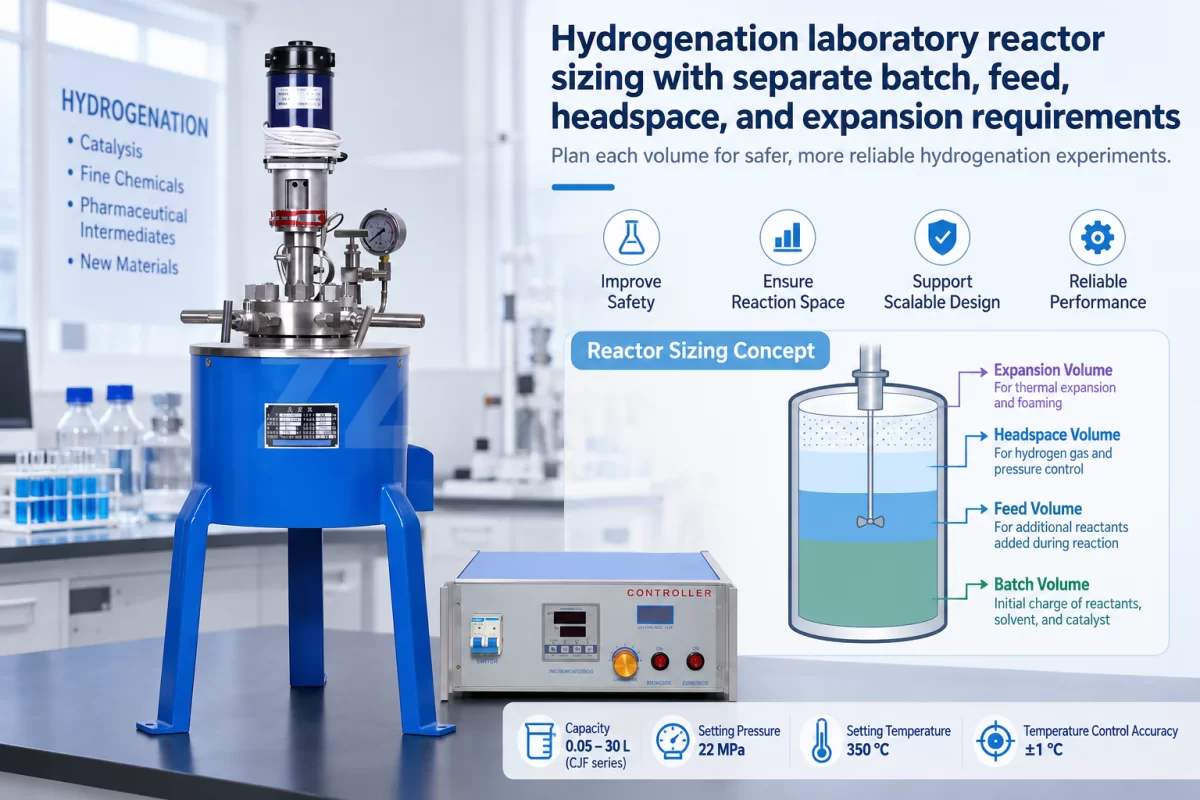
Nominal vessel capacity and working charge are different quantities. The appropriate working charge depends on the chemistry and operating plan; a single loading percentage should not be applied to every solvent, catalyst, or reaction mixture. Keep four sizing considerations separate.
Current batch
Define the intended initial liquid charge, catalyst quantity, and relevant mixture properties at operating conditions. Include the minimum batch that must be mixed and measured effectively, not only the largest planned experiment.
Changes during addition
Account for liquid feeds, sampling, and changes in reaction-mixture volume. Added material may alter liquid level, viscosity, solids concentration, and mixing behavior. The starting charge alone is not a sufficient sizing basis.
Process allowance
Establish the headspace and operating allowance needed for the actual process, including thermal expansion and any credible foaming behavior. These requirements should follow the process assessment rather than an assumed universal fill ratio.
Future expansion
Evaluate anticipated larger batches as a separate scenario. Buying a much larger vessel immediately may affect small-batch mixing, temperature measurement, cleaning, and handling. The discussion of stainless steel reactor vessel sizing offers a related starting point, while the final choice remains specific to the hydrogenation duty.
Is the largest available vessel the most practical laboratory choice?
I would compare the routine batch and the expansion batch independently. A useful selection supports today's experimental work without assuming that tomorrow's larger process will have the same mixing, thermal, or pressure requirements.
Match wetted materials, mixing, and sealing to the chemistry
The TGYF-C specification lists stainless steel 304 and 316 as material options, mechanical stirring, and modular electrical heating. Those details belong to TGYF-C; they should not be transferred to an FCF or CJF model without its own configuration documentation. Neither stainless steel designation alone proves compatibility with every hydrogenation mixture.
Material selection should consider the solvent, catalyst, reactants, products, cleaning agents, and operating conditions. Review the entire wetted path, including valves, fittings, dip tubes, probes, and seal components. Compatibility of the vessel body does not establish compatibility of every connected component.
Agitation deserves equally careful review. A listed stirring-speed range does not demonstrate gas dispersion, catalyst suspension, or uniform mixing under every load. Impeller geometry, liquid level, mixture viscosity, solids loading, and available torque all influence performance. Similarly, the proposed seal arrangement needs a defined pressure and temperature capability for the intended chemical service; leak-free or maintenance-free operation should not be assumed.
For additional context, the hydrogenation reactor design guide can support the equipment discussion. The purchasing decision should still rest on the configuration offered for the specific experiment.
Distinguish required controls from supplied capabilities
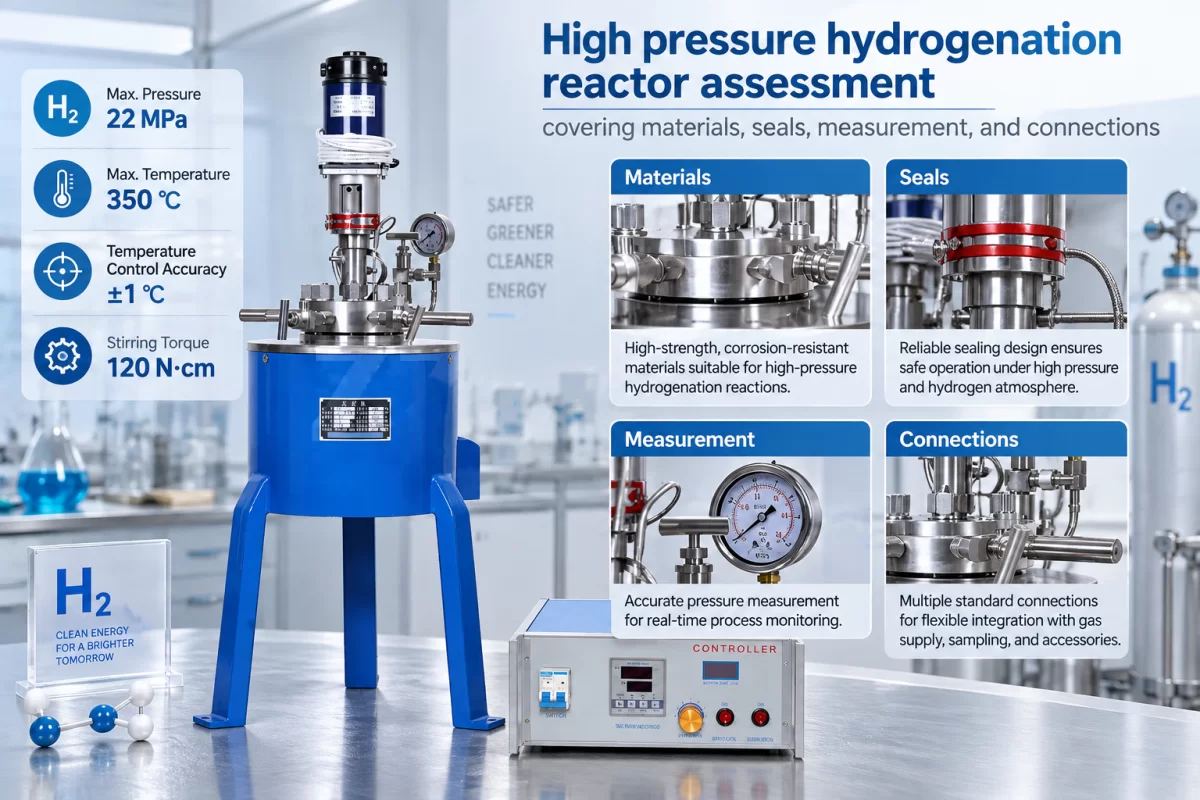
A process requirement is not automatically a supplied feature. Hydrogenation work may require controlled gas supply, suitable pressure measurement, representative temperature sensing, sampling connections, and a defined means of managing reaction heat. Each function should be identified in the quotation and equipment documentation.
- Measurement: Specify the pressure and temperature ranges, sensor locations, and any recording needs relevant to the experiment.
- Interfaces: Define gas, liquid-feed, sampling, and discharge connections, including the required connection standards and compatible components.
- Thermal management: Describe the intended temperature profile and available utilities. Electrical heating alone does not establish the ability to remove an exothermic reaction's heat.
- Protection and installation: Include the required protective devices, laboratory ventilation, and site electrical requirements in the engineering review. Any certification requirement should be supported by documentation for the offered equipment.
What provides a useful basis for comparing reactor reliability?
I look for evidence that can be reviewed: applicable inspection records, component specifications, maintenance requirements, and support arrangements. Reliability is a purchasing consideration, not a ranking promise, and a broad product description should not substitute for those records.
Build a configuration-based purchasing comparison
Compare quotations against the same process brief. Record the proposed model, nominal capacity, wetted materials, documented operating envelope, agitation arrangement, sealing construction, measurement package, and connection scope. Distinguish equipment included in the offer from options or customer-supplied utilities. This makes both technical and commercial differences easier to assess.
Our company's reference price: US$2,990. This is a budgeting reference, not a quotation for a particular hydrogenation configuration. The actual quotation depends on the selected configuration and the outcome of the inquiry.
Choose the best fit through documented suitability
The best high pressure lab reactor for hydrogenation experiments is the one whose documented capabilities match the intended process—not necessarily the largest vessel or the highest advertised pressure. Keep specifications tied to individual models, assess the allowable pressure–temperature combination, and evaluate material compatibility, mixing, sealing, measurement, and interfaces as one complete configuration.
A sound procurement decision also separates the current batch, changes during feeding, process allowance, and future expansion. This turns a general equipment search into a practical comparison of suitable options.
Submit the reaction materials, intended working batch, feed changes, target pressure and temperature, agitation needs, site utilities, and required connections so the corresponding model and configuration can be assessed and a configuration-specific quotation prepared.