
Laboratory equipment · Procurement guide
A Buyer's Guide to High Pressure Lab Reactors for Hydrogenation
Buying a High Pressure Reactor for hydrogenation starts with a documented process requirement—not the largest capacity or highest pressure printed in a catalog. This high pressure lab reactor for hydrogenation processes buying guide explains how to read model tables, discuss suitable media, and define a complete delivery scope before approving a purchase.
Start with a hydrogenation procurement specification
The High Pressure Lab Reactor is the product to discuss when preparing a laboratory pressure-reactor inquiry. Selection should nevertheless follow the offered model and configuration: vessel volume, wetted materials, permitted pressure–temperature envelope, stirring arrangement, sealing, measurement, and connection details all matter.
Separate the process requirements from the equipment capabilities in the purchasing document. The process side should describe the reaction mixture, catalyst, solvent, hydrogen supply conditions, desired operating temperature and pressure, expected viscosity, and sampling needs. The equipment side should record the supplier’s corresponding model-specific commitments. A catalog rating alone does not establish compatibility with a particular hydrogenation mixture.
- Reaction media: identify substrates, solvents, catalysts, impurities, and cleaning chemicals, with relevant concentrations.
- Operating conditions: distinguish normal operation from credible pressure or temperature excursions.
- Functional requirements: describe gas addition, liquid feeds, agitation, cooling, sampling, and data recording.
- Site requirements: specify utilities, installation space, ventilation arrangements, and applicable local requirements.
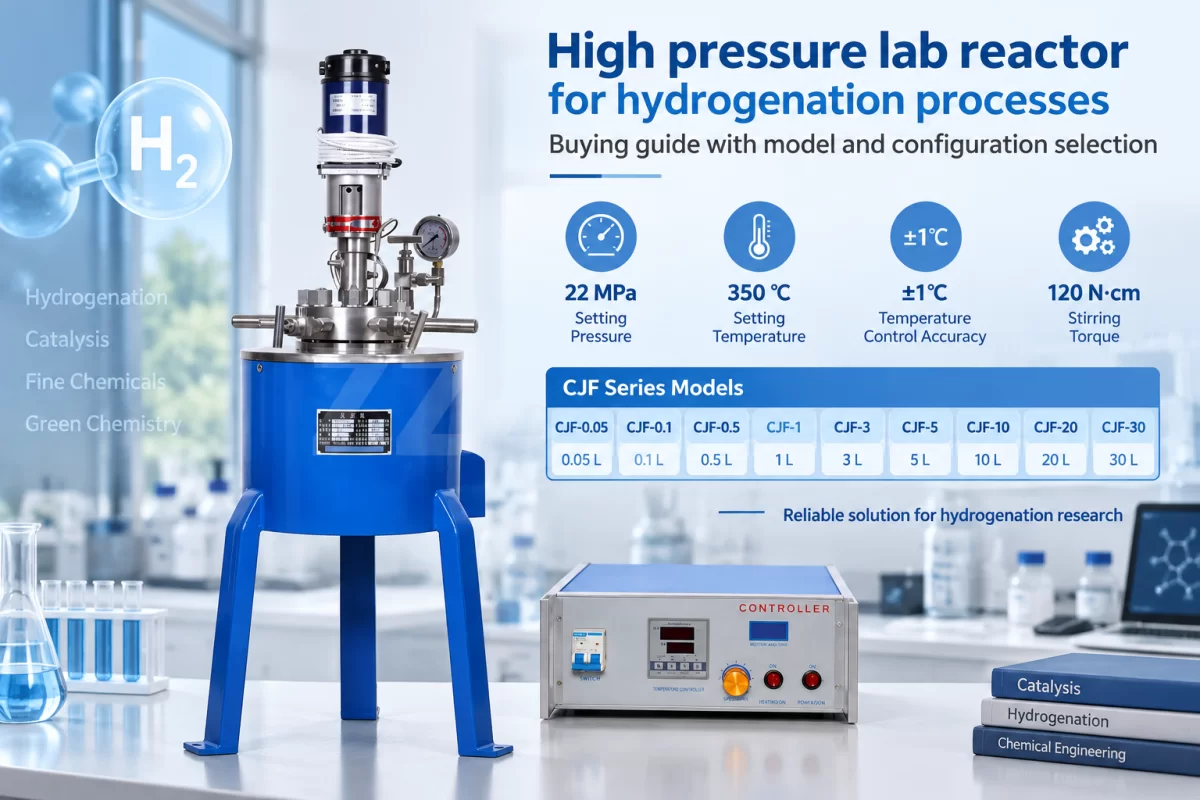
Does a high pressure rating establish suitability for hydrogenation?
I would not treat pressure rating as proof of suitability. Hydrogenation also requires an appropriate material and seal combination, suitable gas connections, effective mixing, and a reviewed thermal-management arrangement. Those features should be documented for the proposed operating conditions before purchase.
Read each model row—not the series maximum
The FCF model table shows why capacity and pressure must stay together. FCF-20 is listed with a 20 L capacity and 22 MPa pressure, while FCF-30 is listed with 30 L and 16 MPa. FCF-50 has a different combination again: 50 L, 10 MPa, and 300°C. A larger vessel cannot automatically inherit the pressure or temperature listed for a smaller model.
| Model | Capacity (L) | Listed pressure (MPa) | Listed temperature (°C) | Stirring speed (r/min) | Heating power (kW) |
|---|---|---|---|---|---|
| FCF-0.1 | 0.1 | 22 | 350 | 50–1000 | 0.6 |
| FCF-0.25 | 0.25 | 22 | 350 | 50–1000 | 0.8 |
| FCF-0.5 | 0.5 | 22 | 350 | 50–1000 | 1.5 |
| FCF-1 | 1 | 22 | 350 | 50–1000 | 1.5 |
| FCF-2 | 2 | 22 | 350 | 50–1000 | 2 |
| FCF-3 | 3 | 22 | 350 | 50–1000 | 2.5 |
| FCF-5 | 5 | 22 | 350 | 50–600 | 4 |
| FCF-10 | 10 | 22 | 350 | 50–600 | 7 |
| FCF-20 | 20 | 22 | 350 | 50–600 | 10 |
| FCF-30 | 30 | 16 | 350 | 50–600 | 12 |
| FCF-50 | 50 | 10 | 300 | 50–600 | 12 |
| FCF-100 | 100 | 6 | 300 | 50–600 | 14 |
Purchasing interpretation: the listed pressure and temperature are specification fields, not a complete operating envelope. Obtain the allowable pressure at the intended temperature for the offered vessel, closure, seals, valves, and fittings. Do not assume that both listed limits can be used simultaneously.
Keep model families separate as well. For example, the CJF capacity list associates CJF-1 with 1 L and CJF-3 with 3 L; an FCF heating-power or stirring-speed value should not be transferred to either model. The model designation in the quotation, drawing, and acceptance document should match throughout.
Heating power helps identify the installed heating specification, but it does not establish heat-up time or cooling performance. Similarly, a listed speed range does not guarantee catalyst suspension or gas–liquid mass transfer for every impeller, viscosity, or batch size.
Separate batch size, additions, process allowance, and expansion
Nominal vessel capacity is not the same as an approved liquid working volume. A procurement inquiry should describe four distinct sizing requirements rather than combining them into a single “required capacity” figure.
Current batch
State the initial liquid charge, catalyst quantity, expected slurry behavior, and minimum useful batch. Smaller batches may introduce different mixing and measurement requirements from batches near the upper working-volume limit.
Changes during addition
Describe liquid feeds and changes in mixture volume during the reaction. Include relevant thermal expansion, gas uptake, and foam behavior. The supplier needs the maximum anticipated contents during the process, not only the starting charge.
Process allowance
Define the need for gas space, agitation clearance, and allowances associated with the specific chemistry. No single filling percentage should be applied to all hydrogenation media. The acceptable working volume should follow a process-specific assessment.
Future expansion
Present future batch targets separately. Upsizing can change pressure capability, stirring characteristics, utility demand, and handling arrangements. A planned larger batch should therefore trigger a fresh model comparison rather than an assumption that the current configuration simply scales up.
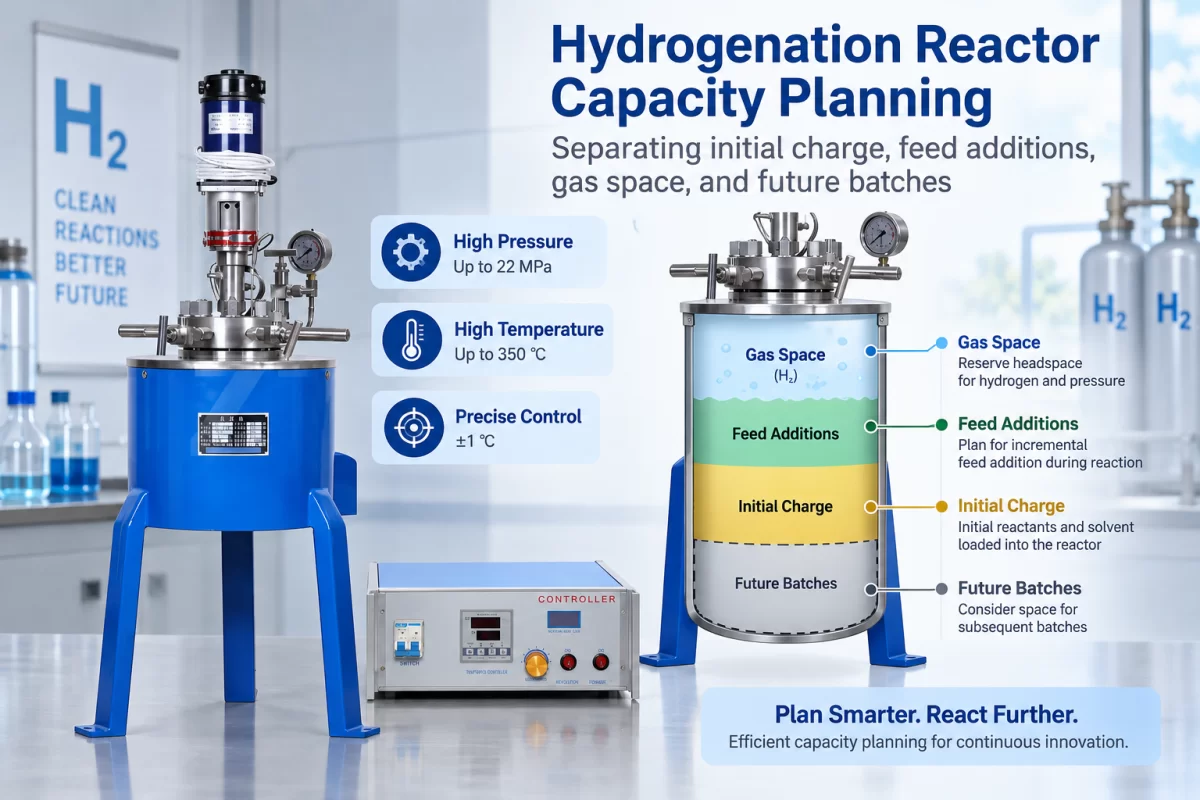
Is the largest affordable vessel the best laboratory purchase?
I would prioritize the vessel that fits the actual batch and operating envelope. Extra capacity is useful only when mixing, measurement, pressure capability, and handling remain suitable. A larger model may also require a different configuration rather than merely more material.
Ask about suitable media and the complete wetted system
Material selection should cover more than the vessel shell. The TGYF-C material listing names stainless steel 304 and 316, but those grades should not be assumed for every CJF or FCF configuration. Specify the required material for the proposed model and ask for the wetted-material schedule.
That schedule should include the vessel, impeller, shaft, dip tubes, valve internals, thermowell, gaskets, and other parts exposed to the mixture. Discuss compatibility with the reaction medium and cleaning procedure, including temperature, concentrations, and relevant impurities. A general material label does not by itself establish corrosion resistance for a particular process.
The stainless steel chemical reactor technical guide provides related background for material discussions. The purchasing decision should still use the material specification offered for the selected reactor.
For hydrogenation, also request details of the sealing arrangement, gas inlet, pressure measurement, temperature measurement, sampling connections, and discharge connection. Identify connection standards and component ratings in writing. Specify the necessary pressure-relief arrangement, control functions, and documentation for review against the laboratory’s requirements; do not assume these are included in the base package.
Make delivery scope and acceptance criteria explicit
A useful quotation should describe a complete configuration, not simply “one high pressure reactor.” Ask the supplier to distinguish included equipment from optional accessories and customer-provided services.
- Main assembly: named model, vessel and closure, support arrangement, agitator, and specified heating equipment.
- Measurement and control: sensors, gauges or transmitters, controller functions, and any requested recording capability.
- Process connections: gas supply interface, feed and sampling components, vent and discharge connections, and specified fittings.
- Safety and documentation: agreed protective components, operating instructions, drawings, material documents, and applicable test records.
- Commercial scope: packing, delivery terms, installation responsibilities, training, spare parts, and warranty conditions.
Agree on acceptance criteria before placing the order. Suitable items to define include identification of the delivered model, verification of connection details, review of agreed documents, and demonstration of specified controls under agreed test conditions. These are purchasing requirements to negotiate, not a statement that every item is supplied as standard.
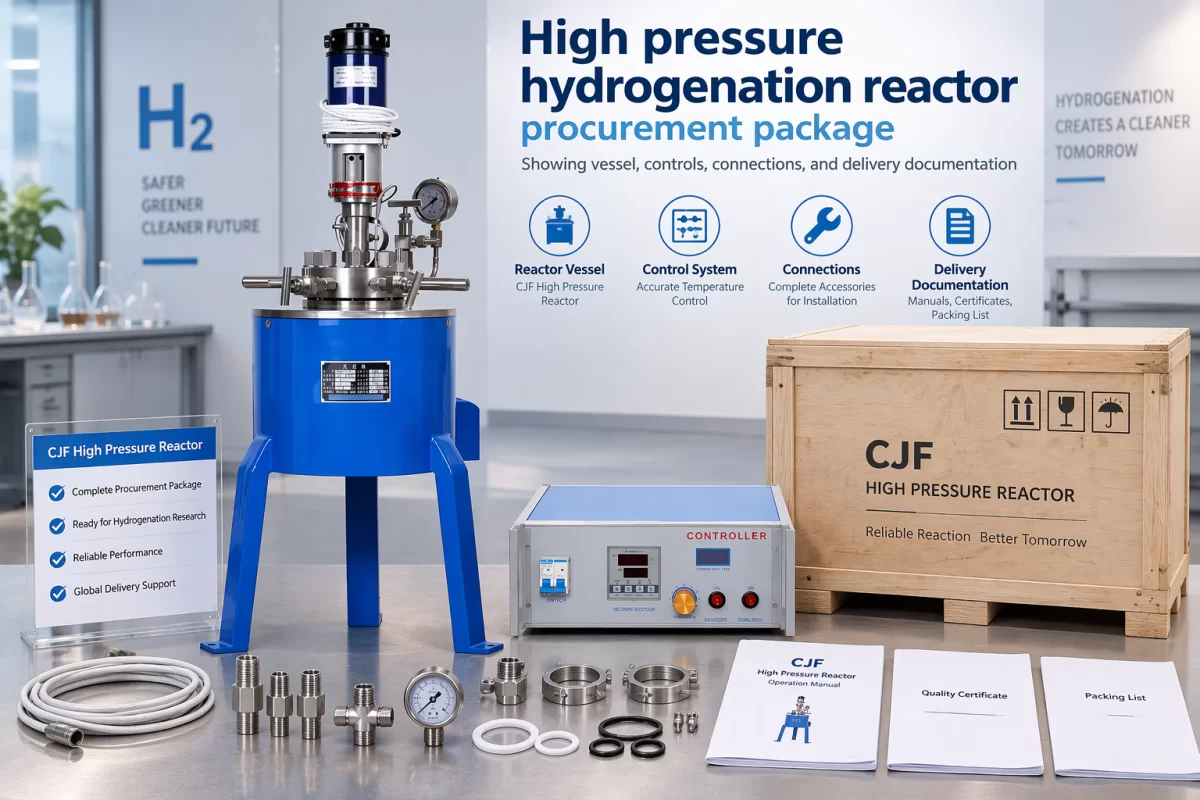
What makes two reactor quotations genuinely comparable?
I compare the same model-specific operating requirements and the same delivery scope. Differences in materials, seals, controls, gas-handling components, documentation, or services can make two headline prices represent substantially different purchases.
Our reference price
US$2,990
This preliminary budgeting reference is the central selection from our single-value listed prices, using the lower middle price for an even number of entries. It is not a quotation for a particular FCF, CJF, or TGYF-C configuration. The actual quotation depends on the selected configuration and inquiry results.
For additional process-oriented reading, see the guide to high pressure lab reactors for hydrogenation experiments. Use that background alongside the model-specific quotation and the laboratory’s own process assessment.
Buy a documented hydrogenation configuration
The practical conclusion of this hydrogenation reactor buying guide is straightforward: select a named model against a defined batch and process envelope, assess the complete wetted and pressure-containing system, and purchase an explicit delivery package. Do not combine a series’ largest volume with its highest pressure, temperature, or stirring specification.
Submit the reaction media, current batch, anticipated additions, target pressure and temperature, future batch goals, and required stirring, sealing, measurement, and connection configuration. These details provide the basis for reviewing an appropriate High Pressure Reactor proposal and preparing a configuration-specific quotation.