
Which Stainless Steel Reactor Vessel Is Best for APIs?
The right API reactor is not simply the strongest tank. It must resist the chemistry, transfer heat predictably, mix the batch evenly, prevent contamination, and be easy to clean and document.
The best all-round configuration
This combination offers a practical balance of corrosion resistance, hygiene, temperature control, durability, and cost. A typical vessel should also provide enough ports for charging, sampling, reflux, pressure measurement, vacuum, and cleaning. The exact design must still be checked against the solvent, catalyst, pH, chloride content, operating pressure, and cleaning chemicals used in the process.
ZZKD supplies stainless steel reactor vessels from laboratory to pilot scale. For example, the supplied SS-5L specification uses 316 stainless steel for the vessel, circulation heating, a PT100 digital temperature display, 0–600 rpm agitation, and a stated operating range of −0.098 to 0.5 MPa. These are useful capabilities for development work, but the user’s process engineer must approve the final design and code requirements.
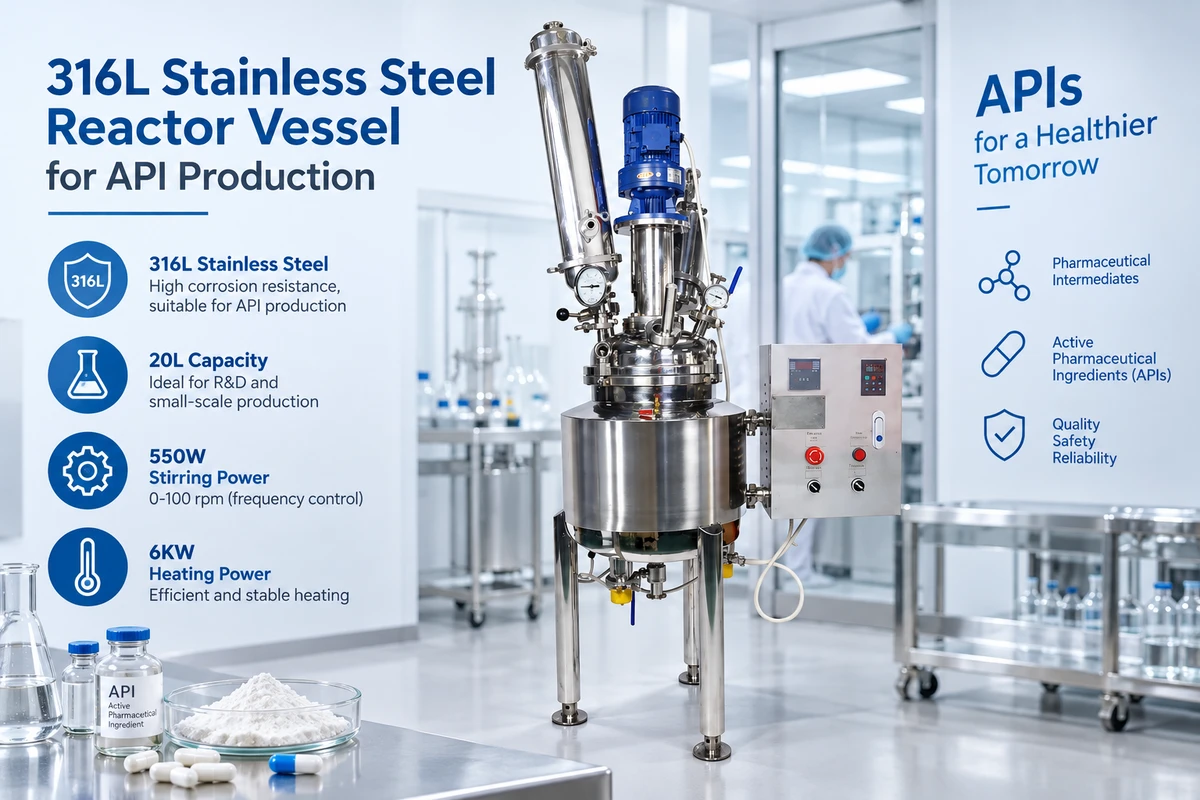
Why 316L usually beats 304 for APIs
Both 304 and 316-series stainless steels are common, but 316L contains molybdenum and generally offers better resistance to pitting in chloride-bearing environments. The “L” means low carbon, which helps reduce sensitization risk after welding. For pharmaceutical service, that extra corrosion margin is often worth the higher initial cost.
Author’s answerIn my view, 304 can be acceptable for non-aggressive utilities or carefully verified processes, but 316L is the safer default for product-contact surfaces. Material selection should always be confirmed by a corrosion review using the real formulation and cleaning cycle.
Stainless steel is not universal. Concentrated hydrochloric acid, hot chloride solutions, certain halogenated chemistries, and other highly corrosive media may require a higher alloy, glass lining, or fluoropolymer lining. A coupon test or materials specialist can prevent an expensive mismatch. For broader material and design context, see the ZZKD stainless steel chemical reactor technical guide.
Six features that matter more than the nameplate
Documented internal finish: A smooth, crevice-minimized surface is easier to inspect and clean. Specify a measurable roughness target, weld treatment, and passivation documentation rather than relying only on the word “sanitary.”
Reliable heat transfer: A full jacket supports controlled heating and cooling. Fast reactions may require a larger heat-transfer area, internal coils, or an external loop after a proper heat-removal calculation.
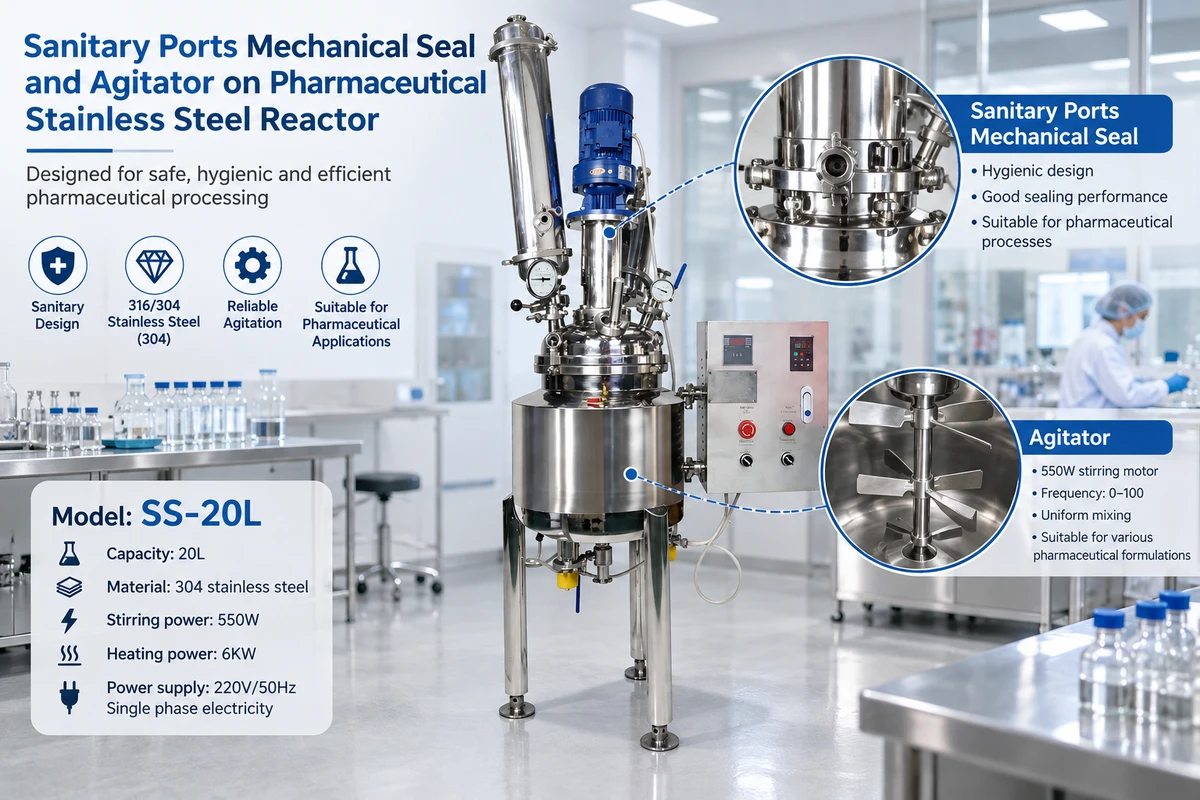
Process-matched agitation: Impeller style, diameter, baffles, power, and speed determine mixing quality. ZZKD laboratory and pilot configurations can provide frequency-controlled speeds up to 600 rpm, while viscous or large-scale batches may need greater torque at lower speed.
Containment at the shaft: A cleanable mechanical seal is practical for many processes. A magnetic drive can be preferable where toxic, potent, air-sensitive, or leak-sensitive materials demand stronger containment.
CIP/SIP-aware geometry: Drainability, spray coverage, dead-leg control, gasket compatibility, and accessible sampling points reduce residue risk. Clean-in-place or sterilize-in-place capability must be designed and validated for the actual process.
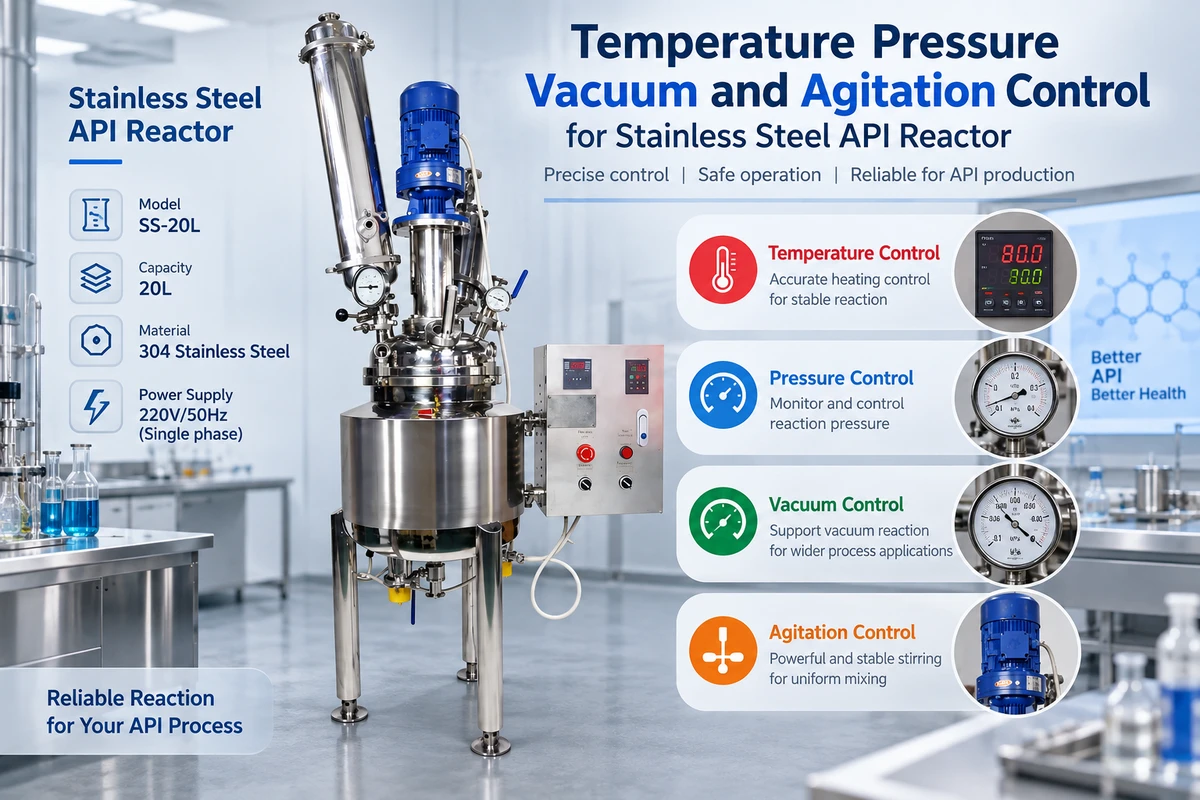
Controls and records: Accurate temperature, speed, pressure, and vacuum data support repeatability. Production systems may also need alarms, recipes, audit trails, and integration with site automation.
How much capacity is actually needed?
Working volume is lower than total vessel volume because mixing, foaming, gas flow, and boiling need headspace. As a simple starting point, a liquid process may use roughly 60–80% of gross volume, but the safe fill depends on reaction behavior and must be tested. A 20 L vessel, for example, may suit a batch with a final liquid volume around 12–16 L; it is not automatically a 20 L working batch.
Author’s answerNo. In my assessment, an oversized reactor can make low-volume mixing and temperature sensing less reliable, while an undersized unit leaves too little headspace. The best vessel keeps the normal batch inside a proven operating window.
Scale-up also changes mixing time, surface-to-volume ratio, and heat removal. Keeping the same rpm is not the same as keeping the same mixing performance. Impeller tip speed, power per volume, shear sensitivity, and heat-generation rate should be evaluated by process engineers during scale-up.
Practical ZZKD options and reference prices
The following table converts the supplied product list into a simple purchasing view. Prices are reference figures, not final quotations. Where a listing presented a range, the lower practical listed figure is shown to avoid overstating the planning budget. Final cost changes with 316/316L material, surface finish, pressure code, seal type, controls, condenser, documentation, and customization.
| Example size | Best use | Relevant supplied specification | Reference price |
|---|---|---|---|
| 5 L | API feasibility and formulation development | 316 vessel, −100 to 250°C, 0–600 rpm, circulation heating | US$1,485 |
| 20 L | Larger development batches | 304 listed on basic model; 316/316L product-contact upgrade recommended for many APIs | US$1,634 |
| 50 L | Pilot campaigns and process demonstration | Double wall, SUS316/SUS304 options, up to 600 rpm on selected configuration | US$2,042 |
| 60–80 L | Pilot batches requiring more headspace | Jacketed system; confirm sanitary finish and documentation | US$2,135 |
| 100 L | Pilot or small production, subject to validation | Double-wall configuration; condenser option in price listing | US$3,300 |
Reference prices come from the provided ZZKD price sheet and may exclude freight, taxes, site qualification, code certification, and optional accessories. Request a current written quotation before budgeting.
Pressure, vacuum, and safety cannot be guessed
A synthesis that runs under slight vacuum has very different risks from hydrogenation. The vessel, jacket, nozzles, sight glass, seals, piping, relief devices, and instruments all need ratings suitable for the worst credible temperature and pressure. Vacuum also matters: a vessel designed only for internal positive pressure may still need checks for external-pressure collapse.
Author’s answerNot without documented engineering approval. I would select a purpose-built pressure reactor with an appropriate design code, relief strategy, gas-rated components, grounding, hazardous-area controls, and process hazard review.
The ASME Boiler and Pressure Vessel Code, Section VIII, Division 1 provides widely recognized rules for pressure-vessel construction. Local law may require ASME, PED, GB, or another standard. A supplier specification showing −0.1 to 0.5 MPa is useful for screening, but it does not by itself prove that a complete installation is legal or safe for a particular reaction.
What “GMP-ready” should mean in practice
No reactor becomes GMP-compliant through a label alone. GMP applies to the facility, procedures, training, records, maintenance, cleaning, and validated process as well as equipment. A useful supplier package can support compliance with material certificates, weld records, surface-finish reports, gasket certificates, calibration information, manuals, drawings, and factory acceptance testing.
The FDA’s Process Validation: General Principles and Practices guidance describes process validation as lifecycle work covering process design, process qualification, and continued process verification. That framework explains why a stable, measurable reactor matters: the equipment must help keep the commercial process in a state of control over time.
More pharmaceutical context is available in the ZZKD guide to stainless steel reactors in pharmaceutical manufacturing.
Final recommendation
Best for most APIs: a 316L product-contact, jacketed stainless steel reactor with a specified smooth internal finish, sanitary and drainable geometry, PT100 temperature control, process-matched agitation, a suitable mechanical or magnetic seal, and documented pressure/vacuum ratings.
Best next step: send the supplier a process requirement sheet covering batch volume, composition, pH, chlorides, solvents, viscosity, solids, heating/cooling duty, operating and design pressure, vacuum, hazardous-area classification, cleaning method, surface finish, required code, and documentation package.
For a typical non-high-pressure API development program, the ZZKD 5 L 316 stainless steel model is a sensible laboratory starting point. A 20–50 L jacketed 316/316L configuration is usually more suitable for pilot work. For potent compounds, corrosive formulations, hydrogenation, or regulated production, customization and formal engineering review are essential.
Build the reactor around the API process
ZZKD can match vessel capacity, contact material, jacket, agitation, ports, condenser, controls, and documentation to a defined process. A detailed requirement sheet produces a more useful quotation than capacity alone.
Explore ZZKD Reactor Vessels